|
Did you know the Center for Pediatric Clinical Effectiveness is on social media?
|
|
Spotlight on:
Clinical Trials Research Affinity Group (RAG)
The Research Institute has launched a new Clinical Trials Research Affinity Group to build a community of investigators conducting clinical trials at CHOP and the greater UPenn community. Led by
Pamela Weiss, MD, MSCE
, CPCE faculty member and Director of Clinical Research in the Division of Rheumatology, the new affinity group aims to establish a collaborative network of investigators with knowledge of or interest in clinical trials and serve as a liaison between investigators,
the CHOP Research Institute, and hospital administration to facilitate not only the conduct and enhancement of on-going trials but also the start-up of new trials within the CHOP network.
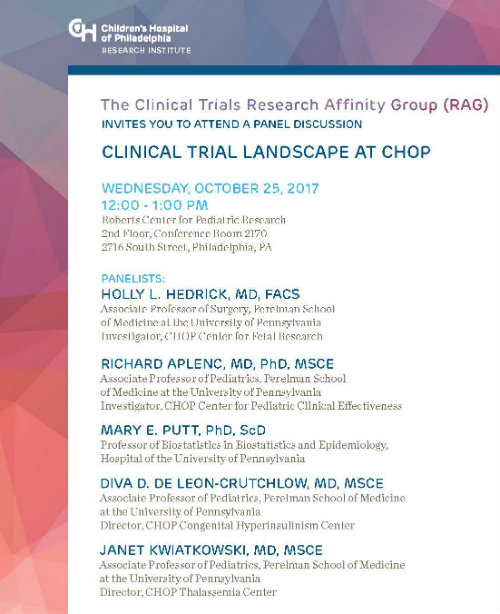
The Clinical Trials Research Affinity Group will be hosting their inaugural event, a panel discussion titled
"Clinical Trial Landscape at CHOP"
on Wednesday, Oct. 25 from noon to 1:00 pm at the Roberts Center. The discussion will be moderated by Pamela Weiss, MD, MSCE, and panelists include Holly L. Hedrick, MD, FACS; Richard Aplenc, MD, PhD, MSCE; Mary E. Putt, PhD, ScD; Diva D. De Leon-Crutchlow, MD, MSCE; and Janet Kwiatkowski, MD, MSCE.
|
|
|
|
|
mHealth Research Affinity Group Works In Progress
Date: October 16, 2017
Time: 12:30 - 2:00 pm
Location: Abramsom Research Center, 123-C
Sandra Amaral, MD, MHS will present "U-REAACT: a Multi-Center Trial to Engage Youth with Kidney and Urological diseases in their Treatment Adherence through text messaging, positive feedback and financial incentives." Gregory Tasian, MD, MSc, MSCE will present "PUSH: Integrating Technology, Financial Incentives, and Structured Problem Solving to Maintain High Fluid Intake Among Adolescents and Adults with Kidney Stones." Register
here.
Fighting Asthma Disparities Summit
Date: October 17, 2017
Time: 7:45 AM - 4:00 PM
Location: Roberts Center for Pediatric Research
A look at the past 20 years of childhood asthma research and clinical practice guidelines and a view of current trends in asthma diagnosis and treatment, particularly as it relates to morbidity, mortality and racial and ethnic disparities, will deepen our knowledge of the current state of this issue and assist us in understanding and identifying gaps in policy and programming. Register
here by October 5. Contact Yolanda Williams at 215-590-5261 or
capp1@email.chop.edu with any questions.
Talking Diversity: Ability, Disability, and Performance: Your Actions Matter
Date: October 24, 2017
Time: 12:00 - 1:00 PM
Location: Main Hospital, Stokes Auditorium
Dr. Thomas Edwards, Associate Professor at Temple University, will discuss the basic building blocks of trust that can be used by both leaders and staff. What does this have to do with disability? Nothing and everything! These concepts are critical to everyone in an organization – however, finding ways to empower everyone to contribute will be especially helpful to those who face additional barriers.To learn more and to register, click
here.
Clinical Trials Research Affinity Group Panel Discussion
Date: October 25, 2017
Time: 12:00 - 1:00 PM
Location: Roberts Center for Pediatric Research, 2nd Floor, 2170
The Clinical Trials RAG invites you to attend a panel discussion, "Clinical Trial Landscape at CHOP." The discussion will be moderated by Pamela Weiss, MD, MSCE, Director of Clinical Research in the Division of Rheumatology, and panelists include Holly L. Hedrick, MD, FACS, Richard Aplenc, MD, PhD, MSCE, Mary E. Putt, PhD, ScD, Diva D. De Leon-Crutchlow, MD, MSCE and Janet Kwiatkowski, MD, MSCE.
|
|
|
October 11, 2017
October 9, 2017
October 5, 2017
October 2, 2017
September 19, 2017
September 18, 2017
September 15, 2017
September 14, 2017
|
|
|
Dr. Aletha Akers and team aimed to estimate group-based trajectories of body mass index (BMI) in a longitudinal cohort of young women and determine the association between sexual identity and BMI trajectory group, adjusting for obesity risk factors.
Concern for device erosion following transcatheter treatment of atrial septal defects (TC-ASD) led in 2012 to a United States Food and Drug Administration panel review and changes in the instructions for use of the Amplatzer Septal Occluder (ASO) device. No studies have assessed the effect of these changes on real-world practice. To this end a multicenter observational study was performed to evaluate trends in the treatment of ASD.
Dr. Nadia Dowshen, Dr. Kate Yun and colleagues explored attitudes and beliefs pertaining to sexual and reproductive health among unmarried, female, resettled Bhutanese refugees 16-20 years.
Gastroesophageal reflux, aspiration, and secondary complications lead to morbidity and mortality in children with neurologic impairment, dysphagia, and gastrostomy feeding. Fundoplication and gastrojejunal feeding can reduce risk.
Dr. Kristen Feemster and colleagues conducted a cross-sectional online survey among 4 chapters of the American Academy of Pediatrics from July through October 2014 to describe characteristics of pediatricians and practices associated with practice-level responses to alternative immunization schedule requests.
Pediatric oncology patients are at an increased risk of invasive bacterial infection due to immunosuppression. The risk of such infection in the absence of severe neutropenia is not well established and a validated prediction model for blood stream infection risk offers clinical usefulness.
Coadministration of IV vancomycin and piperacillin/tazobactam may increase the risk of acute kidney injury in hospitalized children. Pediatricians must be cognizant of the potential added risk of this combination therapy when making empirical antibiotic choices.
Carbapenem-resistant Enterobacteriaceae (CRE) are increasingly identified in children in the United States, but data on the epidemiology of CRE in this population are limited. The objectives of this study were to characterize risk factors for colonization or infection with CRE and describe the microbiologic characteristics of pediatric CRE isolates.
Parenting children with life-threatening illness (LTI) and their healthy siblings requires parents to consider their various needs. Dr. Chris Feudtner and colleagues conducted a concurrent, cross-sectional mixed-methods study to describe challenges parents face prioritizing tasks and goals for each child with qualitative data, compare parents' tasks and goals for children with LTI and healthy siblings with quantitative data, and describe parenting in terms of the process of prioritizing tasks and goals for all children in the family.
Premature infants are at high risk of early-onset sepsis relative to term infants, and most are administered empirical antibiotics after birth. Dr. Karen Puopolo and colleagues aimed to determine if factors evident at birth could be used to identify premature infants at lower risk of sepsis.
This retrospective cohort study aimed to describe antipyretic use among healthy patients in a pediatric emergency department with nonurgent fever and determine if antipyretic administration is associated with increased emergency department length of stay.
|
|
|
The program provides up to 12 months of funding for laboratory, translational and clinical research projects to enable the continuation of an essential level of activity that can lead to additional external funding. Investigators and faculty with extramurally funded research projects administered through CHOP Research Institute are eligible for bridge funding. Pilot studies or other unfunded research will not be considered.
The Greenwall Faculty Scholars Program in Bioethics is a career development award to enable junior faculty members to carry out innovative bioethics research. Applicants must be junior faculty members holding at least a 60% appointment in a tenure series at a university or non-profit research institute in the United States. Priority will be given to applicants who have not yet been considered for tenure, who have not received a comparable career development award, and whose work will have an impact on public policy, biomedical research, or clinical practice. The award supports 50% of a Scholar’s salary plus benefits for three years, plus $5,000 each year for limited project support and travel.
Grants of up to $20,000 are available to help support the research of faculty members or post-doctoral researchers affiliated with non-profit human service organizations in the United States and Canada. Areas of interest to the Fund are: studies to develop, refine, evaluate, or disseminate innovative interventions designed to prevent or ameliorate major social, psychological, behavioral or public health problems affecting children, adults, couples, families, or communities, or studies that have the potential for adding significantly to knowledge about such problems.
The American Kidney Fund Clinical Scientist in Nephrology (CSN) fellowship program enhances the training of nephrologists who wish to pursue an academic career and whose primary professional commitment is to scholarship in the provision of patient care. CSN fellows conduct prevention and outcomes research while receiving advanced training in essential skills such as medical ethics, biostatistics and epidemiology.
The one-year awards include $25,000 for predoctoral and medical students and $35,000 for postdoctoral students. The proposed training must be scientifically linked to autism and may be broadened to include training in a closely related area of scientific research, including but not limited to human behavior across the lifespan, neurobiology, pharmacology, neuropathology, genetics, epigenetics, genomics, epigenomics, immunology, molecular and cellular mechanisms, studies employing model organisms and systems, and studies of treatment and service delivery.
The American Society of Nephrology fights to prevent, treat, and cure kidney diseases by educating health professionals and scientists, advancing research and innovation, communicating new knowledge, and advocating for the highest quality care for patients. As part of this mission, the ASN Foundation is accepting applications for its William and Sandra Bennett Clinical Scholars Program. The goal is to produce the next generation of clinician educators by enabling applicants to improve their teaching skills through the acquisition of education tools and by supporting aspiring nephrology educators interested in conducting a project that advances all facets of nephrology education and teaching. To that end, grants of $100,000 over two years will be awarded in support of projects that explore any aspect of nephrology education.
Innovation grants are designed as seed funding for researchers with a novel approach to pediatric oncology scientific investigation. This may represent a change in research direction and/or an innovative new idea that moves away from an investigator’s prior research but for which a strong case is made for the potential impact on childhood cancers. Innovation Grants will support research proposals to be carried out by investigators who are already established, have a track record of peer-reviewed publications and evidence of successfully competing for extramural funding. The grant is for two years up to $125,000 per year for direct costs only. A no-cost extension is permitted if progress is demonstrated and budget properly justified.
Young Investigator Grants are 3 year awards designed to support scientists in the early stages of their research careers, such as postdoctoral or clinical fellows. Outstanding mentorship and demonstration of a career plan that shows commitment to pediatric cancer investigation are critical components of a successful application.
Alex’s Lemonade Stand Epidemiology Grants are $100,000 per year for two years. Funding allows investigators to pursue research studies in human populations, using epidemiological approaches, in order to significantly contribute to the understanding of childhood cancers. Hypothesis-driven research may focus on risk factors, early detection, prevention, effectiveness and treatment outcomes.
The American Gastroenterological Association is accepting applications for its AGA-Elsevier Gut Microbiome Pilot Research Award. The objectives of the program are to help early-career investigators establish their research careers and support research projects that represent new directions for established investigators. Projects must focus on the relationship of gut microbiota to digestive health and disease.
The Caplan Foundation for Early Childhood is intended to be an incubator of promising research and development projects that may ultimately enhance the development, health, safety, education or quality of life of children from infancy through seven years of age across the country. Each of its grants is made with the expectation that a successful project outcome will be of significant interest to other investigators or developers, within the grantee’s field of endeavor, and will be amenable to beneficial application or adaptation elsewhere. In essence, the foundation’s goal is to provide seed money for those imaginative endeavors, addressed to the needs of young children, which appear most likely to bear fruit on a national scale.
Last year, the NIH received approximately $30 billion in federal support. In spite of this amount, about 42,500 grants were not funded. To address these unfunded proposals, the NIH has a new Pilot Program that is designed to match researchers with nonprofit disease Foundations or with investments from private companies. Through a new collaboration between the NIH and the private contractor Leidos, researchers can now upload their unfunded NIH Proposals into an online portal at the Online Partnership to Accelerate Research (OnPAR). Foundations and other potential funders can review the NIH scores, and decide whether they might be interested in funding the Projects. Currently, this Pilot Program allows researchers with priority scores better than the 30th percentile to submit their abstracts. Interested Foundations might ask that a researcher send their full NIH Application along with its scores. The consensus opinion is that there are a lot of worthy grants being submitted to the NIH, but there is only so much funding available. OnPAR is one way of trying to match researchers with private Foundations.
|
|
About CPCE
We are a pediatric research center dedicated to discovering and sharing knowledge about best practices in pediatric care by facilitating, organizing and centralizing the performance of clinical effectiveness research -- research aimed at understanding the best ways to prevent, diagnose and treat diseases in children. CPCE’s multidisciplinary team conducts research on a diverse range of clinical effectiveness topics grouped within four areas of research:
|
|
|
|
|
|
|