| |
|
Did you know the Center for Pediatric Clinical Effectiveness is on social media?
Like or follow us on
Facebook
,
Twitter
, and
LinkedIn
.
|
|
|
We also welcome you to forward this e-news to your colleagues, and
submit requests for announcements or additions to the e-newsletter by replying to this email.
W
e appreciate your support!
|
|
Spotlight on: ID Week
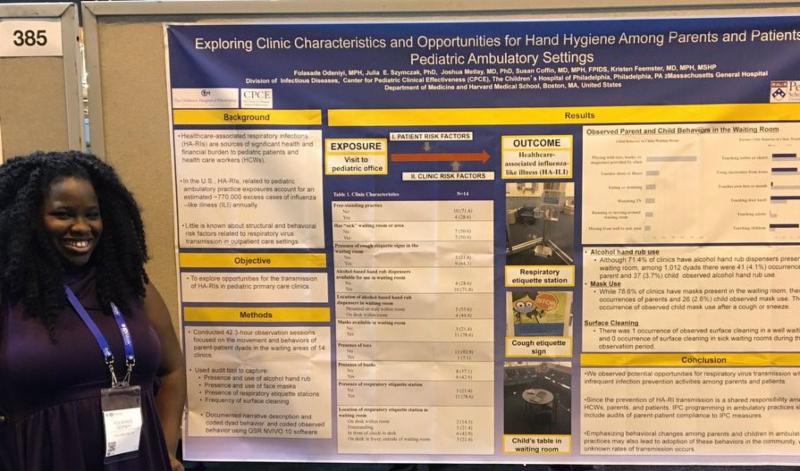
The annual IDWeek conference, going on now in New Orleans, is the combined meeting of the Infectious Diseases Society of America (IDSA), Society for Healthcare Epidemiology of America (SHEA), HIV Medicine Association (HIVMA), and Pediatric Infectious Diseases Society (PIDS). Over the course of five days, infectious diseases professionals from around the country meet, share experiences, and develop collaborations for the improvement of patient care and public health.
This year, several CPCE investigators will be presenting during the annual meeting. Dr. Susan Coffin will be presenting on preventing viral respiratory infections in healthcare settings. Dr. Jeffrey Gerber will be presenting on antimicrobial stewardship in the outpatient setting. Dr. Kevin Downes will be presenting on antibiotic-associated acute kidney injury in hospitalized children. CPCE researchers will also have more than 15 posters displayed over the course of the conference. See a full list of the CPCE presentation at ID Week here.
|
|
|
|
|
Precision Medicine: Methods and Measures for Realizing the Potential of mHealth
Date: Thursday, November 3, 2016
Time: 12:00 – 1:30 pm
Location: 3535 Market Street, 16th Floor, Conference Room D
Speaker Christopher Cushing, Ph.D., of University of Kansas will present on n-of-1 and adaptive interventions in pediatric health. Lunch will be provided. RSVP here or contact mHealth@email.chop.edu with any questions.
NIH Peer Review Online Briefings
Dates: November 1, December 1, and December 2, 2016
Time: 2:00 - 3:00 pm
The NIH Center for Scientific Review will host three online briefings to help applicants better navigate the NIH peer review process. The November 2 session will focus on fellowship grants; December 1 will focus on R01 grants; and December 2 will cover basic research.
Read more.
Social and Public Innovations: A Look at How the Public Sector Uses Data to Innovate and Influence Policy
Date: November 18, 2016
Time: 2:00 - 6:00 pm
Location: Public Health Management Corporation, 1500 Market Street #1500
The Social Innovations Journal launch event will shed a light on how the Greater Philadelphia region is innovating through the use of data. Speakers include Ted Dallas, PA Secretary o fthe Department of Human Services; Nelson Lim, Executive Director of the Fels Institute of Government at Penn; Eva Gladstein, Deputy Managing Director of Health/Human Services, City of Philadelphia; and Andrew Therriault, Chief Data Officer, City of Boston.
Click here to learn more and to register.
|
|
|
|
Ethics, Emotions, and the Skills of Talking About Progressing Disease With Terminally Ill Adolescents: A Review.
For clinicians caring for adolescent patients living with progressive, life-threatening illness, discussions regarding prognosis, goals of care, and treatment options can be extremely challenging. While clinicians should respect and help to facilitate adolescents' emerging autonomy, they often must also work with parents' wishes to protect patients from the emotional distress of hearing bad news.
Clinical course and outcomes of childhood-onset granulomatosis with polyangiitis.
Children with GPA frequently have severe disease presentations including significant renal, respiratory and gastrointestinal involvement. While most children with GPA achieve remission, nearly half have subsequent relapses.
Prevalence of Abuse Among Young Children With Rib Fractures: A Systematic Review. Dr. Joanne Wood and colleagues aimed to estimate the prevalence of abuse in young children presenting with rib fractures and to identify demographic, injury, and presentation-related characteristics that affect the probability that rib fractures are secondary to abuse.
Low rates of pregnancy screening in adolescents before teratogenic exposures in a national sample of children's hospitals.
Adolescents with acute leukemia and ER visits have low rates of pregnancy screening before teratogenic exposures. Standardized practice guidelines for pregnancy screening among adolescents may improve screening rates.
Premature Epiphyseal Closure of the Lower Extremities Contributing to Short Stature after cis-Retinoic Acid Therapy in Medulloblastoma: A Case Report.
Prolonged cis-retinoic acid (RA) exposure contributes to premature epiphyseal closure. cis-RA is administered in various treatment regimens for pediatric cancers, thus increasing the risk for bone deformities and compromised growth.
|
|
|
Alex's Lemonade Stand Foundation 2017 Innovation Grant (LOI due Nov 1, 2016)
Innovation grants are designed as seed funding for researchers with a novel approach to pediatric oncology scientific investigation. This may represent a change in research direction and/or an innovative new idea that moves away from an investigator’s prior research but for which a strong case is made for the potential impact on childhood cancers. Innovation Grants will support research proposals to be carried out by investigators who are already established, have a track record of peer-reviewed publications and evidence of successfully competing for extramural funding. The grant is for two years up to $125,000 per year for direct costs only. A no-cost extension is permitted if progress is demonstrated and budget properly justified.
The AACR-Aflac, Inc. Career Development Award for Pediatric Cancer Research represents a joint effort to encourage and support junior faculty to conduct pediatric cancer research and establish a successful career path in this field. The research proposed for funding may be basic, translational, clinical, or epidemiological in nature and must have direct applicability and relevance to pediatric cancer. The award is $100,000 for two years. AACR membership is required.
NIH Extramural Loan Repayment Program (LRP) (Nov 15, 2016)
The overall purpose of the extramural LRP is the recruitment and retention of highly qualified health professionals as research investigators. Each of the five extramural LRPs provide for the repayment of educational loan debt of up to $35,000 annually for qualified health professionals performing research within the mission of NIH at domestic, non-profit, or government entities, in one of five categories: clinical research, pediatric research, health disparities research, contraception and infertility research, or individuals from disadvantaged backgrounds. CHOP’s institutional contact is
Pearl Ben-Gadson.
Alex's Lemonade Stand Foundation 2017 Young Investigator Grant (Dec 15, 2016)
Young Investigator Grants are 3 year awards designed to support scientists in the early stages of their research careers, such as postdoctoral or clinical fellows. Outstanding mentorship and demonstration of a career plan that shows commitment to pediatric cancer investigation are critical components of a successful application.
Alex’s Lemonade Stand Epidemiology Grants are $100,000 per year for two years. Funding allows investigators to pursue research studies in human populations, using epidemiological approaches, in order to significantly contribute to the understanding of childhood cancers. Hypothesis-driven research may focus on risk factors, early detection, prevention, effectiveness and treatment outcomes.
OnPAR Program for Unfunded NIH Proposals
Last year, the NIH received approximately $30 billion in federal support. In spite of this amount, about 42,500 grants were not funded. To address these unfunded proposals, the NIH has a new Pilot Program that is designed to match researchers with nonprofit disease Foundations or with investments from private companies. Through a new collaboration between the NIH and the private contractor Leidos, researchers can now upload their unfunded NIH Proposals into an online portal at the Online Partnership to Accelerate Research (OnPAR). Foundations and other potential funders can review the NIH scores, and decide whether they might be interested in funding the Projects. Currently, this Pilot Program allows researchers with priority scores better than the 30th percentile to submit their abstracts. Interested Foundations might ask that a researcher send their full NIH Application along with its scores. The consensus opinion is that there are a lot of worthy grants being submitted to the NIH, but there is only so much funding available. OnPAR is one way of trying to match researchers with private Foundations.
|
|
About CPCE
We are a pediatric research center dedicated to discovering and sharing knowledge about best practices in pediatric care by facilitating, organizing and centralizing the performance of clinical effectiveness research -- research aimed at understanding the best ways to prevent, diagnose and treat diseases in children. CPCE’s multidisciplinary team conducts research on a diverse range of clinical effectiveness topics grouped within four areas of research:
|
|
|
|
|
|
|
|