During the first objective of the three-part project, the researchers simulated a packing facility within the laboratory using coupons, or disks, cut from dry surfaces within a packinghouse. Working closely with Claudia Ionita, Ph.D., from the Dawson team, George Nikolich Consulting Inc. collected surface swab samples every two weeks from two California Central Valley peach packinghouses so the researchers could use organisms found in naturally occurring biofilms — microbes living in communities, similar to coral reefs.
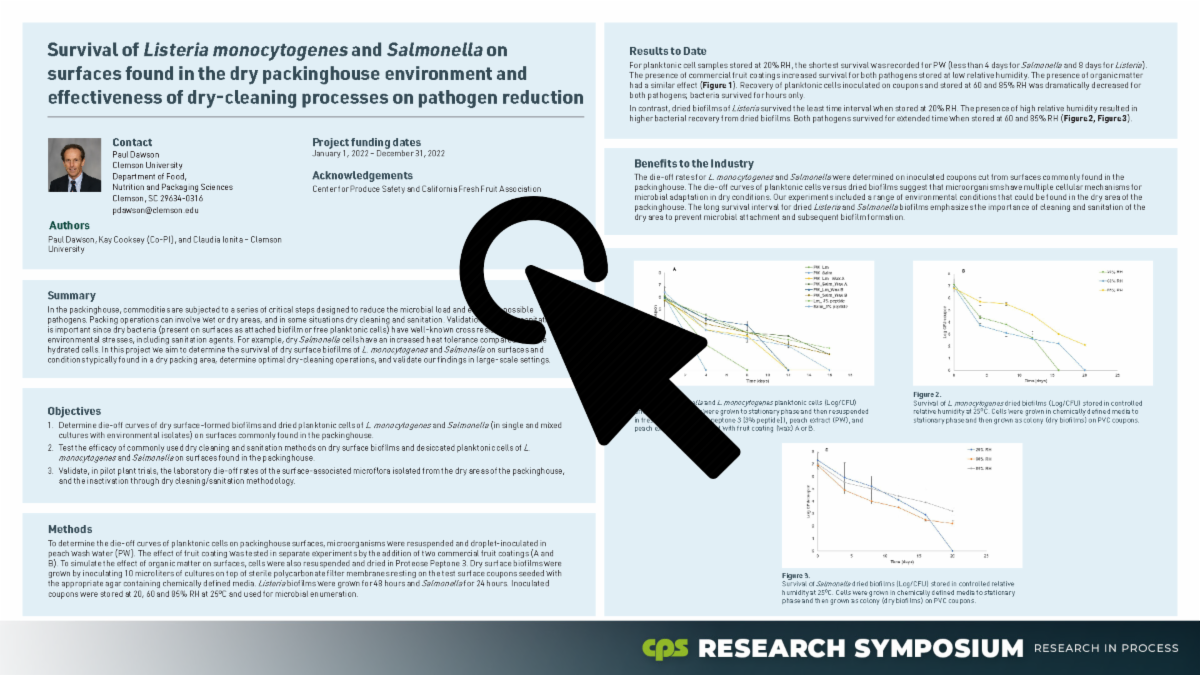
The researchers inoculated the coupons with dried planktonic — free-flowing — cells or dry surface-formed biofilms. They then measured the die-off rates under different environmental conditions regularly found in packinghouses.
The results varied widely among the treatments. Planktonic cells on coupons stored at 25 degrees Celsius and 60% or 85% relative humidity only survived a few hours. But at 20% relatively humidity, the free-flowing cells survived much longer.
“So just drying the surface doesn’t affect them,” Dawson said.
Dried biofilms of each organism, on the other hand, survived several days under the higher humidity regimes but did poorly under low humidity.
The researchers also looked at the effects of three commercial coatings applied to reduce fruit respiration and extend shelf life. Under low relative humidity — 20% — the coatings increased survival for both Listeria and Salmonella planktonic cells. The presence of organic matter, such as that found in peach wash water, had a similar effect.
Dawson said the die-off curves suggest that microorganisms have several mechanisms to adapt to dry conditions. The long survival intervals for dried Listeria and Salmonella biofilms also emphasized the importance of cleaning and sanitizing dry areas to prevent microbial attachment and biofilm formation.
As part of their laboratory work, Dawson said, they are using different methods to analyze the dry biofilms, including plate counts, microscopy, and real-time PCR, a type of genetic fingerprinting. The use of these multiple analyses is to avoid false negatives caused when microorganisms under stress, such as dry conditions, go into a survival mode known as viable but non-culturable cells or VBNC. The organisms can’t be detected using traditional culturing methods, but they remain pathogenic.
The researchers also will look at conditions that cause planktonic cells present on surfaces to form attached biofilm communities.
Their next step is to evaluate a number of approved food-grade sanitizers’ effectiveness on both dried planktonic cells and dried biofilms under lab-simulated dry packinghouse conditions.
They then plan to validate their findings in a packinghouse pilot plant. Together with the lab findings, Dawson said, they hope the results will help identify management practices to reduce pathogen presence in a dry environment.