|
The trial involves three pear varieties: Bartlett, D’Anjou and Bosc. Zhu said she chose Bartlett because it’s the most popular and a summer variety. Both D’Anjou and Bosc are winter varieties. While Bartlett and D’Anjou have smooth skins, Bosc has rough skin. In addition to conventionally grown pears, they included two varieties of organically produced pears: Bartlett and D’Anjou.
Organic production practices restrict the use of certain fertilizers and chemicals, prohibiting the use of synthetic compounds. As a result, she said the set of microbes found on organic pears may differ from those on conventionally grown fruit. Zhu said the inclusion of organic pears was motivated by the continued growth of this category.
For the study, they inoculated unwaxed pears with a non-pathogenic strain of Listeria in a food-grade laboratory. They also included uninoculated fruit as checks.
With the help of industry cooperators, they transferred the treated fruit to commercial CA and cold storage and removed samples every three weeks over a nine-month period.
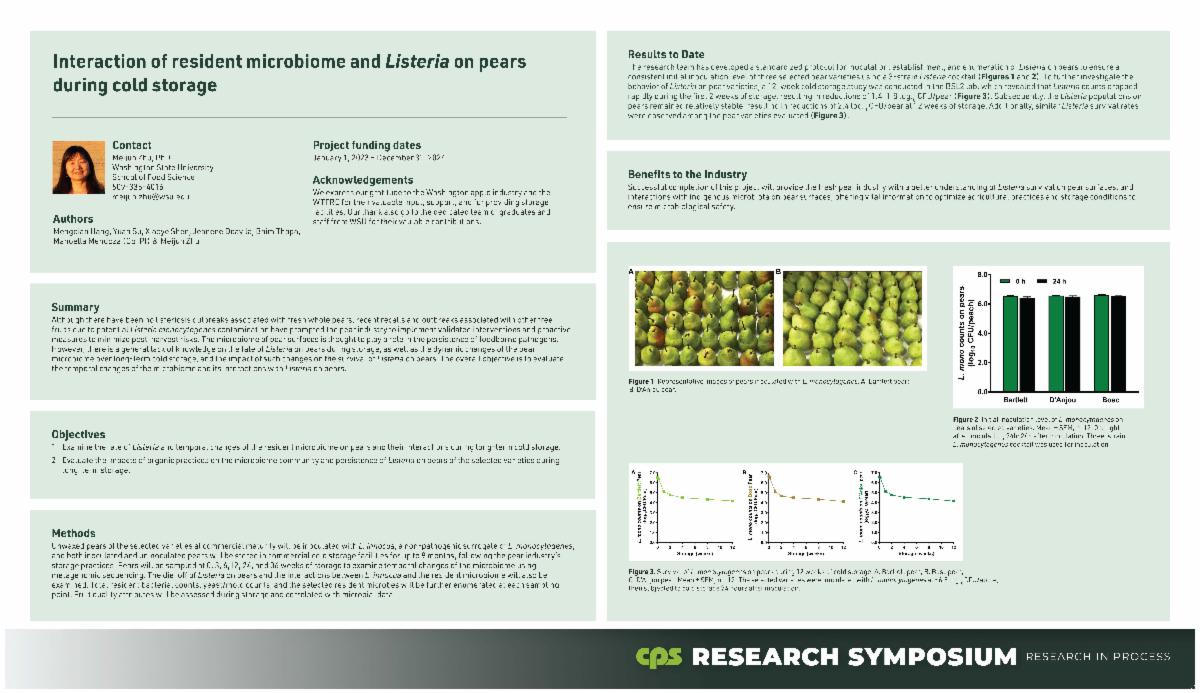
Each time, they measured Listeria die-off as well as potential shifts in microbial populations. In the beginning, Listeria populations quickly decreased and then eventually stabilized, Zhu said, citing preliminary results.
They also assessed fruit quality attributes and hope to be able to correlate those results to microbial data. Researchers are still in the process of running metagenomic analyses of the microbial samples they collected. “We’re hoping our microbial sequencing will empower us to identify, based on interactions, potential biological control agents for decay and pathogens,” Zhu said.
Simultaneously in their laboratory, they inoculated pear samples with a three-strain cocktail of L. monocytogenes, and incubated them for 12 weeks under conditions that mirrored industry cold storage. Zhu said they were able to validate the non-pathogenic strain was an appropriate surrogate for the pathogen.
Both project investigators are continuing sample collection throughout 2024 and will undertake metagenomic sequencing and bioinformation analyses in the same year.
|