|
Harris also is collaborating with Oregon State University on another CPS-funded project that examines how production practices affect dry bulb onion safety. Between the two projects, Nitin said they provide a continuum of what happens in the field and what happens in the packinghouse.
In the laboratory, the researchers are focusing on Salmonella because the pathogen is known to survive for long periods in dry environments compared to E. coli or Listeria, which don’t do well under similar settings.
They also are using the surrogate organism Enterococcus faecium so they can benchmark their results against standard and acceptable practices.
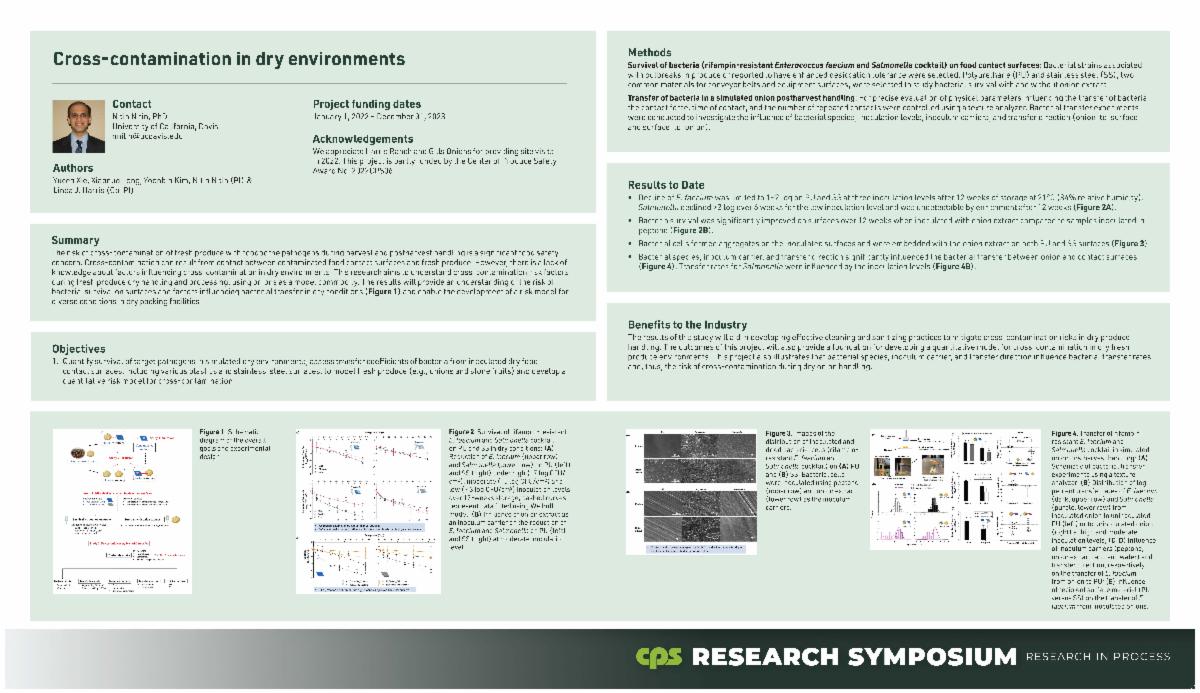
The experiments are designed to mimic cross-contamination that may occur in a dry packinghouse environment. They measured microbial transfer from simulated packing surfaces — stainless steel and common plastic surfaces such as polyurethane — to onions and stone fruit. Along the same lines, the researchers assessed the transfer rate from inoculated produce items to packinghouse surfaces.
As part of the experiment, the treatments were held under a range of conditions and durations to measure bacterial die-off. The time period was selected to reflect the 2- to 3-month-long onion packing season.
They also examined the influence of onion juice on packing surfaces in influencing the transfer of bacteria from the surface to onions.
“Surprisingly, we observed that the presence of onion juice enhances the transfer rate of bacteria compared to surfaces without onion juice,” Nitin said. “We did not observe any significant inhibition of the inoculated bacteria in the presence of onion juice.”
Although the results are preliminary, the researchers found bacterial species and transfer direction significantly influenced microbial movement between the produce and contact surfaces. The inoculum carrier — whether nutrient broth, onion extract or a soil-water mixture — also played a role in transfer.
“One of the things we found is the transfer rate in a dry environment is significantly lower than in a wet environment from what’s reported in the literature,” Nitin said.
|