May 15, 2026 | CRA Member Newsletter Updates: Legislative, State Budget, Regulatory, Local & Federal and California Retail Policy and Law Conference 2026 | | Message from the President | | | |
As we move past the first of two suspense file hearings of the 2026 legislative session, Sacramento is officially entering one of the busiest stretches of the year. These hearings are a major inflection point in the legislative process, determining which bills with significant fiscal impacts continue moving forward and which effectively die for the year. Bills that cleared suspense now head to the floor for a vote by their House of Origin before advancing to the second house, with May 29 marking the deadline for bills to move out of their first chamber.
CRA has been actively engaged throughout this process, and while we secured several important victories, including the defeat of multiple bills we opposed in Appropriations Committee, significant work remains ahead. Over the coming weeks leading into the July 4 holiday and Summer Recess, our team will be deeply engaged in floor fights, second house policy committees, regulatory advocacy, and coalition efforts on behalf of California retailers. As always, member feedback remains critical to shaping our advocacy strategy, and we encourage all members to join our monthly Policy & Regulatory Call as we review suspense outcomes, priority legislation, and the overall state of play for the remainder of session.
With the Legislature now at the halfway point of the year, several two-year bills are also beginning to move. One key example is SB 501 by Senator Ben Allen, which presents an important opportunity to pursue much-needed reforms to California’s loose battery extended producer responsibility (EPR) program established under AB 2440 (Irwin, 2022). As rulemaking begins this summer, CRA is focused on ensuring the program is practical, workable, and cost-conscious for both businesses and consumers. This work complements our sponsored legislation, AB 2549 by Assemblymember Rick Zbur, which includes several technical fixes designed to streamline California’s battery collection programs while continuing to support the state’s broader environmental goals.
On the environmental front, California’s Office of Administrative Law officially approved CalRecycle’s final SB 54 regulations on May 1, triggering the next major phase of implementation. Thanks to CRA’s strong working relationship with CalRecycle, we were able to obtain and distribute the Final Statement of Reasons to members ahead of public release, helping retailers prepare for reporting requirements that begin just weeks after approval.
As anticipated, litigation surrounding SB 54 and related policies is now beginning to unfold. The threat of the first major lawsuit was made by environmental advocacy organizations, including Californians Against Waste and NRDC, challenging revisions made after Governor Newsom previously delayed the regulations over affordability concerns. The lawsuit, the organization argue, would say that the updated rules improperly allow certain forms of advanced recycling technologies. At the same time, litigation challenging California’s SB 343 “Truth in Labeling” law (of which CRA is a plaintiff) continues moving forward on commercial free speech grounds. Because SB 343 is deeply interconnected with SB 54 implementation, CRA is closely monitoring both cases and their broader implications for retailers operating in California.
At the local level, Los Angeles County is advancing a draft Household Hazardous Waste (HHW) Extended Producer Responsibility (EPR) ordinance after similar statewide proposals have failed repeatedly in the Legislature over the past four years due to strong industry opposition efforts, including advocacy led by CRA and our coalition partners. The county’s proposal reflects a growing trend we continue to monitor closely: the use of local ordinances to advance policy concepts that have struggled to gain traction at the state level. Similar dynamics have emerged around self-checkout restrictions and hazard pay proposals. More on the Los Angeles HHW EPR ordinance is below.
Turning to the state budget, Governor Gavin Newsom released his May Revision this week alongside the State Controller’s Annual Comprehensive Financial Report. The state reported $595.5 billion in total revenues and $582.5 billion in expenses for the fiscal year ending June 30, 2025, with both revenues and expenditures increasing roughly 8.5% year-over-year. Revenue growth was driven largely by personal income, corporate, and sales tax collections, while spending increases were concentrated in education and health and human services.
While California’s short-term fiscal outlook has improved due in part to an estimated $16.5 billion revenue surge tied to the continued growth of the AI and technology sectors, significant long-term concerns remain. Many of these gains are viewed as temporary or highly volatile, particularly as California continues facing ongoing questions surrounding competitiveness, affordability, and future tax policy proposals.
Governor Newsom’s May Revision includes approximately $3.6 billion in tax increases intended to help stabilize the budget and eliminate projected deficits over the next two fiscal years. The proposal rejects broader tax increases on corporations and high-income earners but includes a permanent cap on certain corporate tax credits as well as the expansion of sales taxes to electronically delivered software products, proposals that CRA will continue evaluating closely on behalf of the retail industry.
Finally, I want to thank CRA member Conn Maciel Carey LLP and attorney Rachel Conn for contributing expert analysis on Cal/OSHA’s revised Workplace Violence Prevention draft regulations. This type of practical legal insight is exactly why we launched the California Retail Law Center — to provide meaningful value to our members while elevating the voices and expertise of California’s leading retail-focused law firms and practitioners.
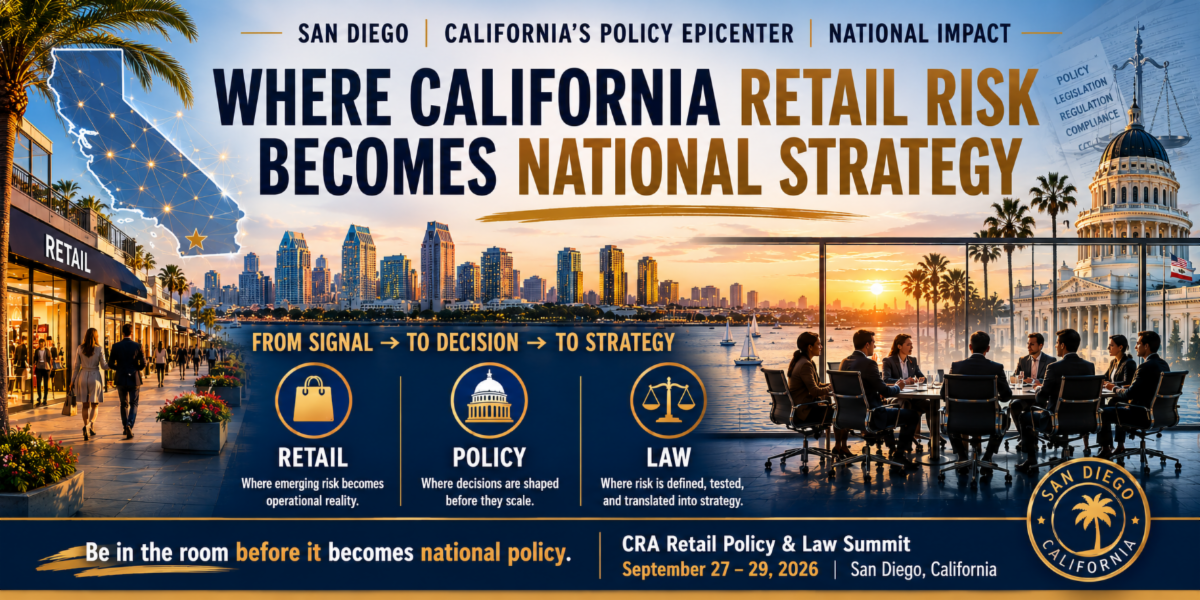
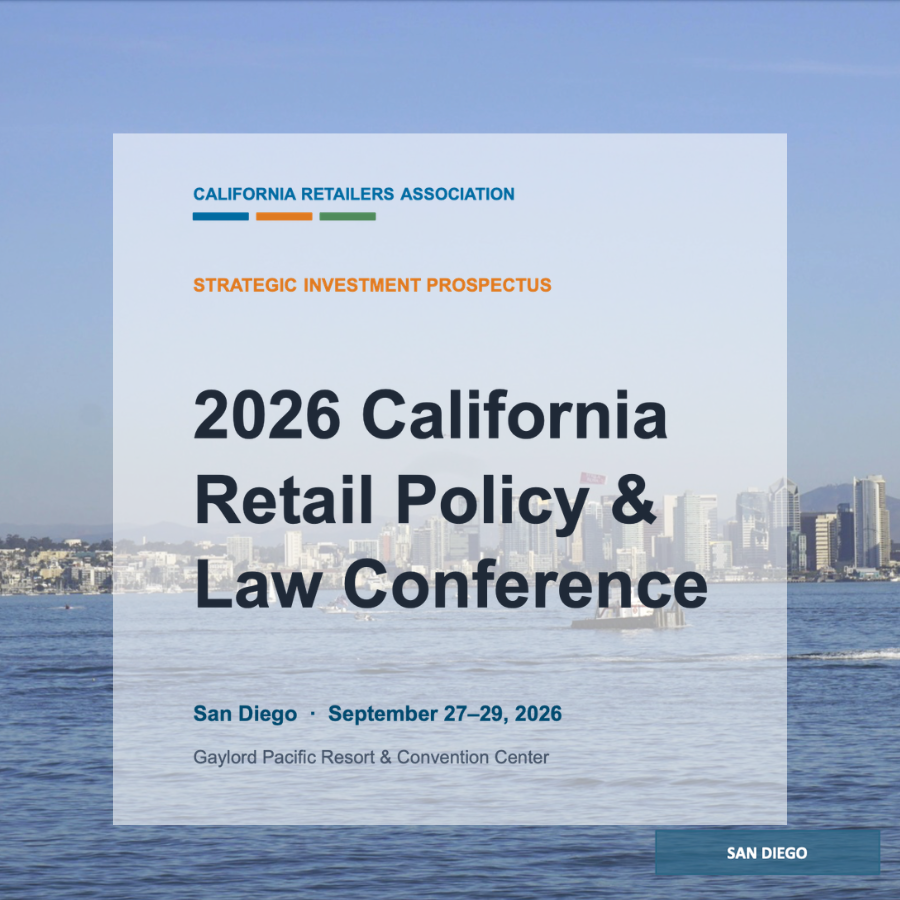
The California Retail Law Center will also play a major role at our upcoming California Retail Policy & Law Conference taking place September 27–29, 2026, at the Gaylord Pacific Resort & Convention Center. The conference will bring together general counsels, compliance and risk officers, privacy and AI leaders, government affairs professionals, sustainability executives, and outside counsel for three days of focused discussion on the legal, regulatory, and policy issues shaping the future of retail in California. Registration and sponsorship opportunities are now live, and we look forward to welcoming the industry’s leading voices to San Diego this Fall. Read more about the Summit and how to register below.
Rachel
| |
In This Newsletter Issue:
- Legislative Updates
- State Budget Update
- Regulatory Updates
- Federal and Local Updates
- CA Retail, Policy & Law Conference
| | | |
First House Suspense File Update
The Senate and Assembly have dispensed with their respective Suspense Files. Below are the results of the hearings. The results are as follows:
- Held in committee: Bill is dead.
- Passed: Bill heads to the floor for a vote before heading over to the next house.
- Passed with amendments: Bill was amended and we have a summary of the amendments, but we won’t have language in print until Monday.
- Rereferred to committee or no action: Usually means the bill needs more work and the committee chair is granting extra time.
Bills that head to the floor of each house have to pass out and be sent to the subsequent house by May 29. CRA will be working hard over the next two weeks to ensure positive outcomes for our priority bills.
TOP PRIORITY BILLS
AB 2564 (Ward) Surveillance pricing OPPOSE
Result: Passed.
AB 1776 (Aguiar-Curry) Cartwright Act: violations OPPOSE
Result: Passed.
AB 2549 (Zbur) Electronic Waste Recycling Act of 2003: manufacturer notices SPONSOR
Result: Passed.
AB 2072 (Solache) CalFresh and WIC Contingency Fund SPONSOR
Result: Held in committee.
AB 2244 (Gabriel) Non-Ultraprocessed Certified food standard OPPOSE
Result: Passed.
AB 2245 (Rodriguez, Michelle) Lubricants waste: packaging: PRO OPPOSE
Result: Held in committee. CRA WIN
AI and PRIVACY
AB 1542 (Ward) Sensitive personal information OPPOSE
Result: Passed.
AB 1883 (Bryan) Workplace surveillance tools OPPOSE
Result: Passed with amendments to revise the facial recognition provision, among other amendments.
AB 1898 (Schultz) Workplace artificial intelligence tools OPPOSE
Result: Held in committee. CRA WIN
AB 2027 (Ward) Worker data: prohibitions: artificial intelligence OPPOSE
Result: Held in committee. CRA WIN
SB 867 (Padilla) Toys: companion chatbots OPPOSE UNLESS AMENDED
Result: Passed with amendments to add coauthors.
ENVIRONMENTAL
AB 1604 (Stefani) Product safety: intentionally added bisphenols NEGOTIATING
Result: Passed with amendments pushing out implementation date one year.
AB 1777 (Garcia) Air pollution: indirect sources OPPOSE
Result: Passed.
AB 1812 (Aguiar-Curry) Solid waste: compostable products OPPOSE UNLESS AMENDED
Result: Passed.
AB 2253 (Boerner) Solid waste: products: environmental marketing claims OPPOSE
Result: Passed.
SB 954 (Blakespear) CEQA: advanced manufacturing facilities: exemption OPPOSE
Result: Passed with amendments that specify final tier does not include fuel.
SB 1031 (Blakespear) Solid waste: compostable products OPPOSE UNLESS AMENDED
Result: Passed with amendments that remove prohibition of "except in in California" label.
SB 1180 (Allen) California Plastic Pollution Mitigation Fund OPPOSE UNLESS AMENDED
Result: Passed with amendments that clarify scope and purpose of mitigation fund.
LABOR
AB 2095 (Lee) Employment discrimination: conviction history OPPOSE
Result: Passed with amendments to strike rebuttable presumption provision, among other amends.
SB 947 (McNerney) Employment: automated decision systems OPPOSE
Result: Passed with amendments that narrow scope of predictive behavior analysis and modify enforcement language.
SB 951 (Reyes) Employment: technological displacement: notice OPPOSE
Result: Passed with amendments to align timeline with current WARN Act provisions.
SB 1130 (Reyes) Invasion of privacy: wearable recording devices CONCERNS
Result: Passed with amendments that exempt hearing aids and alternate communication devices.
FOOD, GROCERY, & ALCOHOL
AB 1605 (Ransom) Driving under the influence: alcohol sales CONCERNS
Result: Held in committee. CRA WIN
AB 1857 (Aguiar-Curry) Unlawfully restrictive covenants: grocery stores CONCERNS
Result: Passed.
AB 2034 (Addis) Food safety: unsafe additives and ingredient disclosures OPPOSE
Result: Held in committee. CRA WIN
MISCELLANEOUS
AB 1609 (Zbur) Customer service chatbots CONCERNS
Result: Passed.
AB 1790 (Connolly) Corporations Tax Law: water’s-edge election OPPOSE
Result: No action. Eligible for further consideration and a vote at a later date.
AB 1793 (Ward) Cash payments: calculation SUPPORT
Result: Passed.
AB 1796 (Jackson) Licensed Professional Interior Designer Practice Act CONCERNS
Result: Passed.
AB 1901 (Berman) Children’s diapers: intentionally added ingredients: disclosure WATCH
Result: Passed with amendments to delay online disclosure requirements.
AB 2064 (Sharp-Collins) Discrimination: criminal history OPPOSE
Result: Held in committee. CRA WIN
AB 2076 (Lowenthal) Online marketplaces: nitrous oxide OPPOSE/NEGOTIATING
Result: Passed.
AB 2108 (Sharp-Collins) Diversion: retail theft SUPPORT
Result: Passed.
AB 2190 (Wallis) Internet website accessibility OPPOSE
Result: Passed.
AB 2217 (Zbur) Criminal procedure: alternatives to arrest SUPPORT
Result: Passed with amendments to contain administrative costs.
AB 2302 (Rodriguez, Celeste) Food safety: infant Formula WATCH
Result: Passed with amendments that remove aluminum from scope of the bill.
AB 2366 (Ávila Farías) Administrative Procedure Act cost-of-living impact SUPPORT
Result: Held in committee.
AB 2729 (Bonta) Medi-Cal: Employer Responsibility for Medi-Cal Trust Fund OPPOSE
Result: Passed with amendments to add an urgency clause and rerferred back to committee.
SB 1103 (Pérez) Large home improvement retailers: immigration enforcement OPPOSE
Result: Passed with amendments that remove private right of action and add publics records act disclosure exemption.
SB 1123 (Wiener) Administrative Procedure Act: major regulations OPPOSE
Result: Passed.
SB 1124 (Archuleta) Public health OPPOSE
Result: Passed.
SB 1284 (Smallwood-Cuevas) Medi-Cal benefits: employer reports OPPOSE
Result: Passed with clarifying amendments.
SB 1327 (Reyes) Weights and measures: electric vehicle supply equipment SUPPORT
Result: Held in committee.
Additional Legislative Outreach Updates
CIPA Reform
CRA President and CEO Rachel Michelin attended and spoke at a press conference alongside Senator Anna Caballero and members of the Alliance for Legal Fairness (ALF) Coalition in support of Caballero's SB 690, which would bring much-needed reform to the California Invasion of Privacy Act.
Senator Caballero: “SB 690 would put a stop to the surge of predatory California Invasion of Privacy Act shakedown lawsuits being filed against businesses of every size and industry. In recent years, a small group of plaintiffs’ attorneys have weaponized the law to file shakedown lawsuits against any business with common website software. Food banks, hospitals, school districts, news publications and small businesses like Elk Grove Plumbing and Heating have all been targets of predatory lawsuits and sued under a 1967 criminal wiretapping statute that predates the internet.”
The press conference was part of a larger lobby day effort hosted by ALF, of which CRA is a member, at the California State Capitol and included meetings with the Assembly Privacy Committee where SB 690 will be heard next, as well as the Speaker's Office, the Governor's Office, the Attorney General's Office and key committee staff. CRA participated and ensured the retail perspective was well represented.
Batteries
CRA sent out a request for feedback regarding updated potential amendments to SB 501 (Allen) Responsible Battery Recycling Act of 2022: covered batteries that we received from the author's office. View the amendments mock up HERE and please send feedback to Sarah including if you are good with the suggested changes to the bill language. Positive feedback is also helpful to have.
Right now, we have concerns with the bill, but no official position yet (we have not registered a position in committee or sent in letters). The draft proposed amendments attempt to do the following according to the author's office:
-
Clarify definition of medium format battery
-
Adjust minimum collection site metric for medium format batteries to provide additional flexibility in small counties
-
Add provisions to better allow for multiple PROs under the program serving different battery sizes
- Clarify that retailers who are not medium format collection sites do not need to accept medium format
Senator Allen's office is also working on organizing a stakeholder meeting with CalRecycle to discuss the possibility and feasibility of having multiple PROs, both in the context of SB 501 and just AB 2440 generally, but they believe the current construct of minimum collect site metrics make this infeasible. Sen. Allen requested that a retail perspective be included in the meeting and CRA will be in attendance.
Legislative Deadlines
- May 29 - House of Origin Deadline
- June 15 - Budget Deadline
- July 3 - Summer Recess begins
- August 3 - Legislature reconvenes
- August 31 - Last Day for Legislature to pass bills
- September 31 - Last day for Governor to sign or veto bills
| | |
CA Governor May Revise Released
California Governor Gavin Newsom released his May Revise on the State Budget yesterday, the final version of the budget for the legislature to review and take action on by July 1, 2026. His May budget revision proposes general fund spending of $246.56 billion, an increase of $18.6 billion from last year’s enacted budget, continuing California’s surge in unsustainable spending.
Overall, the May Revise sends a mixed message to business: no broad new tax hikes this year, some targeted relief and incentives, but continued uncertainty around future deficits and program cuts that could affect costs and consumer demand. For employers, the revised plan largely maintains the January framework, emphasizing structural fixes over one-time gimmicks, which reduces the risk of sudden mid‑year shocks but keeps pressure on longer‑term spending and tax debates.
The May Revision builds on a January proposal that already assumed tens of billions in higher revenues over the multiyear “budget window,” driven in part by strong personal income tax receipts and market gains linked to California’s technology and artificial intelligence sectors. At the same time, analysts continue to warn that state spending has outpaced revenues by roughly 10%, creating a structural deficit that will force difficult choices in the next few years even if short‑term revenues look healthy.
So far, the administration has not advanced across‑the‑board tax increases on employers in this May Revision, instead leaning more heavily on spending solutions and program adjustments to keep the budget in balance. This approach aligns with legislative signals that, at least for 2026‑27, they prefer to avoid large new revenue measures that could spook investment or accelerate out‑migration of high‑income taxpayers and firms amid a Billionaires Tax Initiative on the statewide ballot, which Governor Newsom opposes.
The revised budget continues or expands selective tools aimed at attracting and retaining private investment, most notably the California Competes program, which the administration has proposed extending with up to 180 million dollars annually in tax credits for projects that commit to jobs and capital spending in the state. Governor Newsom also proposes to cut the first‑year minimum franchise tax in half for eligible new businesses, easing the state’s 800‑dollar annual filing tax during a company’s launch year and modestly lowering start‑up costs.
The State Legislative Analyst’s Office maintains projections of sizable operating deficits later in the decade and today’s revision is likely a prelude to continued debate over business tax credits, fee structures, and potential future revenue measures that could reshape California’s competitiveness landscape.
The full text of the Governor’s Budget summary document is available at ebudget.ca.gov.
| | |
San Francisco Proposition D Update - the Overpaid Executive Tax Initiative
The Proposition D Opposition campaign, which CRA is part of, has key economic data and narratives they will soon be pushing out, which includes retail, grocery stores and pharmacies - 10,000 jobs lost, hundreds of thousands of dollars in wages at risk. There will be a report from the San Francisco City and County Economist Ted Egan that will say that Prop. D is trading risk for revenue and with San Francisco population decreasing, this initiative is the last thing the City needs for its fragile recovery from the COVID-19 Pandemic.
The opposition campaign has raised $5.3 million to date out of a base budget of $5.6 million, so we are headed strong into the final weeks before Election Day. Additional opposition campaign support is due by May 20, 2026 to keep the opposition effort going through June 2.
Half of the San Francisco electorate has registered recognition of our opposition argument, which attaches to San Francisco Mayor Daniel Lurie's opposition to the initiative as well as the very negative economic impact it will have and inadequate fiscal controls Measure D will have on the City's General Fund.
We are seeing statewide that not many people have voted in California's election cycle yet so, while there are more 'No' ballots cast so far on Proposition D in the City of San Francisco, we still have a ways to go to continue our efforts to defeat the measure.
For more information about this initiative, opposition campaign and CRA's role click HERE. Please reach out to Rachel if there are questions and/or your company is interested in getting involved.
LA "Olympic Wage" Minimum Wage Update
The Los Angeles City Council is considering a contentious plan to roll back minimum wage increases for tourism workers, as the city faces the looming prospect of a measure to repeal the business tax that could financially ruin the city landing on the November ballot.
The move, approved in a 9-6 vote Wednesday, is an about-face for the council, which voted just last year to increase the minimum wage for airport and hotel workers in the city to $30 an hour by 2028.
Now, the council is considering a plan to delay that boost until 2030, slowing down the pace of annual increases to the minimum wage. City leaders are hoping to stave off a tax repeal that would slash the city budget and lead to major cuts and layoffs. Business leaders behind that ballot initiative garnered enough signatures to get it placed on the ballot but could still withdraw it.
The council has directed the LA city attorney to draft an ordinance to delay minimum wage increases and will have to vote again on the proposal.
Related News Coverage
L.A. moves to delay $30-an-hour minimum wage for hotel, airport workers tied to 2028 Olympics
Los Angeles Times
L.A. could push back $30 wage plan for hotel, airport workers
KTLA Channel 5 LA
LA's $30 Minimum Wage Debate Is Back at City Hall With the Stakes Bigger Than Ever
LA Magazine
LA City Council to discuss $30 minimum wage - NBC Los Angeles
NBC Los Angeles
Major airlines throw huge curveball at City Hall bosses over mass wage hike plot
NY Post
Los Angeles County Draft HHW EPR Ordinance Update
Feedback Due July 15
The CRA Team attended the first in a series of stakeholder meetings that the County of Los Angeles is hosting to review and get feedback on a draft proposal for a countywide household hazardous waste extended producer responsibility (EPR) program. More on the history of this issue is below. The draft ordinance language was just released - view it HERE and below - ahead of the County's next public stakeholder meeting (May 20), which CRA will be attending.
Download and Review the Draft Ordinance Language Just Released HERE.
Access the CRA Team's recap of today's stakeholder meeting HERE
Access the Los Angeles County Public Works Report HERE
Get more information on Los Angeles County's new Clean LA webpage dedicated to this proposal HERE
Please review our recap, the LA County Public Works Report and the Clean LA website and provide feedback to sarah@calretailers.com. Comments and questions are due by Wednesday, July 15, 2026.
Background on the Draft Ordinance
In January 2025, Los Angeles County Supervisor Lindsey Horvath introduced a motion directing county departments to study the creation of a local extended producer responsibility (EPR) program for household hazardous and electronic waste not already covered under state law. The proposal is rooted in the argument that companies profiting from products containing hazardous materials should help fund the safe collection and end-of-life management of those products.
The county’s proposal is part of a much broader and long-running debate in California over creating a statewide HHW EPR program. In recent years, Senator Ben Allen introduced both SB 1143 and SB 501 to establish statewide HHW stewardship frameworks, citing recommendations from California’s Recycling Commission and the growing financial burden HHW management places on local governments. However, following strong and coordinated opposition efforts from industry, including advocacy by the California Retailers Association, neither bill advanced in its original form. Instead, both measures were significantly narrowed: SB 1143 shifted toward expanding California’s existing PaintCare program, while SB 501 was amended to focus on California’s loose battery EPR program, which is expected to enter rulemaking later this summer.
As discussed during Los Angeles County's first HHW EPR stakeholder meeting held in April, advocates are increasingly pursuing a local ordinance strategy to build pressure for broader statewide action. This mirrors approaches previously used on issues such as self-checkout restrictions and hazard pay and was also central to the push that ultimately led to California’s pharmaceutical and sharps stewardship laws. Similar efforts surfaced again this year through AB 2245, which attempted to incorporate HHW EPR concepts into a broader packaging stewardship proposal for lubricant and automotive-related products before failing in Assembly Appropriations.
Momentum around the Los Angeles County proposal intensified following the January 2025 fires, after county officials highlighted the scale and cost of hazardous waste cleanup efforts underway across the region. Supporters of the ordinance argue that existing local collection systems are expensive, inconvenient, and insufficient to address the growing volume and complexity of household hazardous waste streams.
At the start of the year, Los Angeles County staff were given 180 days to return to the Board of Supervisors with draft ordinance language and implementation recommendations and that deadline is quickly approaching.
CRA will remain actively engaged in the Los Angeles County process and will continue closely monitoring developments and stakeholder discussions. Please do not hesitate to reach out with questions or feedback as this proposal continues to evolve.
Update on Local Efforts to Ban Gas Heaters
California regulators are struggling to balance the state’s climate goals with affordability concerns. The Bay Area has emerged as the latest battleground and gas heaters are at the center. Just three years after the Bay Area Air Quality Management District became the first agency in the nation to phase out the sale of gas space and water heaters, a discussion over that rule has expanded into a larger debate about pausing the plan altogether.
That tension was on full display at the agency’s meeting on Wednesday, where a clear split emerged between the mayors, city staffers and county supervisors on the board over the future of a regulation that would ban the sale and installation of gas-powered water heaters in 2027 and furnaces in 2029.
While the hearing didn’t culminate in a vote, it crystallized the battle lines ahead of an October meeting where the board, which represents 8 million residents, is expected to finalize changes to the rule.
Ten board members voiced support for keeping the regulations, which are designed to reduce emissions from the region’s largest source of smog-forming pollutants, with amendments to delay the start date for the water heater portion from January to October of next year.
The changes, proposed by agency staff, would also expand exemptions to cover 38% of households, recognition of increased costs around electric water heater installation. Those proposed amendments haven’t appeased opponents, though, and eight board members called for the rule to be suspended entirely. Although they accounted for a slight minority on Wednesday, their hesitation represents a major shift from 2023, when only one board member abstained from voting to pass the original rule.
In the past three years, the conversation has changed. Democratic lawmakers’ support for aggressive climate policies has given way to a focus on cost-of-living issues. This is due to several factors: a political rebranding sparked in part by President Donald Trump’s return to office on a platform of lowering prices, high inflation and skyrocketing gas prices linked to the ongoing war with Iran. The Trump administration has also dismantled federal incentives that offset the costs of installing electric appliances, making it harder for many households to pencil out the switch.
A rollback of the Bay Area’s heater rules would represent a major loss for electrification advocates who watched Southern California regulators reject a plan to phase out gas heaters last year. A federal court in 2023 also blocked local ordinances that banned the installation of gas lines in new buildings.
The Bay Area debate mirrors the brawl that unfolded last fall at the South Coast Air Quality Management District, where board members voted 7-5 to reject rules that would have required heater manufacturers to sell an increasing percentage of zero-emission equipment, ramping up to 90 percent by 2036. That effort faced opposition led by SoCalGas and business groups, and sparked accusations that an AI-powered campaign was used to flood board members’ inboxes with opposition letters.
In both cases, environmental groups and public health advocates say that opponents, including realtors and restaurant associations, have overestimated the economic impacts of switching to electric heaters, and ignored the healthcare costs linked to increased cases of asthma, heart disease and other conditions linked to smog. BAAQMD staff estimate their rule would save residents $890 million in health care costs annually.
Tariffs Update – Section 122 Tariffs Ruled Illegal, CBP CSMS on Protecting IEEPA Refund Information, Section 301 China Tariff Review
Section 122 Tariffs Ruling Appeal
Late last week, the Court of International Trade ruled 2-1 that the Section 122 temporary 10% global tariffs implemented by President Trump were illegal. The court ordered relief for the two private party plaintiffs and the State of Washington, but did not issue a nationwide injunction.
The Liberty Justice Center, which filed the suit on behalf of the companies, issued a press release celebrating the court’s decision. Washington State Attorney General Nick Brown also released a statement on the ruling.
The administration quickly appealed the decision to the Court of Appeals for the Federal Circuit. The Court of Appeals has issued an immediate administrative stay on the CIT decision, which means the importers will continue to pay the tariffs. The judge ordered the plaintiffs (both State and business) to respond to the Government’s motions by May 19, with the Government’s reply due by May 22. The temporary stay will run through at least May 22.
IEEPA Tariff Refunds
U.S. Customs and Border Protection provided its latest update to Judge Richard Eaton with the Court of International Trade on the status of the International Emergency Economic Powers Act (IEEPA) refunds. In the agency’s declaration, Brandon Lord, CBP’s Executive Director, Trade Programs Directorate, Office of Trade noted:
-
As of 7am eastern time on Monday, May 11, 2026, the CAPE declarations that passed the file validations cover 15,123,221 entries with IEEPA duties that passed the entry-specific validations and were accepted for the removal of IEEPA duties through CAPE. As of the same time, 8,338,081 of the accepted entries have subsequently been liquidated and/or reliquidated without IEEPA duties.
-
As of 7am eastern time on Monday, May 11, 2026, the anticipated duty refund and interest amount for the 8,338,081 liquidated and/or reliquidated entries is approximately $35.46 billion. This amount reflects the sum of the anticipated principal to be refunded and the associated interest due, after removal of the IEEPA duties and the liquidation and/or reliquidation of the entries in accordance with all applicable laws and regulations.
- Anticipated refunds and interest payments for the remaining entries continue to be consolidated by the CAPE Refund component, based on the entries’ importer of record (IOR) or authorized CBP Form 4811 designee and date of liquidation and/or reliquidation. CBP’s transmission of these consolidated refunds to the Treasury is subject to confirmation of Automated Clearing House (ACH) account information by CBP prior to transmission.
Judge Eaton issued an updated order in response to CBP’s declaration. The next update is scheduled for May 26. He noted that they discussed CAPE’s subsequent functionality, including processing refunds for entries flagged for reconciliation. He also said:
It is worth repeating that those who wish to take advantage of CAPE must have ACH accounts. As of May 11, 2026, “1,880 consolidated refunds have not been transmitted to the Treasury because ACH account information has not been provided by the [importer of record] or its authorized . . . designee.” Lord Decl. ¶ 6. It is apparent that importers of record should confirm that they have provided the required ACH account information to Customs.
CBP CSMS on Protecting IEEPA Refund Information
Customs and Border Patrol (CBP) issued CSMS # 68569567 - Best Practices for Protecting Your Information Regarding IEEPA Refunds. According to the message, with the launch of the Consolidated Administration and Processing of Entries (CAPE), CBP expects that scammers will attempt to use social media, email, and other communication methods to secure account information from importers in order to interfere with the process of refunding International Emergency Economic Powers Act (IEEPA) duties. The CSMS provides best practices to protect IEEPA refund information.
USTR Announces Second Four-Year Review of China Section 301 Tariffs
The Office of the United States Trade Representative (USTR) published a Federal Register notice announcing the initiation of the second four-year review of the China Section 301 tariffs. The notice initiates the first phase of the review, which provides an opportunity for domestic industries who benefit from the Section 301 tariffs to request a continuation of the tariffs.
Domestic industries are asked to comment on the Section 301 actions taken on July 6, 2018, and August 23, 2018 (List 1 and List 2). Requests for continuation must be received in the 60-day window prior to the second four-year anniversary of the respective action.
If USTR receives requests to continue the tariffs, the agency will announce the continuation of the action, and will undertake a review of the action as described in Section 307(c)(3) of the Trade Act (19 U.S.C. 2417(c)(3)). This will include an opportunity for other interested stakeholders to submit comments on the effectiveness of the action in achieving the objectives of Section 301.
US House of Representatives Passes Combating Organized Retail Crime Act
The US House of Representatives passed the Combating Organized Retail Crime Act (H.R. 2853). The bill now moves to the Senate for consideration. It is unclear at this point how quickly the Senate will act or if any issues may arise.
| | California Retail Policy and Law Conference 2026 | |
Please join us at the
California Retail Policy & Law
CONFERENCE 2026
California is often where the next legal, regulatory, and enforcement challenges for retail take shape. The issues debated here rarely stay here - within months, they can shape compliance expectations, litigation strategy, and policy across the country.
Join retail leaders, in-house counsel, compliance executives, government affairs professionals, regulators, and outside counsel for three days of focused discussion on the legal and policy issues affecting retail now and in the years ahead.
This is not a trade show - it is a working conference designed to help participants turn complex developments into practical strategy.
| |
Conference sessions will address:
- California Invasion Privacy Act (CIPA), privacy, and ad-tech enforcement.
- Artificial intelligence, algorithms, and pricing.
- CARB, CA Department of Toxic Subtsances Control, climate disclosure, and Environmental, Social and Governance (ESG) reporting.
- Extended Producer Responsibility, SB 54, packaging, textiles, and e-waste.
- Workforce, Private Attorneys General Act (PAGA), class actions, and Americans with Disabilities Act (ADA) issues.
- National patchwork, copy-cat laws, and post-election enforcement risk.
- And more!
| | We welcome CRA members' feedback on the content for the conference. Are we missing a topic or issue area? Do you have a program idea you would like to share? Please provide comments on the working draft agenda to Rachel. | | |
ATTENDEES WILL GAIN
- Practical guidance from policy, regulatory, and legal professionals.
- Direct insight into California policy and regulations that often become national models.
- A forum for discussion with peers navigating similar operational and compliance challenges.
- CLE-eligible programming in California and select other jurisdictions.
| |  | |
WHO SHOULD ATTEND
- General counsel and deputy general counsel.
- Compliance and risk officers.
- Privacy, AI, and data governance leaders.
- Government affairs and state policy teams.
- Employment, litigation, and labor counsel.
- Sustainability, EPR, and product compliance leaders.
- Outside counsel in privacy, AI, labor, environmental, and retail litigation.
| |
|
Gaylord Pacific Resort & Convention Center, San Diego
Set at the waterfront Gaylord Pacific Resort & Convention Center, the conference offers space for both formal sessions and the informal conversations where trust, insight, and partnerships are built. The property is seven miles from downtown San Diego and overlooks the Chula Vista Marina and the Pacific.
Contact Us
For questions and help with sponsorship and registration, contact events@calretailers.com.
| | | | |
California Retailers Association https://calretailers.com/ | |
Follow CRA on Facebook, Twitter, Linkedin and Instgram to stay up to date on the latest developments in statewide and local legislation and policies, regulations, relevant industry and member related news and association events. |
| | | |