|
Dear Friends of CRRJ,
The summer is well behind us, and we launched into a new school year with a head of steam, due in no small measure to the excellent work of our summer interns.
CRRJ welcomed five undergraduates from Bates, Temple, the University of Chicago, and Vassar, and joining them were several Northeastern LL.M and JD students. We also continued to collaborate closely with students and faculty at Southern University Law Center and the University of Kentucky's law school.
We worked assiduously to improve and grow the Burnham Nobles Digital Archive, adding material to existing cases and expanding its geographic scope. Our archivist, Joy Zanghi, led a team of historians, data engineers, and enthusiastic students who ensured each case in our data base is supported by not less than three discrete sources, while also “de-duping” the documents. The global audience for our material continues to grow, attesting to the Archive's impact in broadening knowledge about the Jim Crow era, and growing interest in reparatory initiatives. Archive users are searching our database from many countries, including the U.K., China and Germany.
The Archive provides the underpinning for our curricular design and restorative projects. Sara Merlo, our curriculum specialist, spent the summer drawing on the Archive to create a curriculum for North Carolina high school students that instructs them on the state’s lethal Jim Crow history. This summer, Lydia Beal, our senior researcher, collaborated with filmmaker Eric Gulliver to document the story of World War II veteran Hosea “Shant” Carter, murdered in Marion County, Mississippi in 1948. Carter’s son, Jimmie Dale Carter, began working with CRRJ to memorialize his father in 2014. We also continued to collaborate with the Booker Spicely Committee in North Carolina to teach his case and honor his sacrifice.
Also gaining traction is our Posthumous Pardons project. In partnership with CRRJ, this summer the Law Firm Antiracism Alliance solicited and supported efforts to revisit historical cases where criminal defendants were executed despite overwhelming evidence that rampant racism drove the decisions made by police, prosecutors, juries, judges, and appellate courts. As traditional judicial review is unavailing in these cases, the lawyers are pursuing a range of remedies. True, where the individuals are long dead, their protests stilled and the evidence cold, it may not be easy to establish their actual innocence, but it is nevertheless critical to address the records.
| |  |
|
This history has been erased from the official narrative that standards of justice have “evolved.” We therefore re-open these cases to redress the harm to individuals as well as to collective understandings of justice. Our Posthumous Pardons project, alongside our undertaking to resuscitate cold cases, is becoming a central part of our work in unpacking the legacy of the Jim Crow courthouse.
As to this past season’s work on the reparations front, CRRJ is leading Northeastern University’s investigation into Boston’s history of discrimination against African Americans from 1940 to the present. Our inquiry focuses largely on education, housing, the impact of discriminatory hiring practices on city police and fire services, and the criminal legal system. Our team shares with Tufts University the assignment to bring to the City of Boston’s Task Force on Reparations high quality and original research on the city’s role in perpetuating deep and longstanding racial inequalities - disparities that, in 2015, were famously captured in a report by the Federal Reserve Bank of Boston that put the median net worth for African American households at $8 compared to $247,500 for whites. With national reparations activists and experts, we are also pursuing a federal reparations program for the descendants of race-based lynching and other incidents of historical homicidal racial violence. We are grateful to our partners at the Mills College Black Reparations Project for their support in this work.
Finally, we are collaborating with Kris Manjapra, Northeastern Professor of History and Global Studies and director of the Arts & Humanities Social Action Lab, on the project “Dignity for Disappeared Ancestors.” The project seeks to understand and expose the scope of different kinds of “disappearings at death” that have historically been unequally imposed on African American and African Diasporic communities on account of the racial logics of the criminal legal system, medical teaching institutions, and museums. Among other themes, the project examines the role of criminal proceedings in facilitating the racialized acquisition of ancestors for medical/eugenics study. This past summer two law students and a graduate student in history collaborated on this research.
In sum, with Boston’s winter just around the corner, we are looking forward to returning to the classroom in Spring with new course offerings and research projects. Your feedback and support continue to mean a great deal to us, and we look forward to hearing from you.
| |
CRRJ Director and founder, Professor Margaret Burnham | |
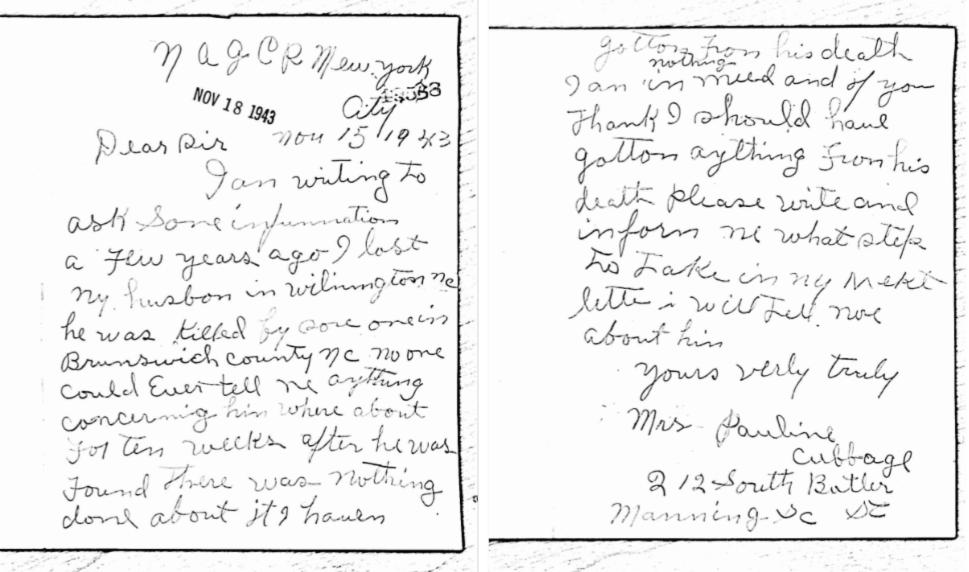
From the Burnham-Nobles Archive: African American Women Write | |
Above: In the summer of 1940, Pauline Cubbage’s husband, David Cubbage, went missing. The couple lived in Wilmington, North Carolina. On November 7, 1940, his remains were found in Jackey’s Creek, a swamp in Brunswick County. Ms. Cubbage wrote this letter to the NAACP's Thurgood Marshall in hopes of finding answers to the many questions she had about her husband’s death. | |
|
This summer, Halle Snell and Takiyah Watson, students at Vassar College, conducted research on historical cases of racial violence at the Civil Rights & Restorative Justice Project. With guidance from CRRJ Director Margaret Burnham, and edited by Catherine McGloin, what follows is a special investigation conducted by these students into the numerous, poignant letters contained within the Burnham-Nobles Digital Archive, written by Black women to public officials and civic leaders seeking justice for their loved ones.
These women wrote about relatives who went missing and were feared to have been killed by whites, police brutality, and Southern mob lynchings. The letters reveal their determination to access the legal system on behalf of their families and a sophisticated appreciation for how the levers of power operated. While the investigative documents in the archive tell us what the victims of this violence endured, the letters offer a window into the resistance and protest that typically began with family members.
Ms. Pauline Cubbage
In the summer of 1940, Pauline Cubbage’s husband, David Cubbage, went missing. The couple lived in Wilmington, North Carolina. He left for nearby Brunswick County in early June seeking work.
On November 7, 1940, his remains were found in Jackey’s Creek, a swamp in Brunswick County. Coroner John Caison, who was a former confederate soldier, concluded that Cubbage had starved to death and did not hold an inquest. It took ten weeks before anyone from Brunswick County contacted Ms. Cubbage, and she never received a death certificate.
Three years later and still without answers, Ms. Cubbage wrote a letter to Thurgood Marshall at the NAACP in New York City. Marshall wrote back to Ms. Cubbage on November 24, 1943, informing her of his doubt that any legal action could be taken “at this late date.”
The circumstances surrounding Mr. Cubbage’s death are still unknown.
Ms. Corinne Lee-Banks
On July 15, 1933, 21-year-old Corinne Lee-Banks wrote to President Roosevelt on behalf of her younger brother, Hirsch Lee, a 14-year-old Black boy who was brutally murdered by a mob of white men.
Lee-Banks urged President Roosevelt to investigate her brother’s murder and find his body for her family. Her appeal on behalf of her brother is a powerful testament of her loyalty to family and her courage and perseverance in seeking justice from the highest authorities.
The White House forwarded her letter to Pat Malley, former U.S. Attorney General. Malley advised Lee-Banks to contact state authorities in Mississippi.
Mrs. Ethel Davis
On October 11, 1945, the Attorney General of the United States received a letter from the mother of Private Willie Lee Davis, Ethel Davis, regarding the death of her son.
Two years earlier on July 3, 1943, Willie Davis was on military leave in Summit, Georgia, his hometown, when he was killed by Summit Police Chief James Mitchell Bohannon. Ethel Davis wrote to the Attorney General, Thomas Clark, urging the Department of Justice to reconsider its decision not to charge the man responsible for her son’s death.
Davis wrote in her letter about her desire to protect her other son, also in the service. She said she thought it wrong for the government to let her son’s killer go free after he risked his life to serve his country.
“Why do negroes have to fight if we have no right, I think it is a shame,” she wrote.
| |
Updates at CRRJ and in the Field | |
University of Kentucky CRRJ Clinic welcomes third cohort of students | |
Following the success of last year's pilot program, the Civil Rights and Restorative Justice Clinic at the University of Kentucky J. David Rosenberg College of Law (CRRJ-KY) will be offered again this fall as an experimental course, with the third cohort of students beginning their case work in August 2024.
CRRJ-KY students will investigate cases of historical homicide that took place in the Commonwealth of Kentucky during the Jim Crow-era. Moving beyond the highly publicized and large-scale spectacles of lynchings, clinic students will investigate cases of lesser-known and, at times, everyday instances of violence.
| | | |
CRRJ and Southern University celebrate a decade in partnership | |
The decade-long partnership between Northeastern University School of Law's Civil Rights and Restorative Justice Project (CRRJ) and the Southern University Law Center's Louis A. Berry institute for Civil Rights & Justice (SULC) was celebrated at the school in Baton Rouge, Louisiana.
Together, teams from CRRJ, directed by Professor Margaret Burnham, and SULC, led by Ada Goodly Lampkin, have spent 10 years investigating historical cases of Jim Crow-era anti-Black violence, uncovering the truth and seeking justice for victims’ descendants, in recognition of the pain and trauma their families have endured for generations.
| | | |
Summer interns present case findings, expand CRRJ's work to include 100 new cases | |
As the summer draws to a close, six student interns, who have spent nine weeks investigating close to 100 cases of racially motivated homicides, presented their findings and proposed avenues for further research before CRRJ team members and associates.
“In addition to these case investigations, these students have supported our interdisciplinary projects and research into historical police killings, and conducted research for our federal reparations project,” said Malcolm Clarke, CRRJ’s Elizabeth Zitrin Justice Fellow, who supervised the students throughout the summer.
| | | |
CRRJ Welcomes, Alex Stein, Staff Attorney and Program Director | Please join us in welcoming Alex Stein ('19) to the Center for Law, Equity and Race (CLEAR) - our new Staff Attorney and Program Director for the Civil Rights and Restorative Justice Project (CRRJ). An Illinoisan who has practiced both criminal and civil rights law as an attorney in Chicago, Stein comes to CLEAR from the Cook County Public Defenders Office’s Family Defense Division, where he was an Assistant Public Defender litigating cases involving DCFS and other federal agencies. | | | |
Prof. Burnham gives opening talk at Human Rights Home Lawyers' Network symposium | |
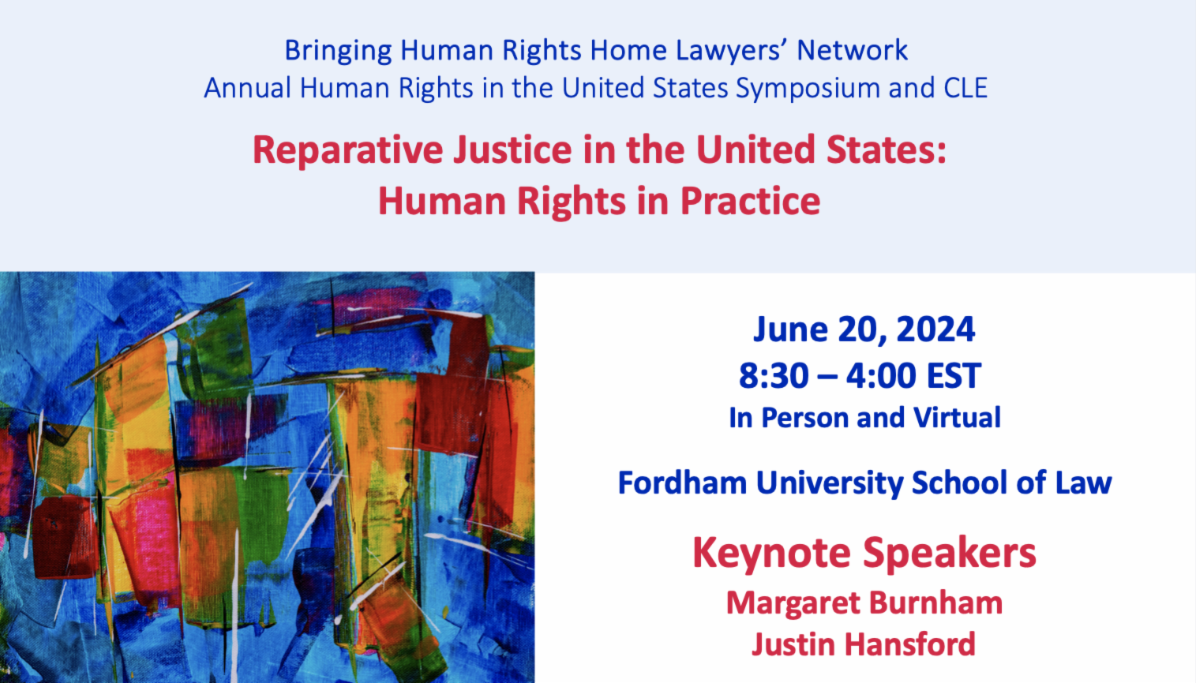
CRRJ Director, Professor Margaret Burnham, was a keynote speaker at the Bringing Human Rights Home Lawyers' Network annual symposium, held on June 20, 2024, at the Fordham University School of Law.
The event - co-hosted by the Program on Human Rights and the Global Economy at Northeastern Law, theCenter on Race, Law and Justice at Fordham Law, and the Leitner Center for International Law and Justice at Fordham Law — focused on Reparative Justice in the United States.
| | | |
2024 summer interns aid CRRJ case investigations, reparations research and restorative justice efforts | |
This summer, Northeastern Law's Civil Rights and Restorative Justice Clinic (CRRJ) the Center for Law, Equity and Race (CLEAR) and the Criminal Justice Task Force (CJTF) welcomed 19 intern students.
Nine students assisted CRRJ in furthering several important projects and case investigations, including the Redressing Racist Executions Project, Federal Reparations Project, and CRRJ's posthumous exonerations work.
| | | |
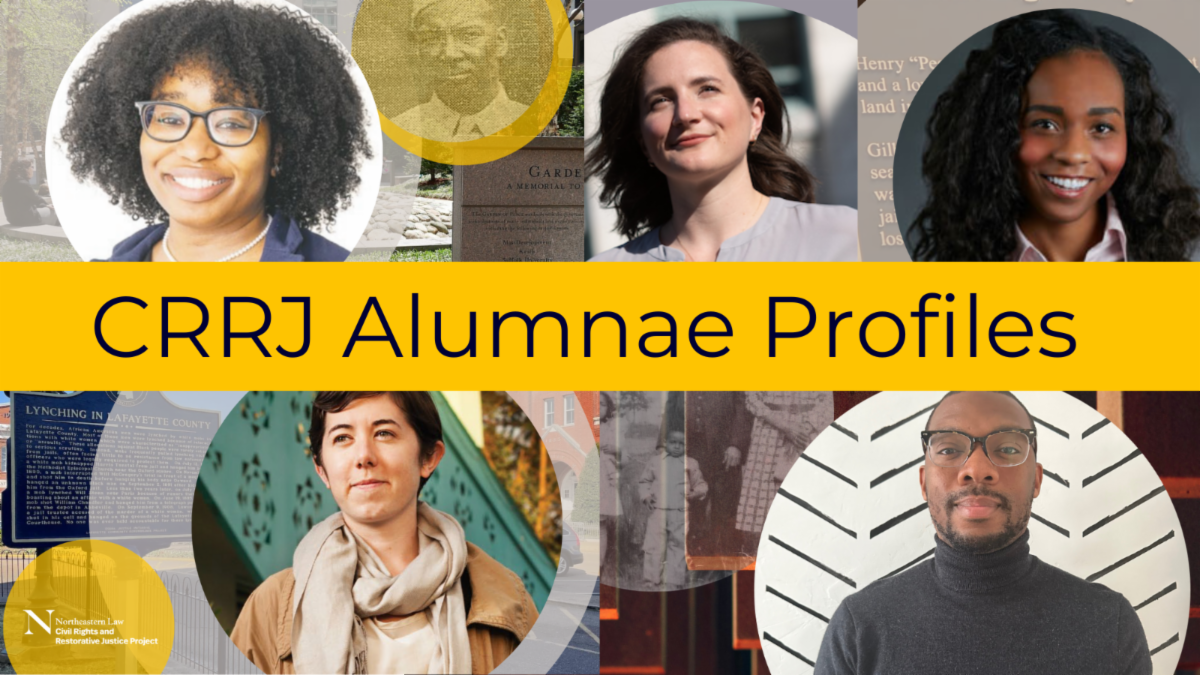
At the beginning of 2024, CRRJ launched their new series, re-connecting with past Clinic students to find out how their time working on CRRJ's cases impacted their professional careers and personal outlook. | |
This Month: Rosalie Nevins-Alderfer ('15) | |
From CRRJ to Social Work: Community Healing and Change | |
Rosalie Nevins-Alderfer ('15) was never interested in practicing law in the usual way. "When I entered the traditional legal curriculum, I realized pretty quickly that the typical, adversarial process didn't align with my values," said Nevin-Alderfer, Director of Quality and Compliance for a large non-profit, community mental health center in southern Vermont. "I felt like everywhere I went it was hard to make change and I got more interested in trying to work to change the structure of the system,” she said, in a recent interview with CRRJ.
And so began a lifelong journey that would take Nevins-Alderfer through Northeastern Law, the Civil Rights and Restorative Project’s Clinic, and into a successful career in social work.
| | | | |
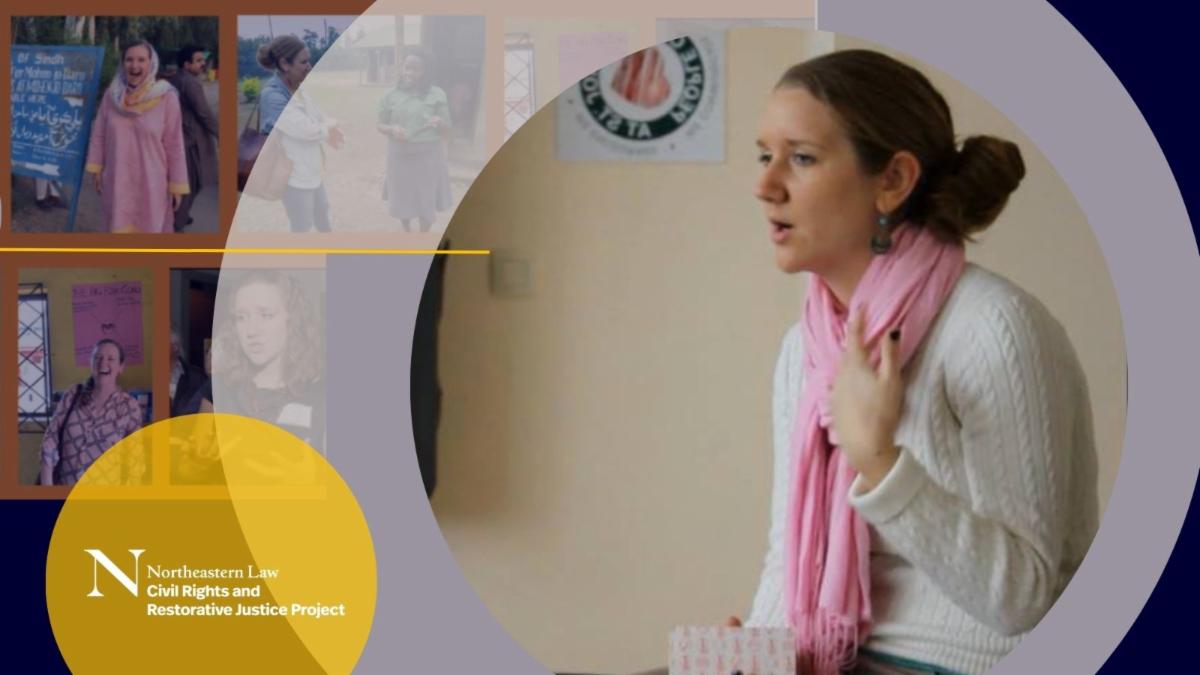
Spotlight on: Sara Merlo, CRRJ Education Consultant | From public schools in North Carolina to refugee camps in the Democratic Republic of the Congo; Sara Merlo, Northeastern Law’s Civil Rights and Restorative Justice Project’s recently appointed Education Consultant, has spent the last 15 years crafting her skills as a world-class educator in history and social studies. | |
Above: Sara Merlo, CRRJ's Education Consultant. Photos courtesy of Merlo. | |
|
With an undergraduate degree in history and a master’s degree in teaching, both from the University of Virginia, Merlo has taught in Charlottesville Virginia, Brussels Belgium, Kinshasa Congo and Brooklyn New York.
“What I’m passionate about is making sure we’re not just telling the histories of marginalized people – which is important and essential – but that we’re also intentional about weaving them into the main narrative of American history,” Merlo told CRRJ in an interview. “There’s space to do that, and we must do that. It’s not happening yet and I’m excited to be part of this project because it’s one step closer to that.”
Merlo’s work over the last six months started with selecting nine cases of racialized killing from the 59 which occurred in her home state, North Carolina, and are contained in the Burnham-Nobles Digital Archive. Assisted by Kayla Scott, a former high school U.S. History Teacher and 2L student at Howard University Law, Merlo arranged these cases into three thematic source packets: Law Enforcement, Violence and Neglect; Black Soldiers and Veterans; and Lynching and Failure of the Law.
“The thing that makes the Archive amazing to use is that the resources are already curated into stories, with summaries and primary sources,” said Merlo. “It’s an easy resource for students and teachers to tap into.”
These lesson plans include cases from across the state, victims — men and women — ranging in age, including several teenagers. They are primarily designed for high school students, but Merlo said she is open to extending them for middle school and college students. Her aim is “to get this archive well-known and well-loved within the education space,” she said. To this end, Merlo is now working to grow CRRJ’s network of North Carolinian educators, “courageous and experienced teachers who are willing to teach these stories in their classrooms.”
| |
Vote Suppression, Franchise and White Supremacy: an American History | The 2020 presidential election triggered a wave of concerns and legislation regarding election integrity, voter suppression and the security of American democracy. Over the last four years, states including Florida, Texas, Georgia and Mississippi have enacted several laws severely limiting access to the ballot box and voter registration organizing. | | | |
Is Rebel Ridge based on a true story? | Filmed on location in rural Louisiana, featuring a corrupt local police force and a racist sheriff (Don Johnson) viewers may wonder if the recently released Netflix thriller Rebel Ridge is based on a true story. Rebel Ridge is rooted in historical precedents; African Americans have indeed been killed as a result of illegal forfeitures gone awry, property seizure, police corruption and in some cases, pure greed. | | | |
Repeat Killers From the Archive | |
Within the Burnham-Nobles Digital Archive, there are several cases that will forever be linked, sharing a common perpetrator or group of perpetrators.
In this article, search timelines detailing the histories of three prolific perpetrators, all police officers, involved in multiple killings from the 1930s to 1950s. This interactive display highlights their prolific violence and the climate of impunity within law enforcement agencies.
| | | |
CRRJ and CLEAR leaders discuss reparations at Martha's Vineyard event | Professor Margaret Burnham, CRRJ director and faculty co-director of Northeastern Law's Center for Law, Equity and Race (CLEAR) was the featured speaker at an event hosted in Martha's Vineyard on July 30 to discuss the case for reparations.CLEAR's managing director, Dr. Deborah A. Jackson, was a panelist at the event organized by Nkechi Taifa, an attorney and the director of the Reparation Education Project. | | | |
|
Staff Attorney
CRRJ seeks a community activist/organizer to build a project based on the Burnham-Nobles Digital Archive; design, manage, and execute CRRJ’s community-based programs; promote strong collaborative relations with CRRJ’s non-academic partner organizations; and engage in other activities to support its restorative justice work. This is a full-time, in residence position.
| |
|
Elizabeth Zitrin Justice Fellow
CRRJ seeks a community activist/organizer to build a project based on the Burnham-Nobles Digital Archive; design, manage, and execute CRRJ’s community-based programs; promote strong collaborative relations with CRRJ’s non-academic partner organizations; and engage in other activities to support its restorative justice work. This is a full-time, in residence position.
| |
Launched in 2007 by University Distinguished Professor Margaret Burnham, the center of CRRJ’s work is the investigation of racially motivated homicides in the Jim Crow South, and the creation of the Burnham-Nobles Digital Archive, which contains more than 1,000 cases. In 2022, CRRJ became a program of the Law School's Center for Law, Equity and Race. | | We rely on donors like you to continue our work. Donations are used for litigation expenses, field research and restorative justice projects. With your help, we can continue training tomorrow’s civil rights lawyers, filling in the gaps in U.S. history and informing our national dialogue on racial redress and criminal justice. | | | | |