Community Support Network at WIHD
Let Us Help You!
|
|
The help you need is here in one place.
(914) 493-8119
|
|
Progress Monitoring – What Can Parents Do? |
|
In the midst of the COVID pandemic, and all of the mayhem surrounding remote learning and transferring special education services and supports to a virtual education environment, . . . .it is easy to lose sight of the bigger picture of a student’s IEP and how it should be used to drive program development. Don’t forget that as a parent you are an equal and integral member of your child’s Committee on Special Education (CSE). Whether your child’s education is in person, remote or hybrid, you are likely reaching the end of the first marking period when report cards go out. For students with IEPs, a Progress Report focusing on IEP goals should accompanying or follow the report card. While the report card tells us how our child is performing in school in relation to the standard grade level rubrics, the purpose of a Progress Report is to keep tabs on the student’s progress toward their individual goals set by the CSE the year before. The first Progress Report of the school year is especially important, because in many cases this is the first you are hearing from your child’s new set of teachers and service providers. You can learn a lot about the effectiveness of the IEP put together by the CSE, by looking at the student’s progress on annual goals reflected in the Progress Report.
The most recent guidance (09/28/20) to school districts from the US Office of Special Education Programs states that, “ . . . .school staff and parents are encouraged to work together to find ways to meet the needs of children with disabilities, notwithstanding the COVID-19 challenges.” See entire memo here.
So how can we use Progress Reports to collaborate with our school teams to meet our child’s needs - - COVID-19 challenges and all? To begin with, upon receiving the report, parents should be looking to see if their child appears to be on track to meet their goals by the end of the school year. Things that might stand out for each goal include:
- Has the student even started to work on the goal?
- Is the student not progressing satisfactorily toward the goal?
- Has the student already achieved the goal?
- Is the performance/progress reflected consistent with your own observations at home?
Any of these is a good reason to reach out to your child’s special education teacher, case manager or teaching team to ask to have the progress report explained to you. First, ask how your child’s progress is being monitored and measured. Second, ask them to show you what is the basis for how your child’s performance or progress is documented on the progress report (they might show you work samples, or progress monitoring charts, or test/assessment scores, for example). Together the team is then able to explore whether the IEP is effective in it’s current form for the student or whether any changes need to be made (in terms of supports, services, etc.). The question to prompt discussion is really, why hasn’t the student progressed in the way the CSE anticipated? Why are performance observations/impressions in school different than at home? Such a discussion amongst all members of the team early in the school year can be instrumental in crafting or maintaining an IEP with supports and services most appropriate for the student to promote optimal outcomes.
Take the initiative when you receive your child’s first Progress Report for the 2020-2021 school year . . . .and reach out to your special education teacher or case manager if you don’t receive it with the report card!
Safe and Happy Holidays to everyone!
|
|
High School to Adulthood - Transition Information
Save the Date: January 11-13, 2021
The Community Support Network will be hosting a virtual Transition Conference during the week of January 11 -13, 2021. There will be key note speakers, break out sessions, and workshops on topics including Employment, College, Adult Services, Guardianship, and Benefit Navigation, and more! Stay tuned for more information.
Transition Planning Resource
Inclusive College Programs for Students with Disabilities
Listen to college administrators and staff, parents and faculty discuss how they approach program development at the college level for students with intellectual and developmental disabilities in this informative panel discussion.
Featured Panelists include:
- Kelly Glover, Program Director, Vocational Independence Program (VIP) at College of Mt. Saint Vincent, Riverdale, NY
- Jan Goings, Program Director, Transition and Access Program (TAP) at University of Cincinnati, Cincinnati, OH
Guardianship Workshop: December 9, 7:00 pm
Join us for this important informational workshop on Guardianship. Topics to be covered are: What is guardianship? What are the different types of guardianship?
What is supported decision-making? RSVP to Dawn Kitz at dkitz@rboces.org in order to get the link to participate or at (845) 624-5833 for information.
|
|
Parent Member Training - Virtual session
Monday 11/23/20 9:00 am - 2:30 pm
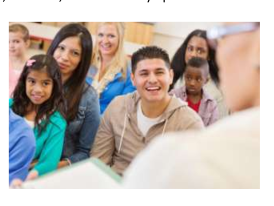
Did you know that Parent Members can help support you at your child's CSE meeting? Did you also know that most districts have very few (some have none!) parents trained to be Parent Members? Did you know that in a few short hours, you can get this training too?
Watch this helpful video that describes the role of the Parent Member.
This virtual workshop will provide an overview and best practices approach to the CPSE/CSE process. Parents and Parent Members will learn to develop techniques and strategies to become effective members of the IEP team in their respective roles. This training is open to anyone interested in learning about the special education process, or even as a refresher course on CPSE/CSE! Any parent or guardian whose child has or had an IEP in the last 5 years, will receive a certificate for submission to their school district to serve as a Parent Member at CPSE /CSE meetings.
|
|
What's new at CSN
Spanish Translations in ZOOM
In order to better meet the needs of the many families we serve, we have started adding captioning and Spanish translation to some of our online presentations, workshops and trainings. Please let us know if you would like a specific topic (our offerings are available on our website) to be available in Spanish let us know!
|
|
Recent Workshop Highlights!
These workshops, some have been during the day, others in the evenings, have been very well attended, and also have been rated high in satisfaction by the participants.
Some examples of recent workshops:
- October’s Transition Planning Discussion Series "What's Next?" on 10/7, discussed Education and Training programs and on 10/21 discussed Social and Recreational programs.
-
On October 15th, We partnered with the Lower Hudson Regional Partnership to host a program entitled "Family Engagement: Communication and Culture" which included a sociology component and a zoom workshop
-
On October 14th, Hear Our Voices (HOV) Self-Advocates group hosted a zoom meeting titled Self advocacy in relationships. CSN's Stephanie Bellantoni, led a guided discussion about the importance of speaking up in relationships and being respectful of everyone's needs. Thanks to our Self Advocates for a very candid and helpful session.
Check the WIHD calendar of events for details on upcoming events.
|
|
Help us help you!
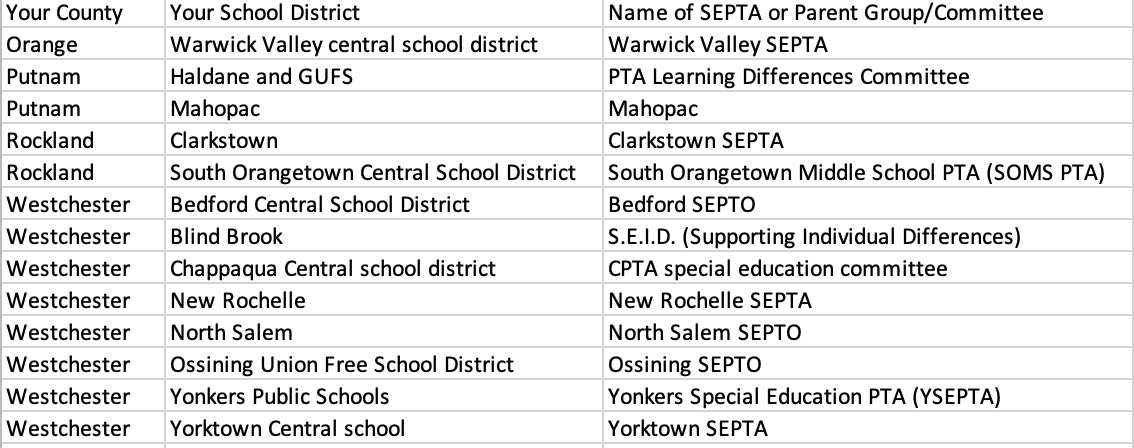
Your help is needed: The WIHD Community Support Network is updating our list of SEPTAs in the Hudson Valley. We try to send out communications to these groups (for benefit of your members). Please help by completing this information form linked here.
So far, we've received the following 13 district's information - there are 40 school districts in Westchester alone! Thanks to all for your help.
|
|
Responding to the Challenges of Learning in Masked Environments
Proper use of masks is essential to minimizing the spread of COVID-19 but wearing a mask for an extended length of time can be physically uncomfortable and lead to changes in mood and behavior. Inevitably, there may be students who do not wear a mask for a variety of reasons.
|
|
Children and Youth with Special Healthcare Needs Statewide Project
Westchester Institute for Human Development (WIHD) is working with Local Health Departments (LHDs) across New York State (NYS) to positively impact the lives of Children and Youth with Special Health Care Needs (CYSHCN) and their families.
We are recruiting families to participate in discussions about how to best support families in NYS who have a child or youth (0-21 years of age) with special health care needs (intellectual, developmental, physical, emotional, etc.).
We need your help getting the word out to families about this important opportunity to directly share their experiences with NYS! See our Recruitment Flyer in Spanish .
If you have any concerns or questions, please call Jeannie at 914-719-7761 or Susan at 914-719-7774 or email at rsc@wihd.org
|
|
Brendan’s Blog and the GetWIHDit Facebook group for Self-Advocates
This October, my community and I donated over 700 Halloween treat bags to local organizations that support and feed kids who needed the Halloween spirit. It felt good to help others. Next month I will be collecting for the food bank for Thanksgiving. More info soon!
Events update: our Friday night Kensico Dam picnic/walk has ended for winter. I am working with my Com Hab Eric to do a weekly Zoom BINGO! Who would like to join us? Send me an email at bklein@wihd.org
By the time you read this the election will be over! What was your Election voting experience like? I waited in a long line but people were so friendly. Hope lots of you voted, too. Here is the voting video that I did for the voting campaign
Hear Our Voices Self-Advocacy Group
On October 14th the Hear Our Voices Self Advocacy Group explored Self-Advocacy in Relationships, exploring what communication looks like in a relationship, what is healthy and what is not healthy. Members openly discussed challenges in communicating about uncomfortable topics with people we care about. What a great conversation!
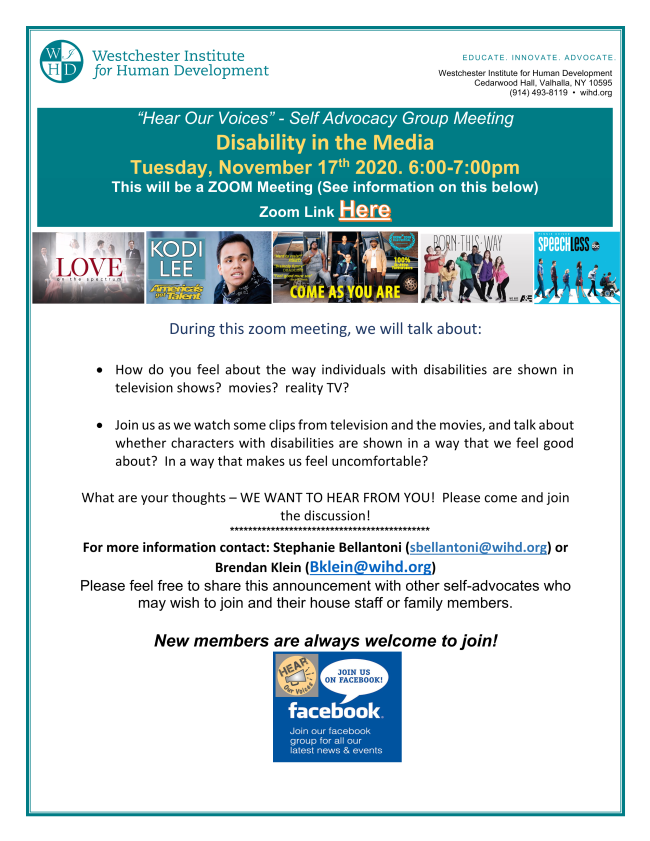
There is the next HOV meeting on November 17th at 6:00 pm to 7:00 pm on Zoom. The topic will be Disability in the Media. Click here for the Zoom registration link.
- Brendan Klein
|
|
New York State - Special Education Office
Website of the Office of Special Education Office of the New York State Education Department (NYSED). View
New York State - OPWDD
Website of the New York State Office for People with Developmental Disabilities (OPWDD). View
New York State - Self Direction Program
Webpage of theNew York State Office for People with Developmental Disablities (OPWDD) on Self Direction, a way to choose a mix of supports and services that allows you to set up services, providers, staff and schedule that work best for you. View
New York State - ACCES-VR
Website of the New York State Education Department, Adult Career and Continuing Education Services - Vocational Rehabilitation (ACCES-VR). View
|
|
Community Support Network:
Find us on Facebook, Twitter, and Instagram!
|
Self Direction Parent Forum
Westchester DSP Job Bank
SpEd2AdultTransitionConex
WeWorkHV! Jobs, Internships & Service Opps for People w/Disabilities
WIHD Red de Apoyo Comunitario
Lower Hudson Early Childhood Development Center
|
|
|
|
|
|
|
|
|