Rheumatology Highlights: CY 2025 Medicare PFS Final Rule | |
|
On November 1, 2024, the Centers for Medicare and Medicaid Services (CMS) released the CY 2025 Medicare Physician Fee Schedule Final Rule, updating Medicare payment rates for physician services and other key policies. The rule reflects an update conversion factor of $32.35 – a decrease of approximately 2.83% from the current CY 2024 conversion factor – due to a 0.02 percent positive budget neutrality adjustment; the 0.00 percent update adjustment factor specified under MACRA; and, the removal of the temporary 2.93 percent payment increase for services furnished from March 9, 2024 through December 31, 2024, as provided in the Consolidated Appropriations Act, 2024.
Following significant advocacy by CSRO and its coalition partners, CMS finalized updates to its Medicare Claims Processing Manual, Chapter 12, section 30.5, to include language consistent with CPT code definitions for the complex non-chemotherapy infusion code series stating that the administration of infusion for particular kinds of drugs and biologics can be considered complex and may be appropriately reported using the chemotherapy administration CPT codes 96401-96549. CMS believes the updates will provide complex clinical characteristics for the MACs to consider as criteria when determining payment of claims for these services.
CMS also finalized that it will set the payment limit for a biosimilar for which negative or zero ASP data are reported for all NDCs equal to the sum of the following until at least one NDC for the biosimilar has positive manufacturer’s ASP data for a quarter: the volume-weighted average of the most recently available positive manufacturer’s ASP data from a previous quarter, and 6 percent (or 8 percent for qualifying biosimilar biologicals, as appropriate) of the amount determined under section 1847A(b)(4) of the Act for the reference biological product (as defined in §414.902) for the given quarter. CMS acknowledged concerns about the underlying causes of negative or zero ASP data and biosimilar market dynamics that may cause manufacturers to exit the market, along with the issue of provider acquisition costs exceeding payment limits.
Finally, CSRO is disappointed that CMS decided to finalize the Rheumatoid Arthritis (RA) Cost Measure for implementation in the Merit-based Incentive Payment System (MIPS) starting in 2025 and rebuff the concerns raised by CSRO and other commenters. CSRO strongly urges rheumatology practices to become familiar with the RA cost measure specifications to avoid scoring poorly on this measure in the cost category.
Other notable policies include the following:
-
Complex Add-on Code G2211: CMS revisited its finalized policy that G2211 is not payable when the office and outpatient E/M is reported with Modifier ~25 (significant, separately identifiable O/O E/M visit by the same physician or other qualified health care professional on the same day as the procedure or other service). CMS finalized its proposal to provide an exception to the Modifier ~25 billing prohibition for G2211 “to allow payment of the O/O E/M visit complexity add-on code when the O/O E/M base code reported by the same practitioner on the same day as an AWV, vaccine administration, or any Medicare Part B preventive service furnished in the office or outpatient setting.” CMS confirmed that this policy includes the “Welcome to Medicare” visit. CMS said it might also consider expanding use of G2211 to services other than office and outpatient E/Ms where the practitioner is the “continuing focal point.”
-
Reporting of Distant Site Address: CMS finalized its proposal that, through 2025, it will continue to permit practitioners to use their currently enrolled practice location instead of their home address when providing telehealth services from their home.
-
Direct Supervision via Virtual Presence: CMS finalized its proposal to allow for direct supervision via virtual presence using audio/video real-time communications technology on a permanent basis, but only for a subset of incident to services when: (1) the service is provided by auxiliary personnel employed by the billing practitioner and working under their direct supervision, and for which the underlying HCPCS code has been assigned a PC/TC indicator of ‘5’; or (2) the service is an office or other outpatient E/M visit for an established patient that may not require the presence of a physician or other qualified healthcare practitioner (i.e., CPT 99211). For all other services, CMS finalized its proposal to continue to allow for direct supervision via virtual presence using real-time audio and visual interactive telecommunications technology through 2025.
-
Rheumatology MVP: CMS finalized modification to the existing Advancing Rheumatology Patient Care MIPS Value Pathway (MVP).
-
Rheumatology Specialty Set: CMS made substantive changes to 4 of the quality measures in the Rheumatology Specialty Set, including:
- RA: Glucocorticoid Management
- RA: Functional Status Assessment
- RA: Periodic Assessment of Disease Activity
- Tuberculosis Screening Prior to First Course of Biologic and/or Immune Response Modifier Therapy
Payment rates can be calculated using the relative values in Addendum B, which is available to download here.
| |
|
Election Recap
Former President Donald Trump secured the 270 electoral votes needed to win the 2024 presidential election last week. Trump surpassed his 2020 election performance, winning both the Electoral College and popular vote by a significant margin, while Vice President Kamala Harris was not able to match Joe Biden’s success from four years ago. Trump ultimately won 312 electoral votes to Harris' 226, claiming all seven swing states: Arizona, Nevada, Georgia, North Carolina, Pennsylvania, Michigan, and Wisconsin.
Republicans also gained control of the Senate, flipping seats in West Virginia, Montana, Ohio, and Pennsylvania. The GOP will now hold 53 Senate seats in the 119th Congress to Democrats’ 46. Sen. John Thune of South Dakota has been voted by the Senate GOP to serve as the next majority leader, replacing Sen. Mitch McConnell (R-KY), the Senate’s longest serving leader.
Control of the House of Representatives remains undecided more than a week after Election Day. The GOP is projected to win 216 seats to Democrats’ 207, with 218 seats needed for the majority. Most of the undecided House races are in California, where state law requires mail ballots to be postmarked by Election Day.
CMS: Copay Accumulator Ban Coalition Urges Action on NBPP
The All Copays Count Coalition, of which CSRO is a member, wrote to Administrator Brooks-LaSure noting that the 2026 Notice of Benefit and Payment Parameters (NBPP) failed to address whether copay assistance paid on behalf of enrollees is considered a cost-sharing payment. The Departments of Health and Human Services, Labor, and Treasury (tri-agencies) previously stated that they planned to release a rule on this issue, although nothing has been published to date. The Coalition will continue to advocate for lowering the maximum out-of-pocket limit and requiring insurers and PBMs to include copay assistance payments in their calculation of an enrollee’s out-of-pocket limit to provide patients with the protection they need.
| |
Happening Wednesday: CSRO Town Hall | |
|
CSRO Town Hall
November 20, 2024
7pm CT / 8pm ET
| |
|
Join CSRO as we gather with the rheumatology community for a virtual Town Hall to share updates on CSRO's state, federal, and regulatory advocacy work.
The program will feature CSRO's Government Affairs team as they provide insights on the Medicare Physician Fee Schedule, utilization management reform, down coding, the SAD List, and more!
Hear from our team in DC on a post-election analysis of what we can expect during the lame duck and upcoming 119th Congress. Attendees will also receive an insider look at state and federal priority issues for the year ahead and a review of new laws going into effect on January 1.
| |
Legislation Around the Country | |
|
State Elections Recap
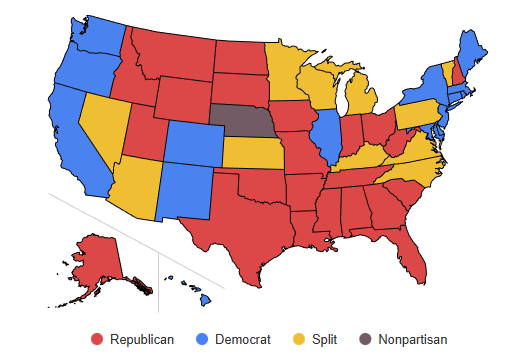
On November 5, 78% of all state legislative seats were also on the ballot. Going into 2025, Republicans will have control of 27 State Houses, while Democrats will control 21. Republicans maintained their trifecta power in 23 states, while Democrats will have a trifecta in the Governor’s office and both chambers of the state legislature in 17 states.
Going into the election, Republicans were focused on defending vulnerable majorities in several State Houses, including Arizona, New Hampshire and Wisconsin – all of which they maintained. However, Republicans lost their supermajority in North Carolina, which previously enabled them to override several vetoes by Democratic Gov. Cooper. Democrats were faced with maintaining their slim majorities in Michigan, Minnesota and Pennsylvania, which all resulted in divided party control of the legislature. In Michigan, Republicans took back the House, breaking the Democratic trifecta in the state. In Minnesota, the House is split 67-67 between the DFL and the GOP for the next two-year term, upsetting the DFL’s Democratic trifecta.
| |
|
MD: PDAB Examines UPL
The Maryland Prescription Drug Affordability Board requested comments on its proposed Chapter on the upper payment limit (UPL) implementation. CSRO submitted a letter voicing concerns over the use of therapeutic class, Medicare’s Maximum Fair Price and international reference pricing as criteria for determining the state’s UPL. CSRO does not believe these criteria are accurate reflections of cost for the Board’s reference. CSRO also noted that Executive Director York has repeatedly referenced a “rebate model” that will mitigate the impact of the UPL on providers. While CSRO is encouraged that the state intends to make healthcare practices that directly administer medications on an outpatient basis whole, CSRO is concerned that none of the proposals to date have outlined this practice or even mentioned a rebate model. CSRO urged the Maryland PDAB to immediately release Draft Proposed Regulations for Comment on this rebate model.
OH: Biomarker Legislation Heard in Senate Insurance
On November 13, the Ohio Senate Insurance Committee heard HB24, which would require Medicaid coverage for biomarker testing. CSRO submitted comments expressing its support for biomarker testing, which is a pivotal advancement in precision medicines. CSRO believes biomarkers have the potential to revolutionize how rheumatologists approach treatment selection, allowing for targeted therapies that can significantly improve health outcomes and quality of life for patients with rheumatologic conditions. The bill previously passed the House.
NY: Urge Hochul to Sign Step Therapy
CSRO calls on the New York state rheumatology community to urge Governor Hochul to sign A.901(a)/S.1267(a), which would enact step therapy patient protections in New York. This legislation would: prohibit insurance companies from requiring patients to try and fail on off-label treatments; limit steps to no more than two medications per therapeutic category; and provide greater clarity on timelines for trying and failing on a medication. The legislation currently sits on the Governor’s desk and awaits her consideration. If you live or work in New York, take action now and write to Governor Hochul.
| |
|
What's Happening in the States
CSRO tracks legislative activity relevant to the rheumatology community and their patients. Click here to view a full status report of CSRO priority bills.
Be sure to check out our interactive legislative map tool for additional details.
| |
|
Ohio
Biomarker Testing
- HB 24: Heard in Senate Insurance
| |
Mark Your Calendar: Upcoming Events
| |
|
CSRO Town Hall: November 20, 2024
Join CSRO as we gather with the rheumatology community for a virtual Town Hall to share updates on CSRO's state, federal, and regulatory advocacy work.
| |
|
SAVE THE DATE - CSRO Advocacy Conference: September 12-14, 2025
Mark your calendars to join us in Dallas, Texas, for CSRO's annual Advocacy Conference!
| |
|
Action Center
Use CSRO's convenient online platform to easily find out who your elected officials are and engage with them directly.
Advocacy Council
Amplify your voice by assembling with other like-minded individuals to enhance CSRO’s advocacy initiatives.
Career Center
Locate the perfect fit whether you're looking for new career opportunities or trying to find the right candidate.
Explanatory Statement: “Underwater” Biosimilars
To aid in addressing the issue of "underwater" biosimilars with payers, CSRO has created a document to illustrate the extent of the problem.
Legislative Map Tool
Find your state on our interactive map tool to learn about current or proposed policy and ways you can take action to make an impact.
Payer Issues Reporting Form
Request assistance with any payer relation issues that may be impacting your patients or office.
Policy Correspondence
Easily access all of CSRO’s policy letters submitted to payers, state, and federal governments as an informational resource.
Rheum for Action
Learn about the latest advocacy issues in CSRO's advocacy column authored by Dr. Madelaine Feldman and produced in partnership with Rheumatology News.
Step Therapy Cover Sheets
Review CSRO's state-specific step therapy materials that help guide practices in gaining an exemption from step therapy protocols.
| |
|
Questions?
Please visit the CSRO website for other news and updates, and do not hesitate to contact us with any questions at info@csro.info.
| | | | |