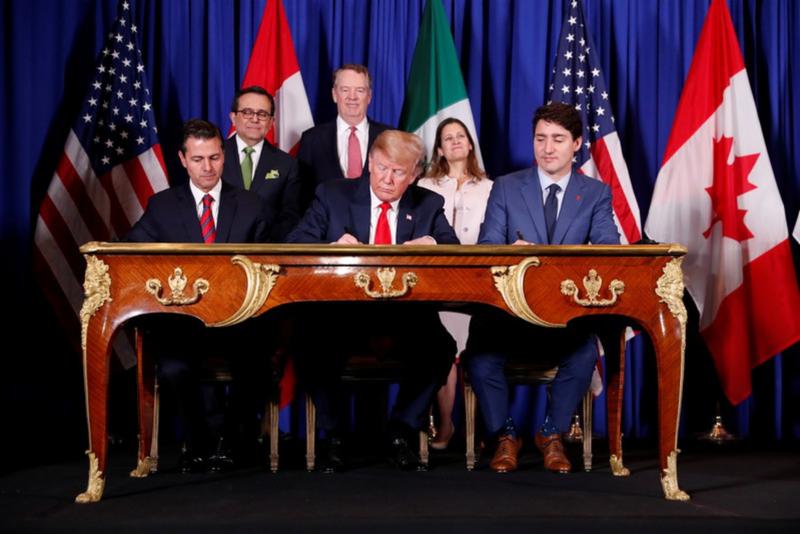
The leaders of the world's major countries are in Argentina now for this year's G20 Summit, and trade is the dominant topic. Earlier today in Buenos Aires, President Trump, President Peña Nieto, and Prime Minister Trudeau signed the U.S.-Mexico-Canada Agreement, USMCA.
Presidents Peña Nieto, Trump, and Prime Minister Trudeau sign the USMCA, backed up by their chief negotiators: Mexican Secretary of Economy Ildefonso Guajardo, U.S. Trade Representative Robert Lighthizer, and Canadian Foreign Affairs Minister Chrystia Freeland.
Tomorrow, December 1, President Trump is scheduled to have dinner with President Xi of China, a dinner which might (or might not) result in some easing of the current trade tensions between the United States and China.
Today's featured quote is from an event roughly two weeks ago in Washington, namely the 2018 Annual Experts' Meeting of the Canada-U.S. Law Institute. The event was held at the law offices of Steptoe and Johnson and Dick Cunningham of Steptoe was one of the four presenters. His comments covered a lot of ground, and in the process made stunningly clear the relationship between today's signing ceremony and tomorrow's dinner. Here is a larger version of the passage with today's quote:
It is beyond dispute that the U.S. Administration wants to find other countries around the world that will cooperate with the U.S. in achieving its goals. And, to assess that, as a foreign country, you should not focus on "America first" or "Make America Great" or shibboleths like that. You should think about, what is the U.S. view of what the great problem is in the world and the U.S. view of how it wants to address that problem, and how it wants to cooperate with other countries to address it.
Further on Mr. Cunningham was more explicit about the U.S. goals vis-à-vis China and China's likely response.
With respect to U.S. goals, he said:
The United States has started down a road in which their expressed goal is to stop China from doing a whole bunch of things. And the most critical one is to get China to back off from the "Made in China 2025" massive program of technological enhancement through subsidies and all sorts of other stuff. That's what all these tariffs are all about. Get China to back off on all of that.
He was not optimistic about the long-term prospects for U.S. success with this approach, saying:
"I think there is almost zero chance that that will happen."
For Dick Cunningham the solution lies closer to home. Wrapping up his presentation, Mr. Cunningham said:
Suppose none of that works to change China's policy. Where does that leave the U.S. ? Where it leaves the U.S., I suggest, is that you have to fight this by enhancing the U.S. technology. You have to fight this by developing our competitiveness against the competitiveness, however unfairly achieved, by your great rival. That ... has great opportunities for cooperation between Canada and the United States, in ways that don't require Canada to say, "We join in with you in saying China is a bad guy. China is doing all these things. Your unilateral trade restriction actions are okay."
[You] find ways in which you can cooperate, with - that dreaded word in this administration - "value chains," with increased cooperative use of Canada's resources and Canada's technology too, with increasing use of Mexico's energy and labor.
It seems to me, the U.S. is drawn toward that inexorably as it faces the inevitable long-term failure of what it's trying to do through import restrictions.
And there is where I think the creativity really needs to come. There is where I think all of those committees [established by the USMCA] have some real benefit. And that's where I think the great fascinating game is going to be over the next decade or two decades between the United States, China, Canada, and Mexico. So that is, as I said, a speculation.
But, if it doesn't go that way, then it's total, devastating trade war, expanding continuously, and I don't think there are any winners in that game.
|