California Canopy Connection
CAL FIRE Urban & Community Forestry Quarterly News & Updates
|
|
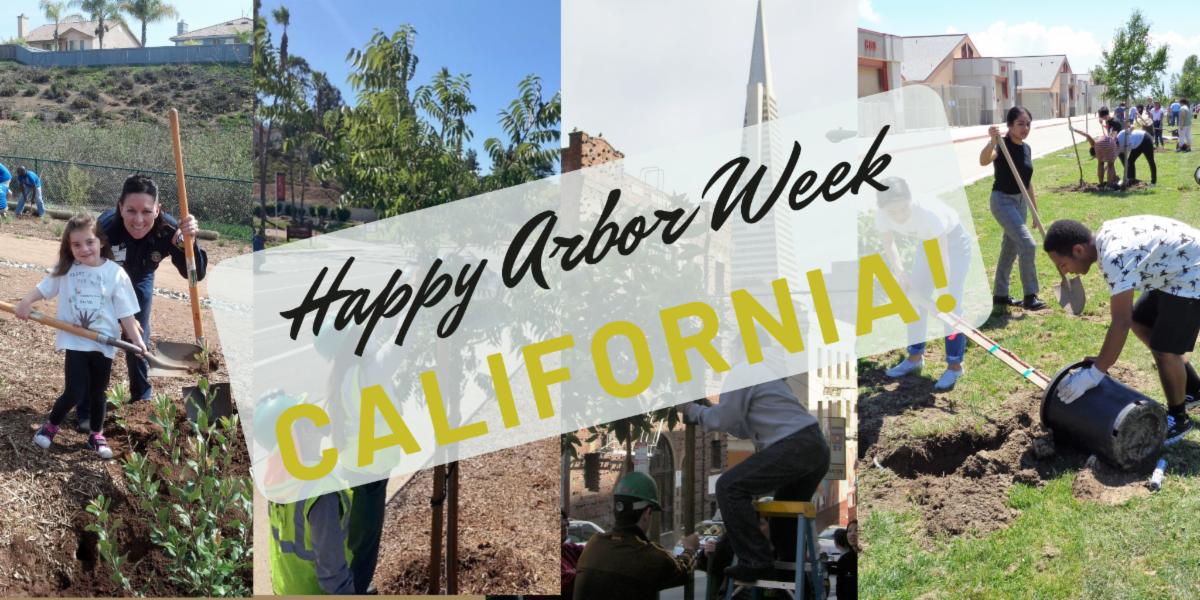
Arbor Week in California is from March 7-14 every year and it is a great opportunity to celebrate the trees in your community! Check with your local city or urban forestry nonprofits to find Arbor Week events or other tree planting opportunities in your area.
In this newsletter, you will find:
- CAL FIRE's Urban and Community Forestry (UCF) Program Green Schoolyard Grants Application period is now open
- Updates on UCF grant funding
- Open position on the UCF Program team
- Celebrate California Arbor Week March 7-14, 2023!
- Project Highlight: Anahuacalmecac Debs Park Reforestation Project
- Meet UCF's Marco DeAnda, Regional Urban Forester (RUF) for the San Diego Region
- Learn more about the City of El Centro and the Imperial Valley Urban Forest efforts
- Learn more about Tree City USA and apply now for the Arbor Day Foundation's Recognition Programs
|
|
CAL FIRE UCF Staff Contact Information |
|
Walter Passmore - State Urban Forester
|
Julia Gowin - Northern California Supervisor
|
Vacant - Southern California Supervisor
For questions, contact Walter Passmore.
|
Sacramento Headquarters Staff |
Eileen Hollett-Stonum - Urban Forestry Education Specialist
|
Kahoua Yang - Urban Forestry Analyst
|
|
Regional Urban Foresters (RUF) |
Henry Herrera - Los Angeles, Ventura
|
Greg Dion - Inland Empire
|
Marco DeAnda - San Diego, Orange, Imperial
|
Tanner Mar - Bay Area / North Coast
|
Jessica Casas - Central Valley / Central Coast
|
Evan Jones - Sacramento Valley / N. California
|
|
|
Now Open: UCF Green Schoolyards Grants Application Period |
|
The grants portal for CAL FIRE's Urban and Community Forestry Green Schoolyards Grants is now open.
The application deadline is April 28, 2023 at 3:00 PM.
No late submissions are accepted. Please read the grant guidelines carefully and have all appropriate documents prepared for your application. We suggest those that are planning to apply for an Implementation Grant to contact the Division of the State Architect (DSA) early on in the application process to understand the potential needs of the school campuses (more information in the grant guidelines).
Please note: The CAL FIRE website is in transition and up-to-date information, including the latest grant guidelines, forms, and link to the application portal may not be available until later in the week of March 6 or the week of March 13. Please use the resources provided in this email and reach out to your Regional Urban Forester if needed.
|
|
|
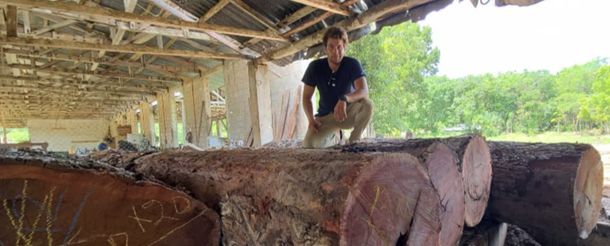
Watch Henry Herrera, Regional Urban Forester for Los Angeles and Ventura Counties, highlight the Green Schoolyards Grant program and a great example of an effective project at the Compton Creek Natural Park at Washington Elementary School in English (left) and Spanish (right). Read more about the project here or at the Los Angeles Conservation Corps Website.
|
|
Announcements for Urban and Community Forestry Grants |
|
Though at this time there is no state funding available for UCF Grants, the budget process remains ongoing and the UCF Program believes funding could be available before the end of this fiscal year. We also anticipate receiving Federal Inflation Reduction Act funding from the USDA Forest Service, though the amount of funding is unknown and this is not yet confirmed. |
|
|
Open position on CAL FIRE's UCF staff! |
|
CAL FIRE's UCF program is hiring a Partnership and Equity Coordinator. Applications due March 15, 2023. This position will accept applications for Senior Environmental Scientist (Specialist). For questions about the position, contact Walter Passmore. |
|
Second Step, create a CalCareer account. A CalCareer account will give you access to all open positions, allow you to set notifications, upload resumes, and send in your applications.
|
|
Third step, apply to job postings when available by the listed due date. Send in all required documents including a State Application Template (STD 678).
|
|
Keep in contact with our team to know when positions with UCF become available! We anticipate more positions will be opened for application soon. We hope to work with you in the future! |
|
Celebrate California Arbor Week March 7-14, 2023! |
|
California celebrates Arbor Week from March 7-14 every year. During Arbor Week, commemorative events are held throughout the state. Cities, community groups, and individuals plant trees, host tree-planting ceremonies, and educate California’s youth about the remarkable work trees do for our communities every day - from cleaning the air and water to improving the overall health of our neighborhoods.
A few ways you can join the celebration:
Connect with your local city, county, or urban forestry nonprofit to join tree-planting events in your community.
Arbor Week Media Kit and Educational Resources - These resources from California ReLeaf make it as easy as possible for community members and organizations to participate and successfully get the word out about California Arbor Week and implement lesson plans.
|
|
|
|
Congratulations to the 2023 Arbor Week Poster Contest Winners! |
|
Project Highlight:
Anahuacalmecac Debs Park Reforestation Project
|
|
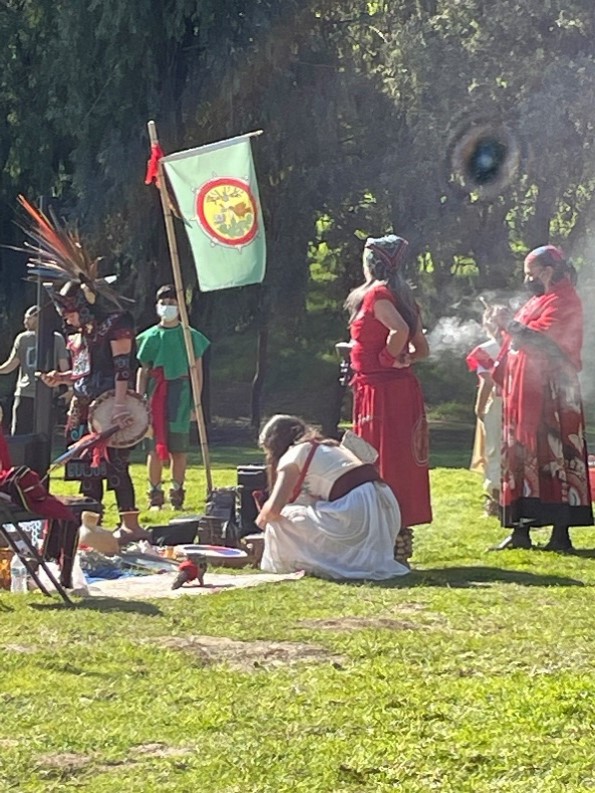
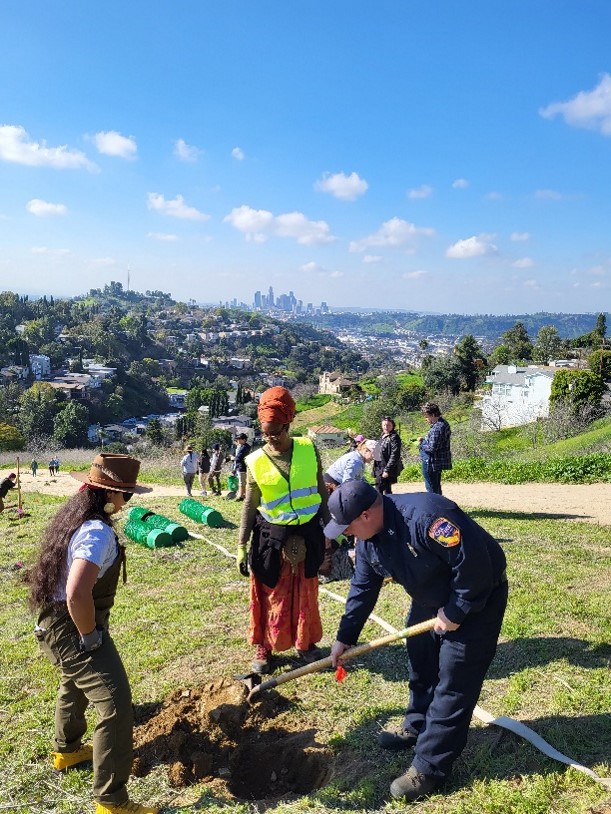
Images: Left: Student leaders at Anahuacalmecac learn that relationships to land are immersed in culture and meaning. Here students and parents prepare incense for a tree-planting ceremony. A student leader and Kitlapowa XinachOhtli or Wayfinder is kneeling on the green grass preparing incense. Photo credit: Yassy Wilkins, U.S. Forest Service. Right: CAL FIRE, TreePeople, and Native partners and volunteers planting trees at Debs Park on Saturday, January 28, 2023. | USFS Photo Library |
|
CAL FIRE is currently administering a State Urban Forest Resilience Grant on behalf of the United States Department of Agriculture Forest Service’s (USFS) Urban and Community Forestry Program, which was awarded to Anahuacalmecac International University Preparatory of North America (Anahuacalmecac), Los Angeles County’s only indigenous TK-12 school. This project will plant 500 native trees at Ernest E. Debs Regional Park (Debs Park). Debs Park is a 300-acre open space nature reserve in northeast Los Angeles and is territory of the Tongva and Gabrielino Shoshone Nations.
As of January 28, 2023, almost one thousand Anahuacalmecac students, staff, nonprofit partners, public volunteers, and tribal leaders have cleared specifically designated areas of non-native plant species in order to prepare the site for native tree planting and long-term maintenance. Native tree species include coast live oak, southern California black walnut, Mexican elderberry, and toyon. Indigenous traditional knowledge of the plants, wildlife, medicinal use, and ceremonial activities will be shared with project participants, especially youth. The project works to cultivate meaningful relationships among 250+ urban Native youth with their cultural identities and heritage by healing the land through nature and land-based traditions while also exposing youth to environmental careers. The project will also engage at-risk communities in the intergenerational transmission of Indigenous knowledge between elders and youth, to potentially include curriculum development, experiential learning, workforce development, and intergenerational activities around harvesting. Past and revitalized current use of prescribed fire by Native Americans in California will also be discussed.
Anahuacalmecac’s project partners include the Gabrielino-Shoshone Nation of Southern California, Audubon Center at Debs Park, City of Los Angeles Department of Recreation and Parks, North East Trees, TreePeople, CAL FIRE, and the USFS. Future projects at Debs Park and other open space parks throughout Los Angeles are being discussed to help restore and maintain the land in a natural state.
|
|
-Written by Henry Herrera, UCF Team |
|
Marco De Anda joined the UCF team in November 2022 as the Regional Urban Forester (RUF) for San Diego, Imperial, and Orange Counties. Marco was born in Mexico City and moved to California at age 20 to obtain a degree in Forestry and Natural Resources from Cal Poly, San Luis Obispo. While in school, he completed several internships including assessing the impacts of logging to stream habitats and salmonid populations in Northern California and working in the high evergreen forests of Chiapas, México surveying private and communal forests to halt forest conversion from primary and secondary forests to palm oil plantations. After graduation, Marco joined CAL FIRE at the Soquel Demonstration Forest in Santa Cruz, and then moved into the fuel management division of CAL FIRE in San Diego, planning prescribed burns, fuel brakes, writing management plans, and more.
Marco believes in the power and wellness that nature brings to our lives, especially in cities, and has experienced firsthand the power that trees bring to urban environments, bettering entire communities and creating spaces for families to gather, socialize, and play in green spaces. He wants to be able to expand urban forests and convert concrete spaces to green spaces within cities.
“I am very excited about this new venture in my professional career and becoming well-rounded in the discipline of forestry. I have always believed in the benefits that parks and trees bring to the urban environment. Parks, urban forests, and trees are an expression of the character and health of a city, providing a natural environment for ALL inhabitants. As a San Diegan, I enjoy and benefit from all our natural spaces and I'd like more people to have the opportunity to have more exposure. I will work for this to happen.”
|
|
|
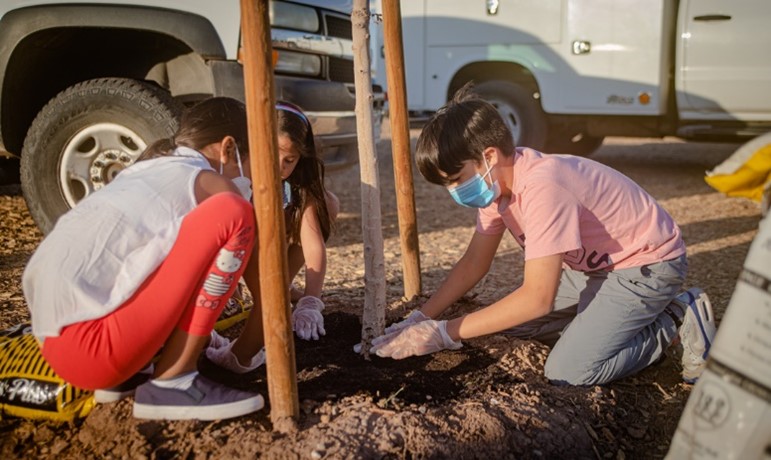
Images: Earth Day 2022 celebrations | City of El Centro Photo Library |
|
IMPERIAL VALLEY URBAN FOREST
A FOREST, IN THE DESERT?
|
When you picture a forest, what comes to mind? Lush green trees, enormous trunks, or maybe, exotic plant life? In actuality, a forest can take many shapes and sizes. While some thrive in moist environments and open spaces, others thrive in busy neighborhoods and lively parks. In either case, a forest is much more than aesthetic and shade. A forest, in the simplest of terms, is a group of living, breathing trees. By absorbing harmful levels of CO2, trees aid in the global battle against air pollution and climate change.
Being a desert-based agricultural community on the border of Mexico and the United States, the Imperial Valley faces a unique mixture of environmental challenges. In 2017, the City of El Centro realized a strong, sought-after solution to these challenges, and the Imperial Valley Urban Forest was born with the motto: “From root to rise; strong roots create a strong foundation.”
The Imperial Valley Urban Forest is being made possible through three separate grants totaling over $2.3 million, awarded by CAL FIRE. Administered by the City of El Centro and the Friends of El Centro Community Services Foundation, the Imperial Valley Urban Forest had the lofty goal of planting the Imperial Valley’s first urban forest. By 2024, Imperial Valley Urban Forest will have planted 3,000 trees across the Imperial Valley. All trees will be tracked, monitored, and measured for carbon sequestration, environmental benefit, and monetary value.
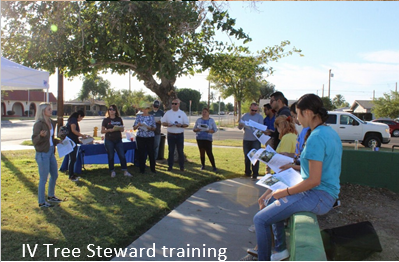
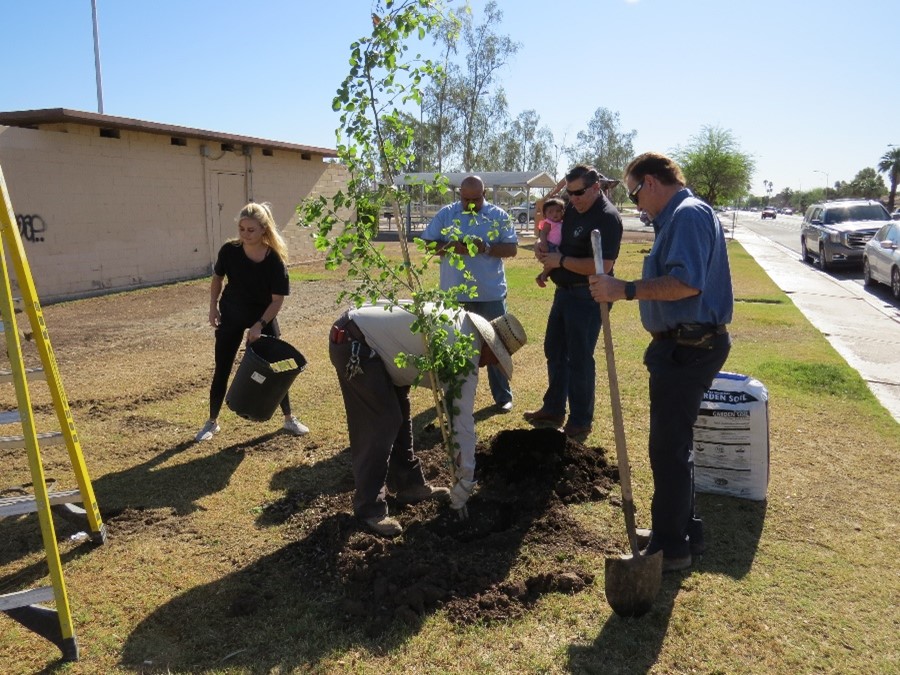
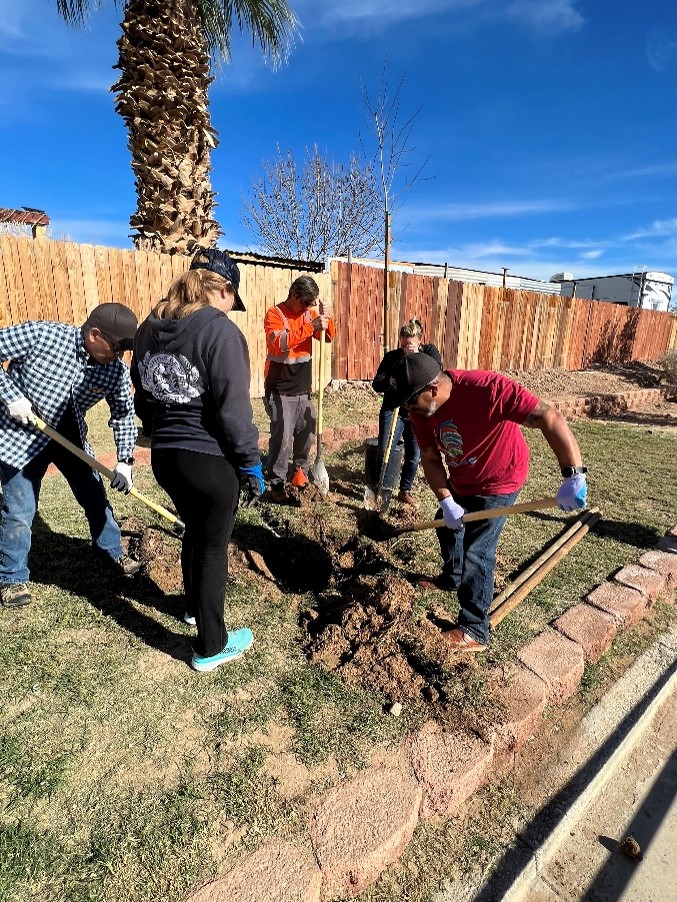
The first grant program in the amount of $335,028 was awarded to the City of El Centro and established the Imperial Valley Urban Forest for the purpose of planting trees on public property. The goal of this initial phase was to plant 1,400 trees across the Imperial Valley, in partnership with the cities of Brawley, Calexico, Imperial, and Holtville. Additionally, a curriculum was created to begin the Tree Stewardship Training Program, which sought to educate community members on best practices for tree planting, maintenance, and the benefits of an urban forest. In this first phase, approximately 500 persons were provided with in-person training at the various tree-planting events that were held throughout the Imperial Valley.
The second grant in the amount of $961,895 was awarded to the Friends of El Centro Community Services Foundation and established the El Centro Free Tree Program. The grant provides for the planting of trees on private property and was awarded to the Foundation with the goal of planting 1,000 trees across disadvantaged communities (DAC) in the El Centro area. Project trees were dispersed amongst El Centro residents with a portion of trees provided to local school districts. As part of this program, El Centro residents were given the opportunity to apply for a free tree on their property. Each community member receiving tree(s) through this program was provided planting and care information during the installation of their tree. Combining the at-home education with an Earth Day event held in conjunction with this grant, the Foundation was able to deliver education to an additional 1,400 residents.
To further advance the goal of educating the community, the Free Trees program took to social media with the creation of the IV Urban Forest Instagram Page (@iv_urbanforest). As part of this online educational opportunity, not only were the IVUF programs promoted but followers were treated to various informational series such as Tree of the Week, Green Tips, Tree Talk, and Green Fact Fridays. For those wishing to learn more in-depth information, a blog was also created to provide the particulars on what it means to be a Tree Steward in the Imperial Valley and detailed information on various trees used for our IVUF Program. The blog can be found at tinyurl.com/ivuftreetalks.
The third grant awarded by CAL FIRE to the City of El Centro in the amount of $1,024,760, created the Imperial Valley Urban Forest Inventory Program. The aim of this grant is to create a comprehensive inventory system for the partnering cities. Additionally, it aims to facilitate the use of inventory techniques to create a comprehensive inventory system, encompassing both public and private tree plantings. Contractor, West Coast Arborists, will be conducting an inventory of up to 25,000 trees. In addition, this program calls for the planting of 500 trees amongst public property in the City of El Centro as well as Brawley, Imperial, and Holtville.
A healthy foundation starts from the ground up; with the right education, tools, and a little extra attention, the tiniest saplings grow into advantageous sources of shade and hope. This program is the first logical step in achieving a living, breathing Imperial Valley Urban Forest.
|
|
|
|
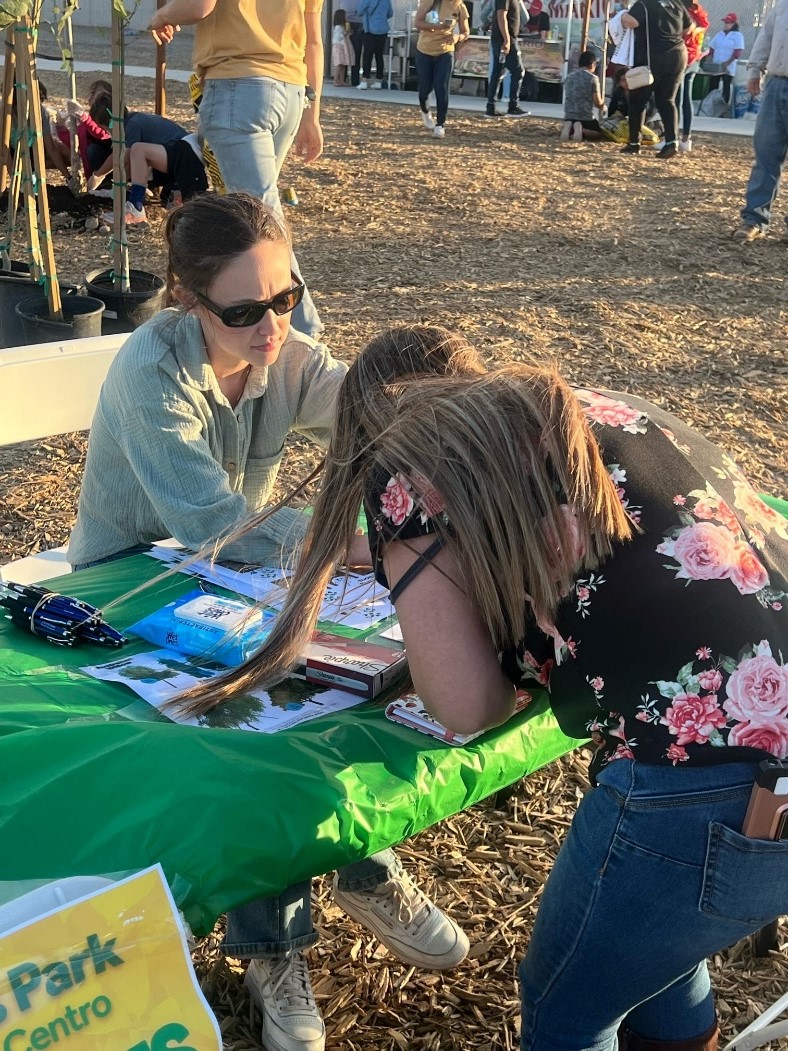
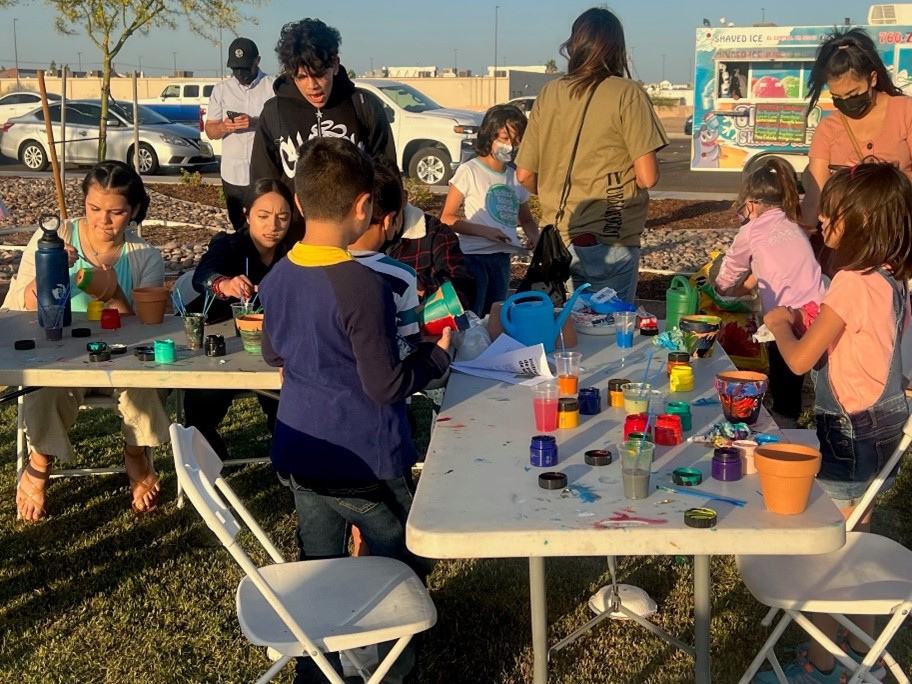
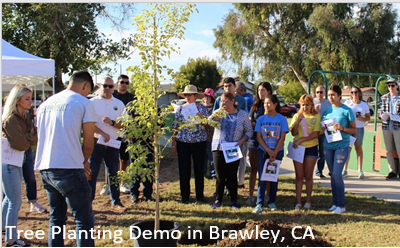
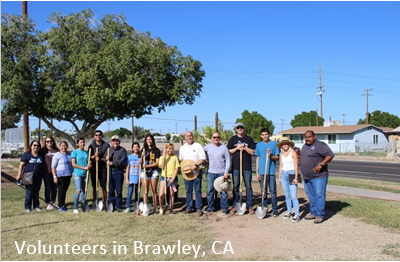
Images: (from top left to right) Tree planting demonstration in Brawley, CA; Volunteers in Brawley, CA; IV Tree Steward training; (bottom left) Arbor Day 2018; (bottom right) Imperial Community Planting | City of El Centro Photo Library |
|
It's that time of year again… applications for the Arbor Day Foundation's recognition programs are now open and will close on April 30, 2023. We encourage you to invite a partner to work toward recognition with you. When communities, campuses, K–12 schools, utilities, and healthcare institutions work together, community forests grow. |
|
Tree City USA (TCUSA) is a national program of the Arbor Day Foundation that is administered locally by state foresters. TCUSA provides a framework for community forestry in cities and towns across the United States. The program started in 1976 through the Arbor Day Foundation, National Association of State Foresters, and the USDA Forest Service. The idea was to expand the concept of Arbor Day from tree planting to more comprehensive tree care.
Communities receive Tree City USA recognition by meeting four core standards:
Standard 1: Maintaining a tree board or department
Standard 2: Having a public tree care ordinance
Standard 3: Spending at least $2 per capita on urban forestry
Standard 4: Having an Arbor Day observance and proclamation
California has a dedicated State Urban Forester and several Regional Urban Foresters (RUFs) throughout the state to help coordinate the Tree City USA Program. These foresters provide urban forestry technical assistance, education, and grants to help advance urban forestry in California. In addition, the RUFs help recruit new TCUSA applicants and provide information about the benefits of being a Tree City USA. Trees provide urban environments with many benefits including decreased temperatures, cleaner water and air, increased property value, improved urban wildlife habitat, among many other social, health and economic benefits. It has even been proven that being around trees reduces stress and crime, improves academic performance and trees create jobs! By earning a TCUSA recognition, your city will bring all these benefits, and more, to its residents. California’s RUFs are also available to guide you through the TCUSA application process. Once you application is submitted, your local RUF will review your application for regional approval. Upon regional approval, the application will then be reviewed by the State Urban Forester. Once the State Urban Forester approves the application, it will be reviewed and approved by the Arbor Day Foundation. If any changes need to occur along the way, your local RUF will work with you to make the necessary corrections or guide you on how to meet the requirements for the following year. Once the application has been fully approved, your RUF may be available to attend your current year’s Arbor Day event and present you with your TCUSA recognition.
Tree City USA provides opportunities to educate the community about the value of tree resources, the importance of sustainable tree management, and the engagement of the individuals and organizations advancing tree planting and long-term maintenance in our urban forests across California.
Consider dedicating more than the minimum $2 per capita and invest more in your urban forestry programs. You can increase tree protection and care through stronger ordinance and policy creation. And don’t limit the celebration of your city trees to one day—find ways to celebrate your trees year-round. Plant and maintain even more trees! Find more guidance and specific Growth Award activities here.
If you have any questions about becoming a Tree City USA or ways to increase your impact, contact your CAL FIRE RUF today.
|
|
Learn more about Tree City USA from Urban Forestry Education Specialist, Eileen Hollett. |
|
|
|
Tree City USA provides communities with a four-step framework to maintain and grow their tree cover.
|
|
|
|
|
Tree Line USA recognizes best practices in utility arboriculture.
|
|
|
|
|
Tree Campus Higher Education |
Tree Campus Higher Education provides a simple framework for colleges and universities to grow their community forests.
|
|
|
|
|
Tree Campus Healthcare recognizes health institutions that make an impact on community wellness through tree education, investment, and community engagement.
|
|
|
|
|
Tree Campus K–12 inspires the next generation of tree stewards through experiences that bring the benefits of trees to life inside and outside the classroom.
|
|
|
View previous editions of our newsletter: |
|
Questions, comments, concerns, feedback?
|
|
California Department of Forestry and Fire Protection | Urban & Community Forestry Program
P.O. Box 944246 | Sacramento, CA 94244-2460
|
|
|
|
|
|
|