California Asphalt Pavement Association
Vol. 13, Issue 48 || Dec. 7, 2020
|
|
Greetings!
This weekly report contains news and information of interest to the asphalt pavement industry, customers and agency partners in California. Please feel free to distribute this newsletter to others who may be interested in asphalt pavements. To provide feedback or story ideas click HERE. Having difficulty viewing this newsletter? View as Webpage
|
|
Surge in coronavirus cases prompts additional restrictions in CA; asphalt industry still designated as 'essential' but faces new safety rules, disruption |
|
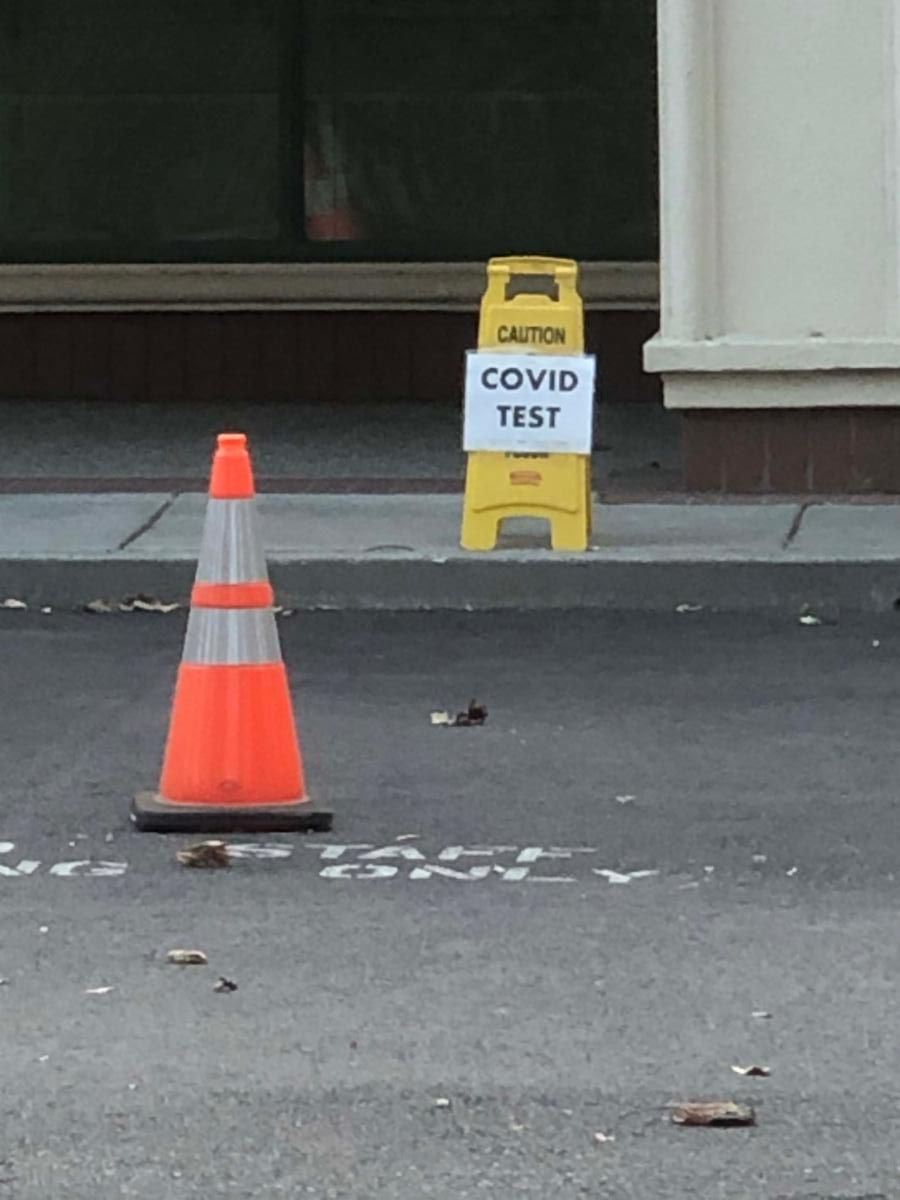
A post-Thanksgiving surge in coronavirus infections and hospitalizations prompted state and local officials to issue a series of more restrictive "stay at home" orders in recent days, although the asphalt pavement industry remained designated "essential" and largely exempt from the restrictions.
New safety regulations and public health guidance, however, continued to create confusion and occasional disruption as more and more Californians test positive for COVID-19, the respiratory ailment caused by the virus.
A possible COVID-19 exposure, later determined to be a false-alarm, nonetheless forced the cancellation of the final day of a Joint Training & Certification Program "Soils & Aggregate" class held last week at Cal State Long Beach. A "Hot Mix Asphalt 1" class scheduled for this week on the campus will be held, program managers say.
The constantly changing environment of pandemic disruptions has caused widespread confusion and anger as businesses and individuals struggled to absorb yet another wave of changes and public health pronouncements. Los Angeles Times columnist Erka D. Smith summed up the chaotic situation thusly: "Gone is any semblance of clear communication of a clear plan with clear reasoning about how best to beat back COVID-19. In its place has emerged a haphazard, layered mess of rules and restrictions. And, for the most part, our elected leaders have no one to blame but themselves."
The latest "Regional Stay-at-Home Order" issued by Gov. Gavin Newsom on Thursday was pegged to hospital Intensive Care Unit (ICU) capacity, adding additional complexity to the color-coded tiered system of restrictions put in place over the summer. Several local public health agencies, including in Southern California, the San Francisco Bay Area and the San Joaquin Valley, followed up soon thereafter with local restrictions to numerous businesses. To find the status of a particular county in California, click HERE.
The asphalt pavement industry remains authorized to operate during the stay-at-home order under Sector Index 13 (Item 1) of essential workforce definitions, which can be found HERE. Meanwhile, new COVID-19 emergency workers' safety regulations, all 21 pages of them, was issued by CalOSHA.. The regulations, which officially took effect Dec. 1 and include new reporting, sick-leave, record-keeping and quarantine protocols, can be found HERE. California is one of 14 states that have authority to impose their own workplace safety rules beyond federal standards. A Nov. 23 Asphalt Insider story on this topic is HERE.
Adding to the potential for confusion is new guidance by the federal Centers for Disease Control and Prevention (CDC), which suggested that quarantine times could be reduced from the recommended 14 days to 10 days or as few as seven, with symptom monitoring and testing. More information on that guidance is HERE. The CDC guidance states that it is up to local jurisdictions determine quarantine options for their jurisdictions.
According to the California Department of Public Health, as of Dec. 6, there have been 1,341,700 confirmed cases of COVID-19 in California this year, resulting in 19,876 deaths. Hospitalizations in California have quadrupled since late October, and the daily death toll has nearly tripled. Los Angeles County has been particularly hard hit, experiencing a record number of cases and hospitalizations.
In the case of the Joint Training & Certification Program, which is a partnership between Caltrans, industry and academia, classes are held on the campuses of Cal State Long Beach (Los Angeles County) and San Jose State University (Santa Clara County). The final day of a "Soils & Aggregate" class held last week was cancelled when a university employee who did not interact with trainees was potentially exposed to a COVID-19-positive person in a non-JTCP setting, JTCP managers told Asphalt Insider. The employee ultimately tested negative, and a Hot Mix Asphalt 1 class scheduled for this week was given the OK to be held as usual, with the elevated COVID-19 safety protocols in place, according to JTCP Manager Dr. Shadi Saadeh. Saadeh and Caltrans said they would make arrangements with the Soils & Aggregate class participants to complete the final day of instruction, which includes testing and issuing of competency certificates.
In another sign of COVID-19 surge disruption, the State of California last week announced that many state offices would be closed and workers asked to work remotely, with some exceptions. Caltrans construction projects have continued to operate during various COVID-19 health orders, and state officials on a Dec. 1 conference call with the construction industry praised the safe practices being employed on jobsites and encouraged everyone to "stay vigilant."
For additional information, the California Department of Public Health COVID-19 web page is HERE. The daily announcements on the pandemic and response can be found HERE.
|
|
Caltrans names Ray Hopkins as new chief of the Division of Construction |
|
Caltrans on Friday announced that Ramon "Ray" Hopkins has been promoted to chief of the Division of Construction, taking over one of the most challenging jobs in the department at a most challenging time. He replaces Rachel Falsetti, who retired Nov. 30.
Hopkins, a 22-year veteran of the department, has been deputy chief of the division since 2018. He is a familiar name to the asphalt pavement industry due to his work on the Caltrans-industry Pavement & Materials Partnering Committee that reviews and updates Caltrans materials specifications, test methods, construction standards, new technologies and best practices.
"Ray brings extensive leadership and management skills gained over 28 years of overseeing multifaceted engineering projects around the globe," said Mike Keever, Deputy Director for Project Delivery in an internal Caltrans e-mail announcement. "Ray will be using all of his skills and experience to work with all of you to advance the Department's priorities, including safety, equity, sustainability, innovation and ensuring we have a world-class transportation network."
Hopkins replaces Falsetti, who retired at the end of November after serving in the position since June of 2015. She helped thaw a sometimes frosty relationship with the construction industry, and guided the department through major changes in personnel and then a sudden ramp-up in work brought on by SB1. Due to the COVID-19 pandemic there was not an opportunity for the construction industry to give her a proper in-person send-off prior to her retirement, but something may be planned in the future once public-health restrictions ease up.
In a Dec. 1 conference call with the construction industry, Keever noted that Falsetti "ran through the tape" attending meetings and tying up loose ends until her very last day on the job. One of her last interactions with the construction industry was during a Nov. 17 conference call, which she announced would be her last. She was lavished with praise by construction company representatives. Typical of the comments was from Mike Ghilotti with San Rafael-based Ghilotti Bros. Construction, a longtime Partnering Steering Committee leader, who praised her commitment to partnering principles. "Thank you for your leadership," he said. A previous Asphalt Insider article about Falsetti when she was first named to the position is HERE.
Before ascending to the chief of the Construction Division this month, Hopkins was named deputy chief of the division in May of 2018, which also came with it a leadership position on the Caltrans-industry Pavement & Materials Partnering Committee. Several significant changes in Caltrans procedures were published on his watch, including a "Construction Procedure Directive" on the Hamburg Wheel Track Test for Hot mix Asphalt (which can be viewed HERE), a major overhaul to Caltrans pavement smoothness specifications, and a steady move to align Caltrans specifications and test methods to more closely match national standards. The other Caltrans representatives on the PMPC Executive Committee include State Pavement Engineer Sergio Aceves, State Materials Engineer Tim Greutert and Dolores Valls, Deputy Division Chief for Structure Policy and Innovation. The industry representatives are Brandon Milar with CalAPA and Charley Rea with CalCIMA. Keever sponsors the committee along with Deputy Director of Maintenance & Operations Cory Binns.
Hopkins, who holds a Bachelor of Science degree from the University of Arizona, Tuscon, began his engineering career as a Combat Engineer Officer in the U.S. Marine Corps where he served on active duty for six years; most of which was overseas. Once returning to the United States, he continued his career in the Marine Corps Reserve for an additional six years and then resigned with the rank of Major.
Hopkins joined Caltrans in 1998 and started his career as a Design Engineer in Fresno. Soon after, he transferred to District 5 Construction and began working as an Assistant Resident Engineer, and obtained his Professional Engineering license in 2002. As a Construction Engineer, he managed several high- profile projects, including the widening of the Highway 46 corridor in San Luis Obispo County. Hopkins was assigned as a Construction Field Coordinator for the Division of Construction, covering Central Region as well as Districts 8 and 9, prior to being promoted to deputy division chief in 2018.
"I am excited for this opportunity to lead the Division of Construction," Hopkins told Asphalt Insider. "I value the relationship we have built with our industry partners over the years and I intend on continuing to foster these relationships as we work together to successfully build a transportation network that serves all Californians.
"We will continue to implement new and innovative technology to become more efficient and sustainable in the way we do business," Hopkins added. "By partnering with the industry, I am confident that we can continue to leverage each other’s strengths and successfully deliver a robust construction program."
Known for his no-nonsense style and holding himself and others to high standards, Hopkins takes over what is arguably the most difficult job at Caltrans at an extraordinary time in the department's 125-year history. On one hand, Caltrans is flush with money thanks to SB1, the 10-year, $50 billion Road Repair & Accountability Act passed by the Legislature in 2017. But all that money means lots of pressure on the department to get the projects designed and advertised, and then to the Division of Construction, which oversees the private contractors who bid on and then build the projects. This is the most visible indication for motorists, and taxpayers, on the success or failure of SB1, which survived a contentious repeal fight at the ballot box in 2018.
Meanwhile, Caltrans in recent years has seen a large wave of retirements of senior personnel, followed by a hiring boom to ramp up to deliver SB1 work. Then along came a global pandemic, upending how the department oversees the construction activity designated as "essential" and mandated to continue this year during the public health emergency. The department is also pulled in many different directions on a wide range of issues.
In an exclusive interview that appears in the current issue CalAPA's association magazine, California Asphalt, Assembly Transportation Committee Chief Jim Frazier acknowledged the many and varied challenges facing Caltrans when he said, "One of the things about Caltrans -- we ask them to do everything," adding, "And then we swamped them with projects with SB1." The full interview, in question-and-answer format, can be found HERE.
Despite the challenges, construction industry leaders welcomed Hopkins to his new job and vowed to work with him to deliver successful projects that will ultimately prove SB1 is delivering on its promises.
"We look forward to continuing working with Ray in his new role," said Tim Denlay with Knife River Corp., who is co-chair of the CalAPA Technical Advisory Committee. "We congratulate him on his new position."
|
Ray Hopkins was present on Oct. 17, 2019 when Caltrans recognized employees and industry experts for a yearlong effort to review and update the state's pavement smoothness specifications. A previous Asphalt Insider story about the collaborative pavement smoothness effort can be found HERE.
|
Spots still available for 'Quality Asphalt Paving' class Tuesday, Dec. 8 in 'virtual' format |
Procrastinator alert: Today is the last day to register for one of CalAPA's most popular classes, "Quality Asphalt Paving," to be held in virtual format on Tuesday, Dec. 8 from 9 a.m. to 11:30 a.m. Details and on-line registration is HERE.
Taught by veteran paving company owner turned consultant Skip Brown, the class emphasizes construction of a quality asphalt pavement project, including the best practices in plant coordination, laydown, compaction, safety and more. The class also will touch on asphalt specifications and inspection. It is good for newer employees or as a refresher for more senior personnel, and is popular with industry and agency personnel alike. Special pandemic pricing for this class is $99 for CalAPA members and public agency representatives, and $129 for all others.
Brown (pictured) is a noted expert in the asphalt pavement industry and second-generation paving company owner who now serves as a consultant to the public and private sector on paving strategies, maintenance and other expertise. Over his long career he has personally supervised the placement of more than 4 million tons of asphalt on California streets, highways and parking lots. This class benefits greatly from his "boots on the ground" perspective on what makes for a high-quality paving operation, including how to identify and avoid problems. the class will be moderated by CalAPA Director of Technical Services Brandon Milar, P.E. All attendees receive a digital workbook with all course slides, a technical glossary and list of key acronyms defined, as well as a digital certificate of completion.
Since the class is "live," there will be ample time set aside for questions and answers, which has proven to be a popular interactive component of CalAPA classes held via "webinar" format. Registration must be completed on-line HERE. For questions about this class, contact Sophie You of CalAPA at (916) 791-5044. Look for announcements of additional CalAPA classes in future issues of the Asphalt Insider newsletter.
|
|
Featured resource: New & improved Asphalt Pavement Alliance website |
|
The Asphalt Pavement Alliance, a coalition of the National Asphalt Pavement Association, the Asphalt Institute and State Asphalt Pavement Associations, including CalAPA, has just unveiled a revamped website. You can view it HERE.
The stated mission of the Alliance is "to establish asphalt pavement as the preferred choice for quality, performance, and the environment. The APA will accomplish this through research, technology transfer, engineering, education, and innovation."
The website features various resources, a master event and training calendar, videos, reports and white papers, marketing tools and other resources. Part of CalAPA member dues go toward underwriting the activities of the Asphalt Pavement Alliance.
|
|
Each week we highlight a word, acronym or other term commonly used in the asphalt pavement industry in California.
AADT: Average Annual Daily Traffic.
|
|
Paving Pointer of the Week |
Each week we highlight a key point or best practice of interest to asphalt paving crews, inspectors and others working in the field. We welcome suggestions. More tips can be found in our Asphalt Parking Lot Construction Checklist HERE.
ASPHALT MIXTURE: Ask yourself: Is this the correct mix type for theproject and the layer you are constructing? Verify that the truck delivery ticket matches the approved mix design.
|
|
"The quieter you become, the more you can hear.”
-- Baba Ram Dass
|
|
CALAPA CALENDAR:
*
'Quality Asphalt Paving' class (on-line), Tuesday, Dec. 8, 9 a.m. to 11:30 a.m.
Contact: Sophie You (916) 791-5044.
|
|
PAVEXpress, the popular (and free!) on-line pavement design software now includes a module for calculating Life-Cycle Cost Assessment (LCCA).
|
|
We hope you enjoy CalAPA's Asphalt Insider newsletter. We are committed to providing you with the most up-to-date information on technical issues, regulation, news, analysis, events and trends in California that is of interest to the asphalt pavement industry and our various agency partners. Click HERE to contact us with any comments or suggestions.
Sincerely,
Russell W. Snyder, CAE
Executive Director
California Asphalt Pavement Association (CalAPA)®
|
|
The "Asphalt Insider" is an official publication of the California Asphalt Pavement Association. For more information or to inquire about membership, call (916) 791-5044, or click HERE to send us an e-mail. Copyright © 2020 California Asphalt Pavement Association -- All Rights Reserved. The CalAPA name (No. 5,621,794) and logo (No. 5,621,795) are registered trademarks with the U.S. Patent & Trademark Office.
|
|
P.O. Box 981300, West Sacramento, CA 95798
1550 Harbor Blvd., Suite 211, West Sacramento, CA 95691
|
|
|
|
|
|
|
|