California Asphalt Pavement Association
Vol. 13, Issue 29 <|> July 27, 2020
|
|
Greetings!
This weekly report contains news and information of interest to the asphalt pavement industry, customers and agency partners in California. Please feel free to distribute this newsletter to others who may be interested in asphalt pavements. To provide feedback or story ideas click
HERE. Having difficulty viewing this newsletter?
View as Webpage
|
|
CalAPA member Sully-Miller hosts 'virtual' asphalt plant tour for local air quality regulators
|
|
CalAPA member Sully-Miller conducted a "virtual" asphalt plant tour last week for representatives of the South Coast Air Quality Management District as regulators work on new air-quality regulations that could impact the industry.
CalAPA has helped coordinate similar tours, including one that took place on March 3 hosted by DeSilva Gates materials at their Sunol facility and attended by representatives from the California Air Resources Board and the San Francisco Bay Area Air Quality Management District.
With the onset of the coronavirus pandemic, however, in-person visits have become increasingly difficult to put on.
As CalAPA Environmental Committee Co-Chair Scott Taylor with Taylor Environmental Services, remarked, “After waiting and trying to figure out a way to conduct a site visit in person, it became obvious that South Coast Air Quality Management District (SCAQMD) was continuing with rule development and a virtual tour was the best way to provide the first-hand information they needed for their work."
CalAPA member Sully-Miller, represented by Ken Barker and William Quach, joined Taylor and representatives of the California Construction and Industrial Materials association (CalCIMA) and the California Asphalt Pavement Association to “virtually” tour Sully-Miller's Sun Valley plant July 22 to inform the South Coast AQMD’s proposed rule 1147.1 ‘NOx Reduction from Equipment at Aggregate Facilities’ rule-making.
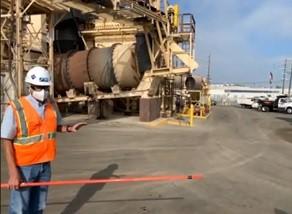
As Barker used his phone to conduct a live walk-through of the plant, assisted by Quach with a camera-steadying device known as a gimbal, the regulators asked numerous questions via a chat box and had them answered in real-time by Barker and Taylor. The event took approximately one hour.
Afterward, Michael Krause, Manager of NOx/Sox/RECLAIM/Toxics/VOC Rules 3, called the tour a “shining example” of transparency and industry-regulator educational collaboration. The air district covers air quality regulation for a sprawling area that includes Los Angeles, Orange, Riverside and San Bernardino counties. Other SCAQMD staff who attended the tour included Shannon Lee, senior air quality engineer; Gary Quinn, program supervisor; air quality specialists Yanrong Zhu and Steve Tsumura and Susan Nakamura, Assistant Deputy Executive Officer.
The tour coordination team included Suzanne Seivright-Sutherland, director of local governmental affairs for CalCIMA, Adam Harper, CalCIMA's policy director, and CalAPA Regional Director Bill Knopf. In an after-action report, Seivright-Sutherland wrote: “This was the first virtual plant tour South Coast AQMD participated in, and their team expressed significant accolades for the excellent job the Sully-Miller team executed!”
Commented Barker after the tour: “I think we have opened up a new door with these virtual tours. We can make life easier for industry and the agencies to understand what we do and how we do it.” In addition to cutting-edge virtual technologies, Barker used an old-school pointing tool repurposed from a fruit picker pole. “We are adapting because of COVID-19,” he said. “With a pointer like that, you can make darn sure people know what you are talking about.”
|
|
Ken Barker with CalAPA member Sully-Miller conducts a "virtual" tour of the company's asphalt plant in Sun Valley.
|
|
|
Major federal parks infrastructure bill passes Congress, headed to president for signature
|
|
One of the most significant conservation bills in decades, the Great American Outdoors Act, passed Congress on a bipartisan vote last week and heads to the president's desk. The bill garnered a rarity in Washington these days, strong bipartisan support.
The Great American Outdoors Act (GAOA), is meant to address the longstanding backlog of infrastructure improvements needed at our National Parks, which is estimated to exceed $1.8 billion in California alone, including poorly maintained roads and parking lots.
The bill has largely flown under the radar in Washington, and attracted Republican and Democratic votes as it moved through the U.S. Senate and the House of Representatives, where is received final passage on July 22. The bill text is
HERE
.
In a June letter to Republican Leader Kevin McCarthy of Bakersfield, CalAPA wrote: "The GAOA will provide an annual allocation of $1.9 billion for five years in order to address the backlog of deferred maintenance in our National Parks and public lands. In addition to properly maintaining these historic and recreational sites, this needed investment will generate thousands of construction-related jobs.
"As you know," the letter continued, "our National Parks serve as a critical economic engine for many communities throughout California, as visitors spend billions of dollars each year at local businesses, hotels and restaurants. The GAOA will assist our economy at a time when it is most needed."
The bill passed the U.S. Senate on June 17 on a bipartisan 73-25 vote, with Sens. Dianne Feinstein and Kamala Harris of California both voting "yes." The House vote on July 22 was equally lopsided, 310-107, Of California's 53-member House delegation, only U.S. Reps. Devin Nunez, Doug LaMalfa and Tom McClintock, all Republicans, voted no on the measure. Republican U.S. Rep. Paul Cook did not cast a vote.
The National Park System supports more than 35,000 jobs in California, and attracts more than 41 million visitors each year.
The bill has been called one of the most important conservation bills in history because it could nearly eliminate a $12 billion National Park Service maintenance backlog and fully fund the Land and Water Conservation Fund (LWCF) for the first time since it was enacted in the 1960s.
Royalties from oil and gas drilling — as well as mining — on public lands will help offset the national park maintenance backlog and forest preservation with about $1 billion per year until 2030. A summary of the bill produced by the National Asphalt Pavement Association, a CalAPA partner, is
HERE
.
Steve Ward with CalAPA member Pavement Recycling Systems Inc., and a member of the CalAPA Legislative Committee, commented, "We are very pleased to see bipartisan passage by Congress of the Great American Outdoors Act. Maintenance of our National Parks infrastructure has been overlooked for far to long and this legislation provides the stable funding they have desperately needed for many years. This is a good example of what can be accomplished when Industry and other organizations work together toward a common goal, it is our hope that this can serve as an example for establishing stable and dependable funding for the rest of America’s failing infrastructure, providing thousands of good jobs for hard-working Americans."
The current issue of CalAPA's magazine,
California Asphalt
, profiles the paving rehabilitation work being done in National Parks and federal lands in California. You can read it
HERE
.
|
|
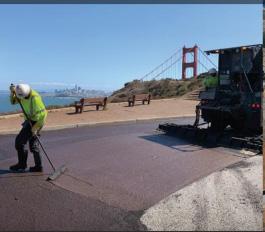
Recent pavement preservation work at Golden Gate National Recreation Area in San Francisco Bay. Pavement work in National Parks and federal lands in California was spotlighted in the current issue of California Asphalt, CalAPA's association magazine, which is on-line
HERE
.
|
|
|
|
People in the news: Governor appoints CalAPA-endorsed contractor Miguel Galarza to CSLB
|
|
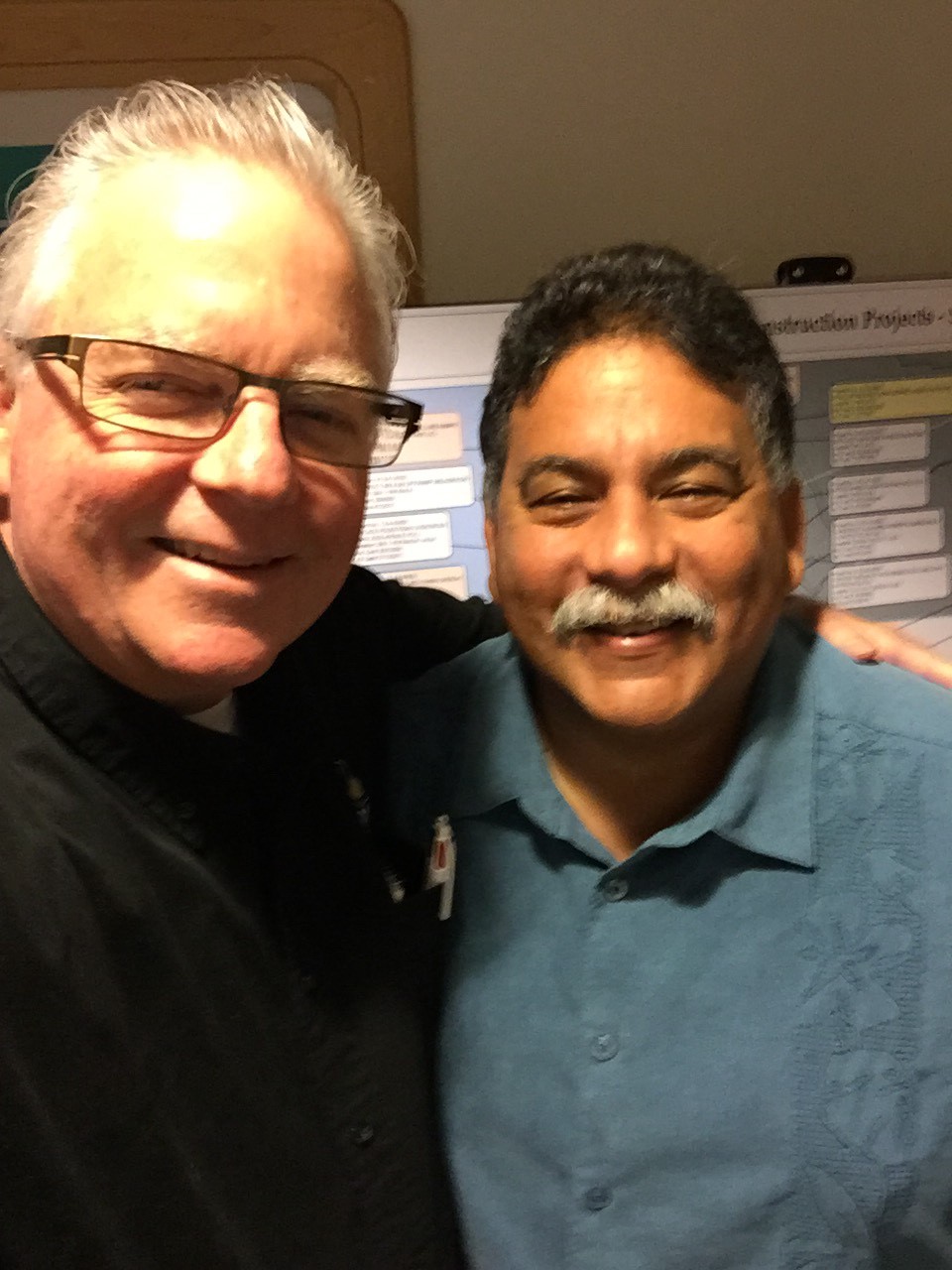
Miguel Galarza, owner of San Francisco-based Yerba Buena Engineeering & Construction (right) with CalAPA Executive Director Russell Snyder at a meeting at the Caltrans District 4 offices in Oakland in 2017.
|
|
Miguel Galarza, longtime champion of mentoring minority-owned and women-owned construction companies, was appointed last week by Gov. Gavin Newsom to serve on Contractors State License Board. CalAPA was among numerous organizations and individuals who endorsed Galarza's appointment.
Galarza, 59, of Millbrae, is owner of Yerba Buena Engineering & Construction of San Francisco, which he founded in 2002. Previously, he was a
senior program manager at Mendelian Construction from 1993 to 2002. Galarza was project manager estimator at Hopkins Heating and Cooling from 1991 to 1993. He was a union carpenter at Carpenters Local Union No. 22 from 1981 to 1991.
Galarza is a member of the Associated General Contractors of America National Diversity & Inclusion Council and district director for the San Francisco Chapter of Associated General Contractors of California. He is also a member of United Contractors, California Building Industry Association and the Society of American Military Engineers. The appointment was announced by the Governor's Office on July 23.
Galarza gained national attention in 2007 when he played a prominent role in a Caltrans-industry mentor-protege program developed in the Caltrans District 4 regional office that oversees the San Francisco Bay Area. The program, which matched established construction companies with emerging contractors, many of them minority- and women-owned, won a National Diversity Award by AGC of America.
He has garnered numerous other awards and recognition over the years, including from the U.S. Small Business Administration, U.S. Department of Defense and the California Hispanic Chamber of Commerce. In 2019 he won a San Francisco Collaborative Partnering Award.
In its May 18 letter to the governor, CalAPA wrote, "Mr. Galarza is widely known and respected in the construction industry in California, and nationally, for his knowledge, leadership and integrity, and also for helping to elevate standards for the industry."
Shortly after the announcement, Galarza told
Asphalt insider
: "As
a licensed contractor for more than 28 years, I am honored that Governor Newsom has allowed me to serve the construction community of our great state. I look forward to contributing my 40-plus years of construction and contracting knowledge to the California Contractors State License Board. I would also like to personally thank Russell Snyder, the executive director of the California Asphalt Pavement Association, for his endorsement and his friendship over the years. Your leadership and encouragement has given me the confidence and determination to make a difference in our unique community, and for that I thank you."
The Contractors State License Board, first established in 1929 and now part of the state Department of Consumer Affairs, licenses and regulates contractors in 44 classifications that constitute the construction industry in California. There are approximately 300,000 licensed contractors in California. The governor and the Legislature make appointments to the 15-member CSLB Board.
Galarza joins Mary Teichert on the CSLB Board. She was appointed to the board in September of 2019 by the governor. Her family-owned company, Teichert Inc., a CalAPA member, has been in operation in California for more than 125 years and holds the oldest active general contractor's license in the state, No. 8. To learn more about the Contractors State License Board, click
HERE
to visit their website.
|
|
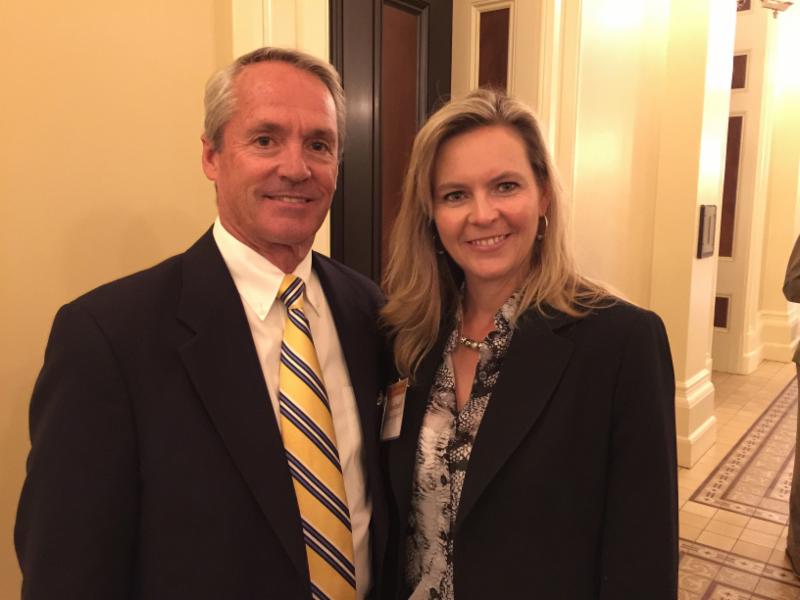
Mary Teichert (right) with Tom Foss with CalAPA member Griffith Company attend a hearing at the state Capitol in Sacramento in 2016 to discuss transportation funding. Teichert was appointed to the Contractors State License Board by Gov. Gavin Newsom in 2019.
|
|
|
Each week we highlight a word, acronym or other term commonly used in the asphalt pavement industry in California.
PAVEMENT STRUCTURE (COMBINATION OR COMPOSITE):
All courses of selected material placed on the foundation or sub-grade soil, other than any layers or courses constructed in grading operations. When the asphalt pavement is on an old Portland Cement Concrete base or other rigid-type base, the pavement structure is referred to as a combination or composite-type pavement structure.
|
|
Paving Pointer of the Week
|
Each week we highlight a key point or best practice of interest to asphalt paving crews, inspectors and others working in the field. We welcome suggestions. More tips can be found in our Asphalt Parking Lot Construction Checklist
HERE
.
TONNAGE CALCULATION
: Are there enough trucks on the run to haul the mix needed to complete the job? If you have five trucks on the round each carrying 25 tons = 125 tons per round. If each round takes one hour to make, then the production rate is 125 tons per hour. If the job requires 1,000 tons at 125 tons per hour = eight hours to get the mix to the job.
|
|
"
Chance favors the prepared mind."
-- Louis Pasteur
|
|
We hope you enjoy CalAPA's
Asphalt Insider newsletter. We are committed to providing you with the most up-to-date information on technical issues, regulation, news, analysis, events and trends in California that is of interest to the asphalt pavement industry and our various agency partners. Click
HERE to contact us with any comments or suggestions.
Sincerely,
Russell W. Snyder, CAE
Executive Director
California Asphalt Pavement Association (CalAPA)®
|
|
The "Asphalt Insider" is an official publication of the California Asphalt Pavement Association. For more information or to inquire about membership, call (916) 791-5044, or click
HERE
to send us an e-mail. Copyright
©
2020 California Asphalt Pavement Association -- All Rights Reserved. The CalAPA name (No. 5,621,794) and logo (No. 5,621,795) are registered trademarks with the U.S. Patent & Trademark Office.
|
|
P.O. Box 981300, West Sacramento, CA 95798
1550 Harbor Blvd., Suite 211, West Sacramento, CA 95691
|
|
|
|
|
|
|
|