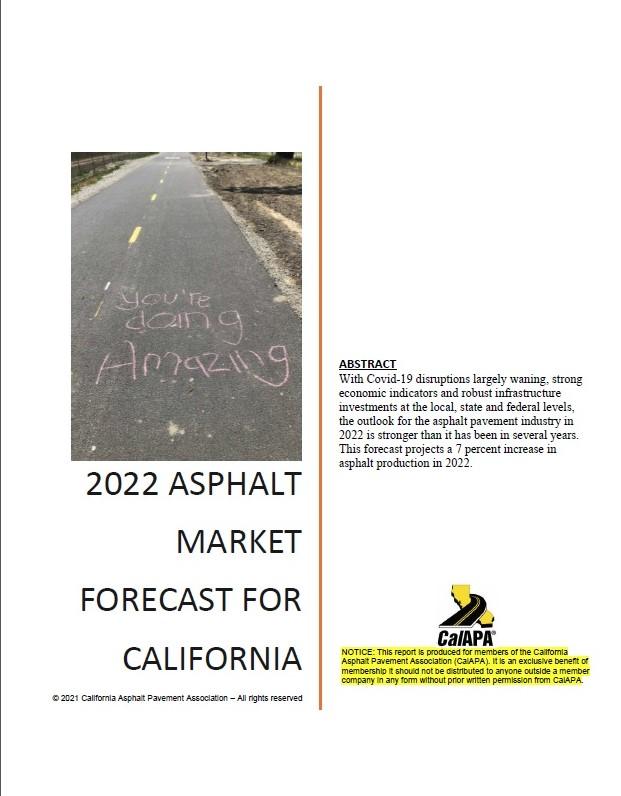
Editor’s Note: Last week we offered our completely subjective Top 10 news stories of 2021 that impacted the asphalt industry in California. You can read the story HERE. This week we’re back with our fearless prognostications for 2022. If you would like to see how we fared with our predictions a year ago, you can read that story HERE. For more detailed information and economic analysis, CalAPA members should refer to the “2022 Asphalt Market Forecast for California” report that was sent to members last month. Another source of insight, the annual forecast issue of CalAPA’s official magazine, “California Asphalt,” will hit mailboxes later this month.
No. 1: Global COVID-19 pandemic disruptions persist in California
The global coronavirus pandemic, which upended pretty much everything in 2020 and 2021, will continue to be felt throughout 2022. California will begin the year with record-breaking numbers of COVID-19 cases, and worrisome upward trends in hospitalizations and deaths. Although effective vaccines are widely available, as well as promising treatments, millions remain unvaccinated and further study determines the vaccine-induced protection against serious illness and death wane over time, requiring booster shots. The asphalt industry is in a broad category of “essential” activities that will continue to operating during the public health crisis, but ever-shifting health and workplace safety guidance will continue to create confusion for employers and workers. By year’s end the pandemic will become endemic, never fully going away but becoming more manageable.
No. 2: Pressure mounts to quickly convert tax dollars into to road improvements
Local, state and federal agencies will face increasing pressure in an election year to quickly convert tax dollars into transportation improvement projects. In the case of the landmark $1.2 trillion federal infrastructure law passed in 2021, many members of California’s Congressional delegation will be campaigning for re-election based on their vote for the law and will want to see construction activity in their home districts. The phenomenon is similar to what occurred in 2018, shortly after the California Legislature passed SB1, the $50 billion Road Repair & Accountability Act of 2017. When the fuel-tax measure was put before voters in 2018, elected officials pressed public works agencies to show tangible improvements visible to the public for the increased investments. A flurry of pavement preservation projects appeared across the state prior to the Nov. 6, 2018 SB1 repeal vote, which was soundly defeated by the electorate.
No. 3: Worker availability will continue to be a top concern
An expected upswing in paving work in 2022 will create additional demands for workers across the state. The activity will place increased pressure on an industry already having difficulty finding qualified workers. Training of the next generation of workers will be at the forefront, as will stepped-up efforts to publicize the many career opportunities the asphalt pavement industry has to offer. Employers that offer attractive wages, benefits and working conditions will have an edge over competitors. Careers in public works will be seen as increasingly more attractive as the state’s aging infrastructure requires more attention, creating more employment and promotional opportunities, and innovations in sustainability create gratifying work that helps to burnish the state’s “green” reputation.
No. 4: Environmental regulations will dominate the news headlines
California’s elaborate web of environmental regulations will continue to get more complex and costly in 2022 as elected officials and regulators will face increasing pressure to further reduce air pollution and address ambitious climate-change goals, plus an increasing emphasis on the impact of the transportation system, and the industries that support maintaining that infrastructure, on low-income communities. State and local regulators will receive little resistance from a Democratic presidential administration looking to enhance its environmental credentials. Companies in the asphalt space will find they are spending an increasing amount of time and money on environmental regulation compliance.
No. 5: Anti-road trend encounters voter backlash
Agencies in recent years have been spending more time and attention on non-traditional transportation system improvements, such as “complete streets” that seek to boost pedestrian, bicycle and transit use, often at the expense of efficient auto and truck mobility. But as traffic congestion worsens, and pavement conditions deteriorate, voters will punish road-adverse politicians at the ballot box. Weary taxpayers will be looking for a return on investment from billions of dollars in state and local tax dollars invested in recent years and perceive the lack of tangible results as an important quality-of-life issue.
No. 6: Discount rate goes under the microscope
A complex formula for how to calculate the lifecycle cost of various pavement designs, which has periodically sparked controversy in other states, will be evaluated by the California Department of Transportation in 2022. The review will reignite the long-festering debate between the asphalt and concrete industries over which pavement type represents the best value over time to the state. The review will drag on over many months and ultimately Caltrans will conclude that the timing and current volatility of construction materials costs precludes making a major change to the current 4 percent “discount rate” this year.
No. 7: Natural disasters will test state’s infrastructure
Mother Nature will provide a stark reminder in 2022 that the resiliency of the state’s infrastructure is essential to recovering quickly from natural disasters. Intense storms will pummel coastal areas and mountain passes, and powerful earthquakes will challenge public works agencies to respond quickly to return vital transportation systems into working order. Asphalt’s “speed of construction” attributes will be once again on full display as contractors working under emergency orders will reopen routes quickly, much to the relief of residents and businesses.
No. 8: Volatility characterizes oil prices in California
Ranked as our top story of the past decade, the global glut in oil, coupled with reduced demand, placed unprecedented downward pressure on crude prices, which also translated to lower prices for liquid asphalt. The benchmark Caltrans Crude Oil Price Index, which is used to adjust asphalt price payments, was averaging over $500 per barrel from 2011-2014, but starting in 2015 dipped below $300 a barrel. Pandemic-induced reduction in travel pushed prices briefly below $200 in 2020, but prices have drifted upward since then, settling in at $433.5 in December of 2021. Prices will rise higher as 2022 progresses and demand increases and inflationary and regulatory pressures add costs to the product.
No. 9: Democrats maintain firm grip on power at the state level
Despite voter displeasure with political divisiveness, Democrats will retain a firm grip on governing in California in 2022, sweeping all state Constitutional offices and maintaining solid majorities in the state Senate and Assembly. Gov. Gavin Newsom, who survived a recall vote in 2021, will easily be re-elected to another four-year term in 2022 and declare the result a mandate from the electorate on his policies while casting his gaze, as all California governors ultimately do, toward Washington. In somewhat of a silver lining for Republicans, they will pick up a few seats in the House of Representatives, helping the GOP take control of the House in 2023, although the California Congressional delegation will continue to be solidly Democratic.
No. 10: The economy will shift into overdrive
After a miserable 2020 and an uncertainty-filled 2021, the California economy is poised to rocket out of the doldrums and lead the nation in economic growth in 2022. Construction activity, a key barometer of a strong economy, will start to resemble the go-go era of the mid-2000s and various public and private projects that consume asphalt will move forward at a brisk pace.
Honorable mention: Long-life asphalt pavement
Fresh on the heels of the successful completion of a prominent project on Interstate 5 in Sacramento, another long-life asphalt pavement project will be proposed by Caltrans for a high-profile route in Southern California, competing head-to-head with a concrete design.
---[
Do you think there something important missing from this list? Feel free to drop us a line HERE with your 2022 prediction. The best prediction that actually comes to pass in 2022 will be eligible for a prize and recognition in the newsletter.