California Asphalt Pavement Association
Vol. 15, Issue 5 || Jan. 31, 2022
|
|
Greetings!
This weekly report contains news and information of interest to the asphalt pavement industry, customers and agency partners in California. Please feel free to distribute this newsletter to others who may be interested in asphalt pavements. To provide feedback or story ideas click HERE. Having difficulty viewing this newsletter? View as Webpage
|
|
SPECIAL REPORT: Asphalt industry unveils 'The Road Forward,' an ambitious climate action plan aimed at a carbon-neutral future
|
The asphalt pavement industry launched perhaps its most ambitious initiative since the construction of the Interstate Highway System in the 1950s and 1960s, proposing a series of bold actions aimed at achieving net-zero carbon emissions by 2050.
The plan, unveiled last week at the National Asphalt Pavement Association's Annual Conference in Scottsdale, Ariz., has been more than a year in development and draws upon expertise of numerous experts and stakeholders. The title of the plan is "The Road Forward: A Vision For Net Zero Carbon Emissions for the Asphalt Pavement Industry." Details of the plan can be found HERE.
Elements of the plan may sound familiar and build on existing industry initiatives, such as the use of more Reclaimed Asphalt Pavement (RAP) and Warm Mix Asphalt (WMA) technologies. However, the plan recognizes that more must be done in this space and sets ambitious goals, identifies gaps in current knowledge, and a vision to galvanize the industry around the initiative.
“This is one mission and one vision for the entire industry to point us where we need to go to proactively lower emissions and accelerate beyond the industry’s past efforts in environmental stewardship and sustainability,” said J. Richard Willis, Ph.D, NAPA's Vice President for Engineering, Research & Technology at the conference.
The plan culminates more than a year of work by a 21-member Climate Stewardship Task Force, which studied the industry's current actions around addressing climate change, identified opportunities for improvement and crafted a mission, vision and roadmap for achieving its goal to achieve Scope 1, 2 & 3 net-zero carbon emissions by 2050.
The work will be aided by pooled-fund research partially underwritten by CalAPA member contributions, and leadership representing State Asphalt Pavement Associations, Inc. participated in the Task Force and help guide the development of the plan. It also complements many initiatives already championed for years by CalAPA in environmental-conscious California.
“It has been a privilege to work with NAPA on behalf of the State Asphalt Pavement Associations (SAPA) on the 'Road Forward' effort," Bruce Barkevich, vice president of the New York Construction Materials Association, told California Asphalt Insider. "This project is developing the roadmap toward carbon neutrality for the asphalt industry with a very ambitious goal of obtaining this for the year 2050. I found this effort to be educational and rewarding as this plan will emphasize the steps needed to continue to support the nation's infrastructure while doing it in a more sustainable way. There are many hurdles to cross on this journey, but as always, the asphalt industry and its amazing companies will be more than up to the challenge. As the most recycled product in the United States, we have a great foundation to build on.”
The plan includes four goals, 19 tactics and eight research and implementation gaps.
“We as an industry need to take it upon ourselves to be responsible, to make these changes, and, where we can, get help," Willis said.
The NAPA conference also prominently featured other environment-focused presentations that will have a familiar ring to the industry in California. John Lane, environmental services manager with Sacramento-based Teichert, offered the California experience on a workshop, "Environmental Justice Impacts on Asphalt Mix Plant Operations." A General Session presentation was titled, "Black, green & Gold: Exploring Climate Incentives & Initiatives."
But it was the climate-action plan that was the center of attention at the conference. The four major goals set forth in the plan include:
- Achieve net zero carbon emissions during asphalt production and construction by 2050.
- Partner with customers to reduce emissions through pavement quality, durability, longevity and efficiency standards by 2050.
- Develop a net zero materials supply chain by 2050.
- Transition to electricity from renewable energy providers in support of net zero carbon electricity by 2050 and reduce electrical intensities.
The stated mission of the plan is to "engage, educate and empower the U.S. asphalt community to produce and construct net-zero carbon emission asphalt pavements." The stated vision is: "Sustainable communities and commerce, connected by net-zero carbon emission asphalt pavements."
"In short," a brochure about the plan states, "human forces, the free market and governments are aligning to reduce carbon emissions by injecting policies and practices into business models. NAPA leaders believe that, over the next several decades, reducing carbon emissions will be the industry's foremost goal, persisting even amid changing political or economic situations."
The California Asphalt Insider newsletter, as it has for many years, will continue to provide periodic updates on the Road Forward plan and progress. A fact sheet about the asphalt industry in California, which includes information about asphalt's many "green" attributes, is HERE. A fact sheet about asphalt plants and communities is HERE. Every year the association's official magazine, California Asphalt, devotes an entire issue on the industry's environmental issues in California. The most recent environment-themed issue is HERE. |
|
Representing California at last week's NAPA conference in Arizona were, from left, Jordan Reed with George Reed, CalAPA's Russell Snyder and Dan Ridolfi with Lastrada Partners. |
|
At NAPA's conference last week were, from left, John Lane with Teichert, Murry Wilson with R.J. Noble and Jordan Reed with George Reed Inc. |
|
Comparing notes on a break during last week's NAPA conference in Arizona were CalAPA members Brian Handshoe with Kenco Engineering (left) and Jordan Reed with George Reed Inc. |
|
A look back: Moisture sensitivity |
Editor's Note: Since it was founded in 1953, the California Asphalt Pavement Association has communicated important information to its members about issues that impact the industry. The following is an excerpt from a July 3, 2002 newsletter to members in Northern California on a topic that continues to have relevance today.
---[
"The Moisture Sensitivity of AC Task Group (MSACTG) is fervently working to develop and implement short-term policies for identification and mitigation of moisture sensitivity in AC mixes in time for the 2003 construction season. The Task Group has decided to proceed with a revision of the Moisture Sensitivity matrix in conjunction with a revised test method. MSACTG subgroups are meeting to discuss the available test methods and possible modifications (AASHTO T283, ASTM, etc), the certification of technicians and accreditation of labs, the available treatment method specification and mixture acceptance criteria, and the definition of the wet and freeze zones. The outcome of this process could change production operations. For more information on the Task Group’s progress or to participate in these meetings, please contact the NCAPA office."
|
|
California Transportation Commission changes announced |
The California Transportation Commission, which oversees transportation investments and policy in the state, is undergoing some changes. Longtime Commissioner Bob Alvarado representing the Carpenters Union is retiring, and last week Gov. Gavin Newsom named his replacement: Jay Bradshaw, executive secretary-treasurer of the Northern California Carpenters Regional Council.
The CTC has 11 voting members and two non-voting ex-officio members. Of the 11 voting members, nine are appointed by the governor, one is appointed by the Senate Rules Committee and one is appointed by the Speaker of the Assembly.
During the CTC's meeting on Jan. 26, Commissioner Lee Ann Eager was elected chairwoman of the commission, and Carl Guardino (pictured at right speaking at the CalAPA Spring Asphalt Pavement Conference in Ontario in 2013) was elected vice chair, effective March 1. The official CTC announcement is HERE. |
|
Federal OSHA formally pulls back on mandatory COVID-19 vaccination, testing; state & local requirements on face covering changing |
The federal Occupational Safety and health Administration last week officially withdrew its vaccination and testing emergency temporary standard in the wake of a U.S. Supreme Court ruling that the standard went too far.
The Emergency Temporary Standard was issued on Nov. 5 in an effort to promote COVID-19 vaccination among companies with 100 or more employees, the rule was controversial and immediately triggered court challenges.
In announcing it was officially withdrawing the ETS on Jan. 25, OSHA nevertheless said it "strongly encourages vaccination of workers against the continuing dangers posted by COVID-19 in the workplace." More information is HERE.
The U.S. Supreme Court, on a 6-3 vote, ruled Jan. 13 that OSHA had exceeded its authority with the standard. "Although Congress has indisputably given OSHA the power to regulate occupational dangers, it has not given that agency the power to regulate public health more broadly," the high court wrote in an unsigned opinion. "Requiring the vaccination of 84 million Americans, selected simply because they work for employers with more than 100 employees, certainly falls in the latter category."
Workplace safety regulations in California remain in place, including a requirement that employees working in indoor settings wear face coverings. More information on CalOSHA COVID-19 regulations can be found HERE.
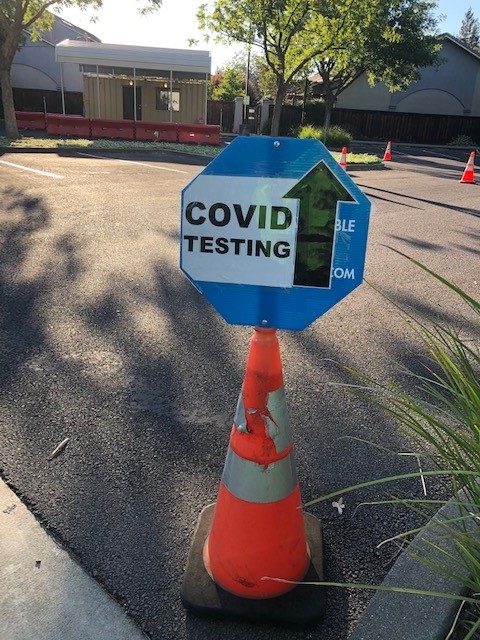
The COVID-19 pandemic, meanwhile, continues to disrupt workplaces. In California, the California Department of Public Health reported that the state has confirmed a total of 7.7 million COVID-19 cases, resulting in 78,825 deaths. the CDPH reports that 81.7% of the eligible population in California has received at least one dose of the available COVID-19 vaccines. Sharp spikes in COVID-19 cases in recent weeks in California, driven partly by the Omicron variant, appear to be trending downward.
In Los Angeles County, home to alarming increases in COVID-19 cases in December and early January, prompting the postponement of the CalAPA Annual Dinner, positive COVID-19 cases have been dropping sharply. As of Jan. 17, the county has begun requiring employers to require employees who work indoors to wear a "well-fitting medical grade mask." Details about that guidance is HERE. |
|
Each week we highlight a word, acronym or other term commonly used in the asphalt pavement industry in California.
EARTHWORK: The work consisting of the construction of the roadway, excluding bridges,
pavement structure, and selected capping material.
|
|
Paving Pointer of the Week |
Each week we highlight a key point or best practice of interest to asphalt paving crews, inspectors and others working in the field. We welcome suggestions. More tips can be found in our Asphalt Parking Lot Construction Checklist HERE.
COMPACTION/DENSITY: The plans and specifications should specify that density is tested. The
inspector needs to monitor the specified compaction density with a gauge to ensure that final
target densities are achieved. Regular visual inspection of the mat during compaction is also
required: look for segregation, indentations, properly sealed joints, and under-compacted areas.
|
|
"Pain of preparation is much less than the pain of regret."
-- Mark Milley
|
|
CALAPA CALENDAR:
View all CalAPA events HERE.
*
"Asphalt Pavement 101" class in virtual format.
Wednesday & Thursday, Feb. 16 & 17
*
"Asphalt Forensics" class in virtual format
Wednesday, Feb. 23
*
"Quality Asphalt Paving" class in virtual format
Thursday, Feb. 24
*
"Asphalt Pavement 101" class (in-person)
Wednesday, March 16, 8 a.m. to noon
Doubletree Hotel, 222 N. Vineyard Ave., Ontario.
*
SAVE THE DATES!
March 16-17, 2022
Spring Asphalt Pavement Conference & Equipment Expo
Doubletree Hotel Ontario Airport.
Details soon!
*
CalAPA Annual Dinner
Thursday, Jan. 20, 2022
Thursday, May 19, 2022
Jonathan Club, 545 S. Figueroa St., Los Angeles
|
|
There's never been a better time to join the California Asphalt Pavement Association! Members receive insight and advanced notice on critical issues that impact every company's bottom line. CalAPA members also receive invitations to exclusive member-only events, in-depth "Member Alerts," our comprehensive asphalt market forecast for California, discounts and industry-specific networking opportunities not available anywhere else. CalAPA's new searchable on-line membership directory helps connect potential customers with member companies. Click HERE to download our Member Service brochure. Click HERE to view Vol. 1 of recent testimonials. Not convinced? Click HERE to view Vol. 2 of recent testimonials. Click HERE to send us an e-mail inquiry, or contact Bill Knopf with CalAPA at (442) 400-9697. |
|
|
|
2022 Asphalt Market Forecast |
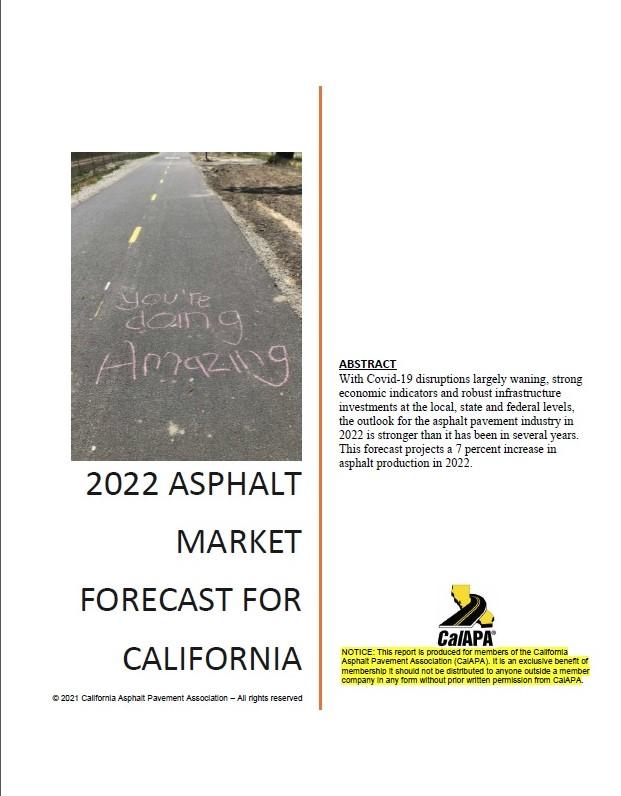
The 2022 Asphalt Market Forecast for California, an exclusive member-only benefit, is now available. See the Dec. 3 "Member Alert" for details on how to download this essential report, or contact the association at the link below to request your copy.
|
|
We hope you enjoy CalAPA's Asphalt Insider newsletter. We are committed to providing you with the most up-to-date information on technical issues, regulation, news, analysis, events and trends in California that is of interest to the asphalt pavement industry and our various agency partners. Click HERE to contact us with any comments or suggestions.
Sincerely,
Russell W. Snyder, CAE
Executive Director
California Asphalt Pavement Association (CalAPA)®
|
|
The "Asphalt Insider" is an official publication of the California Asphalt Pavement Association. For more information or to inquire about membership, call (916) 791-5044, or click HERE to contact us. Copyright © 2022 California Asphalt Pavement Association -- All Rights Reserved. The CalAPA name (No. 5,621,794) and logo (No. 5,621,795) are registered trademarks with the U.S. Patent & Trademark Office.
|
|
P.O. Box 981300, West Sacramento, CA 95798
1550 Harbor Blvd., Suite 211, West Sacramento, CA 95691
|
|
|
|
|
|
|
|