|
The California Asphalt Pavement Association
Vol. 19, Issue 27 || July 6, 2026
| | |
Greetings!
This weekly report contains news and information of interest to the asphalt pavement industry, customers and agency partners in California. Please feel free to distribute this newsletter to others who may be interested in asphalt pavements. To subscribe to the newsletter click HERE. To provide feedback or story ideas click HERE. Having difficulty viewing this newsletter? View as Webpage
| |
Bill to streamline mitigation for transportation improvement projects clears key policy hurdle | | |
An industry-endorsed bill to streamline the delivery of transportation improvement projects cleared a key legislative hurdle last week.
The bill, AB2059, authored by Assemblywoman Lori Wilson, D-Suisun (pictured), passed the Senate Environmental Quality Committee on a 5-0 vote on July 2.
“I am thrilled AB 2059 passed the Senate Environmental Quality Committee with bipartisan support,” Wilson, who is also the chairwoman of the Assembly Transportation Committee, told Asphalt Insider. "I look forward to seeing this bill, which would help streamline rural transportation projects, cross the finish line.”
The bill is being sponsored by CalAPA-supported Transportation California. It seeks to place a cap on the cost of California Environmental Quality Act (CEQA) mitigation measures for significant transportation projects located in rural counties. The bill has been amended during its journey through the Legislature and is expected to be amended again before it reaches the Senate Floor. Nevertheless it represents a trend in in the Legislature to attempt to address massive red tape and other obstacles that hamper the state's ability to address its housing and transportation needs.
Last month the Legislature advanced a $11.25 billion affordable housing and homeownership bond, which will appear on the November ballot. SB417, authored by state Sen. President Pro Tem Monique Limon, D-Santa Barbara, was signed into law by the governor June 25. On its way to becoming law, the bill picked up a sardonic "YIMBY" label as a counter to longstanding anti-development "NIMBY" movements, or "Not In My Back Yard." A press release about the bill is HERE.
In a support letter for AB2059 joined by CalAPA, Transportation California wrote that the bill is "reinforcing a core principle of CEQA: mitigation should be feasible, proportional, and effective. Today, project sponsors are often directed toward mitigation strategies that are expensive, operationally complex, and uncertain in their ability to meaningfully influence travel behavior or reduce emissions. These requirements can add significant cost to project budgets, diverting limited transportation funding away from investments that reduce congestion, improve safety, and support multimodal access, all of which contribute to emissions reductions.
"This raises a fundamental issue of cost-effectiveness," the letter stated. "At a time when transportation funding is constrained, California must ensure that every dollar spent delivers the greatest possible climate and mobility benefit. AB 2059’s targeted 5 percent cap in rural counties helps ensure that mitigation remains a meaningful component of project delivery without overwhelming the projects themselves. This allows agencies to balance mitigation investments with other strategies that reduce emissions, including system preservation, operational improvements, and multimodal enhancements."
The next stop for the bill is the fiscal Senate Appropriations Committee. More information about the bill can be found HERE. More information about Transportation California is HERE. Information on CalAPA's advocacy mission can be found HERE.
| |
New publication offers practical tips to improve energy efficiency at asphalt plants | |
The National Asphalt Pavement Association (NAPA), a CalAPA partner, has released a free technical publication intended to provide tips for optimizing the energy efficiency of asphalt plants. An announcement about the publication is HERE.
Focusing on a key aspect of plant operations, burner tuning, the publication demonstrates how a simple maintenance practice can deliver measurable environmental benefits and cost-savings. A case study highlights how one plant reduced emissions by 10% and lowering energy intensity by 11%, saving about $0.21 per ton in production savings. The improvements also have positive implications for a facility's Environmental Product Declaration (EPD) report.
The release of the technical publication is part of a larger industry trend to continue to improve efficiency and reduce emissions of asphalt operations, which is connected to a larger "The Road Forward" goal for the industry to achieve net-zero carbon emissions by 2050. You can learn more about that initiative HERE. CalAPA's various environmental-related reports and fact sheets can be found HERE.
| | |
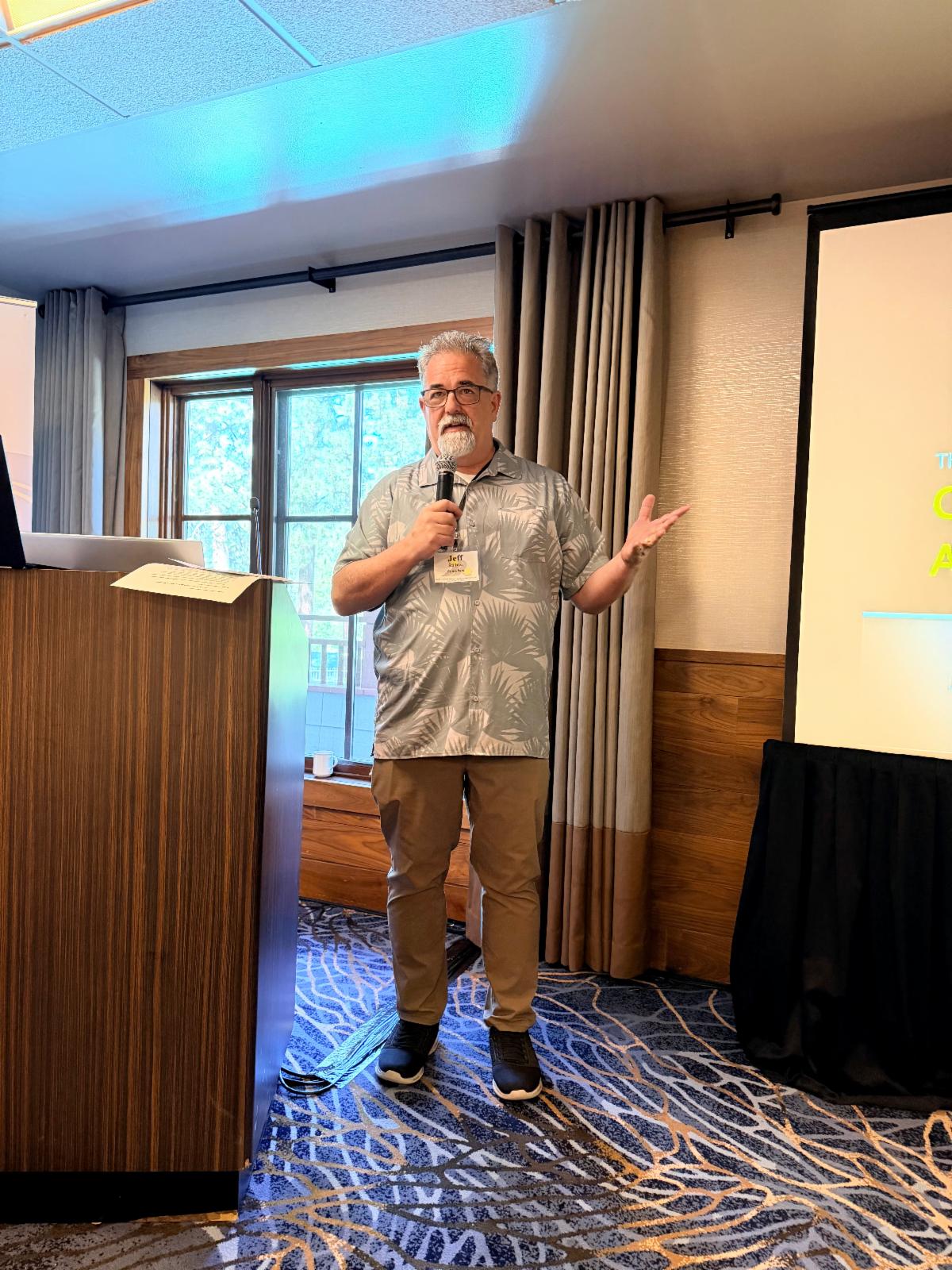
One of the speakers at CalAPA's "Summit at the Summit" Executive Leadership Forum, communications consultant and media personality Jeff Bliss (pictured), demonstrated his skill behind the camera when one of his photos was published over the weekend in the Orange County Register.
His photo of a junior lifeguard training graduation held in Laguna Beach appeared on Page A2 of the newspaper. It is also reproduced below.
Bliss is a familiar name to the asphalt industry. In addition to conducting a crisis communications presentation at the "Summit" event at Lake Tahoe, he also wrote about the topic in a previous issue of CalAPA's association magazine HERE.
All registered attendees of the event were sent an e-mail with instructions on how to download all the presentations delivered at the event. Questions should be directed to CalAPA at (916) 791-5044.
We know the photo is not really asphalt-related, but no doubt everyone who went to the beach that day, and all around California over the holiday weekend, traveled there on an asphalt road and parked on an asphalt parking lot. So that is our justification for publishing an otherwise impressive photo.
And since we're noting contributions by "Summit" speakers since the event, a column by keynote speaker Dan Walters marking the nation's 250th anniversary ran over the weekend in CalMatters, the on-line news site. That commentary is also share-worthy and can be read HERE. Happy Birthday, America.
| |
| | Graduates of a junior lifeguard program pictured in Laguna Beach on Thursday, July 2. Photo by Jeffrey C. Bliss. Copyright (C) 2026 -- All Rights Reserved. Used with Permission. | | | |
Longtime industry advocate Charley Rea to retire | |
Charley Rea, a longtime construction materials advocate and participant at numerous technical and policy meetings between Caltrans and the construction industry, will be retiring, it was announced.
Known for his gentlemanly demeanor, dry wit and vast storehouse of information about concrete and aggregates, Rea leaves behind a legacy of effective advocacy. He is pictured, seated third from the left, during a 2018 signing ceremony for the Caltrans-industry Pavement & Materials Partnering Committee (PMPC) charter, surrounded by Caltrans officials.
An announcement to fill the position, Director of Concrete Advocacy & Industry Affairs, is HERE.
| |
|
Each week we highlight a word, acronym or other term commonly used in the asphalt pavement industry in California.
DIAMOND GRINDING: A process that uses a series of diamond-tipped saw blades mounted on a shaft or arbor to shave the upper surface of a pavement to remove bumps, restore pavement rideability, and improve surface friction.
| |
Paving Pointer of the Week | |
Each week we highlight a key point or best practice of interest to asphalt paving crews, inspectors and others working in the field. We welcome suggestions. More tips can be found in our "Asphalt Parking Lot Construction Checklist" HERE. Information on the CalAPA "Quality Paving Certificate" program is HERE.
TONNAGE CALCULATION: Are there enough trucks on the run to haul the mix needed to complete the job? If you have five trucks on the round each carrying 25 tons = 125 tons per round. If each round takes one hour to make, then the production rate is 125 tons per hour. If the job requires 1,000 tons at 125 tons per hour = eight hours to get the mix to the job.
| | |
Each week we highlight a term that is specific to climate-change issues related to the asphalt pavement industry. This feature is intended to raise awareness of the asphalt industry's climate-change initiatives and the specialized terminology that goes with them. More information on "The Road Forward" asphalt industry climate initiative can be found HERE. A recent CalAPA magazine story on the topic is HERE.
KYOTO PROTOCOL: A 1997 international treaty where nations detailed emission reduction targets for first time.
| |
Caltrans Statewide Crude Oil Price Index | |
Editor's Note: As a convenience to our readers, Asphalt Insider reports the most current Caltrans "Statewide Crude Oil Price Index" posting. The department posts this monthly on its public website HERE. The index is used to calculate payment adjustments for paving asphalt under special provisions section "Payment Adjustments for Price Index Fluctuations" in those projects containing the section. The department posts the index on or about the first business day of the month using the daily Brent crude oil prices from the previous month as reported by Business Insider. Inquiries about the index should be directed to Caltrans at: Oil.Index@dot.ca.gov .
July 2026: $457.2 ($/ton)
Last month: $565.2
1 year ago: $378.5
| |
|
"Knowing is not enough: we must apply. Willing is not enough; we must do."
– Johann Wolfgang von Goethe
| | |
We hope you enjoy CalAPA's Asphalt Insider newsletter, widely regarded as the most influential publication of its type in California. We are committed to providing you with the most up-to-date information on technical issues, regulation, news, analysis, people, events and trends in California that is of interest to the asphalt pavement industry and our various agency partners. To subscribe to the newsletter, click HERE. For comments, questions or to suggest a story idea, click HERE. We are committed to promptly notifying our readers of any errors in this publication. Please click on the comment link above to alert the editor of any errors or omissions.
Sincerely,
Russell W. Snyder, CAE
Executive Director
The California Asphalt Pavement Association (CalAPA)®
| | The "Asphalt Insider" is an official publication of the California Asphalt Pavement Association. For more information or to inquire about membership, call (916) 791-5044, or click HERE to contact us. Copyright © 2026 California Asphalt Pavement Association -- All Rights Reserved. The CalAPA name (No. 5,621,794) and logo (No. 5,621,795) are registered trademarks with the U.S. Patent & Trademark Office. | | | | |