California Asphalt Pavement Association
Vol. 15, Issue 6 || Feb. 7, 2022
|
|
Greetings!
This weekly report contains news and information of interest to the asphalt pavement industry, customers and agency partners in California. Please feel free to distribute this newsletter to others who may be interested in asphalt pavements. To provide feedback or story ideas click HERE. Having difficulty viewing this newsletter? View as Webpage
|
|
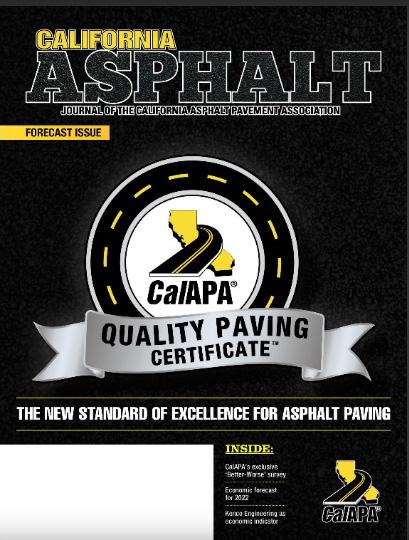
Special forecast issue of CalAPA's magazine, California Asphalt, now on line
|
A special forecast issue of CalAPA's official magazine, California Asphalt, is arriving in mailboxes around the state this week. An on-line version of the issue can be viewed HERE.
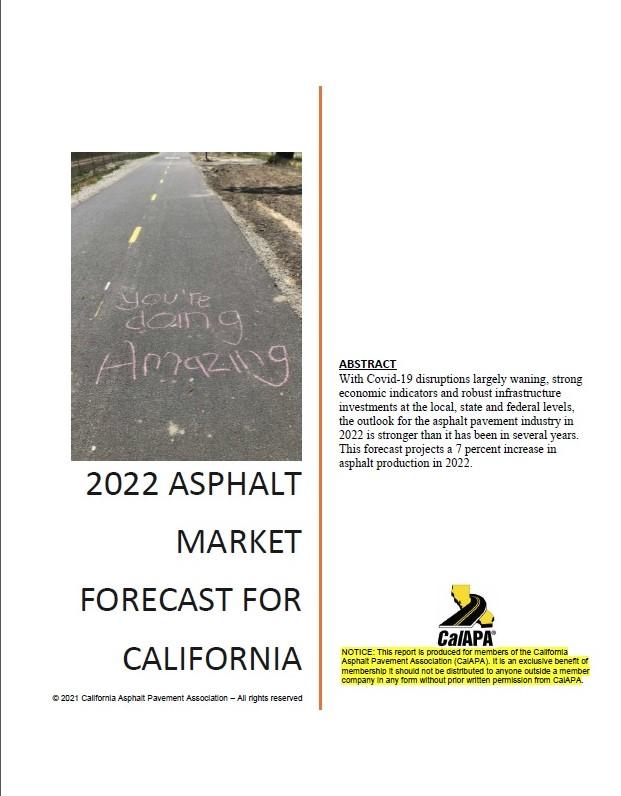
The issue features a roundup of the various economic forecasts for the state and the nation by UCLA, Chapman University and others. The story complements the special report, "2022 Asphalt Market Forecast for California," which was distributed to all CalAPA members in December and the subject of a special member-only webinar in January. To receive a copy of the report, CalAPA members are asked to submit a request to the association via an on-line feedback form HERE.
The cover story of this month's magazine highlights the Quality Pavement Certificate program recently launched by CalAPA to establish a new standard for excellence in the paving industry. The issue also features a story on CalAPA member Kenco Engineering, a California-based manufacturer and distributor of wear parts for the construction industry. The company has become a bellwether indicator over the years of economic trends in the asphalt industry. The issue also includes a roundup of association-related news and the results of CalAPA's exclusive "Better-Worse" survey.
California Asphalt magazine, now entering its 25th year of publication, is produced six times a year and distributed to industry leaders and public works officials statewide. The magazine provides exclusive, in-depth coverage of issues and trends that impact the asphalt pavement industry in California. For advertising inquiries, contact Kerry Hoover of Construction Marketing Services at (909) 772-3121. A 2022 advertising rate sheet for the magazine can be found HERE. An archive of past issues of the magazine can be found HERE.
|
|
A look forward: Moisture sensitivity |
Editor's Note: In last week's newsletter we featured a look back at a 2002 newsletter article on moisture sensitivity. You can read that article HERE. This week CalAPA's Technical Director, Brandon Milar, P.E., examines the current and future state of the issue.
---[
Last week we shared with you a newsletter item related to moisture sensitivity that was shared nearly 20 years ago. During the 2000’s most of the meetings held between industry and Caltrans were related to resolving concerns with premature failures related to moisture damage of Hot Mix Aphalt (HMA). Today, our technical discussions revolve around recycling, Balance Mix Design, and appropriate penalties for non-compliant materials. Our discussions related to moisture sensitivity are primarily focused on regions that have not fully accepted the best practices and testing protocols that resulted from the Caltrans and industry partnering effort.
This successful partnering effort between Caltrans and industry included the open discussions with the many stakeholders, collaboration with experts from across the United States, and the utilization of our university research partners and Caltrans’ contracted engineering services resources. Caltrans hosted a national seminar in 2003 that resulted in a summary on the current state of the practice and methodologies to minimize the moisture sensitivity of HMA. Several of these best practices were identified and subsequently put into practice.
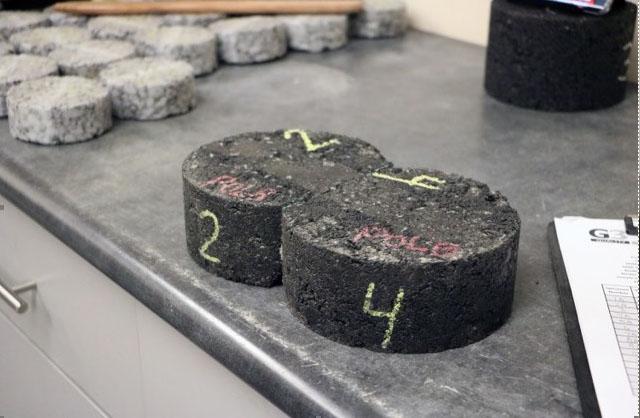
Caltrans included testing requirements for HMA utilizing the Hamburg Wheel Tracking Test (AASHTO T324/CT389) and the Standard Method of Test for Resistance of Compacted Asphalt Mixtures to Moisture-Induced Damage (AASHTO T283). These tests are used to design mixes on Caltrans projects. As with any new test, Caltrans and industry representatives continue to review and revise these tests to improve their implementation. As part of this process Caltrans expanded the types of acceptable treatments for use to minimize moisture sensitivity. At the time, lime treatment of the aggregates used in mix production was the primary methodology used. The effort evaluated and included liquid antistrip additives based on their improved chemistry and performance in lab and field trials. Recently Caltrans included a new class of antistrip additives, "organosilanes," to the acceptable treatment list based successful lab and field evaluations compared to lime treated mixes.
Finally, the group included the plasticity index requirement on the fine aggregates to identify the existence and quantity of clay materials. These clay materials were shown to contribute to the moisture sensitivity of mixes. Testing has not shown a significant clay issue in aggregates throughout most of California. It does provide insurance as more materials are imported into regions due to the concern with dwindling permitted aggregate reserves.
In the end, we look toward these partnering efforts as models for success in future endeavors. We recognize the importance of providing open forums where stakeholders can interact and share research, lab and field experience, and successful strategies. Partnering results in the efficient resolution to issues and the ability to successfully implement innovative strategies to meet a mutual goal: asphalt pavements that perform as designed and are a good value for the owner.
|
|
Asphalt's speed-of-construction & smooth-ride attributes (plus recycling) on display at 1st NASCAR race at L.A.'s Memorial Coliseum |
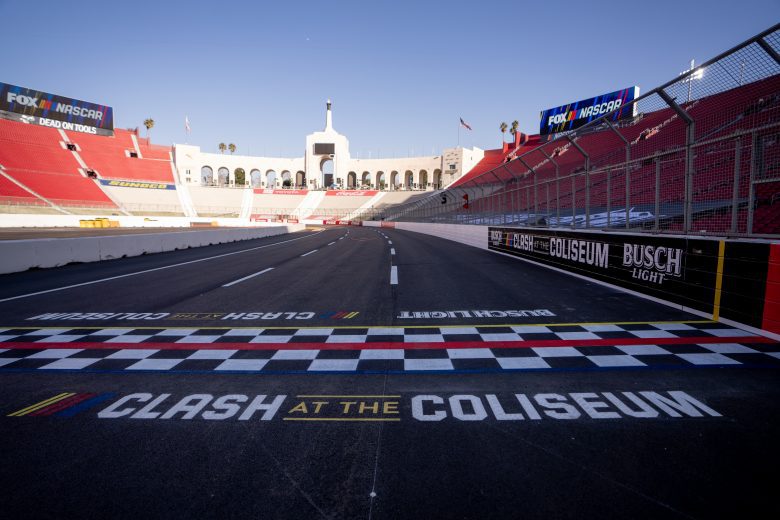
L.A.s venerable Memorial Coliseum, inspired by its namesake in Rome, has witnessed many monumental events over the years, including the 1932 and 1984 Olympics, two Super Bowls, a World Series, countless USC football games and epic rock concerts. But in a first, the stadium hosted the inaugural race of the NASCAR 2022 racing season Sunday when a temporary asphalt race track was constructed inside the stadium. Yes, you read that right -- inside the stadium.
Dubbed "Busch Light Clash at the Coliseum," the roaring race cars careened around a quarter-mile track built inside the stadium just for the race as thousands cheered. When the smoke cleared, Joe Logano driving the No. 22 Ford Mustang beat out an all-star field, including second-place finisher Kyle Bush. Fittingly, Logano's car was painted "CalAPA yellow." (Our apologies to official sponsor Pennzoil).
Broadcast live on FOX to a national audience, the exhibition race generated buzz not only for the drivers and fans, but also the race commentators. "The track was awesome," noted race commentator Clint Bower following the race. The race track was just a quarter-mile oval, reminiscent of dirt tracks at country fairs, and the final race was 150 laps but covered just 37 miles -- or just slightly longer than the nearby Harbor Freeway that connects downtown to San Pedro. A story about the track construction is HERE.
The massive challenge with putting on a race inside the Coliseum largely centered on quickly converting a football venue to a race track, and then converting it back to a football venue without doing any permanent damage. Contractors placed nearly 14,000 cubic yards of asphalt, to a depth of about 4 inches, on top of about 9,200 cubic yards of crushed base, above a foot of fill increasing to about 4 feet on the outside to create the 2.5-degree bank. Barricades were added for safety, and the first 14 rows of the Coliseum seating for football was blocked off from spectators.
Although the race cars could not reach the 180 mph speeds often seen at Daytona and other major NASCAR tracks, racers nevertheless reached more than 60 mph before veering into the tight turns at around 40-plus mph. The speeds in practice runs and on race day were substantially higher than computer simulations run by race track designers. Logano's fastest lap averaged 67.4 mph, and was completed in a blistering 13.3 seconds. He led for 34 of the final race's 75 laps. That's a lot faster than the Harbor Freeway, particularly during rush hour.
Of course, for race cars a smooth riding surface can be the difference between life and death, which is why asphalt is the preferred pavement surface for tracks of all types nationwide. Also, asphalt's speed-of-construction advantage, often on display in major freeway construction and emergency work, also was the only option for such an audacious exhibition race. Finally, asphalt's environmental credentials also were on display. All of the asphalt placed for the special race will be ground up and recycled into new pavement elsewhere in the Los Angeles area.
Although the asphalt pavement industry also likes to boast of how long its product lasts, from long-life pavement applications that last 40 or more years and needing minimal maintenance, in this particular case the useful life of the project was just two days. The L.A. Memorial Coliseum needs the asphalt cleared out by Feb. 27 to make way for a rugby match by the Los Angeles Giltinis, the city's Major League Ruby team, the latest gladiators to take the field in the Coliseum.
|
|
Each week we highlight a word, acronym or other term commonly used in the asphalt pavement industry in California.
COARSE GRADED AGGREGATE: An aggregate having a continuous grading in size of
particles from coarse through fine with a predominance of coarse sizes.
|
|
Paving Pointer of the Week |
Each week we highlight a key point or best practice of interest to asphalt paving crews, inspectors and others working in the field. We welcome suggestions. More tips can be found in our Asphalt Parking Lot Construction Checklist HERE.
PROJECT REVIEW: Every paving project should start with a detailed review of the project's
contract, plans, and specifications. Any questions arising from this review should be directed to
the design firm's engineers.
|
|
Editor's Note: This week we launch a new feature for the newsletter, a "Climate Term of the Week." This feature is intended to raise awareness of the asphalt industry's climate-change initiatives and the specialized terminology that goes with it. More information on the "Road Forward" asphalt industry climate initiative can be found HERE.
CARBON CREDIT: Trade-able certificate used in carbon mitigation policy systems.
|
|
“Don’t trip over what’s behind you.”
-- Bumper Sticker
|
|
CALAPA CALENDAR:
View all CalAPA events HERE.
*
"Asphalt Pavement 101" class in virtual format.
Wednesday & Thursday, Feb. 16 & 17
*
"Asphalt Forensics" class in virtual format
Wednesday, Feb. 23
*
"Quality Asphalt Paving" class in virtual format
Thursday, Feb. 24
*
"Asphalt Pavement 101" class (in-person)
Wednesday, March 16, 8 a.m. to noon
Doubletree Hotel, 222 N. Vineyard Ave., Ontario.
*
CalAPA Annual Dinner
Thursday, May 19, 2022
Jonathan Club, 545 S. Figueroa St., Los Angeles
|
|
There's never been a better time to join the California Asphalt Pavement Association! Members receive insight and advanced notice on critical issues that impact every company's bottom line. CalAPA members also receive invitations to exclusive member-only events, in-depth "Member Alerts," our comprehensive asphalt market forecast for California, discounts and industry-specific networking opportunities not available anywhere else. CalAPA's new searchable on-line membership directory helps connect potential customers with member companies. Click HERE to download our Member Service brochure. Click HERE to view Vol. 1 of recent testimonials. Not convinced? Click HERE to view Vol. 2 of recent testimonials. Click HERE to send us an e-mail inquiry, or contact Bill Knopf with CalAPA at (442) 400-9697. |
|
|
|
2022 Asphalt Market Forecast |
The 2022 Asphalt Market Forecast for California, an exclusive member-only benefit, is now available. See the Dec. 3 "Member Alert" for details on how to download this essential report, or contact the association at the link below to request your copy.
|
|
We hope you enjoy CalAPA's Asphalt Insider newsletter. We are committed to providing you with the most up-to-date information on technical issues, regulation, news, analysis, events and trends in California that is of interest to the asphalt pavement industry and our various agency partners. Click HERE to contact us with any comments or suggestions.
Sincerely,
Russell W. Snyder, CAE
Executive Director
California Asphalt Pavement Association (CalAPA)®
|
|
The "Asphalt Insider" is an official publication of the California Asphalt Pavement Association. For more information or to inquire about membership, call (916) 791-5044, or click HERE to contact us. Copyright © 2022 California Asphalt Pavement Association -- All Rights Reserved. The CalAPA name (No. 5,621,794) and logo (No. 5,621,795) are registered trademarks with the U.S. Patent & Trademark Office.
|
|
P.O. Box 981300, West Sacramento, CA 95798
1550 Harbor Blvd., Suite 211, West Sacramento, CA 95691
|
|
|
|
|
|
|
|