|
The California Asphalt Pavement Association
Vol. 18, Issue 12 || March 24, 2025
| | |
Dear Russell,
This weekly report contains news and information of interest to the asphalt pavement industry, customers and agency partners in California. Please feel free to distribute this newsletter to others who may be interested in asphalt pavements. To subscribe to the newsletter click HERE. To provide feedback or story ideas click HERE. Having difficulty viewing this newsletter? View as Webpage
| |
Special report: Road-focused CalAPA delegation descends on state Capitol | |
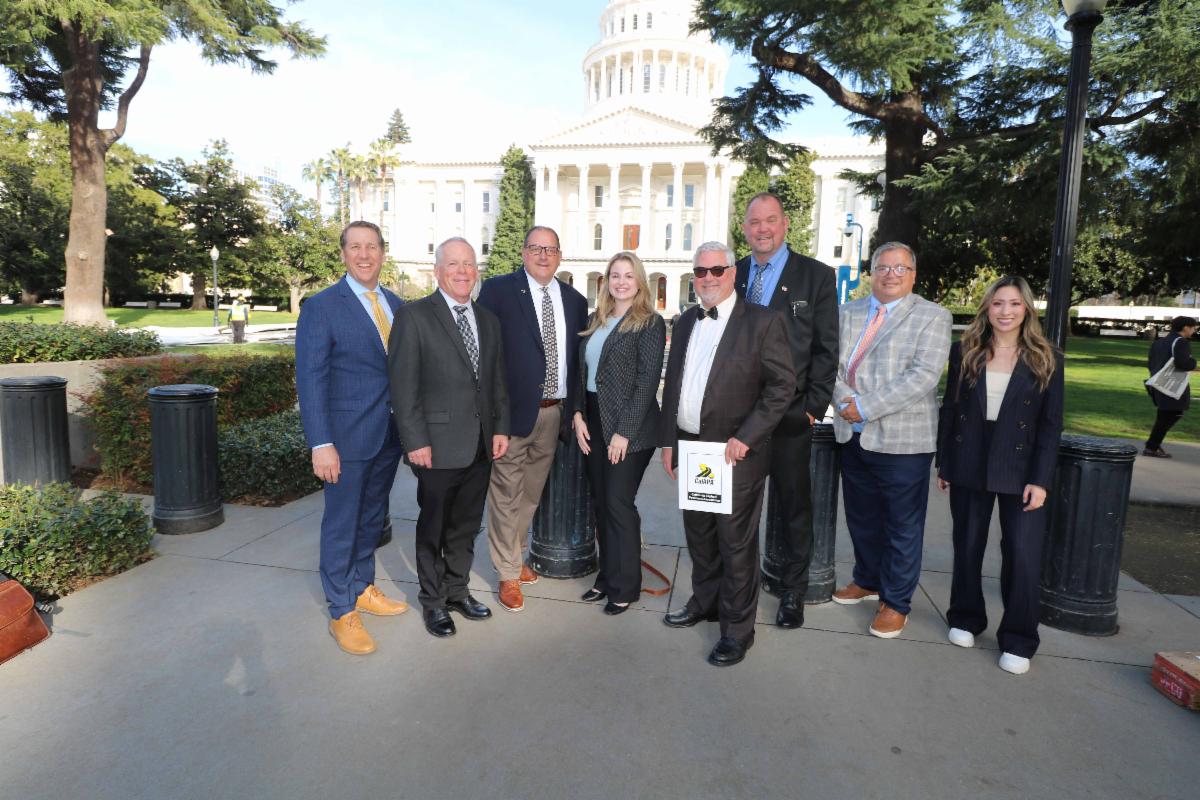
CalAPA members, laser-focused on road repair and armed with revealing new data to make their case, met with dozens of legislators and staff last week at the association's annual Capitol "Fly-in" to Sacramento.
The diverse CalAPA delegation was led by the association's 2025 Chairman, Scott Metcalf with Ergon Asphalt & Emulsions, as well as Legislative Committee Chair Steve Ward with Pavement Recycling Systems and Political Action Committee Chair Brian Handshoe with Kenco Engineering -- all veterans of engagement with elected officials in Sacramento and Washington, D.C. They were joined by Gary Houston with Valero Energy, a member of the Board of Trustees of CalAPA's newly established charitable arm, the California Asphalt Research & Education (CARE) Foundation.
The delegation also included some new faces this year, including new Board Member Eric Richard with Reed & Graham, and Board Member Phil Reader with the Reed Family Companies, who is also active in the CalAPA Technical Advisory Committee and the Caltrans-industry Pavement & Materials Partnering Committee. Another first-timer was Sarah Sisson with All States Materials, who is active in the Women of Asphalt California Branch (WofACA). Joining them in the first-timer club was Pete Lambert with McGuire & Hester, an occasional CalAPA trainer who represents Northern California paving contractors on the CalAPA Board of Directors. Houston, Sisson and Lambert represented the industry eloquently when the subject of asphalt-related career opportunities was a topic of conversation.
The legislative appointments were coordinated by CalAPA's Sacramento lobbyist, Jeff Sievers, assisted by Beverly Yu, of the advocacy firm Carpenter Garcia Sievers, recently recognized by the Sacramento Business Journal as one of the top lobbying firms in California.
"I so enjoyed the 'Fly-in this week in Sacramento!" Sisson said via e-mail afterward. "It is a one-of-a-kind event and I hope to be able to attend in the coming years."
The March 18-19 event began with a lunchtime briefing at the exclusive Sutter Club a block from the Capitol dome, followed by scheduled appointments with elected officials and staff members and an elegant dinner back at the Sutter Club. Day 2 included more appointments, and wrapped up with a joint lunch-debrief with the CalAPA Board of Directors at the executive board room of the Sutter Club.
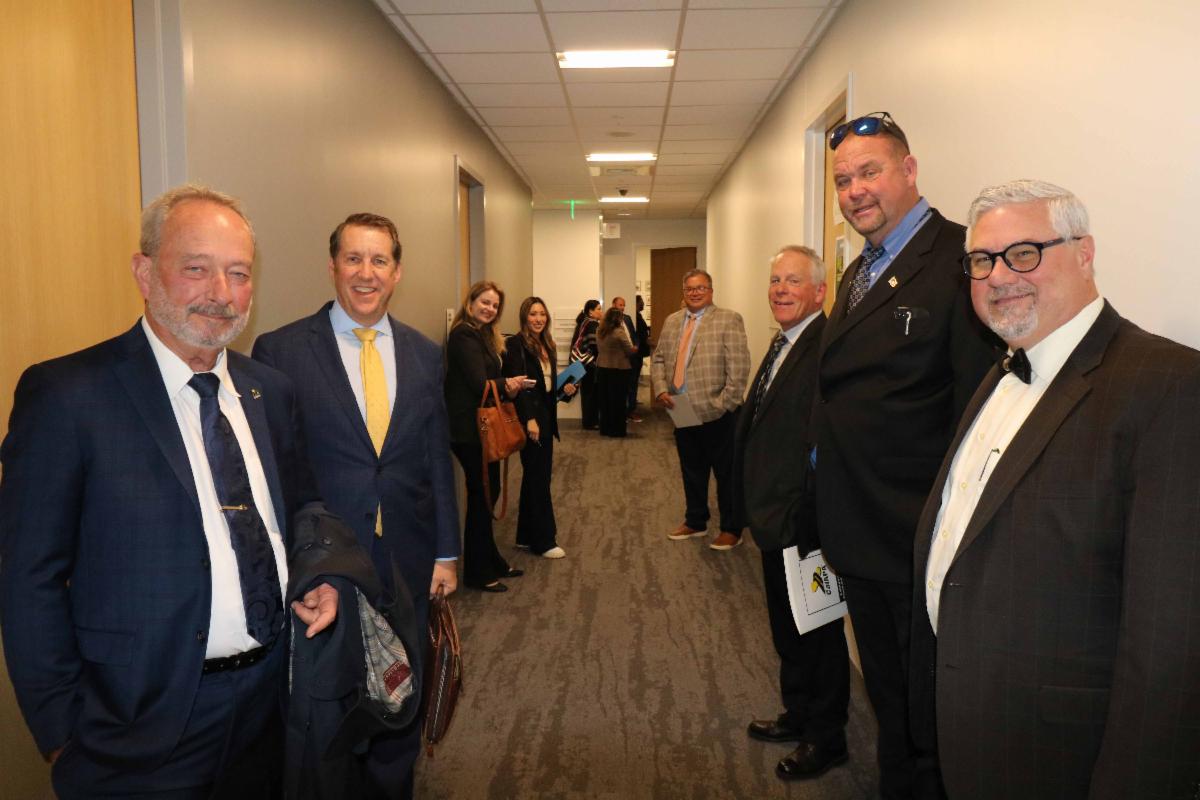
As was the case with previous "Fly-ins," there were numerous hallway encounters with legislators and staff at the State Office Building that is serving as a temporary home to legislative offices during an extensive remodel of the historic Capitol. One of those hallway encounters was with Assemblyman Juan Alanis, R-Modesto, who despite rushing to a meeting stopped dead in his tracks to exchange pleasantries with the CalAPA delegation.
Central to the discussions this year is the persistent lack of traditional road-repair projects that were expected following the passage of SB1, the "Road Repair & Accountability Act of 2017." Despite the promises of SB1 backers that the $50 billion tax measure would address years of neglect to state and local roads, the 28th annual Highway Report by the Reason Foundation, a think tank, recently ranked California 49th of the nation's 50 states in cost vs. quality, down from 47th last year. A summary of the findings focusing on California can be found HERE.
The report tracks with CalAPA's own analysis of Caltrans highway maintenance expenditures, which the association has shown to be flat or declining in recent years. Key elected officials and committee staff expressed interest in the CalAPA data, which was shared with them following the meetings and also part of a special presentation to the CalAPA Board of Directors. Following numerous anecdotal reports from members, the association utilized Caltrans data to develop an analysis in 2023 to confirm the trend, and previously shared the information with Caltrans leadership. The new reports come as the Newsom Administration's California State Transportation Agency (CalSTA) released an update March 7 to its "Climate Action Plan for Transportation Infrastructure (CAPTI)," which de-emphasizes traditional system improvements, such as pavement repair, over travel-suppressing spending favored by environmentalists. A press release about the CAPTI plan update is HERE.
Another topic of discussion during the Fly-in was waning tax revenue devoted to roads due to the proliferation of electric vehicles, which pay no fuel tax and a nominal registration surcharge yet cause considerable wear-and-tear to roads and bridges. The Legislature held a hearing on the issue March 3, chaired by Assembly Transportation Committee Chair Lori Wilson. Previous Asphalt Insider coverage of that hearing is HERE.
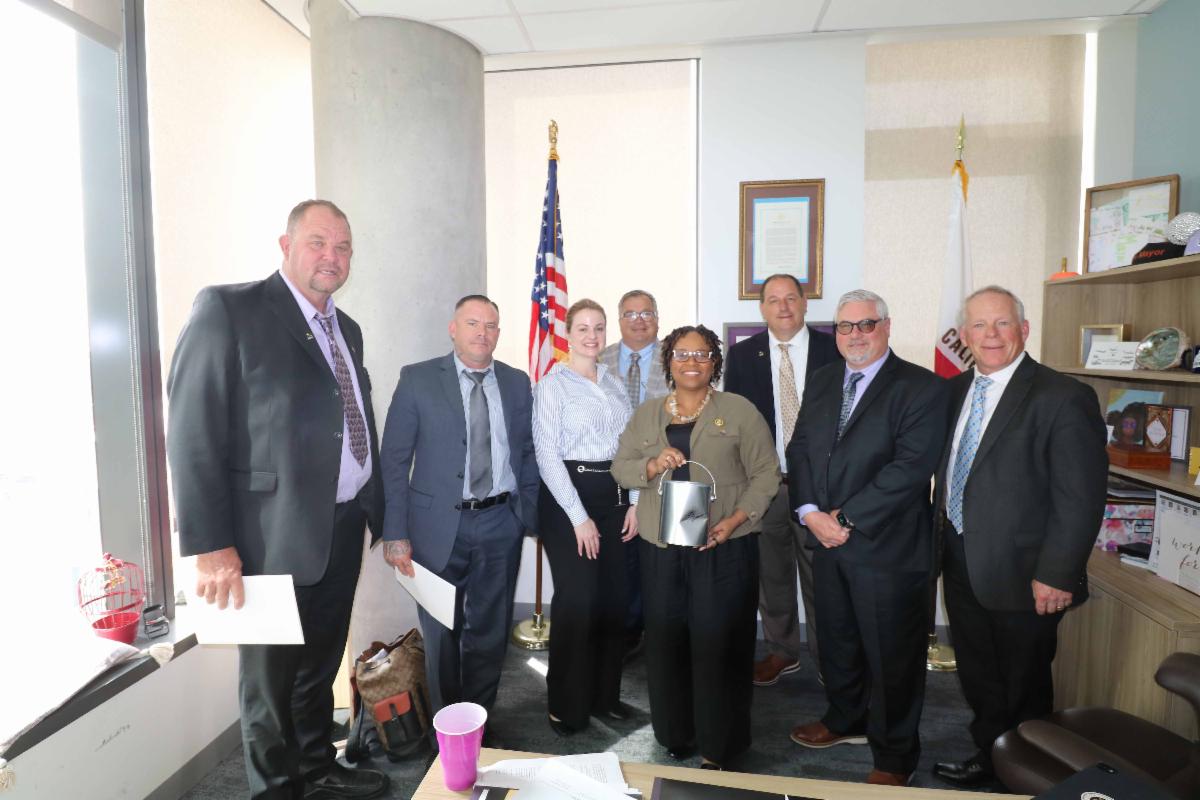
The CalAPA delegation met with Wilson, D-Suisun City, in her office on March 19, and she reiterated her pledge not to "kick the can down the road" on transportation funding as she stated at the CalAPA Annual Dinner Jan. 16 in Los Angeles. To emphasize the point, she pulled out the dented can presented to her back in January by CalAPA Hall of Fame inductee Skip Brown, which she said is proudly on display in her office as a daily reminder of her commitment.
Wilson has introduced a bill in the Legislature, AB1421, soon to be amended, meant to explore gas-tax alternatives for road funding. She is also carrying a highway safety bill, AB390. Both bills are supported by CalAPA as well as the CalAPA-supported coalition, Transportation California.
To learn more about CalAPA's legislative engagement, click HERE.
| | The CalAPA "Fly-in" delegation gets a briefing at the Sutter Club from CalAPA's lobbyist, Jeff Sievers (back to camera). | | Meetings with dozens of elected officials and staff members at the CalAPA "Fly-in" included numerous hallway encounters. | | Assembly Transportation Committee Chair Lori Wilson (center) displays the famous CalAPA "can" in her office on March 19. Pictured with her, from left: Pete Lambert, Phil Reader, Sarah Sisson, Erich RIchard, Wilson, Scott Metcalf, Brian Handshoe and Gary Houston. | |
Just added: CalAPA 'Asphalt Pavement 101' class April 23 in Sacramento | |
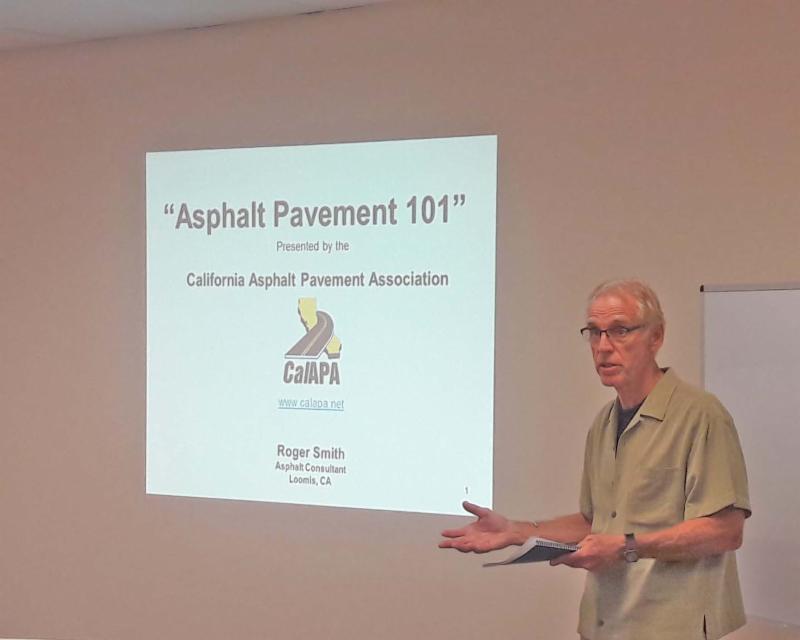
Due to increased demand, CalAPA has just added a new offering of its popular "Asphalt Pavement 101" class to its technical training calendar. The class will take place on Wednesday, April 23 from 10 a.m. to 4 p.m. in Sacramento. Seating is limited and registration must be done in advance on-line HERE.
CalAPA’s enormously popular "Asphalt Pavement 101" class is a good overview of everything asphalt, touching on how asphalt pavements are designed, constructed and maintained. It is taught by Roger Smith, a former senior materials engineer with Caltrans and the Asphalt Institute, as well as a former executive director of CalAPA. Attendees of this class can earn CEU credit via a nationally recognized Registered Continuing Education Program (details on the website).
The class is packed with loads of useful information for contractor and agency paving crews, quality control specialists, lab personnel and others who interact with asphalt pavements. The class will cover pavement structure and terminologies, asphalt binders, aggregates, asphalt mixes, plant operations and mix delivery, paving and rolling, acceptance specifications and testing.
Because so much is changing in the world of asphalt pavements, the class is an excellent refresher course for veterans in the industry as well as providing a good overview for those new to asphalt pavements. The class is a recommended prerequisite for other CalAPA technical classes, such as “Caltrans Section 39 Specifications,” “Essentials of Pavement Smoothness” and “Quality HMA Paving.”
All those attending the class will receive a handy reference workbook as well as a certificate of completion. The class may help satisfy the continuing education requirement of CalAPA's "Quality Paving Certificate." Details on that program can be found HERE.
The April 23 "Asphalt Pavement 101" class is being hosted by CalAPA member McGuire & Hester at their facility at 1016 N. Market Blvd., Suite 20 in Sacramento. There is ample free parking at the training site. Lunch and refreshments are included.
For more information on the CalAPA technical training program, click HERE. Details on other CalAPA classes and events can be found on the association's on-line calendar HERE.
| |
Free NAPA educational webinar April 7 will delve into 'circular economy' | |
If all this sustainability talk has your head spinning, the National Asphalt Pavement Association, a CalAPA partner, aims to help demystify the topic with a free educational webinar on April 7 from 11 a.m. to 12:30 p.m. PDT. Details and on-line registration is HERE.
Titled "A Primer on the Circular Economy," the webinar will be presented by Nick Mummau, senior project manager, Sustainable Solutions, Corp., and Amlan Mukerjee, Senior Director Sustainability & Intelligent Construction for NAPA.
The webinar will cover the concepts of a circular economy along with recent industry trends and how the circular economy impacts the asphalt business. Attendees will develop an understanding of the circular vs. a linear economy, knowledge of industry trends and market drives, and an awareness as to asphalt's role.
Other free NAPA educational webinars will be advertised HERE.
| |
Commentary: As Los Angeles faces a massive budget deficit, will the city's asphalt plants face new scrutiny? | |
Los Angeles Mayor Karen Bass, already under pressure for the city's response to the Palisades fires that devastated parts of her city, also faces the prospect of trying to close a yawning city budget deficit that she predicted could be up to $1 billion.
"We must leave no stone unturned," Bass said in March 19 letter to her city administrative officer calling for a budget plan that includes spending cuts. The text of that letter is HERE.
We have a suggestion: re-look at the two city-owned asphalt plants. This is not a new idea.
The Los Angeles Controller's Office previously questioned the wisdom of the city building a new asphalt plant in 2016 to serve its street maintenance crews. The cost of that plant skyrocketed from $10 million to $38 million, with a total debt service in one 2017 city memo pegging the cost at $60.2 million. A city Bureau of Engineering report on the project is HERE.
Then-City Controller Ron Galperin questioned the wisdom of the city producing its own asphalt when there is a robust private market nearby, and suggested that the City of Los Angeles do as other cities have done in recent years, including the City & County of San Francisco, and shutter its plant in favor of purchasing asphalt from a competitive private market. The City has operated Asphalt Plant 1 on East Olympic Boulevard since 1947. At a groundbreaking ceremony Feb. 9, 2017, then-Mayor Eric Garcetti touted the potential savings to be generated by the plant of up to $5 million per year, but the city has been mum on those optimistic projections since then. We wonder why.
If indeed the mayor wants to "leave no stone unturned" in the search for cost-savings, the city's two asphalt plants might be a good place to start.
| |
|
Each week we highlight a word, acronym or other term commonly used in the asphalt pavement industry in California.
OPEN GRADED AGGREGATE: An aggregate containing little or no mineral filler or in which the void spaces in the compacted aggregate are relatively large.
| |
Paving Pointer of the Week | |
Each week we highlight a key point or best practice of interest to asphalt paving crews, inspectors and others working in the field. We welcome suggestions. More tips can be found in our "Asphalt Parking Lot Construction Checklist" HERE. Information on the CalAPA "Quality Paving Certificate" program is HERE.
TONNAGE CALCULATION: Are there enough trucks on the run to haul the mix needed to
complete the job? If you have five trucks on the round each carrying 25 tons = 125 tons per round. If
each round takes one hour to make, then the production rate is 125 tons per hour. If the job requires
1,000 tons at 125 tons per hour = eight hours to get the mix to the job.
| | |
Each week we highlight a term that is specific to climate-change issues related to the asphalt pavement industry. This feature is intended to raise awareness of the asphalt industry's climate-change initiatives and the specialized terminology that goes with them. More information on "The Road Forward" asphalt industry climate initiative can be found HERE. A recent CalAPA magazine story on the topic is HERE.
WARM MIX ASPHALT: Technologies that allow for production at lower temperature.
| |
|
“A penny saved is a penny earned."
– Benjamin Franklin
| | |
We hope you enjoy CalAPA's Asphalt Insider newsletter. We are committed to providing you with the most up-to-date information on technical issues, regulation, news, analysis, people, events and trends in California that is of interest to the asphalt pavement industry and our various agency partners. To subscribe to the newsletter, click HERE. For comments, questions or to suggest a story idea, click HERE. We are committed to promptly notifying our readers of any errors in this publication. Please click on the comment link above to alert the editor of any errors or omissions.
Sincerely,
Russell W. Snyder, CAE
Executive Director
The California Asphalt Pavement Association (CalAPA)®
| | The "Asphalt Insider" is an official publication of the California Asphalt Pavement Association. For more information or to inquire about membership, call (916) 791-5044, or click HERE to contact us. Copyright © 2025 California Asphalt Pavement Association -- All Rights Reserved. The CalAPA name (No. 5,621,794) and logo (No. 5,621,795) are registered trademarks with the U.S. Patent & Trademark Office. | | | | |