California Asphalt Pavement Association
Vol. 14, Issue 52 || Dec. 27, 2021
|
|
Greetings!
This weekly report contains news and information of interest to the asphalt pavement industry, customers and agency partners in California. Please feel free to distribute this newsletter to others who may be interested in asphalt pavements. To provide feedback or story ideas click HERE. Having difficulty viewing this newsletter? View as Webpage
|
|
The year in review: Our picks for the Top 10 news stories that impacted the asphalt pavement industry in California in 2021 |
Editor’s Note: As 2021 draws to a close, we highlight our
choices for the Top 10 stories that impacted the asphalt
industry in California over the past year. Click HERE for our
Top 10 stories of 2020. Look for our 2022 predictions in next
week’s issue of this newsletter.
No. 1: $1.2 trillion bipartisan infrastructure bill becomes law
President Biden on Nov. 15 signed into law a signature $1.2 billion
infrastructure bill that is expected to pump more than $29.9 billion in federal transportation funds over five years into California, or about a 44% increase over current baseline funding for core highway and bridge programs. The passage of the bill, H.R. 3684, will ensure stability in federal funding and assist state and local agencies with developing
improvement projects that will be the centerpiece of the legislation, although highway projects made possible by the new dollars are not expected to appear on the street for a year or more. Thirteen Republicans joined majority Democrats to approve the historic measure on a 228-206 vote on Nov. 5. Of California’s 53-member Congressional Delegation – the nation’s largest – the vote was strictly along party lines. All 41 Democratic members voted for the bill and all 11 Republican members voted against it. The vote culminate years of coordinated lobbying by the asphalt pavement industry and other construction, union and transportation interests.A web page created by the Federal Highway Administration with additional details about the law is HERE. A fact sheet summarizing how the law will impact California can be found HERE.
No. 2: COVID-19 pandemic continued to cast a shadow over the state, nation
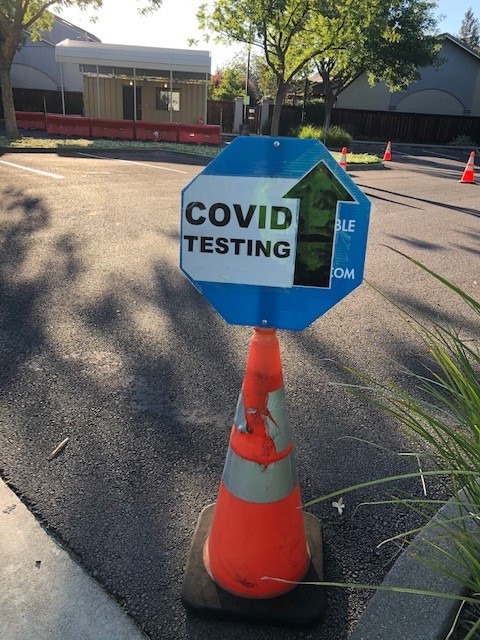
The COVID-19 pandemic confounded all efforts to put it in the rear-view mirror in 2021 just when it appeared it was on the wane over the summer. A new variant called Omicron quickly supplanted the previous dominant Delta variant, appeared to be more easily spread from person to person, and pushed up positive cases as the year drew to a close. That, in turn, contributed to ever-shifting guidance from public health officials to stem the spread. In a bit of a silver lining, however, the new variant did not seem to be resulting in a spike in hospitalizations and deaths as had occurred earlier in the progression of the disease. Going on two years of a global pandemic, more widespread availability of vaccines and treatments appeared to be helping blunt the most serious impacts of the virus. By Dec. 25, the California Department of Public Health reported nearly 5 million Californians had confirmed cases of COVID-19 since the pandemic arrived in force in the spring of 2020, resulting in 75,461 deaths. The CDPH said about 78.9 % of Californians have been vaccinated, but protection against the most serious health impacts of the disease, pneumonia-like systems that could lead to hospitalization and death, did appear to wane in those vaccinated or who previously contracted the disease, so health officials renewed calls for eligible persons to get vaccinated, or for those already vaccinated, to get booster shots and take other precautions. The construction industry in general, and the asphalt pavement industry in particular, designated as an essential service early on in the pandemic, continued to keep projects moving forward in 2021, albeit with periodic disruptions due to work force availability. Local jurisdictions and Cal/OSHA emergency temporary standards for workplaces continued to be in effect, including the wearing of masks indoors, and revisions were scheduled to be put into effect Jan. 14, 2022. More information on those workplace standards is HERE.
No. 3: Model asphalt specification for local agencies is released
A model asphalt pavement specification designed for use by cities and counties on local streets was unveiled Oct. 13 at the CalAPA Fall Asphalt Pavement Conference in Sacramento. The specification, more than 10 years in development, was published by the University of California Pavement Research Center's "CIty & County Pavement Improvement Center." The spec is the culmination of years of meetings between local, state and federal officials, industry experts and academia. It borrows on key elements of the asphalt specification used on the state highway system but with a number of changes to mix properties and testing that make it more appropriate for local roads with less traffic volumes. The HMA-LG specification is featured on the cover of the current issue of CalAPA's official magazine, California Asphalt, which can be viewed on-line HERE. The specification can be downloaded in Word format from the CCPIC website ("Sample Specifications" section) HERE.
No. 4: Long-life asphalt paving wraps up on Interstate 5 in Sacramento
The latest in a series of high-profile asphalt pavement projects designed to last 40 or more years wrapped up paving in 2021. Caltrans District 3 Director Amerjeet Benipal highlighted the project, a joint venture of Granite Construction and Teichert Construction, in his remarks at the CalAPA Fall Asphalt Pavement Conference Oct. 13 in Sacramento. The $370 million
Interstate 5 Corridor enhancement Project will ultimately result in the rehabilitation of 67 lane-miles of pavement, ramps and connectors utilizing a long-life asphalt pavement design that will last 40 years or longer with minimal maintenance. The design called for the utilization of about 600,000 tons of asphalt. Other projects utilizing similar design criteria have been built on I-5 in the North State, on Interstate 80 between Sacramento and the San Francisco Bay Area, and the trailblazing 710 project in Los Angeles County. The design strategy was a culmination of another collaboration between industry, Caltrans and the University of California Pavement Research Center.
No. 5: Gov. Gavin Newsom survives recall election that could have disrupted state agencies
Gov. Gavin Newsom became only the second governor in state history to face a recall vote, and also the first to prevail in such an election. Newsom easily survived the Sept. 14 election when 61% of California voters voted "no" on the recall and only 38% voted "yes." Had the recall been successful, Newsom would have been removed from office and replaced by the top vote-getter among the replacement candidates. Since that top vote-getter was talk show host Larry Elder, a Republican, it would have likely resulted in massive disruption among the higher leadership posts in state government, including in the transportation area, which are populated by political appointees. That was the case following the 2003 recall of Democrat Gov. Gray Davis, who was replaced by Republican Gov. Arnold Schwarzenegger.
No. 6: Construction General Permit for storm-water runoff sparks controversy
The California State Water Resources Control Board accepted public comment in 2021 for its proposed revisions to the Construction General Permit for storm-water runoff, which included harsh new standards that construction industry interests said were not feasible and analysis by Caltrans and others indicated would result in eye-popping cost-increases to highway construction and other roadway work of between $340 million and $570 million per year, which represents an approximately 50% to 100% increase in costs for compliance. More information on the issue can be found HERE. A Caltrans memo presented to the California Transportation Commission on this subject in October is HERE.
No. 7: CalAPA unveils "Quality Paving Certificate" program
The California Asphalt Pavement Association announced a program to help project owners identify asphalt paving companies with a demonstrated commitment to industry-recognized standards of excellence. The Quality Paving Certificate program would be conferred to companies that meet strict standards for excellence, including continuing education, a rigorous self-assessment, passing of a written exam and other criteria independently verified by the association. Details about the program are HERE.
No. 8: Air quality regulations continue to be at the forefront in California
Reducing emissions from on-road and off-road vehicles, as well as from asphalt plants, dominated the headlines in 2021. The South Coast Air Quality Management District adopted new regulations covering asphalt plant aggregate dryers, which was a result of many months of meetings with stakeholders including asphalt plant operators. The new regulations were prominently featured in the environment-themed issue of CalAPA's California Asphalt magazine, which can be viewed on-line HERE. A number of current and proposed regulations overseen by the California Air Resources Board, including advanced clean truck regulations, air toxic "hot spots," the on-going implementation of AB617 community air quality standards and off-road engine regulations continued to challenge the industry to stay on top of ever-changing standards. In an effort to counteract vast amounts of misinformation on the topic, often amplified by social media, CalAPA developed a public-facing fact sheet of information and references directed at communities HERE.
No. 9: Workers remain in high demand
The annual CalAPA "Better-Worse" survey once again found demand for qualified workers among the chief concerns expressed by both industry and agency personnel responding to the survey. The issue is likely to be more acute as public and private asphalt pavement work is expected to increase in the coming year, according to a CalAPA Market Forecast.
No. 10: Disruptions continue to challenge the industry
The COVID-19 pandemic, plus work force, logistics and other disruptions, continued to create havoc and uncertainty in supply chains and markets, even as pavement projects appear to be on an upward trajectory after years of under-investment, particularly in the public sector. The asphalt industry's vaunted efficiencies in delivering its product to customers were continually put to the test in 2021.
|
|
Gavin Newsom (second from right) speaks with CalAPA members during an appearance at a CalAPA event in Los Angeles in 2015. He survived a recall attempt in 2021. |
|
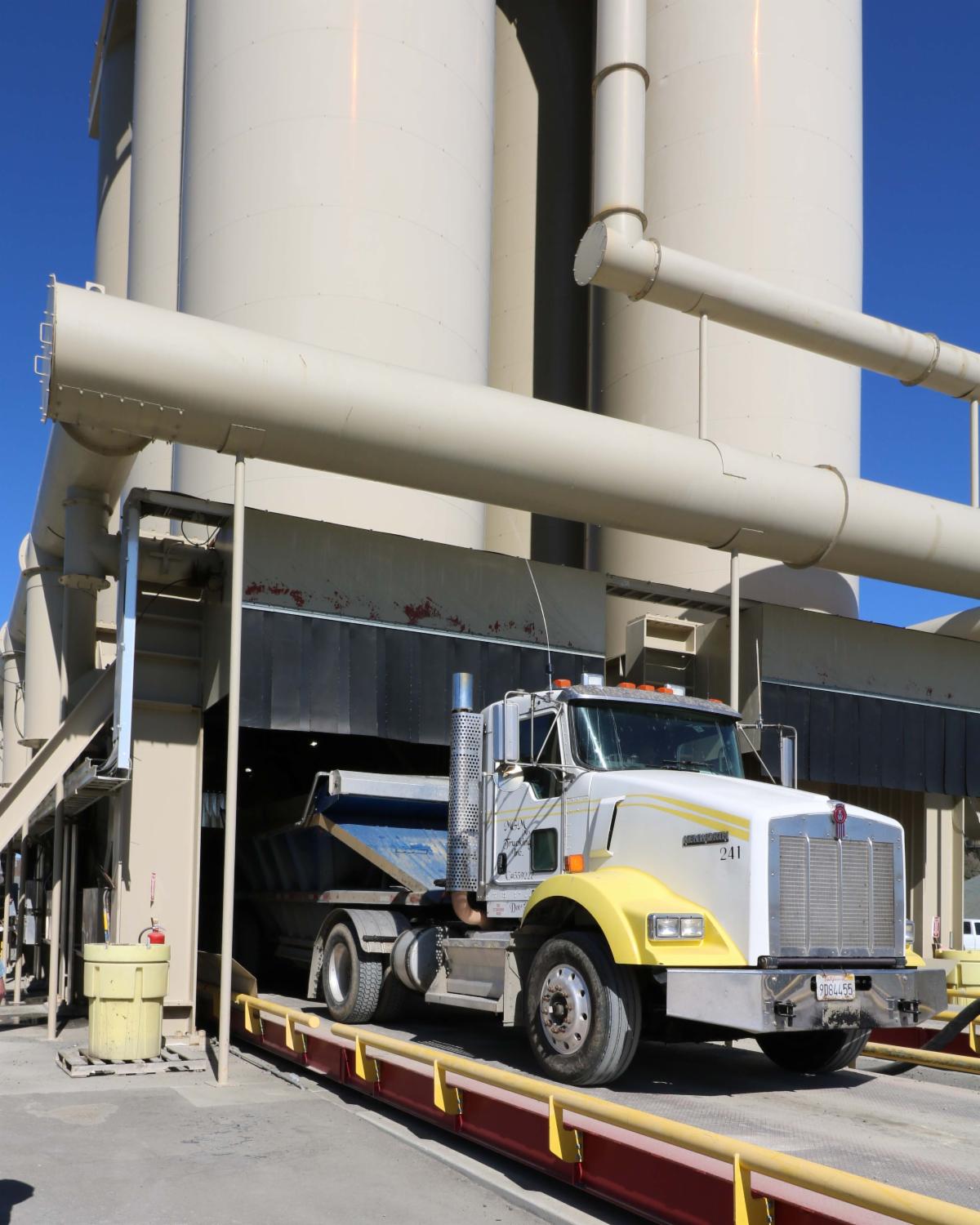
Truck regulations, plus logistic challenges, were ever-present in 2021. |
|
A model asphalt pavement designed for local streets and roads made its debut in 2021. |
|
Mike Keever promoted to No. 2 position at Caltrans; had been acting chief deputy director since May 1 |
The Governor's Office on Thursday made it official, announcing the appointment of Mike Keever as chief deputy director of the California Department of Transportation (Caltrans). Keever has been serving in an acting capacity in the department's No. 2 position since May 1.
Keever is well-known to the asphalt pavement industry, having previously held positions including deputy director for project delivery, which also carries the title of chief engineer, and overseeing the Engineering Service Center, and as Division Chief for Project Management. He is widely respected among the construction industry for his forthright manner and willingness to listen to contractor concerns and champion collaborative efforts to cut red tape and seek innovative solutions to delivering transportation improvement projects as efficiently and cost-effectively as possible.
He was a sponsor of the Caltrans-industry Pavement & Materials Partnering Committee that reviews and updates Caltrans specifications, test methods and construction standards as they pertain to pavements. Several high-profile improvements were pushed through on his watch, including an overhaul to the once-controversial Caltrans pavement smoothness standards. The effort set the tone for other collaborations between the department and industry. Keever's official bio is HERE. The official announcement by the Governor's Office is HERE.
As Caltrans permanently fills leadership positions, it opens up other positions that are held by other employees in acting roles. Currently, the Deputy Director for Project Development position that Keever officially vacated is being filled in an acting capacity by Nabeelah Abi-Rached. Previously, Janice Benton filled the position in an acting capacity for four months.
|
|
|
|
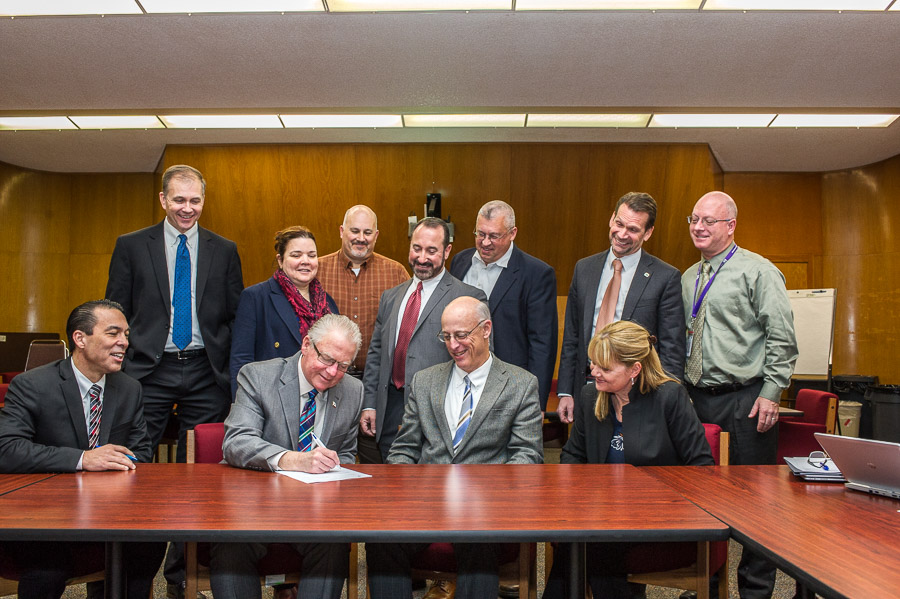
Mike Keever (standing, second from right) was on hand in 2018 for a signing ceremony at Caltrans for a revised Pavement & Materials Partnering Committee charter between the department and industry. |
|
|
|
Sign up now for 'Asphalt Pavement 101' class, in 'virtual' format, to be held Jan. 11 & 12 |
CalAPA’s enormously popular "Asphalt Pavement 101" class returns in "virtual" webinar format on Tuesday and Wednesday, Jan. 11 & 12. Advance registration is required and can be done on-line HERE.
Asphalt Pavement 101 is a good overview of everything asphalt, touching on how asphalt pavements are designed, constructed and maintained. It is taught by Roger Smith, a former senior materials engineer with Caltrans and the Asphalt Institute, as well as a former executive director of CalAPA. Attendees of this class can earn CEU credit via a nationally recognized Registered Continuing Education Program (details below). The class is a half-day packed with loads of useful information for contractor and agency paving crews, quality control specialists, lab personnel and others who interact with asphalt pavements. The class will cover pavement structure and terminologies, asphalt binders, aggregates, asphalt mixes, plant operations and mix delivery, paving and rolling, acceptance specifications and testing.
Because so much is changing in the world of asphalt pavements, the class is an excellent refresher course for veterans in the industry as well as providing a good overview for those new to asphalt pavements. The class is a recommended prerequisite for other CalAPA technical classes, such as “Caltrans Section 39 Specifications,” “Essentials of Pavement Smoothness” and “Quality HMA Paving.”
IMPORTANT NOTE NO. 1: This class will be delivered in remote "webinar" format only. There will be no in-person class location. A link to participate in the class remotely via computer will be sent separately to all registrants. All attendees will also receive via e-mail an electronic certificate of completion from CalAPA documenting that they have completed four (4) Professional Development Hours (PDH) of technical instruction.
IMPORTANT NOTE NO. 2: Because of attendee feedback, we are breaking this 4-hour webinar into two,two-hour sessions to be held on consecutive days: Tuesday, January 11th from 9 a.m. to 11:30 a.m. AND Wednesday, January 12th, 2021 from 9 a.m. to 11 a.m. Attendees must attend both sessions to receive a completion certificate.
On-line registration is required and must be completed by clicking on the registration page link HERE. A link to participate in this webinar will be sent in a follow-up note. For registration questions, please contact Sophie You of CalAPA at (916) 791-5044. |
|
Welcome aboard: Talley Oil, Inc. |
CalAPA is pleased to welcome its newest supplier member, Talley Oil, Inc.
Talley Oil Inc., is a family-owned and operated business based in Madera, Calif.. In operation for more than 75 years, they operate as a full-service road oil and asphalt emulsion sales and service business. The company maintains a fleet of Bearcat Distributor trucks and Asphalt Tanker Transports. Their construction crews perform Chip Seal, Paving Fabric, and other Pavement Maintenance strategies for clients in both the public and private sectors. With emulsion plants and equipment yards at both of their Madera and Bakersfield/Taft locations they are able to focus service on the mid- to southern central valley but also offer services throughout the West Coast.
For more information about Talley Oil, Inc., click HERE to visit the company website, or contact Ken Talley at (559) 673-9011. |
|
CalAPA offices will be closed on Friday, Dec. 31 in observance of the New Year's Day holiday. The offices will reopen during regular business hours on Monday, Jan. 3. |
|
Each week we highlight a word, acronym or other term commonly used in the asphalt pavement industry in California.
PAVEMENT STRUCTURE (COMBINATION OR COMPOSITE): All courses of selected material placed on the foundation or sub-grade soil, other than any layers or courses constructed in grading operations. When the asphalt pavement is on an old Portland Cement Concrete base or other rigid-type base, the pavement structure is referred to as a combination or composite-type pavement structure.
|
|
Paving Pointer of the Week |
Each week we highlight a key point or best practice of interest to asphalt paving crews, inspectors and others working in the field. We welcome suggestions. More tips can be found in our Asphalt Parking Lot Construction Checklist HERE.
TONNAGE CALCULATION: Are there enough trucks on the run to haul the mix needed to complete the job? If you have five trucks on the round each carrying 25 tons = 125 tons per round. If each round takes one hour to make, then the production rate is 125 tons per hour. If the job requires 1,000 tons at 125 tons per hour = eight hours to get the mix to the job.
|
|
"Power over others is weakness disguised as strength. True power is within and available to you now."
-- Eckhart Tolle
|
|
CALAPA CALENDAR:
View all CalAPA events HERE.
*
MEMBERS ONLY!
Free 2022 Forecast Webinar (CalAPA members only)
Monday, Jan. 10, 10 a.m. to 11 a.m.
*
'Asphalt Pavement 101' class in virtual format
Jan. 11 & 12
*
REGISTRATION OPEN:
CalAPA Annual Dinner
Thursday, Jan. 20, 2022
Jonathan Club, 545 S. Figueroa St., Los Angeles
*
SAVE THE DATES!
March 16-17, 2022
Spring Asphalt Pavement Conference & Equipment Expo
Doubletree Hotel Ontario Airport.
Details soon!
|
|
There's never been a better time to join the California Asphalt Pavement Association! Members receive insight and advanced notice on critical issues that impact every company's bottom line. CalAPA members also receive invitations to exclusive member-only events, in-depth "Member Alerts," our comprehensive asphalt market forecast for California, discounts and industry-specific networking opportunities not available anywhere else. CalAPA's new searchable on-line membership directory helps connect potential customers with member companies. Click HERE to download our Member Service brochure. Click HERE to view Vol. 1 of recent testimonials. Not convinced? Click HERE to view Vol. 2 of recent testimonials. Click HERE to send us an e-mail inquiry, or contact Bill Knopf with CalAPA at (442) 400-9697. |
|
|
|
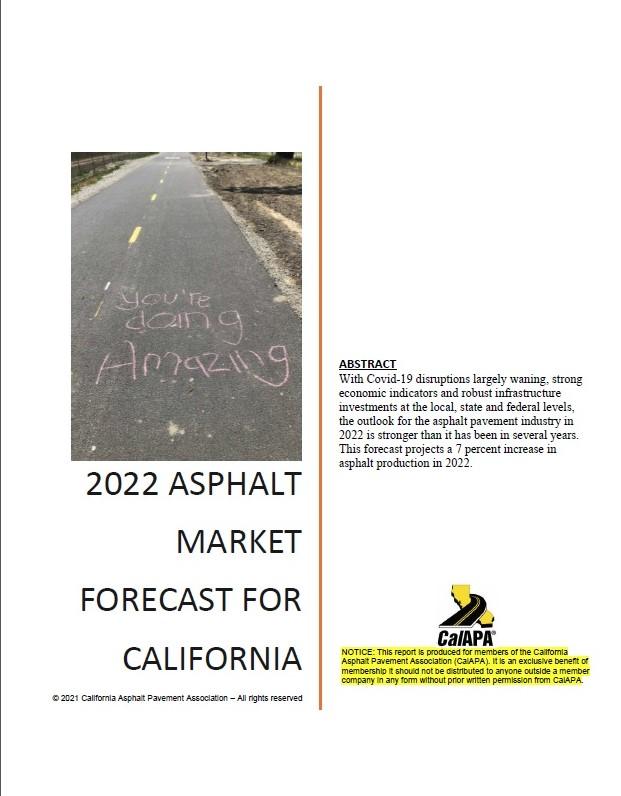
2022 Asphalt Market Forecast |
The 2022 Asphalt Market Forecast for California, an exclusive member-only benefit, is now available. See the Dec. 3 "Member Alert" for details on how to download this essential report, or contact the association at the link below to request your copy.
|
|
We hope you enjoy CalAPA's Asphalt Insider newsletter. We are committed to providing you with the most up-to-date information on technical issues, regulation, news, analysis, events and trends in California that is of interest to the asphalt pavement industry and our various agency partners. Click HERE to contact us with any comments or suggestions.
Sincerely,
Russell W. Snyder, CAE
Executive Director
California Asphalt Pavement Association (CalAPA)®
|
|
The "Asphalt Insider" is an official publication of the California Asphalt Pavement Association. For more information or to inquire about membership, call (916) 791-5044, or click HERE to contact us. Copyright © 2021 California Asphalt Pavement Association -- All Rights Reserved. The CalAPA name (No. 5,621,794) and logo (No. 5,621,795) are registered trademarks with the U.S. Patent & Trademark Office.
|
|
P.O. Box 981300, West Sacramento, CA 95798
1550 Harbor Blvd., Suite 211, West Sacramento, CA 95691
|
|
|
|
|
|
|
|