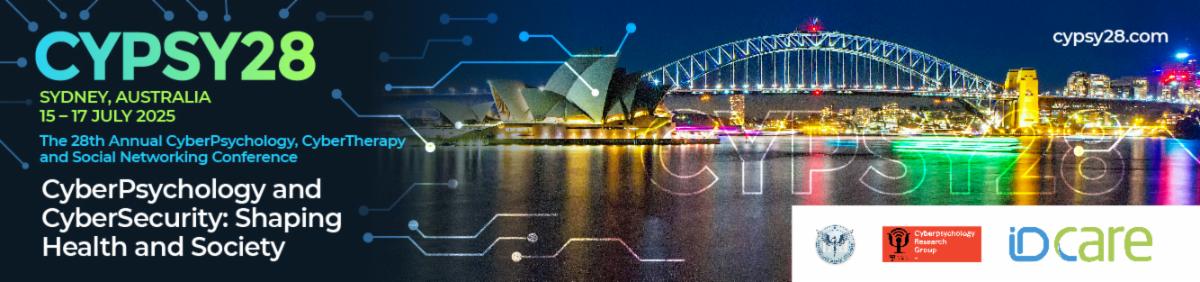
Abstract Portal Closing Monday, 3rd March 2025

Don't Miss Out: Limited Seats in Free Pre-Conference Workshop

Authors have only the weekend left to complete and submit an abstract for consideration in the conference program for the 28th Annual CyberPsychology, CypberTherapy and Social Networking Conference.


The Conference Organising Committee is seeking abstract submissions (400-word limit) that address the 2025 Conference theme 'CyberPsychology and CyberSecurity: Shaping Health and Society'.


The 2025 Abstract Submission Portal will close at midnight on Monday, 3 March 2025 (AEDT). If you have any trouble downloading the guidelines document or accessing the online submission portal, access is available via the Conference website - www.cypsy28.com.

View Call for Abstracts Guidelines
Start your Abstract Submission Now

Highlight on 2025 Workshops

PRE-CONFERENCE WORKSHOPS will be held on the morning of Tuesday, 15th July 2025. Workshop attendance is an additional fee to the Full Conference Registration. All workshops are currently pending Australian Psychological Society (APS) Clinical Professional Development (CPD) points approval.

Pre-Conference Half-Day Workshops

Fee ($AUD and includes GST)

Workshop #1 - Hands-on Training for the Application of Virtual Reality (VR) in the Treatment of Anxiety and Related Disorders

$395.00

Workshop #2 - Advancing Cyber+Human Research

Free of charge (registered conference attendees only)

Workshop #3 - Cyberpsychology of Deception: Practical Strategies for Engaging Scam Victims in Understanding Their Needs and Provide Response Optimisation

$395.00

Register for the Conference and Workshops Today

Hands-on Training for the Application of Virtual Reality (VR) in the Treatment of Anxiety and Related Disorders


Presenters: Stéphane Bouchard (Ph.D.), Ana Beato (Ph.D.) and Iveta Fajnerová (Ph.D)


Date and Duration: Tuesday, 15 July 2025 | 9.00 am - 12.30 pm

Target Audience: Psychologists and Allied Health practitioners


The use of virtual reality (VR) is rapidly gaining traction as an innovative tool for emotional regulation and the treatment of anxiety disorders and obsessive-compulsive disorder (OCD). Introducing technology into the practice of psychotherapy requires specialised training, and therapists need to master several key concepts to maximise the benefits of VR. 


This workshop is designed for professionals familiar with cognitive-behaviour therapy (CBT) for anxiety-related disorders in adults and minors. As such, clinical information about CBT and anxiety disorders will be briefly covered. The primary focus will be on providing hands-on, live demonstrations of VR applications within CBT treatment. The presentation will highlight critical distinctions between effective and counterproductive therapeutic strategies. Clinical examples will be provided to illustrate these concepts in practice. 


The first demonstration will showcase VR´s role in the treatment of OCD, as it provides several practical examples that generalise well to phobias. The second illustration addresses social anxiety disorders, where the integration of VR could require more skills. Additionally, the workshop will cover the integration of VR in the CBT of selective mutism. The conclusion will discuss the relative importance of the feeling of presence in VR applied in therapy and the management of potential unwanted negative side effects induced by immersion in VR (e.g., cybersickness). 


By the end of the workshop, participants will have gained practical skills, increased confidence, and a deeper understanding of how to effectively integrate VR into their therapeutic practice to enhance treatment outcomes. The three workshop leaders have extensive research and clinical experience on the topic with clinical contributions to the development and validation of virtual environments for anxiety disorders and OCD.

Advancing Cyber+Human Research


Presenters: Kimberly Ferguson-Walter (PhD) Program Manager IARPA – Office of the Director of National Intelligence USA, Erin Roper (PhD), Maxine Major (PhD), Brenda Wiederhold (PhD), Scott Brown (PhD), Ami Eidels (PhD), Robert Gutzwiller (PhD), Benjamin Clegg (PhD), Spencer Lynn (PhD) and Palvi Aggarwal (PhD).


Date and Duration: Tuesday, 15 July 2025 | 9.00 am - 12.30 pm

Target Audience: Cyber Security Professionals, Psychologists and those working with victims of crime by deception


The intersection of cybersecurity and human behaviour presents a unique opportunity to enhance cyber defence strategies through multi-disciplinary research - the systematic collection, management, and sharing of high-quality datasets is a crucial first step. As cyber threats evolve, interdisciplinary research integrating psychological, behavioural, and computational approaches is critical. However, progress on research combining human sciences and cyber security is often hindered by fragmented, inconsistent, or inaccessible data. This workshop addresses these challenges by presenting new publicly available cyber+human data, that facilitates collaboration across cybersecurity, psychology, and human factors research communities.


Recognising the role of federally funded research in driving innovation, the U.S. Office of the Director of National Intelligence (ODNI) has emphasised the importance of increasing public access to scholarly publications and digitally recorded research data. The ODNI’s commitment to scientific exchange, innovation, and commercialisation provides a critical foundation for efforts to improve cybersecurity data accessibility, while safeguarding national security interests. Our approach aligns with this vision, presenting data from over 20 different human subject research experiments focused on understanding decision-making in cyber-attack behaviour.


Data sharing remains a challenge in cybersecurity research, in general. Kouper & Stone (2024) found that 58% of cybersecurity datasets and 89% of analytical tools remain unavailable, limiting scientific collaboration and slowing technological progress. Despite this, studies show that publicly shared data leads to greater scientific impact (Zheng et al., 2018). Human focused cyber data is even rarer. Performers from the Reimagining Security with Cyberpsychology-Informed Network Defenses (ReSCIND) program will present the research designs, findings, and data funded under this program (https://www.iarpa.gov/research-programs/rescind).


The implications of improved data availability and curation extend beyond academia to government, industry, and public policy. A well-maintained cyber+human dataset repository would enable real-time threat intelligence, support AI-driven adaptive cyber defenses, and facilitate psychological research. Furthermore, by promoting open and ethical data-sharing practices, this initiative aligns with the ODNI’s broader goal of enhancing innovation, strengthening cybersecurity, and accelerating scientific breakthroughs.


As cyber threats grow in complexity, the need for curated, high-quality, and accessible data is more pressing than ever. A multi-disciplinary approach is necessary because the cyber domain combines human cognition, human behaviour, and technology. By addressing long-standing challenges in cybersecurity data accessibility, combined with addressing the gap in a much-needed human focus, this work lays the foundation for a more resilient, adaptive, and human-centered approach to cybersecurity.

Cyberpsychology of Deception: Practical Strategies for Engaging Scam Victims in Understanding Their Needs and Provide Response Optimisation


Presenters: David Lacey (PhD), Brad Ridout (PhD), Andrew J. Campbell (PhD), and Jacob Szloch (M. Clin. Psych)


Date and Duration: Tuesday, 15 July 2025 | 9.00 am - 12.30 pm

Target Audience: Psychologists and Allied Health practitioners and those working with victims of crime by deception


This workshop equips psychologists, allied health professionals, and staff involved in scam response, such as customer service officers and fraud teams, with awareness and practical strategies for aiding victims of deception. Participants will gain insight into the psychological and behavioural dynamics at play when individuals experience deception, enabling them to recognise victims’ specific needs and apply effective coping and engagement strategies.


The workshop covers various deception scenarios, including cases where victims are unaware of their involvement or are only beginning to grasp the situation. Understanding these complexities is essential for providing appropriate support. Participants will leave with actionable strategies developed by experts who regularly work with scam victims and actively research human behaviour and deception.


A key focus of the workshop is applied cyberpsychology, which focuses on the interaction of human behaviour and technology. The workshop explores deception in digital environments and examines how technology influences both compliant and resistant behaviours among scam targets. Participants will gain insight into the psychological and technological factors that drive scam compliance.


Key topics include the evolution of deception research, and current theories on why individuals fall victim to scams. The workshop is ideal for professionals seeking to deepen their understanding of scams, fraud, and cybercrime prevention, as well as those interested in innovative behavioural approaches to constructively aid victims of scams.


With the rapid rise of online scams worldwide, understanding human-computer interactions that contribute to scam compliance is more critical than ever. This workshop emphasises recognising behavioural triggers and designing systems to counter deception effectively. By building this knowledge, participants will be better equipped to implement strategies that disrupt fraudulent activities and support victims.


Blending theory with practical strategies, this workshop empowers professionals across sectors to respond to scam victims with confidence and expertise.

Visit www.cypsy28.com

Convenors

Dr. David Lacey 

PhD, MA, B.Bus

Conference Co-Chair & Organiser

Managing Director

IDCARE

Australia

Professor Brenda K. Wiederhold 

PhD, MBA, BCB, BCN

Conference Co-Chair & Organiser

Interactive Media Institute

Virtual Reality Medical Center

San Diego, California, USA

Professor Andrew J. Campbell 

PhD, MappSc, BA, SFHEA, MAPS

Conference Co-Chair & Organiser

Chair of the Cyberpsychology Research Group - The University of Sydney

Australia

Learn More About the Convenors
 

Become a CyPsy28 Partner

Unlock unparalleled opportunities by sponsoring CyPsy28. As a sponsor or exhibitor, you’ll gain exclusive access to a highly engaged audience of policymakers, academics, digital health pioneers, and cybersecurity leaders, positioning your business as a key player in shaping the future of technology and society. Don’t miss this chance to showcase your solutions, expand your network, and leave a lasting impact on an influential global community.

View Sponsorship and Exhibition Packages

Help Us Connect with Industry Colleagues

We would love to think that you are all just as excited as us, so we invite you to share this event with your industry friends and colleagues around Australia and across the globe. Let's make the Cypsy28 Conference bigger and better than ever!

X Share This Email
LinkedIn Share This Email
 

Conference Secretariat: GEMS Event Management | PO Box 1221 | Burwood, NSW 1805 AU