September 2024 Newsletter

Contents

1.  Leave the Leaves

2. Can I plant in my tree well?

3.  Species Highlight: Autumn cherry 

4. Urban Forestry Trivia

5.  Become a Cambridge Urban Forest Friend  

6.Sign Up for a Free Tree with Green Cambridge 


Leave the Leaves: When to bag yard waste and when to “leaf” it be

Fall is a great time to clean up your tree well and yard. Removing weeds from tree wells now will give trees the good start to the growing season they need next spring. Leaving fallen leaves in your garden, flower beds, and tree wells can be beneficial to the health of your yard, trees, other plants, and surrounding wildlife. A layer of leaves protects soil from erosion, provides habitat for insects and microbes in the soil, and protects bulbs, perennial plants, and tree roots from extreme temperature fluctuations. As the leaves decompose, they return nutrients to the soil. An insulating layer of leaves can help your lawn’s ecosystem when spring returns and your garden begins to bloom again.


Be sure to clear leaves out of nearby street drains. If unaccounted for, leaves can easily clog drains, increasing the likelihood of floods on streets or your property. 


Excess leaves and other yard waste should be bagged in yard waste bags for curbside pick up. Forest Friends can pick up yard waste bags from Public Works at 147 Hampshire St. 


Can I plant in my tree well?

Well-maintained tree wells support healthier trees. Pulling weeds and removing trash are the two most important steps residents and business owners can take to maintain the tree wells in front of their properties. Planting inside of tree wells can also impact trees, but not always for the better. Too many plants (and especially weeds) in the tree well compete with the tree for limited soil volume, water, and nutrients. If you decide to plant in a tree well, remember that tree health comes first. Planting carefully and infrequently can reduce soil compaction and support pollinators. Perennials with small roots and bulbs planted once every few years can beautify the tree well while also keeping tree roots intact. If you choose to plant in the tree well, choose plants that don’t require a lot of water or have deep roots. Please do not plant grasses because they have thick, matted roots. Please avoid vining plants which can grow up the tree trunk. Additionally, avoid planting within a foot of the tree trunk. If you remember to prioritize tree health while choosing what to plant, you can have both a beautiful tree well and a healthy, long-living tree.


If you’re looking for ideas on what to plant, here are some bulbs that would work great:

  • Crocus
  • Tulips
  • Muscar
  • Daffodils
  • Dahlia
  • Freesia

Whether you plan to plant or not, watering is crucial for our young street trees to survive the city environment—they need lots of water from Forest Friends like you! Newly planted trees are watered by Public Works staff, Water-By-Bike interns, and the tree planting contractor, but you can help out by filling the gator bags on street trees once a week, through mid-November. Forest Friends can pick up gator bags for street trees from Public Works at 147 Hampshire St.


Species Highlight: Autumn cherry (Prunus subhirtella 'Autumnalis')

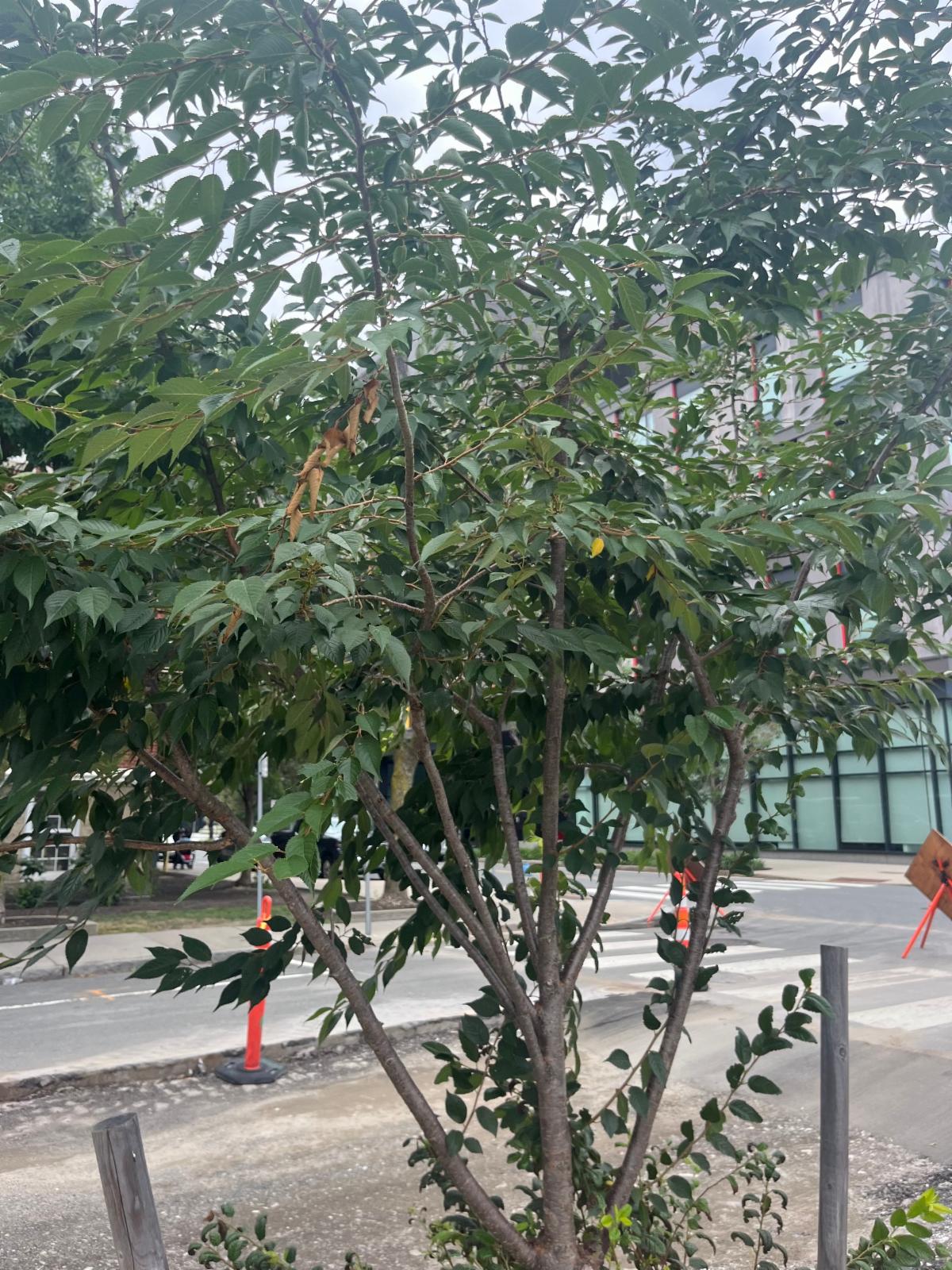
Flowering cherry trees are some of the most frequently planted flowering trees, largely because they look beautiful and survive well in the city environment. The autumn cherry tree is special, however, because it can produce flowers multiple times per year. Its double pink flowers appear every spring, but you might also spot a sparse fall bloom if the weather is warm enough.


The autumn cherry grows fairly fast at a rate of about two feet per year until reaching maturity of about 25 to 40 feet. The tree does not grow to be very tall, but it does have a wide-spreading canopy. If autumn cherries near you are not flowering, you can identify them by their one-to-four-inch-long dark green leaves. Later in the fall, their leaves will turn yellow and bronze before dropping.


Be on the lookout for this tree’s autumnal flowers! 

Autumn Cherry Species


Urban Forestry Trivia 

Learn a fun fact about urban forestry in Cambridge!


The trivia answer will be revealed in next month’s newsletter!


Last month's question was " What type of habitat does the city of Cambridge most resemble?” and the answer was “C. Savannah”

What impact does pet waste have on the City's trees?
A. Pet waste can burn tree bark and lower soil pH leading to root damage.
B. Pet waste can provide helpful fertilizer.
C. Pet waste intensifies the colors of fall foliage.
D. Pet waste contributes microorganisms to the environment that are beneficial to tree health.


Become a Cambridge Urban Forest Friend

We need your help to maintain a healthy, vibrant urban forest! Any Cambridge resident willing to regularly water the tree and provide some general care for the tree is welcome to become a Cambridge Urban Forest Friend.


How to Start

View Website
Questions?

For questions about the Cambridge Urban Forest Friends, please contact Kristen Kelleher, Community Relations Manager at 617-349-4825 / kkelleher@cambridgema.gov.

**Please let us know if you are no longer caring for your street tree and we will remove you from the database and future emails.**
 

Sign up for a free tree from Green Cambridge

If you have space for a tree on your property, Green Cambridge can plant a free native tree to help expand Cambridge’s urban tree canopy! If you own your home in Cambridge, MA and would like Green Cambridge to plant a tree in your yard for FREE, visit https://www.greencambridge.org/canopycrew
Thanks for reading! 

If you enjoy the Cambridge Urban Forest Friends newsletter, you can spread the word about it with this sign-up link. With more sign-ups, more Cambridge residents can learn about how to best support our environment and communities. 
 
 
Facebook  Twitter  
www.CambridgeMA.gov