|
Contents
- Keep Salt Out of Tree Wells
- History Preserved in Trees: Longfellow Park Willow
- Species Highlight: Dawn Redwood
- Winter Planning for Next Years Garden
- Forest Foes
- Urban Forestry Trivia Questions
- Sign Up for a Free Tree with Green Cambridge
| |
Keep Salt Out Of Tree Wells
When it comes to salt, a little goes a long way! When snow melts, it washes any salt and de-icing chemicals from driveways and sidewalks into storm drains. Too much chloride (salt) in our rivers and streams can harm the environment. While the best way to manage snow and ice is through mechanical methods like shoveling, we recognize that sometimes additional treatment is needed to ensure safety but work to keep it away from your trees.
Here are some simple ways to keep walkways safe while protecting our waterways:
- Avoid rock salt and sand: Traditional rock salt (sodium chloride) is particularly harmful to plants and wildlife and should be avoided. Likewise, avoid sand, which can actually make ice more slippery and clogs storm drains.
- Shovel first: For de-icers to be effective, snow should be shoveled first. De-icers work by preventing ice from forming (and should not be used to melt snow that’s already fallen).
- Use sparingly: A light sprinkle of de-icer is enough – piling extra won’t speed up melting and just increases salt concentration in runoff. A good rule of thumb is that a standard size coffee mug is enough to treat 10 sidewalk squares (approximately 100 square feet).
Salt harms the tree’s ability to absorb water and can block nutrients. These issues can lead to yellowing leaves, stunted tree growth, and death.
Winter can be gloomy, but don’t make it worse by poisoning your trees!
| |
History Presented in Trees: Longfellow Park Willow
Henry Wadsworth Longfellow valued the view of the river from his home, writing:
River! that in silence windest
Through the meadows, bright and free
Till at length thy rest thou findest
In the bosom of the sea!
(“To the River Charles,” in Stillman, 31)
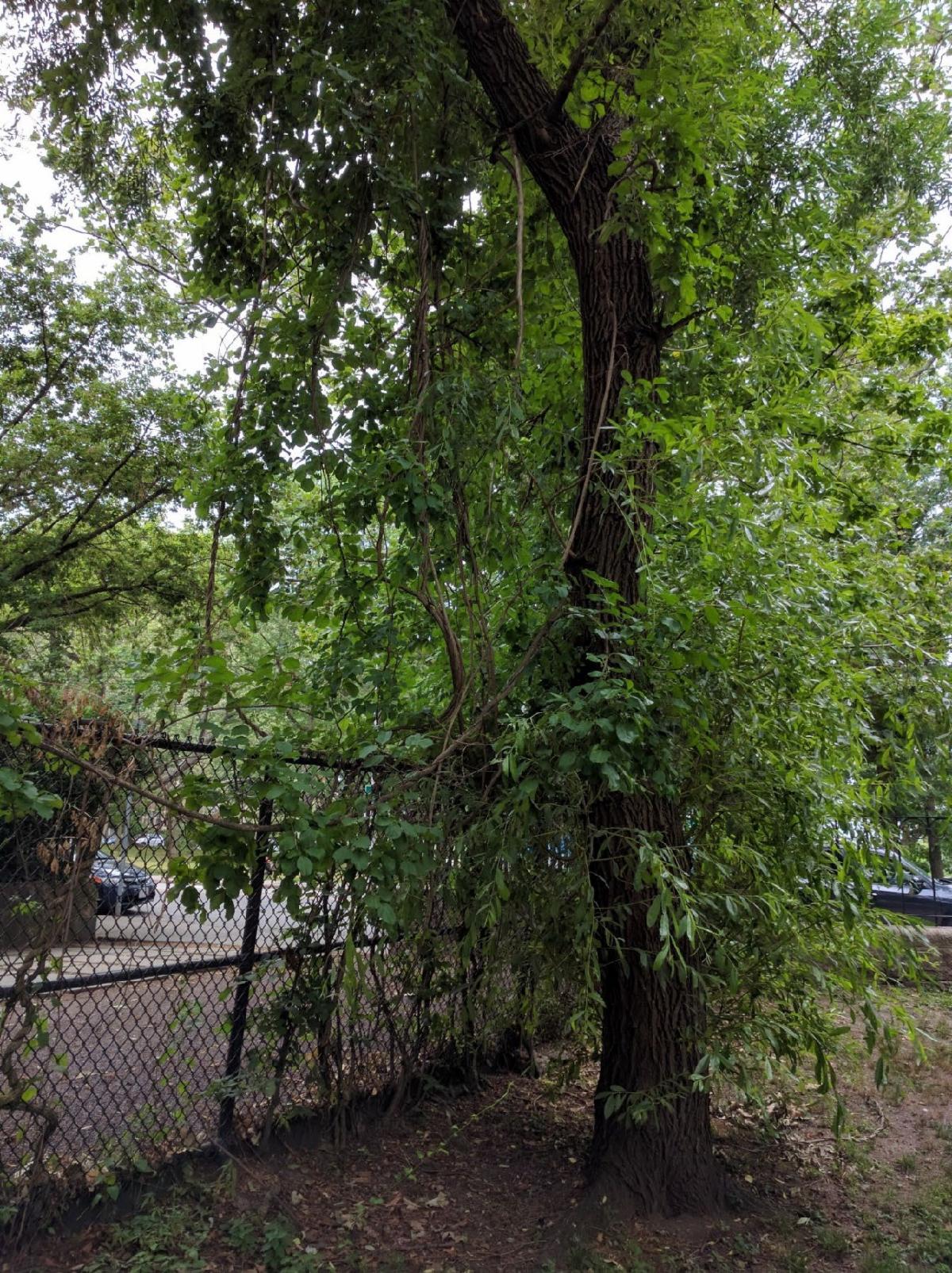
Today, Longfellow Park preserves Longfellow’s home and the view he commemorated. There were several ancient willows on the bank lining his property believed to be planted in 1632, but the vista from the house to the river was open. When creating the park, the association funding the project (working with his heirs and descendants) agreed “no tree whatsoever shall ever be planted or suffered to exist” in the park without the heirs’ consent and pledged to keep shrubs in the upper park trimmed. But, by the 1940s, the planting limitation was no longer followed, and elms were placed obstructing the view. The ancient willows were also long-gone. In 1990 the Cambridge Historical Commission and Carol R. Johnson & Associates developed a plan to recapture the view by removing over sixty volunteer trees from the lower park and extending the lawn out to the fences, as was originally intended. They planted new trees, including a scion of one of the ancient willows.
Thanks to the Cambridge Historical Commission for research on the Longfellow Park willows.
| |
Longfellow Park willow, a scion of a historic tree photographed by CHC staff in 2009. | |
Species Highlights: Dawn Redwood (Metasequoia glyptostroboides)
Aren’t conifers supposed to keep their needles in the winter? The dawn redwood is a deciduous conifer, meaning it has needle-like leaves, but it loses them in the fall.
It's lack of needles right now is not the only thing that makes the dawn redwood an exciting tree. We often call this tree a “living fossil” — because until 1941 the tree was only known from the fossil record. But, that year, a stand was found in the Hubei province of Central China. Harvard University’s Arnold Arboretum gathered and propagated dawn redwood seedlings from that stand and distributed seeds to arboreta and botanical gardens across the world. Most cultivars in the United States are descended from these seedlings. At the Arnold Arboretum, you can see the first dawn redwoods growing in North America in over two million years.
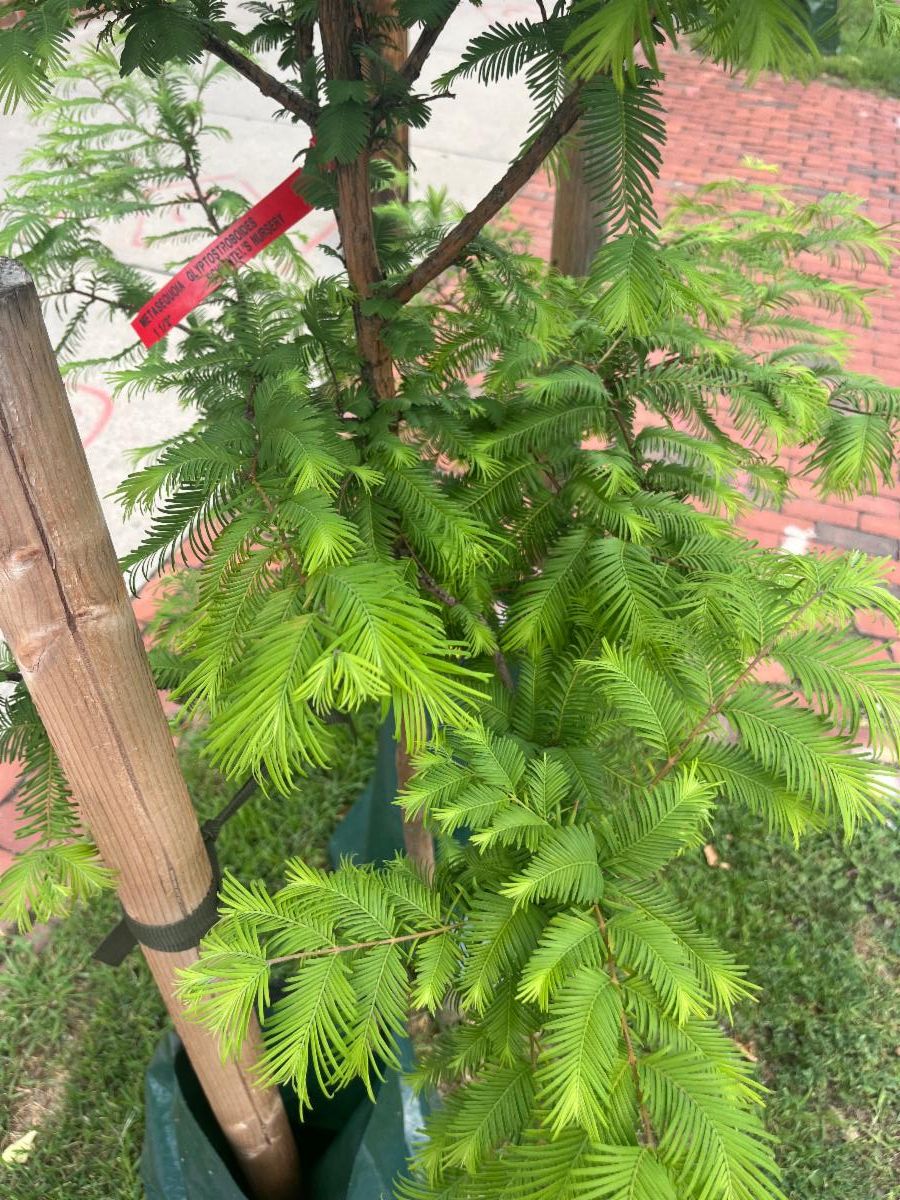
The dawn redwood is also a resilient tree in many different environments and will likely survive well under continued effects of climate change. When given enough space and water, it can develop into a fairly large tree (it is related to the California redwood and the giant sequoia, after all). The largest in Cambridge are two trees on Pleasant St just north of the intersection with Putnam Ave. You can identify these trees by their red-brown peeling bark on grooved trunks with strong roots.
| |
Photo of Dawn Redwood in Cambridge | |
Winter Planning for Next Year's Garden | |
|
Now is the perfect time to begin planning for next year’s garden. Consider replacing parts of your lawn with native plants and herbs. Here’s a simple 5-step plan to prepare your garden for the warmer months ahead.
Step 1: Gather Your Supplies. Collect everything you’ll need: seeds, pots, soil, a watering can, and a rodent-proof screen. The screen will help protect your plants and seeds from rodents.
Step 2: Prepare the Pots. Fill your pots with soil and add fertilizer. Be sure to label each pot with the plant it will contain, so you can easily identify them later.
Step 3: Plant the Seeds. Plant your seeds in the pots, covering them with soil and fertilizer. As a general rule, cover your seeds to about the same size as the seed. Water gently, avoiding flooding, as excessive water can wash seeds out of the pots.
Step 4: Place the Pots Outdoors. Set your pots outside in a shaded spot, such as beneath a bench or table, to protect them from harsh conditions. Cover them with your rodent-proof screen to prevent pests from getting to the seeds.
Step 5: Wait and Watch. Leave your pots outside as the weather changes. Check for seedlings in late March. By late April, start watering the pots every few days depending on the weather. Some plants will be ready for larger pots by May or June, while others may take longer to grow.
You can transform unused spaces on your property into a green oasis. For example, a Cambridge resident turned her garage roof into a massive garden. This is a great way to be environmentally conscious. Here is the link to the article.
| |
Forest Foe: Beech Tree Disease | |
This month, we’re highlighting a growing threat to our city’s tree canopy—Beech Tree Disease (BTD). This disease, first identified in the U.S. in 2012, is caused by microscopic nematodes (Litylenchus crenatae mccannii) that invade beech leaves, leading to dark striping, curling, and thickening. Over time, infected trees experience canopy loss, reduced growth, and eventual death. While the exact way BTD spreads is still being studied, researchers believe it may be transmitted by wind, rain, or even human activity.
Cambridge is home to several notable beeches, including the magnificent Copper Beech at the Main Library, making it even more important to stay vigilant. Since early detection is crucial, we encourage residents to look for symptoms and report concerns. Let’s work together to keep our city’s trees thriving!
| |
|
Learn a fun fact about urban forestry in Cambridge!
The trivia answer will be revealed in next month’s newsletter!
Last month's question was "Which describes all the elements that make up an urban forest? “B - Large canopy trees, understory trees, shrubs, groundcover plantings, and soils."
| |
| What does it mean when a tree has marcescent leaves? | | | |
Become a Cambridge Urban Forest Friend | |
We need your help to maintain a healthy, vibrant urban forest! Any Cambridge resident willing to regularly water the tree and provide some general care for the tree is welcome to become a Cambridge Urban Forest Friend.
How to Start
| |
|
Questions?
For questions about the Cambridge Urban Forest Friends, please contact Kristen Kelleher, Community Relations Manager at 617-349-4825 / kkelleher@cambridgema.gov.
**Please let us know if you are no longer caring for your street tree and we will remove you from the database and future emails.**
| |
Sign up for a free tree from Green Cambridge |
If you have space for a tree on your property, Green Cambridge can plant a free native tree to help expand Cambridge’s urban tree canopy! If you own your home in Cambridge, MA and would like Green Cambridge to plant a tree in your yard for FREE, visit https://www.greencambridge.org/canopycrew
| |
Thanks for reading!
If you enjoy the Cambridge Urban Forest Friends newsletter, you can spread the word about it with this sign-up link. With more sign-ups, more Cambridge residents can learn about how to best support our environment and communities. | | | | |