STAY INFORMED – TALKING POINTS – ACTIONS TO CONSIDER – STORIES | |
Antisemitism Moves from Encampments into Classrooms
| |
This summer, a college in Oregon agreed to adopt the IHRA definition of antisemitism and hire an independent outside monitor to keep watch over its campus – one of the most sweeping campus antisemitism settlements a university has ever signed.
The case began after Oct. 7, 2023, when anti-Israel demonstrators started blaming a Jewish student for what they falsely called Israel’s ‘genocide.’ The harassment escalated – an attempted break-in of her dorm room, the desecration of the mezuzah on her door and a rock thrown through her window that struck her in the head. She reported every incident. The college never recognized the attacks as antisemitic, and she transferred out of the small liberal arts school in Portland, citing the hostile environment.
Reed is not an isolated case. Years of sustained work by the American Jewish community and its allies – lawsuits, federal civil rights complaints and pressure from Jewish organizations – have forced settlements and reforms at universities that spent years ignoring the problem. Reported campus antisemitic incidents fell last year for the first time since the Oct. 7 massacres. That pressure has not reached the classroom, where a quieter form of the same hostility has taken root in what students are assigned and who is teaching them.
Enforcement Finally Has Teeth
Reed College agreed to adopt the International Holocaust Remembrance Alliance definition of antisemitism, employ a Title VI coordinator, hire an independent outside compliance monitor and run recurring surveys of Jewish and Israeli students’ experience on campus. “We believe it should serve as a model for other schools,” stated Denise Katz-Prober of the Louis D. Brandeis Center for Human Rights Under Law, which brought the case alongside the Anti-Defamation League.
This kind of accountability is not limited to elite private colleges. Three Jewish and Israeli professors at the Univ. of Illinois at Chicago took separate discrimination charges to the U.S. Equal Employment Opportunity Commission, alleging a hostile environment for years. The EEOC recently ruled in their favor in every case. Days later, a bipartisan U.S. Commission on Civil Rights report found the same pattern, citing persistent failures by universities and federal agencies.
The biggest settlements came from some of the most prominent campuses. To settle a lawsuit brought by more than 45 students, Columbia Univ. agreed to appoint a Title VI Civil Rights coordinator and fund scholarships for students who studied or worked in Israel. UCLA agreed to a permanent court order and paid $6 million in damages and fees after protesters blocked Jewish students from reaching their classes and the library. In settlements with the Brandeis Center, Harvard and the Univ. of California at Berkeley agreed to new campus measures addressing antisemitism and protecting Jewish and Israeli students.
On Aug. 24, the StandWithUs Center for Combating Antisemitism announced it will train Pennsylvania’s Haverford College faculty, staff and students as part of a settlement ending more than two years of litigation brought by Jewish students. Haverford also agreed that discrimination against Jews cannot be excused by labeling the targets “Zionists,” and adopted new policies on masked and disruptive protesters.
| |
Antisemitism is the New Normal in Jewish Campus Life
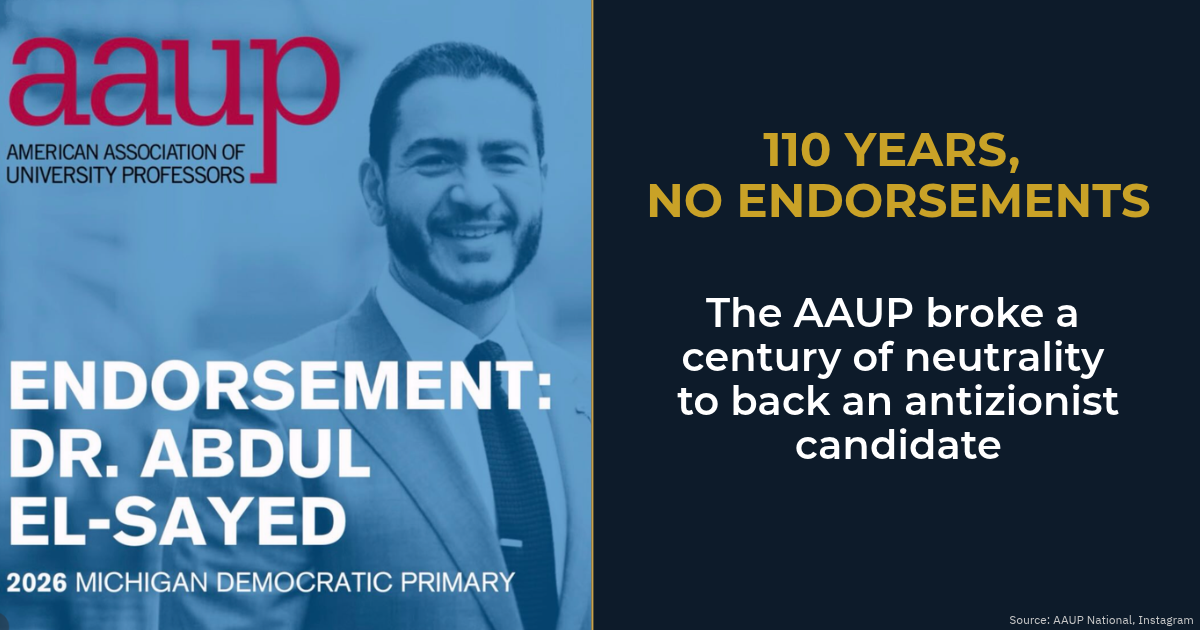
The hostility once made vivid by the encampments now courses endemically through faculty, unions and syllabi. On July 30, the American Association of University Professors made its first-ever national political endorsement, backing antizionist Dr. Abdul El-Sayed for U.S. Senate in Michigan. A new ADL-Academic Engagement Network report found the same politics driving unions elsewhere. The California Faculty Association pressed the 23-campus Cal State system to sever ties with Israeli universities, and faculty bodies at CUNY, Rutgers, Amherst and the Univ. of Michigan passed their own boycott resolutions.
Many student unions have continued to defend their hateful positions. Following an intensive investigation, Columbia’s Task Force on Antisemitism made several recommendations, including hiring Middle East scholars who are not antizionist. Screenshots from a group chat by members of the graduate union condemned the proposal, with one doctoral student calling it a “giant pot of money to pay zionists with.” Another doctoral student and union board member warned the group to be careful what they wrote. She added that everyone already knew where she stood, so she could say, “death to America,” and “death to Israel,” whenever she wanted.
Students are subjected to the same politics in many classes. Recently released ADL research cites examples of professors offering extra credit for attending anti-Israel walkouts and canceling classes so students could join protests. Shortly after the Hamas Oct. 7 massacres, a Univ. of California at Berkeley history professor reportedly assigned a novel written by the spokesman of a Palestinian terror group, and another assignment focused on plane hijacker Leila Khaled – an icon among anti-Israel activists. The purpose of teaching students to see Israel as uniquely evil is not academic – it supplies the justification for shunning, harassing and ultimately pushing Jews to leave universities.
Jewish professors also are targeted. A union president at City College of San Francisco called computer science instructor Abigail Bornstein a “colonizer” and mocked her name. An independent investigator found the leader violated campus harassment and discrimination policies. A 2025 ADL-AEN survey found 73% of Jewish faculty had observed anti-Jewish hostility from colleagues, administrators or staff, with many pressured to self-censor rather than risk retaliation.
Students Initiate Action When Administrators Don’t
In Florida, Jewish students did not wait for university administrations to act. Hillel students met with politicians in the state’s capital to demand additional security funding. Gov. Ron DeSantis and the state’s legislature followed up last year’s pilot program by providing $2.3 million for the Florida Hillel Jewish Student Safety Initiative to promote Jewish life and combat antisemitism. The funding will reach seven universities and about 25,000 Jewish students. Rabbi Jordan Gerson, executive director of Central Florida Hillel, praised Florida’s government for “demonstrating its commitment to fostering an environment where every student can proudly and openly embrace their identity.”
Some universities are starting to step up. At Columbia, the graduate student union withdrew its divestment proposal after the university opened a Tel Aviv global center instead – its 11th site worldwide, and the opposite of what the encampments had demanded. The Univ. of Washington recently canceled a scheduled appearance by Hasan Piker, the streamer who told his audience that Jews who support Israel are “inviting violence,” after students objected.
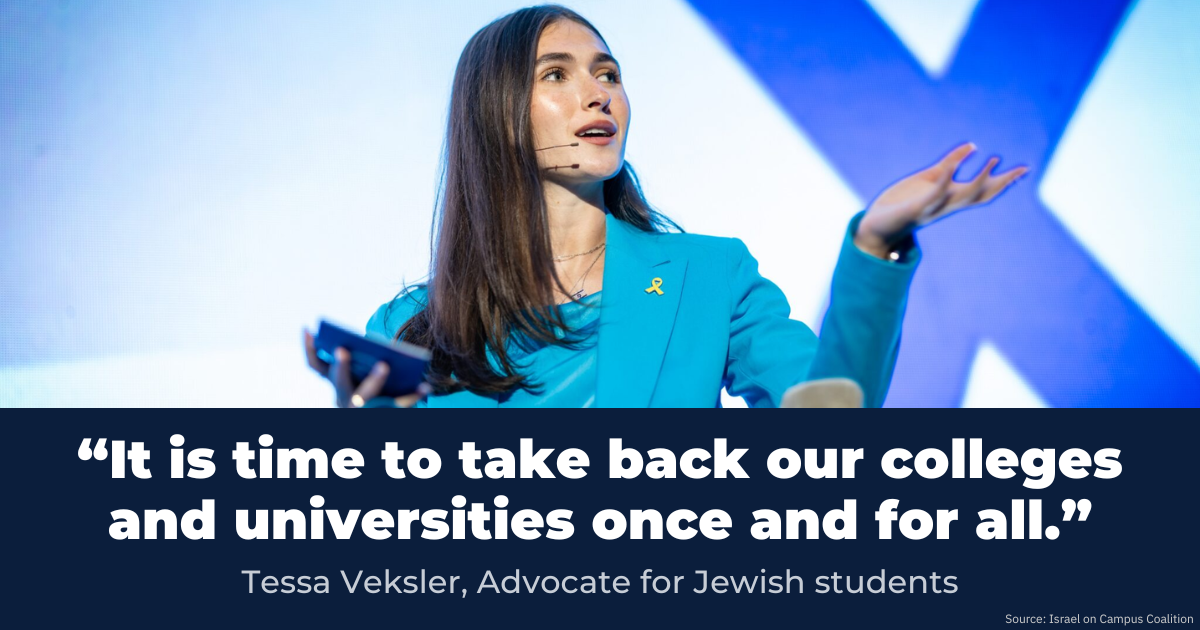
Tessa Veksler knows both sides of this shift personally. In 2024, handwritten signs appeared outside her student-government office at the Univ. of California at Santa Barbara, calling for her to leave campus. This year, her Univ. of California system barred student governments from boycotting any country. At the Israel on Campus Coalition’s 2026 National Leadership Summit, Veksler hosted the students behind wins like these: “Administrations changed because brave student leaders gave them no choice. They followed the rules, filed the complaints, sat through the meetings and refused to leave the room.”
| | |
1. Fewer headlines do not mean less antisemitism
Reported campus antisemitic incidents fell sharply last year, providing an illusion that the threat has diminished. It has not. Universities cracked down on protests and encampments that made national headlines. These actions have not stopped student and professor activists from creating an environment of normalized antisemitism for many Jewish students, faculty and staff – forcing some choosing to hide their identities rather than face consequences. Because a problem stops making news does not make it disappear.
2. Antisemitism has moved from the encampment into the classroom
Hatred of Jews used to hide behind a protest sign – now it is part of the syllabus. Antisemitism and antizionism in the classroom are not new, but the problem has intensified. Many professors assign books written by terrorists, deny the connection of Jews to their ancestral homeland and promote their political ideologies. Many student and faculty unions continue to vote for boycotts of Israeli universities and companies, decisions that are alienating their Jewish and Israeli peers.
3. Campus activists shun anyone who does not denounce Israel
In classes, academic departments and student groups, one question often decides whether a student or professor is included: what do you think about Israel? Give the right answer and you belong. Refuse and you become a pariah whose exclusion others call deserved. The purpose of the activists is to demonize, degrade and dehumanize anyone who supports Israel – Jewish or not. The heaviest cost falls on Jews – forcing many students to hide their connection to their ancestral homeland. This is not a political disagreement – it is a litmus test.
4. Legal and political pressure is working – but the fight is not over
Columbia agreed to pay more than $200 million and change its policies that allowed the harassment of its Jewish students, faculty and staff – one of several campuses that have settled federal or civil lawsuits. Many universities have enacted new policies to improve the lives of Jewish students and their employees, but words on paper must be followed with enforcement by campus leaders. Actions by Jewish organizations and individuals have led to several notable outcomes but the battle against the normalization of antisemitism continues.
5. Jewish students are refusing to wait for administrators to act
Jewish students are suing universities, organizing coalitions and forcing reforms. They are building the Jewish campus life their schools would not build for them. Universities have had years to fix this themselves. Students are no longer waiting.
| |
|
K-12 Education: Similar Patterns
K-12 education will be the topic of an upcoming Focus Project edition. Students, parents and teachers describe normalization of antisemitism as pervasive in many K-12 schools – through teacher activists, unions and curriculum rather than encampments – across a system of roughly 130,000 schools, 13,000 school districts and 54 million students. Administrators often treat each incident as isolated rather than part of a nationwide pattern.
| |
-
Advocate for your state’s legislature to adopt Florida model: The Florida Hillel Jewish Student Safety Initiative is a bipartisan state-funded program designed to promote Jewish life and combat antisemitism – the first program of its kind in the country The funding is for Hillel programming, staff and infrastructure. Contact your own state legislators and ask them to provide similar funding.
-
Demand your alma mater adopt the Reed College policies: Reed’s settlement set a real template – adopting the IHRA definition, a Title VI Civil Rights coordinator, an outside compliance monitor and recurring campus climate surveys. Email your university’s administration to ask directly whether these reforms are in place, and if not, why.
Actions for students:
- In addition to contacting university police as needed, the ADL, the Brandeis Center, StandWithUs, Stop Antisemitism and The Lawfare Project provide online forms for students and staff to report an antisemitism complaint.
- The ADL recently launched a confidential Campus Classroom Reporting system for antisemitism and biased content related to Jews and Israel in college and university classroom experiences, instructional framing, assignments or faculty conduct.
-
Campus Antisemitism Legal Line (joint initiative of The Brandeis Center, ADL and Hillel International): text “CALLhelp” to 51555 to report incidents of antisemitic discrimination, intimidation, harassment, vandalism, or violence.
- Students who experience antisemitic harassment, discrimination and other violations of their civil rights on campus can seek legal support from The Louis D. Brandeis Center for Human Rights Under Law.
- Educate yourself on best practices to combat anti-Israel and anti-Jewish hate on campus.
Connect with organizations that support Jewish students:
| | |
Stories of Resilience
-
Freed hostages join tens of thousands for Selichot high holiday prayers at the Western Wall
-
Christian Zionist volunteers build farms across Judea and Samaria to answer antizionist propaganda
-
Israeli Jewish births surge in 2026, defying fertility slump across the wealthy world
-
IDF marks seven decades of humanitarian relief missions around the world
-
Key West swears in its first Jewish mayor, who calls it incredible pride
Stories Impacting American Jews
-
Jewish and interfaith leaders rally outside Central Synagogue against antisemitism
-
Maine man fired shots at Jewish summer camp basketball court, court documents say
-
Palm Beach County worker accused of Nazi salute and “Heil Hitler” remark
-
Diners stiff Jewish server on $245 bill, writing “Great service, but Free Palestine”
-
Jewish leaders speak out against actor Mark Ruffalo’s attack on the Ellison family amid Paramount-Warner Bros. merger
-
Twenty Marvel actors sign petition to free Marwan Barghouti, serving five life sentences for murder
-
Comedian Bill Maher says Democrats welcome religion so long as the faith is not Jewish
Stories Impacting the U.S. and Israel
-
Bipartisan bill would make foreign-paid influencers register as foreign agents
-
IDF says Hamas runs interrogations and torture out of Gaza hospital
-
U.S. sanctions Hezbollah again, re-designates it a terror group serving the Iranian regime
-
Israel confirms striking Syrian airbase over planned Turkish deployment
-
Syria and Israel hold U.S.-mediated talks in Jordan to ease tensions
Stories from Around the World
| | CLICK BELOW TO ACCESS ADDITIONAL FOCUS PROJECT RESOURCES: | |
Want to Read More of Our Talking Points? | Did you miss a recent edition of The Focus Project? No need to search your inbox. Our most recently published editions are available on our website. Click below to continue reading. | | | | |
The Focus Project develops and distributes news, background, history and weekly talking points on timely issues to inform individuals and organizations about issues affecting the American Jewish community and Israel, and help readers speak with more consistency and clarity. The editions also provide potential responses for addressing incidents of antisemitism and anti-Zionism. With input from a spectrum of major American Jewish organizations, we focus on that which unites us, rising above political and individual agendas.
Recognizing that hatred of Jews comes in many forms and directions, we strive to address all sources as they arise, and educate our growing audience on topics ranging from inter-religious relations to relevant international developments. From week to week, we may focus on issues arising from the political left, university campuses, from the political right and from institutions, government, and corporations. We don’t try to address all issues in each edition. We hope you will find this information useful in your writing and/or speaking. We are always open to your feedback: info@focus-project.org.
| | | | |