Click here to read this email as a page in your web browser

STAY INFORMED – TALKING POINTS – ACTIONS TO CONSIDER – VOICES – STORIES

Where Criticizing Israel Ends and Hating Jews Begins


An American politician considering a run for president recently leveled harsh criticism against Israel’s government while still supporting the U.S.-Israel alliance. Rahm Emanuel – President Obama’s Jewish chief of staff – used a speech at Tel Aviv Univ. to argue that American support of Israel should no longer be unconditional. The reaction split sharply: progressives welcomed his criticism, while conservatives and other supporters of Israel condemned the criticisms and the audacity of an American lecturing Israelis on their own soil about the leaders they elect.


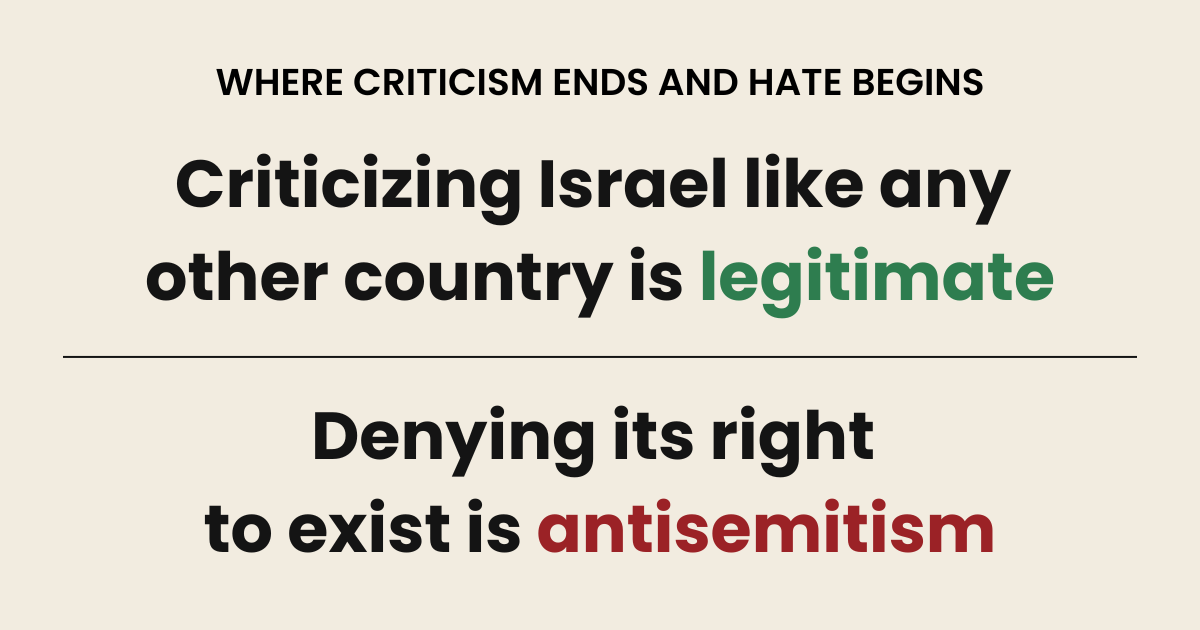
Emanuel’s speech comes as extremists in the Democratic and Republican parties are increasingly hostile toward the U.S.-Israel alliance. Too often, anti-Israel rhetoric crosses the line into anti-Jewish hatred. That line is not hard to find. Criticizing a government’s policies is legitimate – Israelis regularly disagree with their own leaders. Holding the Jewish people accountable for Israel’s actions or denying the country’s right to exist is not legitimate criticism – it is the world’s oldest hatred in a new disguise.

Political Candidates Call for Imprisoning ‘Zionists’


Israel has become a litmus test in national, state and local elections. Some candidates are open about their real target: Jews.


Texas Congressional candidate Maureen Galindo pledged to turn an immigration processing center into a “prison for American Zionists” and a “castration processing center for pedophiles, which will probably be most of the Zionists.” A Zionist is anyone who supports Israel’s existence. Galindo won the most votes in the first round of the Democratic primary for a U.S. House seat that covers parts of San Antonio – but lost the runoff. She also claimed that Zionists are not real Jews. In California, Republican gubernatorial candidate Alicia Lapp made a similar demand. She won just 0.1% of the primary vote after calling for the deportation of “every single Zionist.”


Members of the Democratic Socialists of America have made significant inroads into the Democratic Party – condemning Israel is a major part of their platform. NYC Mayor Zohran Mamdani is one of the most prominent DSA politicians in office. In a 2017 rap video, he referenced “My love to the Holy Land Five” who were convicted by a federal jury for sending $12 million to Hamas. Mamdani also repeatedly refused to condemn the phrase “Globalize the Intifada” on Meet the Press last year. The Intifada refers to repeated terror attacks against innocent Israeli civilians – globalizing it is a call to attack Jews around the world.


DSA candidates who share his views recently won Democratic primaries in long-held party strongholds from NY to Colorado. In NY, U.S. House candidate Darializa Avila Chevalier doubled down on her attendance at a pro-Hamas rally a day after Hamas’s Oct. 7 atrocities. The hostility is not confined to the DSA. In Michigan, progressive U.S. Sen. candidate Abdul El-Sayed branded Israel a “rogue state.”


In CO, Melat Kiros ousted a 15-term incumbent in a primary race for a U.S. House seat. She called Oct. 7 “inevitable.” A leading state Democrat criticized Kiros for refusing to call the deadly Boulder firebombing antisemitic – an attack on a march for Israeli hostages. Newly published research finds that American liberals are more tolerant of antisemitism when statements are framed as criticism of Israel.


The isolationist wing of the Republican Party also is a growing concern. U.S. Sen. Rand Paul has long opposed all foreign aid, including to Israel, and U.S. Rep. Tom Massie was the lone vote cast against resolutions condemning antisemitism in 2022 and 2025. Recently, VP Vance publicly warned Israeli leaders not to criticize the now unraveling U.S.-Iran deal or risk losing American military aid. Some on the far right align with the ‘America Only’ movement that blends isolationism, Christian nationalism and antisemitism.


Israelis Constantly Criticize Their Government


Israel is a vibrant democracy and many Israelis have strongly displayed their right to protest – filling the streets week after week in recent years to protest judicial overhaul, the fate of the hostages held in Gaza and whether the current government should remain in power. Polls routinely show many Israelis are dissatisfied with PM Netanyahu, and Israeli pundits and opposition politicians challenge his decisions daily.


That criticism does not stop at Israel’s borders. American officials across both parties, along with politicians in other countries, regularly fault specific Israeli policies – anti-terrorism measures, dialogue with Palestinians, judiciary changes – without treating it as an attack on Jews.


Many countries have agreed on where the line falls between criticism of Israel and antisemitism. The International Holocaust Remembrance Alliance (IHRA) working definition of antisemitism plainly states that “criticism of Israel similar to that leveled against any other country cannot be regarded as antisemitic.” The IHRA definition has been adopted by 47 countries and hundreds of governments and institutions around the world.


Both Parties Push Back


The extremists are ascendant, but they are not going unanswered – and the pushback is coming from inside both parties. In NY, progressive U.S. Rep. Ritchie Torres, a staunch defender of Israel, beat back primary challengers from the DSA’s slate with 72% of the vote.


Democratic leaders have begun to break their silence. U.S. Rep. Adam Smith, a senior House Democrat, told the Jewish News Syndicate that the far left uses “threats, harassment and intimidation” to force its socialist agenda on the party. Pennsylvania Gov. Josh Shapiro and U.S. Rep. Josh Gottheimer have pressed their colleagues to condemn antisemitism in Democratic ranks. Former Chicago Mayor Emanuel whose father fought in Israel’s War of Independence, has harshly criticized the Israeli government, but firmly defended the country’s right to exist.


The political right has its own reckoning. A new political organization aligned with U.S. Sen. Ted Cruz was launched to confront antisemitism on the political right. Its task grew harder with the recent passing of Republican U.S. Sen. Lindsey Graham, one of Israel’s most steadfast defenders in Congress. His sudden death silences a leading voice for the U.S.-Israel alliance just as the isolationist wing is gaining ground.


The response is real, but so is the threat. The litmus test is spreading, and each election brings new candidates willing to challenge Israel’s right to exist.

1. Criticizing any government is legitimate 


Every democracy demands debate – and Israel is no exception. Israelis protest their own leaders in the street and online. Many Democratic and Republican politicians routinely find fault with specific Israeli policies without anyone calling it bigotry – while also making clear their strong support for the U.S.-Israel alliance and Israel’s right to defend itself. Disagreeing with a government’s policy decisions is normal political dispute – not hatred.


2. Anti-Jewish hatred is being disguised as hatred of Israel


Far left candidates have called to imprison “Zionists” and denied Israel’s right to exist. The far right, “America Only” fringe spreads open conspiracies about Jewish power. Both use “Israel” or “Zionist” as cover for the oldest hatred. When “Zionist” becomes a slur for “Jew,” the target is no longer a government – it is a people. When someone attacks Israel’s policies and then reaches for slurs against Jews, the mask slips and bigotry is exposed for the world to see.


3. No grievance with a government justifies dehumanizing a people


No anger at any country’s actions can excuse vilifying an entire people. This is as true for Israel and Jewish Americans as it is true for Palestinians and Palestinian Americans, Russia and Russian Americans any other group. Anyone who answers a political grievance by dehumanizing a whole people should be condemned for it – without exception.


4. Israel is judged by a double standard like no other nation


Israel’s loudest critics hold it to a standard they apply nowhere else. The same activists and candidates who brand Israel a ‘rogue state’ say nothing of Turkey’s 52-year occupation of northern Cyprus, China’s mass detention of Uyghur Muslims or a war in Sudan that has killed as many as 400,000 people. A recent New York Times editorial noted that Sudan’s catastrophe draws a fraction of the attention paid to Israel. Reserving outrage for the world’s one Jewish state while ignoring atrocities elsewhere is not principle – it is prejudice.


5. More political voices are needed to counter extremists


Extremists are loud, organized and increasingly willing to test candidates on Israel. Leaders in both parties have begun to answer – from Democrats condemning antisemitism in their ranks to a new conservative effort against anti-Jewish hate on the right. The defeat of extremist primary candidates and the recent loss of longtime Israel ally Sen. Lindsey Graham make those voices more necessary than ever.


  • Vote in primaries: Extremists often take advantage of low-turnout primaries because most voters skip them – it is how many DSA candidates have won. Vote in your local primaries that determine who reaches the general election ballot, not only in November.


  • Demand that candidates are clear in their positions on Israel: Candidates seeking your vote should say plainly whether they support Israel’s right to exist as an independent Jewish and democratic state and reject holding all Jews responsible for its government. Their answer separates policy critics from those trafficking in anti-Jewish hate.


  • Urge your state and city to adopt the IHRA definition: Dozens of federal, state and local governments already use it to differentiate between legitimate criticism of Israel and antisemitism. A local resolution gives your community the same clear standard.


Remembering U.S. Sen. Lindsey Graham


Betsy Berns Korn, Chair, and William C. Daroff, CEO, of the Conference of Presidents of Major American Jewish Organizations, issued the following statement:


“We mourn the passing of Senator Lindsey Graham, a devoted public servant, a trusted friend of the American Jewish community, and one of Israel’s most steadfast champions in the United States Senate.


“Senator Graham understood that Israel’s security and the U.S.-Israel alliance advanced American national security, strengthened regional stability, and reflected the democratic values shared by our two nations.


“For decades, Senator Graham met moments of uncertainty, war, and international pressure with resolve. He confronted Iran and its terrorist proxies, spoke forcefully against antisemitism and extremism, and brought strategic judgment and statesmanship to the most consequential foreign policy challenges of our time.


“To the Jewish community, Senator Graham was an engaged and trusted partner who built enduring relationships with Israeli leaders, American Jewish organizations, and communities across the United States that valued his counsel, judgment, and leadership.


“Lindsey Graham never viewed support for Israel as a political position. He viewed it as a matter of principle. His conviction, warmth, and tireless commitment to the U.S.-Israel relationship leave an enduring legacy.


“We extend our deepest condolences to Senator Graham’s family, his staff, his Senate colleagues, and the people of South Carolina, whom he served with distinction for more than three decades. May his memory be a blessing.”

Stories of Resilience


Stories Impacting American Jews


Stories Impacting the U.S. and Israel


Stories from Around the World

CLICK BELOW TO ACCESS ADDITIONAL FOCUS PROJECT RESOURCES:

STAY INFORMED

SPEAK UP

TAKE ACTION

Want to Read More of Our Talking Points?

Did you miss a recent edition of The Focus Project? No need to search your inbox. Our most recently published editions are available on our website. Click below to continue reading.

The Focus Project develops and distributes news, background, history and weekly talking points on timely issues to inform individuals and organizations about issues affecting the American Jewish community and Israel, and help readers speak with more consistency and clarity. The editions also provide potential responses for addressing incidents of antisemitism and anti-Zionism. With input from a spectrum of major American Jewish organizations, we focus on that which unites us, rising above political and individual agendas.


Recognizing that hatred of Jews comes in many forms and directions, we strive to address all sources as they arise, and educate our growing audience on topics ranging from inter-religious relations to relevant international developments. From week to week, we may focus on issues arising from the political left, university campuses, from the political right and from institutions, government, and corporations. We don’t try to address all issues in each edition. We hope you will find this information useful in your writing and/or speaking. We are always open to your feedback: info@focus-project.org.

Copyright © 2026 The Focus Project, All rights reserved.

www.focus-project.org