|
Greetings!
In my latest blog, "Through the Lens of Justice: Tina Modotti's Revolutionary Vision," I share how discovering that this photographer once lived in my San Francisco neighborhood inspired my thesis on her remarkable story. An Italian immigrant who arrived as a seamstress, she transformed herself into one of Mexico's most compelling photographers in just seven years. Her images—workers' hands, farmers marching like a field of flowers—captured dignity where others saw only labor, while revealing the complex dance between artistic and political expression. I hope you'll enjoy reading it!
📅 Mark your calendars: Join us on October 7 for what promises to be an engaging conversation on "Trademark Parody After Jack Daniel's," moderated by Professor Sonia Katyal. Verso Law's Amy Parigi and Ryan Bricker will explore when creative expression gains First Amendment protection against trademark claims—a crucial issue for artists working with commercial symbols. This session is co-sponsored with the Center for Law and Technology. Register here>
This month we cover critical developments in art, law, and technology: deepfake legislation, virtual repatriation challenges, Anthropic's $1.5 billion copyright settlement, the shutdown of Christie's digital art department, and the $136 million Sotheby's Karpidas sale. We also spotlight cultural preservation from Italy's overtourism to the Winnebago Tribe's repatriation fight, plus Banksy's courthouse mural, fake Picassos, and UC Berkeley's own Chiura Obata.
Delia Violante
Founder of the Berkeley Art, Law, and Finance Project
Berkeley Center for Law and Business
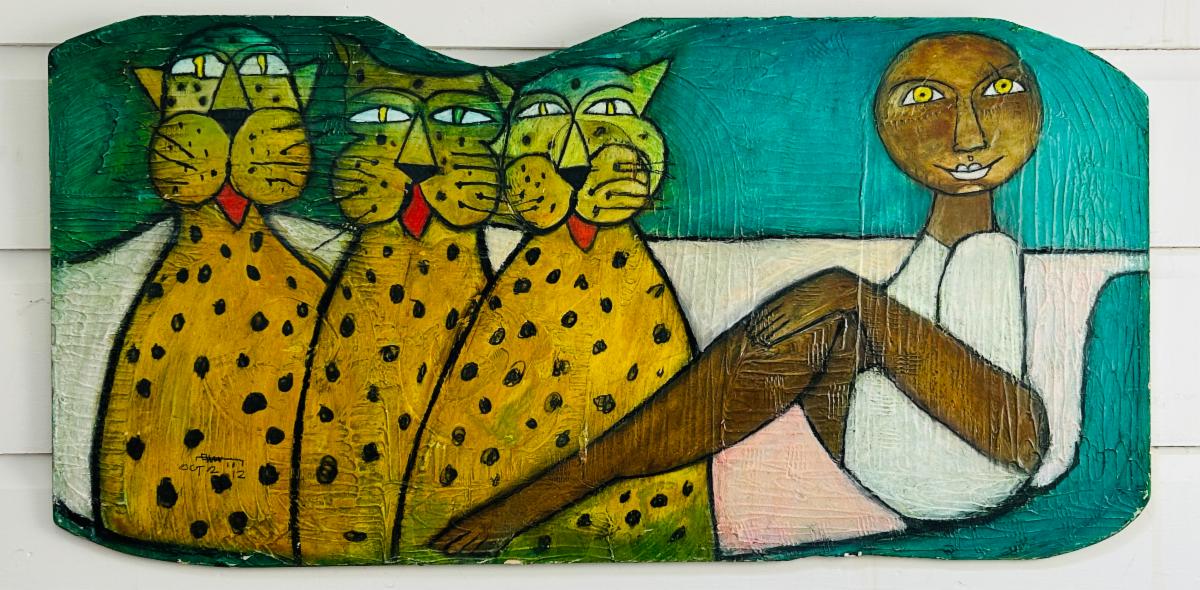
| | Marco Razo - Life of Pi, Mixed media on wood, 24”x 48” | | |
Academic Corner
MICHAEL MURRAY | UNIVERSITY OF KENTUCKY, J. DAVID ROSENBERG COLLEGE OF LAW
Michael Murray from the University of Kentucky, J. David Rosenberg College of Law, explores how contemporary generative artificial intelligence tools have revolutionized the creation of images, videos, and audio. In turn, this allows users to "fake" the appearance, voice, performances, and actions of real people with unprecedented speed and ease. The spread of such content has led to legislative actions at both the state and federal levels. There are many problems and complexities of regulating deepfakes and generative AI through federal and state legislation and federal executive orders, especially in the United States as compared to the European Union. Read more>
| | |
Hot off the Blog...
GIULIA PICCI | BERKELEY ART, LAW, AND FINANCE PROJECT
In "The Promises and Perils of Virtual Repatriation," Picci examines how museums use digital replicas as alternatives to returning contested artifacts. While projects like Digital Benin aim to reconnect communities with displaced heritage, virtual repatriation raises concerns: Western institutions retain copyright over digital copies, reinforcing colonial power dynamics; sacred objects lose significance when digitized; and resource disparities limit community access. Without clear legal frameworks for ownership and control, virtual repatriation risks substituting for—rather than advancing—genuine restitution. Read more>
ROBIN WILLSHEIDT | BERKELEY ART, LAW, AND FINANCE PROJECT
As a winner of the 2025 Beverly Hills Bar Foundation's Rule of Law writing competition, Willscheidt recently presented her article "Poking a Sleeping Bear: Cultural Landscapes in the 1906 Antiquities Act" in a BHBA webinar. Through the lens of Bears Ears National Monument in Utah, Robin argues that "cultural landscapes" fall within the Antiquities Act's purview, which permits presidents to designate "objects of historic and scientific interest" as national monuments. Watch here—law students and young attorneys can view free with a complimentary BHBA membership.
PARIS QUETZAL SISTILLI |COLUMBIA UNIVERSITY/SCIENCESPO PARIS
Sistilli, a graduate of the Columbia University/SciencesPo Paris Dual BA program, reflects on the concept of memory and its essential role in understanding the preservation of national identity and cultural heritage. Cultural memory laws are vital in educating future generations on tumultuous pasts, even when that memory is fragile due to generational trauma. Read more>
| | |
Anthropic Pays $1.5B in Copyright Settlement
THE NEW YORK TIMES
In a landmark settlement, Anthropic, a leading artificial intelligence company, has agreed to pay $1.5 billion to authors after a judge ruled it had illegally downloaded and stored millions of copyrighted books. The settlement is the largest payout in the history of U.S. copyright cases. Anthropic will pay $3,000 per work to 500,000 authors. Read more>
| |
Pennsylvania Museum Wins Grant Lawsuit
ARTNET
The Institute of Museum and Library Services (IMLS), a federal agency, has restored a $750,000 grant to Woodmere Art Museum in Philadelphia following a lawsuit against the current administration's executive order. The museum states they are "thrilled... [and] look forward to the critical work of preserving Woodmere’s collection for the public". Read more>
| | |
Banksy's Courthouse Mural: Legal Questions
THE ART NEWSPAPER
A Banksy arrived overnight on the wall of the Royal Courts of Justice in London on September 8 and was then “removed” two days later. This raises a couple of questions: if caught, might Banksy have to serve a long prison sentence for criminal damage to a Grade I listed building? What sort of intellectual property rights does he have to the offending image? Read more>
| | |
Art Dealer Sentenced for Selling Fake Picassos
MSN
Carter P. Reese, Allentown art dealer and historian, defrauded buyers with fake Picassos, Warhols, and more. Known for being Taylor Swift's former neighbor, Reese landed himself in prison for a two month sentence after the FBI's Art Crime unit cracked down on his counterfeit art scheme. Read more>
| | |
CCA-NVIDIA AI Partnership
CALIFORNIA COLLEGE OF THE ARTS
A groundbreaking collaboration between NVIDIA and California College of the Arts (CCA) ushers in a new era of formal partnership between the tech giant and art scholarship. Both strategically aim to put creatives in conversation with AI innovation, fostering agency and critical awareness. Read more>
| | |
Christie's Closes Digital Art Department
THE ART NEWSPAPER
Christie's is shuttering its pioneering digital art department, dubbed "Christie's 3.0", though it intends to "continue to sell digital art within the larger 20th- and 21st -century art category." Christie's 3.0 broke barriers and helped legitimize NFTs. Read more>
| |
Sotheby's Karpidas Collection Brings $136 Million
ARTNET
The Pauline Karpidas collection became London's highest-grossing single-owner auction with every lot sold. Surrealist works led the sale, realizing $41.1 million including Magritte's La Statue Volante at $13.7 million. Success reflected current market preferences: fresh-to-market works priced in the $1-10 million sweet spot. Read more>
| | |
Art Market Crisis: Media Hype or Reality?
ARTNEWS
What responsibility does the press bear at a fragile moment for the market? With saturated coverage on the "crisis", critics argue that "you can't just harvest negativity because it makes for clicks". Fear mongering on the downturn of the art market raises concerns for further market catastrophe. Read more>
| | |
Chiura Obata's Legacy Endures at UC Berkeley
UNIVERSITY OF CALIFORNIA
After the Japanese attack on Pearl Harbor in 1941, Obata was interned in a camp for Japanese-Americans. While detained, he created over 500 artworks expressing the institutionalized racism against him. Over his 20-year career at UC Berkeley, he taught art to tens of thousands of students and his pieces still hang in university buildings today. Read more>
| | |
Nebraska Tribe Seeks Return of Student Remains
COURTHOUSE NEWS SERVICE
The Winnebago Tribe of Nebraska argued at a hearing on September 17 that under the Native American Graves Protection and Repatriation Act the U.S. Army is obligated to repatriate the bodies of two students who were members of the tribe. The Act governs the return of human remains and tribal cultural artifacts in possession of federal agencies. Read more>
| | |
Italy Battles Overtourism at Historic Sites
ARTNET
The influx of tourists into historic Italian towns to see sites like the Colosseum and Pompeii has taken a toll on the nation's cultural treasures. Italian ministries dodge responsibility for cultural heritage protection, resulting in tensions between the tourism industry and the safeguarding of local monuments. Read more>
| | |
Meet the Artist
MARCO RAZO
Marco Razo candidly expresses the fundamental goals for an artist: to translate everyday reality into symbols, creating a personal language. His paintings are circumstantial—they reflect parts of his life story, images that unravel in his mind and remain captured in time on the canvas. Initially, his painting process plays with the colors, but later becomes more analytical in a balancing act of intuition and reason. Marco's work is deeply rooted in literature, poetry, philosophy, and cinema, drawing inspiration from Mexican popular culture. An alumnus of Pratt Institute in New York City and UNAM in Mexico City, he currently resides in San Francisco, creating two murals for the San Francisco General Hospital and exhibiting his work in cities around the world. Learn more>
| | Please note that some articles listed may be subject to a paywall. | |
Support the Berkeley Center for Law and Business as it organizes programs
and sponsors critical research in law and business.
| | | | |