|
Greetings,
We closed the Fifth Annual Symposium at SFMOMA on June 4 feeling like it was our best yet. Dean Erwin Chemerinsky opened with a keynote on government censorship and the Constitution, and sessions covered Native American cultural property, Holocaust restitution, financial crime in the art market, and authorship in the age of AI. Takeaways, resources, and press coverage are all on our symposium page.
Also on the blog, I share a dispatch on AR, VR, and what it could mean to finally make the 97% of museum collections sitting in storage visible to the public — and the legal and financial questions that come with it.
Elsewhere in the art world: Pace Gallery just declared the mega-gallery model unfixable. The Kennedy Center is in genuine crisis. Art Basel opened with a nervy, make-or-break feel. Federal guidelines are threatening to defund nearly half of all graduate arts programs in the country. And a banana duct-taped to a wall was stolen — again.
On the technology front: Leonardo's notebooks are finally complete for the first time in 400 years — digitally. Herculaneum scrolls buried by Vesuvius in 79 AD are speaking again after two millennia. And Los Angeles just opened its first AI art museum. Our featured artist this month is Luke Chiappetta, a Berkeley Law student whose born-digital works leave meaning deliberately unresolved. A fitting way to close an issue full of questions that don't have easy answers.
📅 Inaugural Berkeley Art, Law, and Finance Intensive Seminar
Monday, Nov 30 through Thursday, Dec 3, 2026. Learn more and apply>
Let's dive in!
Delia Violante
Founding Director of the Berkeley Art, Law, and Finance Project
Berkeley Center for Law and Business
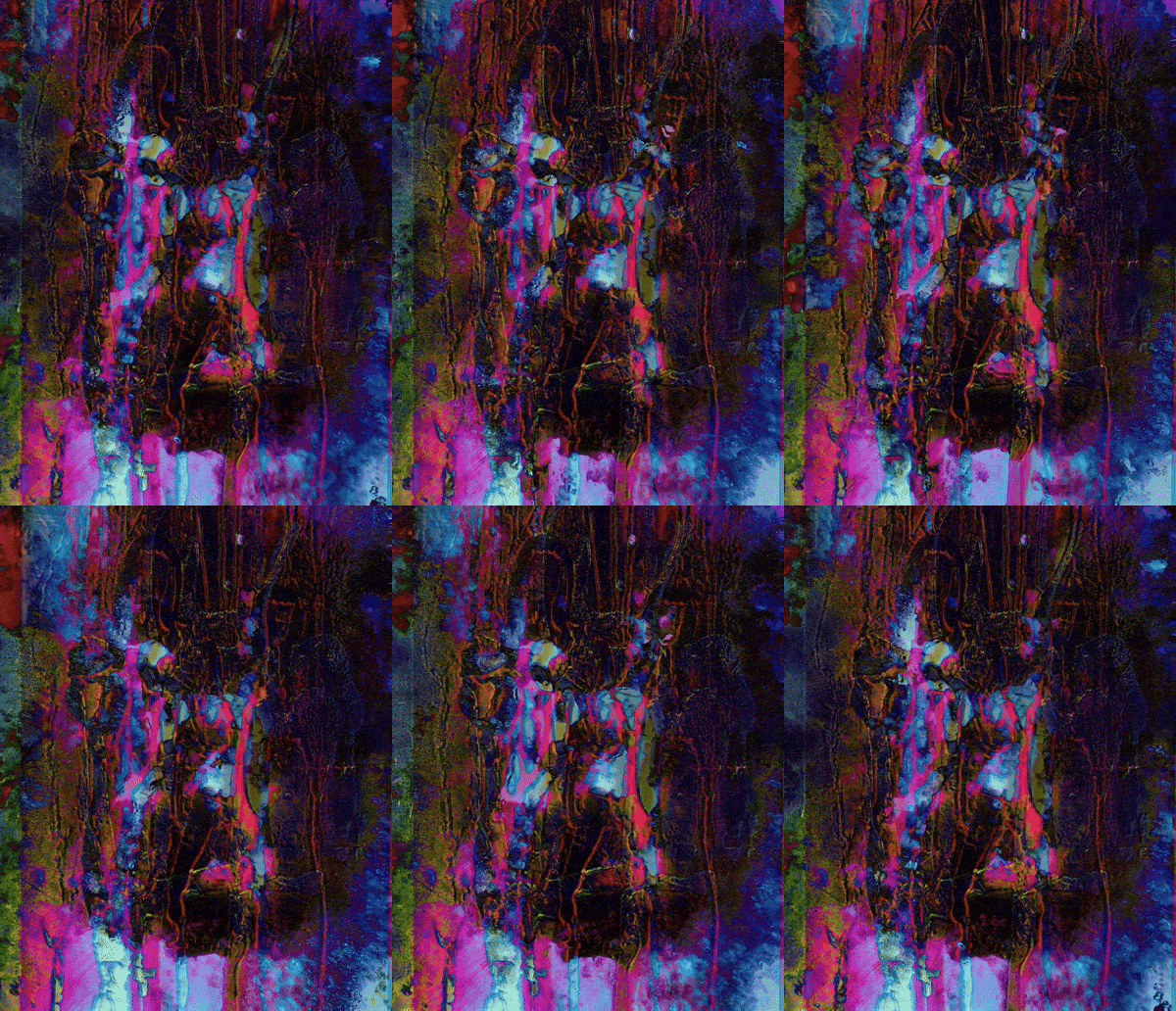
| | Luke Chiappetta - I Can See Through You (animated digital work) | | |
The New Art Forgers
KATRINA GEDDES | OHIO STATE UNIVERSITY, MORITZ COLLEGE OF LAW
In the Arizona State Law Journal, Geddes argues that courts are moving toward a troubling new standard — "substitutive similarity" — that would penalize AI-generated works simply for competing with human-authored ones, and proposes that Congress instead strengthen artists' attribution rights by requiring AI companies to disclose their copyrighted training data. Read more>
| | |
2026 Symposium Takeaways
BERKELEY ART, LAW, AND FINANCE PROJECT STAFF
What does it mean to own culture? To create it? To be responsible for it? These were the animating questions of the Fifth Annual Berkeley Art, Law, and Finance Symposium, held on June 4, 2026, at SFMOMA. Sessions covered government censorship and museum independence, Native American cultural property, Holocaust restitution, financial crime in the art market, and authorship in the age of AI. Read more>
| |
| |
AR, VR, and the Future of Museums
DELIA VIOLANTE | BERKELEY ART, LAW, AND FINANCE PROJECT
In The 97% Problem, Violante distills how augmented and virtual reality technologies could finally make the 97% of museum collections sitting in storage visible to the public — and the copyright, licensing, and financial questions museums, platforms, and artists must navigate to get there. Read more>
| |
| |
Protecting Artists' Style from AI
POLITICO
The CREATOR Act, a new bipartisan bill, would give visual artists the legal power to sue individuals and AI platforms that deliberately replicate their style for profit without permission. Legal experts welcome the intent but warn that "style" may be too vague to enforce effectively. Read more>
| |
Venice Biennale Award Crisis
ARTNET
Nearly 100 artists at the 61st Venice Biennale have threatened legal action after organizers ignored repeated requests to be removed from a visitors’ choice award. The prize was created as a last-minute replacement after the jury resigned en masse over geopolitical tensions surrounding Israel and Russia's pavilions. Read more>
| |
Targeting Ukrainian Heritage
ANTIQUITIES COALITION
On June 15, 2026, Russian air strikes deliberately targeted Ukrainian cultural and religious sites — including the Kyiv Pechersk Lavra, the Kharkiv Art Museum, and the Oleksandr Dovzhenko National Film Studio — in what the Antiquities Coalition condemns as the weaponization of heritage and a violation of international law. Read more>
| |
The Banana Strikes Again
SMITHSONIAN MAGAZINE
Maurizio Cattelan's Comedian — the banana duct-taped to a wall that sold for $6.2 million in 2024 — was stolen from the Centre Pompidou-Metz in France, the latest in a long series of thefts and unsanctioned snacking. The museum replaced the fruit, noting the artwork's value lies in its certificate of authenticity, not the banana itself. Read more>
| |
A Nervy Art Basel
THE NEW YORK TIMES
The 56th Art Basel opened in Switzerland with a make-or-break atmosphere as dealers navigated a prolonged market slowdown and rising costs. Standout sales included a $35 million Picasso at Hauser & Wirth and a large Willem de Kooning at Gagosian — but many American collectors are holding fire until Art Basel Paris in October. Read more>
| |
Pace Gallery Downsizes
ARTNET
Pace Gallery, one of the art market's most prominent galleries, is cutting roughly 50 artists and 50 staff as CEO Marc Glimcher declared that "the current gallery model isn't only broken, it's unfixable." The move signals a broader reckoning with the mega-gallery model as the contemporary art market continues its prolonged downturn. Read more>
| |
The Kennedy Center in Crisis
CBS NEWS
A federal judge has blocked the Kennedy Center's planned closure until 2028, ordered Trump's name removed from its facade, and is demanding programming updates. With plummeting ticket sales, staffing cuts, and artist withdrawals, the Trump-appointed board is expected to vote in mid-July on a path forward. Read more>
| |
Federal Guidelines Threaten Graduate Arts Programs
THE NEW YORK TIMES
New Education Department guidelines would penalize nearly half of all graduate programs in visual arts, music, and performance based on alumni earnings — putting programs at Yale, Harvard, and Juilliard at risk of losing federal loan eligibility. Critics argue the earnings test fails to capture the broader value of an arts education. Read more>
| |
Dataland: Los Angeles' First AI Art Museum
FORBES
Refik Anadol's Dataland opened June 20 in downtown Los Angeles — a 25,000-square-foot immersive complex housed in Frank Gehry's Grand building, where 1.5 billion pixels, bio-sensing wristbands, personalized scents, and a 250-speaker audio system create AI-generated experiences that shift based on visitors' physiological responses. Read more>
| |
Cao Fei on Technology, Humanity, and AI
THE NEW YORK TIMES
In a major survey at Kunstmuseum Basel spanning nearly 30 years of work, Chinese artist Cao Fei reflects on technology's utopian promise and its commercial drift — and why, in the age of AI, she is more interested in balance than in keeping up. "I want to preserve life, our human life," she says. Read more>
| |
Leonardo's Codex Atlanticus Reunited Online
ARTNET
For the first time in 400 years, Leonardo da Vinci's largest surviving notebook is complete — digitally. Florence's Galileo Museum has launched Leonardotheka 2.0, reuniting the 1,119-page Codex Atlanticus with the 550 pages a 16th-century sculptor cut from it, now held by the Royal Collection Trust in the UK. Read more>
| |
Herculaneum Scrolls Speak Again
UNIVERSITY OF KENTUCKY
After nearly 2,000 years of silence, the Vesuvius Challenge has achieved a historic breakthrough — virtually unwrapping carbonized scrolls buried by Mount Vesuvius in 79 AD and recovering new texts by Epicurean philosopher Philodemus, including previously unknown books, using AI-powered imaging and synchrotron X-ray scanning. Read more>
| |
Art at the Obama Presidential Center
THE GUARDIAN
The Obama Presidential Center, opening June 19 in Chicago, commissioned original works by 30 artists — including Julie Mehretu, Mark Bradford, Njideka Akunyili Crosby, and Maya Lin — making it the most ambitious art program ever undertaken at a presidential library. Read more>
| |
What to See in DC This Summer
HYPERALLERGIC
As Washington prepares for America's 250th celebrations, DC museums are staging an urgent artistic reckoning — from Faith Ringgold's bloody flag painting at the National Gallery of Art to collages built from US census language, Black design, and Pueblo pottery. A timely guide to what's on view this summer. Read more>
| |
New Sculpture on Campus
BAMPFA
Mark di Suvero's Mamma Mobius (2018), a large-scale curved steel sculpture by the renowned Cal alumnus (Class of 1957), has been permanently installed on UC Berkeley's Crescent Lawn, joining works by Alexander Calder and Arnaldo Pomodoro — one of the most significant contributions by a Cal graduate to the university's public art. Read more>
| |
Lost Roman Villa Uncovered Near Rome
ARTNET
A magnificent Imperial-era villa linked to Hadrian, Antoninus Pius, and Marcus Aurelius has been unearthed at Castel di Guido, 13 miles west of Rome, after authorities intercepted illegal excavations — revealing intact rooms, intricate mosaics, and a suspected marble statue of the god Silvanus. Read more>
| | |
I Can See Through You
LUKE CHIAPPETTA
Artist Luke Chiappetta creates born-digital pieces that begin with personal memory, emotion, or experience, but which he leaves deliberately unresolved — inviting viewers to find their own meaning within them. What initially appears incomprehensible may gradually feel intimate, while what first seems obvious can become increasingly elusive; Luke is drawn to the moment when a viewer recognizes something without being able to name it, and to how sustained attention can reveal connections that a first glance conceals. Once a piece is finished, it belongs as much to the viewer as it does to him. As a student at Berkeley Law, he approaches this through the same ambiguity that animates legal interpretation — where meaning depends on language, perspective, and incomplete facts, and competing readings coexist. His work follows a similar balance of structure and uncertainty, giving the eye enough form to enter while leaving space for the viewer to shape what the image becomes. In that exchange, interpretation becomes part of the work itself, and the viewer enters not as spectator but as participant. Learn more about Luke>
| | Please note that some articles listed may be subject to a paywall. | | Contribute to Our Blog Have insights on art, law, finance, technology, or culture? We'd love to hear from you. Get in touch> | |
Support the Berkeley Center for Law and Business as it organizes programs
and sponsors critical research in law and business.
| | | | |