|
Greetings,
Asked about AI at a recent BAFTA event, Tom Cruise didn't hedge: "There is nothing like human." His defense of hand-made art could be the epigraph for this issue, which keeps circling the line between what people make and what machines do — from a landmark copyright fight between The Times and OpenAI to the first AI-raised generation of student artists, and Joanna Ong's blog on why the law still demands a human author.
Ownership disputes abound: a court reining in art seizures, and a wave of new laws and rulings sending Nazi-looted masterpieces home — one found hanging above a sofa in a real-estate listing, while scholars gather to ask what restitution really repairs. Money matters aren't far behind, from an art market rebounding to its strongest first half since 2022 to insurers warning that soaring values are outrunning collectors' coverage, and disgraced dealer Inigo Philbrick, out of prison, disputing the size of his own $86 million fraud. Our great institutions, meanwhile, are having a moment: George Lucas opens his billion-dollar museum, and the Bayeux Tapestry crosses the Channel for the first time in nearly a thousand years.
Our featured artist, Astria Suparak, fits perfectly — her work excavates the racism, classism, and colonialism hidden inside popular culture, from sci-fi films to sports.
This issue's Academic Corner, "The Hermeneutics of Restitution," is co-authored by Berkeley Law's own Liana Harris alongside Antoinette Maget Dominicé of the University of Geneva, who joins us this winter as faculty at our inaugural Intensive Seminar.
Coming Up
📅 Inaugural Berkeley Art, Law, and Finance Intensive Seminar
Nov 30 through Dec 3, 2026. Learn more and apply>
Let's dive in!
Delia Violante
Founding Director of the Berkeley Art, Law, and Finance Project
Berkeley Center for Law and Business
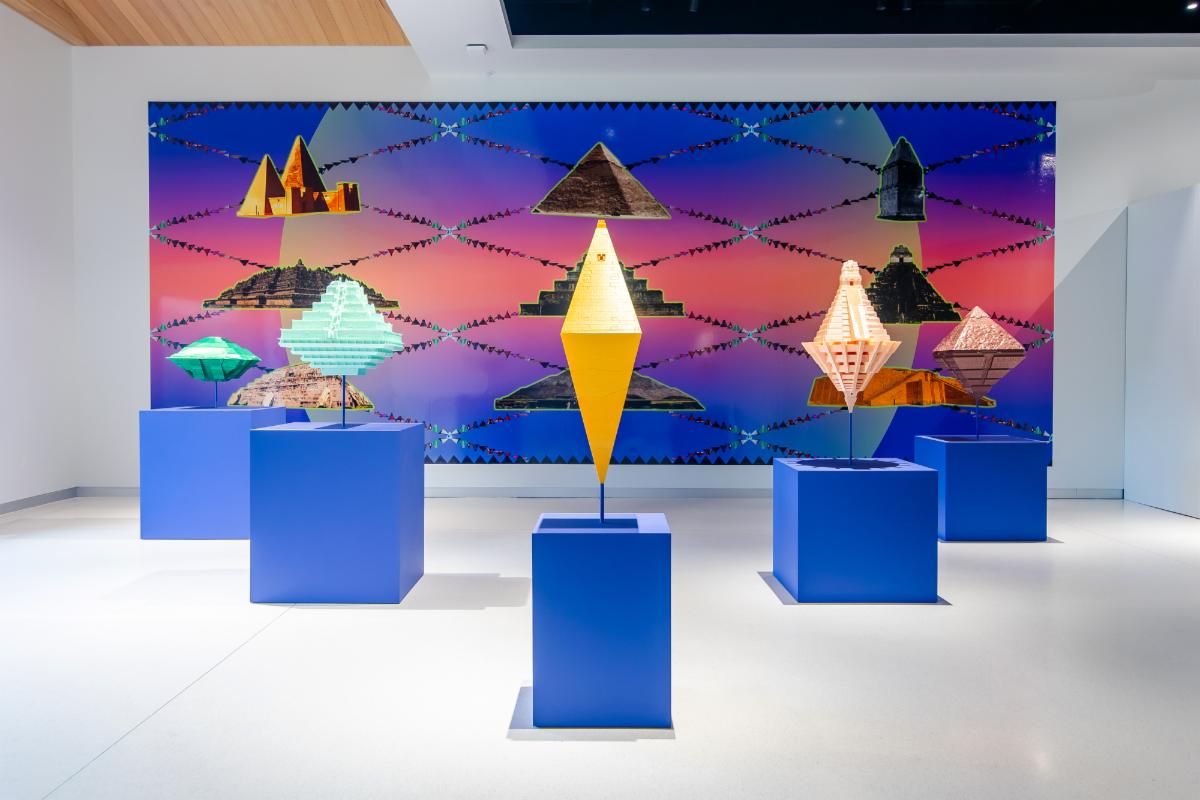
| | Astria Suparak - Pyramid Schemes (Installation), 2026 | | |
The Hermeneutics of Restitution
LIANA ARIELLE HARRIS & ANTOINETTE MAGET DOMINICÉ | BERKELEY LAW & UNIVERSITY OF GENEVA
Reporting from a 2026 University of Bonn conference, Harris and Maget Dominicé distill two days of cross-disciplinary debate on how returning cultural property might inform broader theories of restitution — from Nazi-looted art and colonial-era objects to ancestral remains and reparations. Two tensions recur: the limits of legal remedies for historic wrongs, and the gap between symbolic gestures and real transfers of power. Read more>
| | |
Human Authorship and AI
JOANNA ONG | BERKELEY ART, LAW, AND FINANCE PROJECT
Tracing a line from a Gilded Age photograph of Oscar Wilde to last year's Thaler v. Perlmutter, Ong examines why US copyright still demands a human author — even for work made with AI. The courts' reasoning, she notes, is economic: machines don't respond to incentives, but people do, so protecting human authorship is what keeps creativity flowing to the public. She closes on a path forward: consent-based sourcing for the material AI is trained on. Read more>
| |
Testing California's Restitution Law
THE ART NEWSPAPER
Two Nazi-looted claims filed days before a 2024 California restitution statute expired — over Cranach's "Adam and Eve" at the Norton Simon and watercolors an Auschwitz prisoner painted for Mengele — are the only cases ever to invoke it. Both may hinge on whether museums can still raise the "act of state" defense, which the new federal HEAR Act pointedly strips away. Read more>
| |
Court Curbs Art Seizures
THE NEW YORK TIMES
A New York appellate court has ruled that Manhattan investigators wrongly used a criminal statute to seize an Egon Schiele drawing from the Art Institute of Chicago — a law they'd invoked in more than 100 other cases. Where ownership is genuinely disputed, the court held, restitution belongs in civil court, not a criminal seizure. Experts say the decision sharply limits the DA's antiquities-trafficking unit. Read more>
| |
Springsteen Wins in Court
NJ COM
A New Jersey appeals court sided with Bruce Springsteen, dismissing a suit by the estate of a collector whose mint 1968 Pontiac GTO appeared on the cover of "Only the Strong Survive." The estate claimed a further contract had been promised if the photos ran commercially; the court found the alleged deal too vague to enforce — no amount, no royalty, no witness — and noted the owner was paid the $1,200 he'd agreed to. Read more>
| |
The Art Market Rebounds
BANK OF AMERICA PRIVATE BANK
The latest Fall 2026 report finds the recovery accelerating — first-half auction sales hit $6.8 billion, up 70% year-over-year and the strongest first half since 2022. But the rebound is lopsided: collectors are returning to established historical names while galleries struggle, even as a younger generation far more likely to collect enters through watches, design, and collectibles. Read more>
| |
Underinsured Masterpieces
INSURANCE BUSINESS
As the top of the art market surges — sales above $10 million jumped 30% globally in 2025 — insurers warn that museums and collectors may be underinsured, since "current market value" policy wording means little without high enough limits to pay a major claim. With value increasingly concentrated in a few works, a single fire or flood could wipe out an outsized share of a collection. Read more>
| |
Inigo Philbrick, After Prison
ARTNET
In a candid interview with dealer-columnist Adam Lindemann, convicted art fraudster Inigo Philbrick reflects on prison life, regret, and the $86 million he was ordered to forfeit — a figure he disputes, arguing forensic accounting puts the real losses in "the mid to low 20s." Out since 2024 and off supervised release, he offers the art world one lesson: "The more openly and honestly we communicate with each other, the better." Read more>
| |
The AI Copyright Showdown
THE NEW YORK TIMES
As the landmark copyright suit pitting The New York Times against OpenAI and Microsoft nears a summary-judgment ruling, new filings distill the fight to two questions: whether AI "transformed" the publishers' articles into something new, or merely "substituted" for them and gutted their value. The Times warns the case will shape "not just journalism but the future of responsible AI." Read more>
| |
Tom Cruise on Real Art
THEWRAP
At a BAFTA "Life in Pictures" event, Tom Cruise gave an impromptu six-minute defense of human-made art in the AI age — conceding that broader AI use in filmmaking "is coming, and it's going to happen," but insisting audiences still crave the real: "There is nothing like human." Fitting, from a star who built his brand on practical effects and doing his own stunts. Read more>
| |
Student Artists Confront AI
EDSURGE
At the America's Youth AI Festival in Boston, the "Me, Myself, and AI" art competition asked students to picture AI's role in their communities now and in 50 years — and the winning works were strikingly ambivalent, from a Venezuelan teen's "A Free Venezuela" to an Alabama entry warning of over-reliance on machines. Organizers found the class of 2026, the first raised on generative AI, far more thoughtful about its ethics than expected. Read more>
| |
George Lucas' Billion-Dollar Museum
ASSOCIATED PRESS
After 17 years and $1 billion, George Lucas and Mellody Hobson's Museum of Narrative Art opens in Los Angeles — a "temple to the people's art" that mixes Norman Rockwell, comic art, and "Star Wars" ephemera with a rare Frida Kahlo self-portrait and two walls of Banksy murals made with Lucas himself. Housed in Ma Yansong's cloud-like building, it stakes a deliberate claim for high-meets-low, populist art. Read more>
| |
The Bayeux Tapestry Comes Home
THE NEW YORK TIMES
Nearly 1,000 years after it was stitched, the 230-foot Bayeux Tapestry — the embroidered record of the 1066 Norman Conquest — has traveled from France to the British Museum, a loan brokered by Macron as post-Brexit diplomacy. Laid flat in a single vitrine, it is a strangely nonpartisan record of conquest says critic Jason Farago, and a reminder that "English history is European history." Read more>
| |
Looted Art Above the Sofa
JTA / SUN SENTINEL
A Dutch journalist hunting for a Jewish dealer's lost art found one of the paintings hiding in plain sight — hanging above a sofa in an online listing for the Argentine home of a Nazi financier's daughter. An Argentine court has now ordered "Portrait of a Lady," from the Goudstikker collection, returned to heir Marei von Saher — the same heir suing for the Cranach diptych in Pasadena. Read more>
| | |
Pyramid Schemes
ASTRIA SUPARAK
Astria Suparak’s multidisciplinary practice addresses how institutionalized racism, classism, and colonialism are embedded in popular culture, such as in science-fiction movies, rock music, memes, and sports.
Using creative and scholarly modes, Suparak’s projects chronicle subcultures and omitted perspectives. Her series Asian Futures is an incisive taxonomy of white Western film tropes, tracing their references and precursors through histories of architecture, fashion, religion, and science; the Asian futures, without Asians multimedia performance was described as “cathartic, brilliant” (Variable West) and “a compelling yet brutally honest exploration.” (The Michigan Daily). Suparak’s Tropicsss series proposes possible, expanded affinities and solidarities across geographies and national borders. Her Sports series playfully challenges the assumption that the worlds of sports, art, and politics are mutually exclusive.
In the past five years, Suparak’s installations, videos, and performances have been presented at the Museum of Modern Art, New York; the Institute of Contemporary Art, Los Angeles; the Walker Art Center, Minneapolis; and ArtScience Museum, Singapore.
Astria Suparak has curated exhibitions, screenings, and performances that are “visually and conceptually stunning” (Hyperallergic) with “savvy political consciousness,” for institutions and festivals including the Liverpool Biennial; Museo Rufino Tamayo, Mexico City; MoMA PS1 and The Kitchen, New York; Carnegie Museum of Art, Pittsburgh; Daisy Chain Fields, Irvine, CA; and Expo Chicago, as well as for unconventional spaces such as roller-skating rinks, sports bars, and rock clubs.
A recipient of the 2022 San Francisco Bay Area Artadia Award, Suparak lives and works in Oakland, California. Learn more about Astria>
| | Please note that some articles listed may be subject to a paywall. | | Contribute to Our Blog Have insights on art, law, finance, technology, or culture? We'd love to hear from you. Get in touch> | |
Support the Berkeley Center for Law and Business as it organizes programs
and sponsors critical research in law and business.
| | | | |