|
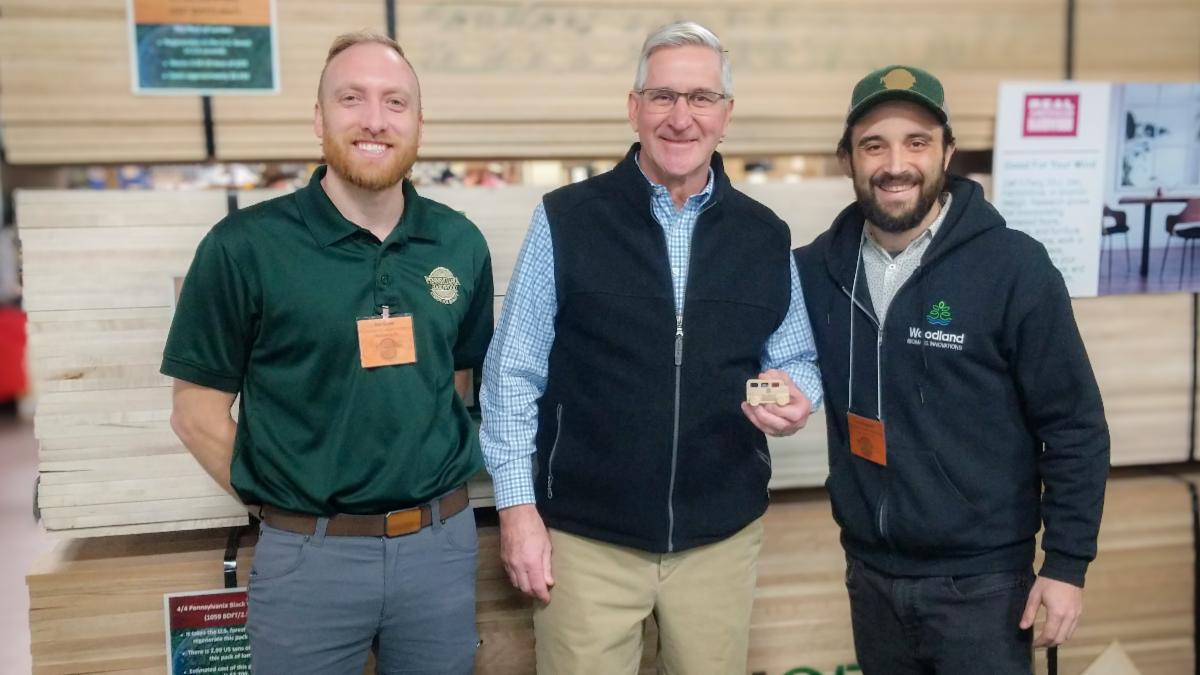
(Photo above LR: Jon Geyer, Executive Director of the PA Hardwoods Development Council; Luca Pandolfi, Founder of Woodland Biomass Innovations; PA Secretary of Agriculture, Russell Redding at the PA Farm Show)
WELCOME KWPA NEW MEMBER
WOODLAND BIOMASS INNOVATIONS
RUN YOUR CAR ON WOOD
TIOGA COUNTY--“It’s all about a circular economy,” says Luca Pandolfi, founder of Woodland Biomass Innovations—a company that is developing a process to “run your car on wood” by transforming woody biomass into 87 octane gasoline.
According to Pandolfi a circular economy—also called circularity—is the model in which resource production, consumption, reuse, and recycling happens locally. The goal of this concept is to address global environmental challenges through a solution that revitalizes local economies and communities concurrently.
“I did a lot of research, and a key missing ingredient to create a circular economy is a local transportation fuel source,” says Pandolfi. “We need a transportation fuel that is local and can offer realistic solutions to address climate change.”
This realization came to him over a decade ago, when he was an undergraduate student preparing his thesis at Ithaca College, NY. Consequently, it was around the time when electric vehicles (EV) were becoming popular under the premise of reducing carbon emissions.
Growing up internationally, Pandolfi felt that electric vehicles had their advantages in some cases, but he questioned their universal applicability.
“In densely populated cities, EVs can make sense, but in rural areas they can’t pervade the market,” he says.
He believes that electric vehicles are harder to maintain and more expensive to repair.
“Economically challenged regions will not be able to gain access to them immediately; nor will some areas be able to make the necessary changes to infrastructure to support them,” says Pandolfi. “We need a solution that adheres to the four “R’s”—reduce, reuse, recycle and repair. We need a solution that uses the cars we have on the road today, instead of manufacturing over a billion new cars, which has a significant environmental cost in of itself.”
With over 1.4 billion gas-burning vehicles on the road, he saw an opportunity. In 2013, his idea was validated as he entered Ithaca College’s Business Idea Competition and won first place.
“It was my first taste of entrepreneurship,” he says. “But I was 22 [years old] and the project needed $250 million to build a commercial-scale facility. I was not certain who would take me seriously at that age,” says Pandolfi.
That is why he took the next few years to work with a variety of start-ups. Learning a myriad of skillsets—such as how to attract investors—his experience paved the way to launch Woodland Biomass Innovations in 2019.
Pandolfi began bringing the company to life by conducting feasibility studies and educating potential partners about the concept. He was searching for a facility location—exploring upstate New York, the area where he currently calls home.
But it was not until 2021 when he met Richard Bohr, a graduate of Rochester Institute of Technology and an innovator with extensive experience in the energy industry, that the project picked up speed.
“Connecting with Rich was pivotal. He became my partner and co-founder,” says Pandolfi. After learning about the goals and objectives associated with Woodland Biomass Innovations, it did not take Bohr long to propose a perfect location.
“My first thought was, 'This is pure Pennsylvania,’” says Bohr, who secured a 160 acre-parcel of land for a facility in Tioga County. "As someone who has lived and worked all across America in the field of energy delivery and production, and having lived here for twenty years, Tioga County, PA is ideally suited to execute and realize the vision of this ambitious business plan."
Pandolfi believes a location in the Northern Tier of Pennsylvania makes sense.
“It is close to an abundant source of woody biomass which needs a place to go. There are no paper mills or competing biomass buyers in the area,” he says. “It is also close to major routes for gasoline distribution.”
The proposed plant production will convert 1,000 tons of dirty chips— woodchips that include bark, limbs, and leaves—into 42,000 gallons or 1000 barrels of gasoline a day. The conversion system will span across five acres of the property.
“We can make enough at that initial facility to supply around 40,000 households daily,” Pandolfi says. To avoid any interruptions in the supply chain, the site will also house a chipper to stockpile enough wood for 60 days of production.
“Chips would be hard to store long term. That’s why we plan to use roundwood/pulpwood with a chipper for long term storage,” he says.
In addition to distributing gasoline to suppliers, there is a small parcel of land adjacent to Route 6, where Woodland Biomass could potentially build a flagship gas station to sell directly to the community.
“When people fill their tanks with our gas, the money isn’t going to foreign places. It will stay in the community. That purchase is going to support 50-100 jobs at our site as well as the secondary jobs with local logger operators. It will create revenue for local landowners who will gain a new income stream from their forest residuals. All of this will stimulate the economy significantly,” Pandolfi says.
Providing a local source of gas has the potential to help generate environmental benefits as well. He added,
“By using what is called biogenic carbon [carbon derived from materials that can be regrown, like plants] instead of fossil carbons, our gasoline will reduce the carbon impact of driving by about 66 percent to start.”
Pandolfi says they will improve upon the process and efficiency over time. His goal is to reach carbon-neutrality.
Early on, Pandolfi researched all types of agricultural biomass to use in the conversion process, but since Pennsylvania has a robust forest product industry and is nearly 60% forested, it was decided that forest residuals would fuel the process.
Additionally, from an equipment standpoint, wood is the easiest material to handle and process. It minimizes the technical risk for the first commercial facility. Although both softwood and hardwood can be used in the process, Woodland Biomass prefers hardwood because it creates less tar. Since 90 percent of the state’s forest is comprised of hardwood, Pennsylvania once again provides a perfect fit.
Jonathan Geyer, Executive Director of the Pennsylvania Hardwoods Development Council, supports the use of woody biomass.
“With over 16 million acres of forestland, Pennsylvania provides opportunities for companies to utilize low grade waste materials,” says Geyer. “The Commonwealth also embraces and supports innovations that can advance forest products—which represent the largest sector of the state’s agricultural industry.”
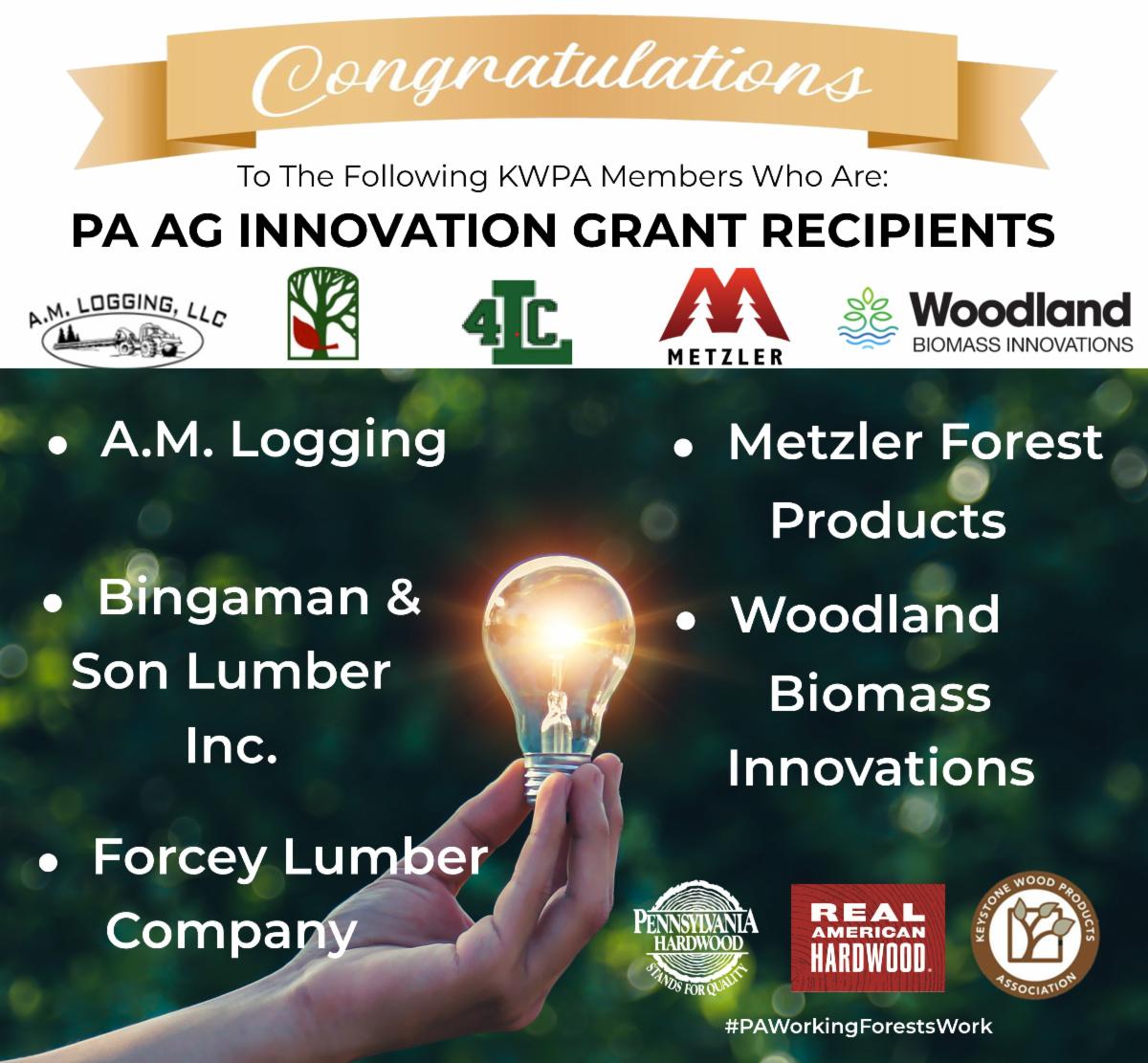
The support from the Pennsylvania Department of Agriculture is apparent, as it recently awarded Woodland Biomass Innovations a $50,000 Agricultural Innovation grant. Pandolfi says the funds will be applied towards the engineered design plans for the Tioga County facility. The facility’s conversion system will use two core technologies—gasification and gas to liquid (GTL).
In the simplest sense, gasification heats woody biomass to a high temperature and pressure while depriving it of oxygen. This converts biomass into a combustible gas called “syngas”. The second process, GTL, converts the resulting syngas into liquid form and refines it into the final 87-octane gasoline product through a series of catalytic conversions.
The concept of gasification dates to the 1800’s when it was used in London to convert coal to syngas to fuel streetlights. GTL was used during WWII to fuel planes, tanks and trucks through Fischer-Tropsch synthesis which converted the hydrogen and carbon monoxide into syngas into hydrocarbons using an iron catalyst. Although the concepts are not new, few companies have attempted to transform biomass into gasoline that is chemically identical to what is currently on the market.
“We are the only project in PA that we are aware of that take the two processes to produce locally sourced sustainable gasoline,” says Pandolfi. However, he is aware of similar projects in other locations that have used a variety of biomass sources--including trash. All have failed.
“What sets us apart is that we have been successfully avoiding pitfalls the others have fallen into. We are designing against their missteps in our plan,” says Pandolfi.
As of now, if their strategy runs smoothly, Woodland Biomass Innovations will continue to raise additional funds for research, development and construction, with hopes to begin production in 2028.
“We are in the end zone for the first phase of the project,” says Pandolfi. “By the end of the quarter we expect to close the current financing round, so it is really the last chance for additional investors to make themselves known and make a commitment. Together, we will produce environmentally sustainable gasoline that can fuel the future.”
For more information on Woodland Biomass Innovations visit: Woodland Biomass Innovations - Sustainable Fuel Solutions
|