|
FDA Updates for February 2026
Oncology (Cancer)/Hematologic Malignancies Approval Notifications | FDA
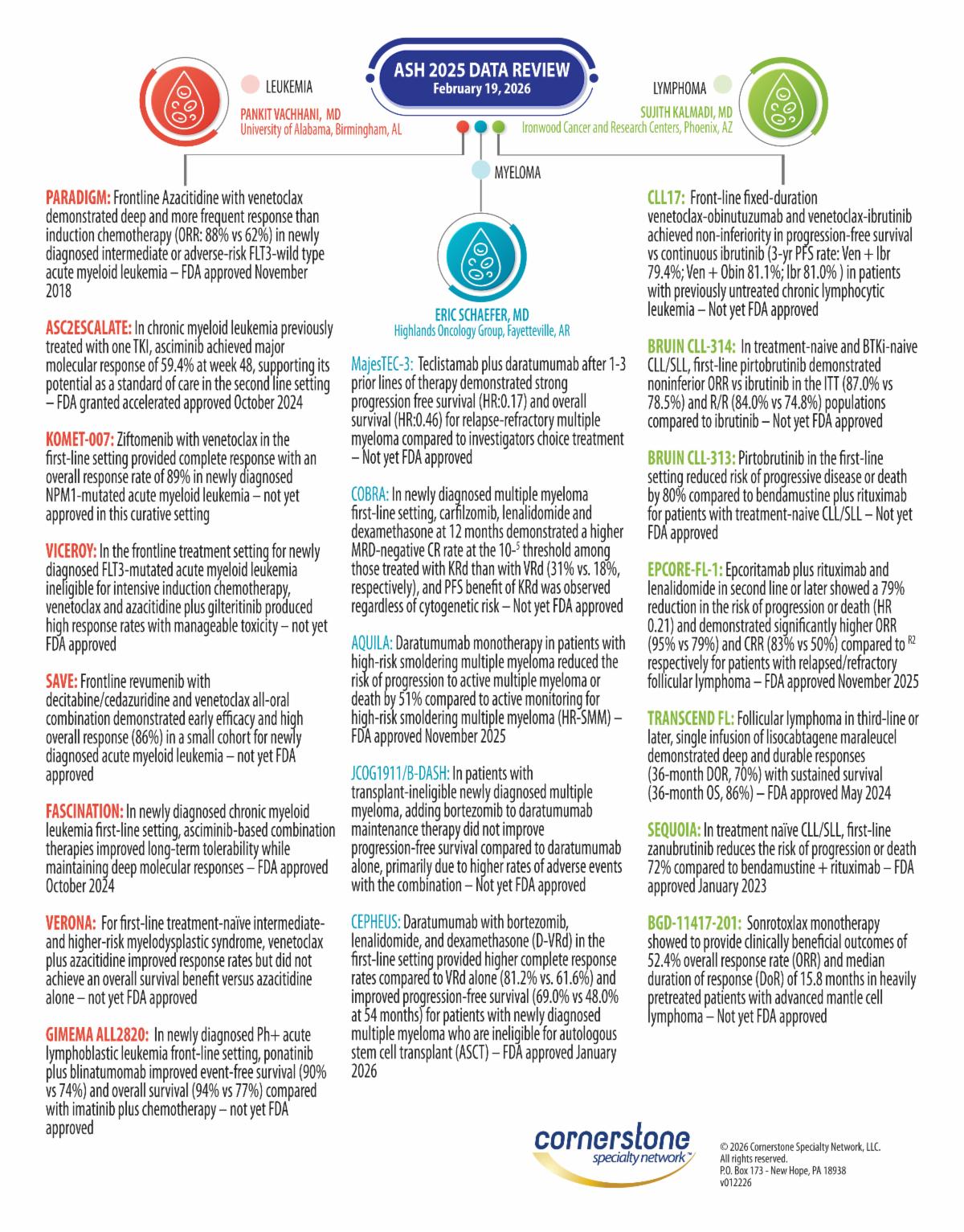
On March 5, 2026, the Food and Drug Administration approved teclistamab (Tecvayli, Janssen Biotech, Inc.) in combination with daratumumab hyaluronidase-fihj for adult patients with relapsed or refractory multiple myeloma who have received at least one prior line of therapy including a proteasome inhibitor and an immunomodulatory agent. The approval also converts the accelerated approval to traditional approval for teclistamab, as monotherapy, in adults with relapsed or refractory multiple myeloma who have received at least four prior lines of therapy, including a proteasome inhibitor, an immunomodulatory agent, and an anti-CD38 monoclonal antibody. Teclistamab received accelerated approval for this indication in 2022, evaluated in MajesTEC-3. Read More
On February 26, 2026, the Food and Drug Administration granted accelerated approval to zongertinib (Hernexeos, Boehringer Ingelheim Pharmaceuticals, Inc.), a kinase inhibitor, for an expanded indication for adults with unresectable or metastatic non-squamous non-small cell lung cancer (NSCLC) whose tumors have HER2 (ERBB2) tyrosine kinase domain (TKD) activating mutations, as detected by an FDA-authorized test evaluated in Beamion LUNG-1. Read More
On February 24, 2026, the Food and Drug Administration granted traditional approval to encorafenib (Braftovi, Array BioPharma Inc., a subsidiary of Pfizer Inc.) in combination with cetuximab and fluorouracil-based chemotherapy for the treatment of adult patients with metastatic colorectal cancer (CRC) with a BRAF V600E mutation, as detected by an FDA-authorized test evaluated in the BREAKWATER trial. Encorafenib received accelerated approval in combination with cetuximab and mFOLFOX6 for metastatic colorectal cancer with BRAF V600E mutation in 2024. Read More
On February 19, 2026, the Food and Drug Administration approved acalabrutinib (Calquence, AstraZeneca) tablets and capsules in combination with venetoclax (Venclexta, AbbVie Inc. and Genentech Inc.) for adults with chronic lymphocytic leukemia (CLL) or small lymphocytic lymphoma (SLL) evaluated. Read More
On February 10, 2026, the Food and Drug Administration approved pembrolizumab (Keytruda, Merck) as well as pembrolizumab and berahyaluronidase alfa-pmph (Keytruda Qlex, Merck) in combination with paclitaxel, with or without bevacizumab, for adult patients with platinum-resistant epithelial ovarian, fallopian tube, or primary peritoneal carcinoma whose tumors express PD-L1 (CPS≥1) as determined by an FDA-authorized test, and who have received one or two prior systemic treatment regimens evaluated in KEYNOTE-B96. FDA also approved the PD-L1 IHC 22C3 pharmDx (Agilent Technologies, Inc) as a companion diagnostic device to identify patients with epithelial ovarian, fallopian tube, or primary peritoneal carcinoma whose tumors express PD-L1 (CPS≥1) for treatment with pembrolizumab. Read More
On February 5, 2026, the FDA provided the following to increase awareness of recent updates to the product labeling of capecitabine (Xeloda) and fluorouracil (5-FU) related to risks associated with dihydropyrimidine dehydrogenase (DPD) deficiency. All healthcare providers should be aware of the risks of DPD deficiency, inform patients prior to treatment about the potential for serious and life-threatening toxicities due to DPD deficiency, and test patients for genetic variants of DPYD prior to initiating treatment with capecitabine or 5-FU unless immediate treatment is necessary. Read More
|