|
Product Stewardship Updates
January 9, 2025
| |
|
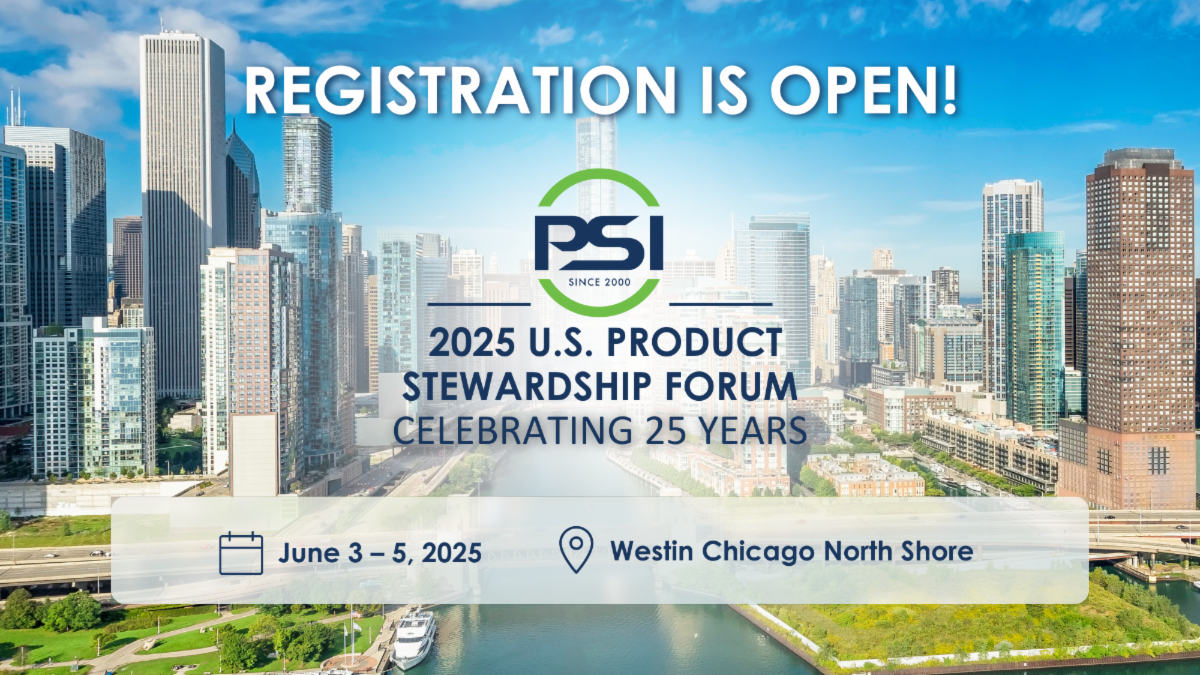
REGISTRATION NOW LIVE FOR PSI 25TH ANNIVERSARY
U.S. PRODUCT STEWARDSHIP FORUM
| |
|
Join 300 EPR leaders from around the globe, June 3-5, 2025 at the Westin Chicago North Shore, for information sharing, cutting-edge EPR solutions, and networking. Registration is open!
For more than two decades, PSI’s U.S. Product Stewardship Forum has been the place to go for meaningful content and in-depth conversations on the EPR issues that matter most. The Forum is consistently ranked by participants as the best EPR conference in the U.S. for the caliber and expertise of speakers, and the breadth of stakeholder perspectives represented – including private industry (producers, PROs, waste management), U.S. governments at all levels, environmental groups, academics, and international companies and governments.
“This was the best EPR conference I have ever attended. Highly recommend – great ROI. I will be at the next one.” - Mark Johnson, Senior VP of Policy & Government Affairs, Washington Retail Association
| |
OREGON REPORT REVEALS UNTAPPED POTENTIAL OF POLICY TO REDUCE GHG EMISSIONS | |
Image courtesy of City of Portland | |
|
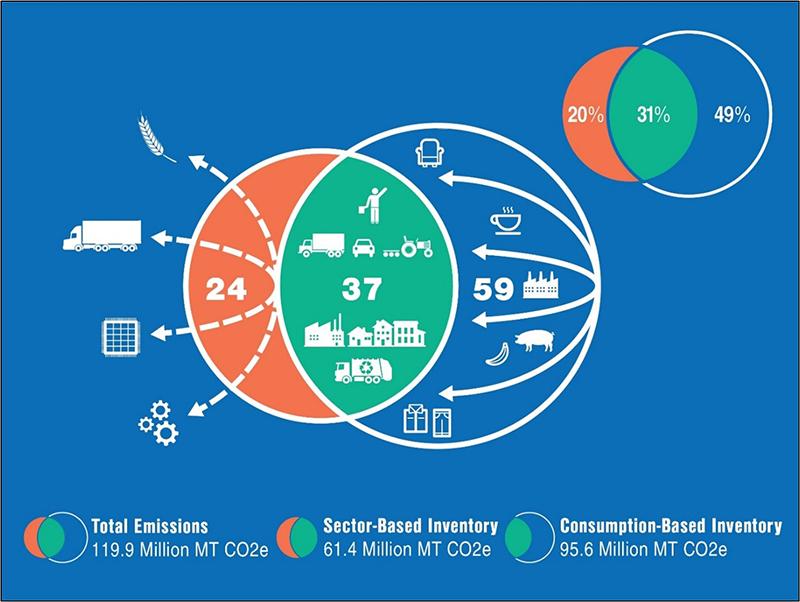
The Oregon Department of Environmental Quality (DEQ), a PSI founding member, recently released a report that evaluates and identifies policy opportunities – including EPR – to reduce Oregon’s consumption-based GHG emissions. According to the report, Oregon’s “sector-based” GHG inventory (which measures GHG emissions arising from production within the state’s borders, as well as imported electricity) overlooks one of the most significant contributions to the state’s climate impacts – emissions from products sold into, and used in, the state. When assessed using a consumption-based methodology, Oregon’s GHG emissions have grown, essentially wiping out the 15% reduction in sector-based emissions achieved since 1999.
The report, which is accompanied by an update to Oregon’s consumption-based GHG emissions inventory and a technical report written by SEI, offers creative ways of applying product stewardship for climate mitigation. “For the first time, Oregon has demonstrated and quantified the GHG reduction potential of a host of new policy options for reducing climate impacts primarily associated with demand or ‘consumption’ of materials,” writes David Allaway, one of the DEQ staff that authored the report. “This quantitative assessment reveals that there is significant untapped potential to reduce GHG emissions through policy means that historically have received little consideration.” The report also makes a compelling case that consumption-based GHG emission methodologies level the playing field for Oregon-based businesses relative to out-of-state producers with whom they compete. This approach also sends a clear signal to the market to shift to lower-carbon production processes, which creates the potential for social, environmental, and economic co-benefits.
| |
MAINE AND OREGON RULEMAKING MILESTONES | |
|
On December 5, 2024, the Maine Board of Environmental Protection adopted the rules for Maine’s Stewardship Program for Packaging. The rules allow the Department of Environmental Protection to implement, administer, and enforce the program, with the goals of reducing the burden to municipalities of managing packaging material and improving the design and management of that material. Additionally, the rules define packaging material, provide a method for determining municipal reimbursement and producer fees, provide a method and criteria for investing in infrastructure and education, detail alternative collection programs, and provide mechanisms for ongoing assessment and updates to the program.
The rollout of Oregon's packaging EPR program took significant steps in late December, with the Oregon Department of Environmental Quality (OR DEQ) passing a second set of rules that address producer fees and product design. DEQ, PSI, and Circular Action Alliance (CAA) will hold a webinar in early February that covers rules governing material exclusions. Additionally, Circular Action Alliance submitted its third and final program plan to OR DEQ on December 6. The plan is available for public comment until January 17, 2025. Comments can be sent to RethinkRecycling@deq.oregon.gov.
| |
CANADA PLASTIC PACT RELEASES UPDATE REPORT ON PLASTIC RECYCLING | |
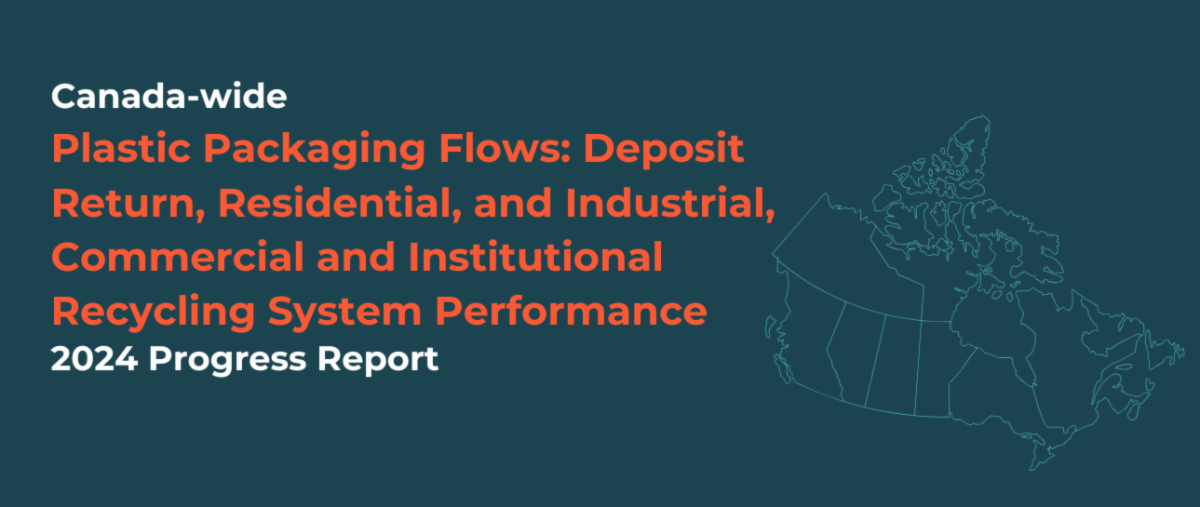
The Canada Plastics Pact released a 2024 progress report on plastic material flows in Canada using 2022 data. Compared to 2019, the most change in source reduction and recycling rates was seen in flexible plastics. Generation of flexibles decreased by 6% in the wake of bans, while the recycling rate increased by 13% compared to 2019. Even so, flexible packaging is recycled at significantly lower rates than rigid plastics (4% compared to 23%) due to the design of the materials and incompatibility with the current recycling system. The lowest overall recycling rates (11%) are in the industrial, commercial, and institutional (ICI) sector, which is comprised of 50% rigid plastic and 50% flexible plastic. The ICI sector remains the least studied of the markets and faces barriers, including lack of recycling infrastructure, contamination, market demand, and other challenges. DRS systems have the highest recycling rate (60%), which the report notes is due to financial incentives; the sector is also comprised of 99% rigid plastics, which are recycled at much higher rates than flexibles. The residential sector stayed steady from 2019 to 2022 with a recycling rate of 16%. Significant changes to extended producer responsibility (EPR) systems across Canada have not yet taken effect. When those changes are fully implemented, between 2025 and 2030, they are expected to drive significant improvements in the recycling rates across all sectors and materials. | |
UAE SEEKS TO IMPLEMENT EPR FRAMEWORK | |
The United Arab Emirates Ministry of Climate Change and Environment (MOCCAE) is implementing a framework for extended producer responsibility (EPR) in order to address environmental challenges and advance the circular economy. The initiative, part of the UAE Integrated Waste Management Agenda 2023-2026, holds producers of packaging, electronics, and batteries responsible for managing the full lifecycle of their products. A pilot project is currently being developed for selected regions of the country to test the EPR framework and gain insights on implementation. Read more. | |
A MUST-READ FOR ALL EPR PROFESSIONALS! | |
|
PERSPECTIVES ON PRODUCT STEWARDSHIP:
Navigating an extended producer
responsibility path to a circular economy
by Scott Cassel, CEO and Founder of PSI
| |
Learn about the emergence of the EPR movement in the U.S., Canada, and Europe; the basic elements and best practices reflected in all effective EPR bills; how to build consensus with other stakeholders; and key definitions, terminology, and issues. Includes in-depth case studies on how EPR bills were developed and laws implemented regarding packaging, paint, and batteries. | |
|
Oregon’s Packaging EPR Law
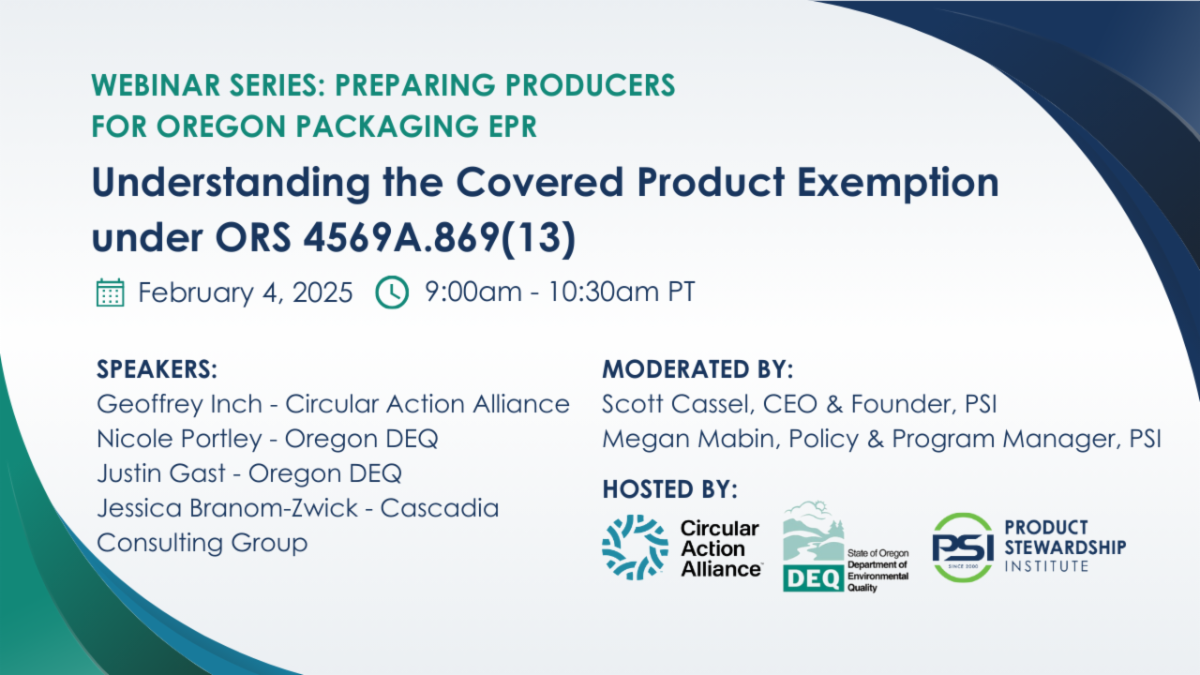
FREE: Understanding the Covered Product Exemption under ORS 459A.869(13)
February 4, 9:00 AM – 10:30 AM PT
| |
|
Hosted by the Product Stewardship Institute on behalf of the Oregon Department of Environmental Quality (DEQ) and in partnership with Circular Action Alliance (CAA), this is the final webinar in a five-part webinar series informing producers about their obligations under Oregon’s Plastic Pollution and Recycling Modernization Act – the state’s new extended producer responsibility (EPR) law for packaging, paper, and food serviceware – which begins July 1, 2025.
Pursuant to ORS 459A.869(13), materials recycled outside of the commingled system can qualify for exemption from the definition of “covered product,” meaning that producers need not pay fees on them if they meet three criteria pertaining to how the materials are collected, handled, and recycled by responsible end markets. This webinar will describe the process for implementing this exemption for 2025 fees, which will include DEQ solicitation of exemption claims from producers.
| |
|
ALUMINUM CAN RECYCLING: The U.S. aluminum beverage can recycling rate has dropped to 43%, the lowest point in decades. Industry groups cite stagnant recycling systems as the cause and emphasize the need for policy, like EPR, to address the issue. Read more.
OREGON RULEMAKING: With rulemaking complete, implementation of EPR in Oregon begins in earnest, with preparations in process for service and facility upgrades. Read more.
| |
The Product Stewardship Institute is a policy expert and consulting nonprofit that pioneered product stewardship in the United States. Since 2000, PSI has helped enact 141 extended producer responsibility (EPR) laws across 20 product categories in 33 states — the bedrock on which the circular economy is built. We work with businesses, nonprofits, academia, and governments to ensure that products are responsibly managed from design to end of life. Join us at www.productstewardship.us. | |
|
The Product Stewardship Institute, Inc. is an equal opportunity employer and provider. Persons with disabilities who require alternatively formatted materials to ensure effective communication should contact Amanda Nicholson at info@productstewardship.us or 617.236.4855.
| | | | |