FRONT AND CENTER
Vol. 2, No 6, June 2023
|
|
Mission
Honoring the legacy of Carolina Marines and Sailors,
Sustaining the ideals that are the foundation of our nation,
Inspiring principled, committed citizens.
|
|
As we start the summer season, we are continuing to make steady progress. While we were hoping to report a decision on the land lease, we remain optimistic that a decision is on the horizon. The Assistant Commandant of the Marine Corps has confirmed receipt of our request and is currently reviewing it.
While we wait for this decision, all pre-construction activities remain on track. RAA (exhibit designer) is moving towards completion of concept development, and we will be able to share those details in July. CJMW (our architect)
|
|
|
has finalized the floor plan adjustments and is now creating the construction documents. Samet (General Contractor) is starting to work with sub-contractors and is preparing for a future start to construction. Exciting times ahead!
As our tremendous supporters know, it has been a long journey and we are forever grateful. I would capture it with the following quote: “Creating something new is easy. Creating something that can last is the challenge.” Unequivocally, we are creating something that will last, and we will honor the legacy of all Carolina Marines and Sailors.
Lastly, there is still time to support our upcoming Golf Tournament on 23 June and we look forward to seeing everyone.
|
|
BGen Kevin Stewart, USMC (Ret)
Chief Executive Officer
|
|
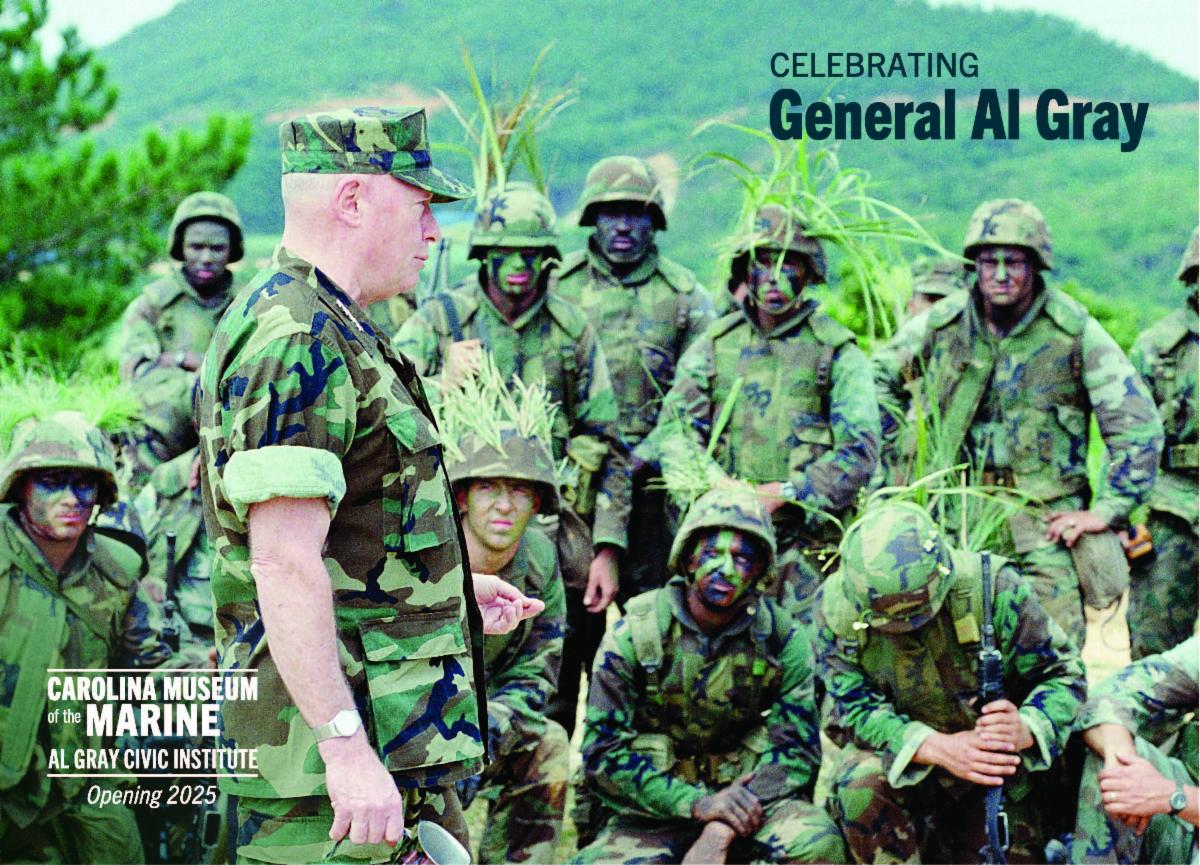
Members of Marine Corps Base Camp Lejeune, citizens of Jacksonville and Onslow County, NC, and Marines everywhere join us this month in celebrating the 95th birthday of beloved General Al Gray, 29th Commandant of our United States Marine Corps. Happy Birthday, General Gray! Semper Fidelis! |
|
Our team hosted Ralph Appelbaum Associates' Matt Krupanski, Mary Beth Byrne, and Lily Remmert aboard Marine Corps Base Camp Lejeune on the 9th and 10th of May. RAA enjoyed lunch with active-duty Marines as well as registrar MSgt Frances Hayden, USMC (Ret) and curator CWO5 Lisa Potts, USMC (Ret). Marines inspire exhibit design! |
|
Interviews
with Carolina Marines and Sailors
|
|
The Conversation with
Col Tim Howard, USMC (Ret)
continues...
|
Dr. Jim Danielson interviews
1stSgt Tony Ford, USMC (Ret)
|
and MGySgt Brian Carey, USMC (Ret) |
|
Al Gray Civic Institute Essays
The intent of these essays is to create civil discourse and spur thought. In line with our mantra of “teaching how to think, not what to think” these essays are complex, and the issues addressed are difficult to navigate without sparking some disagreements.
We welcome this, as we work to inspire principled and committed citizens.
|
|
A Tale of Two Doctrines, Part 1
|
|
____ In our American colonial period, the colonies were populated over time by people from various parts of England, from Scotland and Ireland, and there were people here from France, Spain, and elsewhere. For quite some time, however, the majority of the inhabitants of the colonies of British America were from Britain. Of course, there were Africans here, and they too exerted identifiable influences on the cultures that developed in the various colonies, especially in the South where white and black people lived and worked more closely together than in the North. However, when considering the development of political order among the colonists of British America, it is important to observe that the unjust conditions under which Africans first came here placed restraints on their ability to contribute culturally to life in the developing colonies. It might seem natural to think that what developed across the colonies was a common culture owing to the fact that most people were British, but this is not so. David Hackett Fisher’s influential Albion’s Seed: Four British Folkways in America shows how the different people of Britain who came here, like Puritans in Massachusetts Bay and Cavaliers in tidewater
|
|
|
|
Virginia, and people of Christian communions differing as widely as the Church of England, Puritans, and Quakers, established cultural practices and traditions that were distinct from one colony to another. So much was this the case that people of Virginia, for example, saw themselves as a distinct people, and thus a different country, from Massachusetts. In |
|
other words, while it made sense for the colonists of British America to refer to themselves in general as Americans, in time, they regarded themselves in particular as belonging to the colony, later the state, that was their home. Thus, for example, after our present Constitution was ratified, Thomas Jefferson in a letter to James Madison referred to the newly established Congress as “a foreign legislature,” because the legislature of their country had its seat in Richmond.
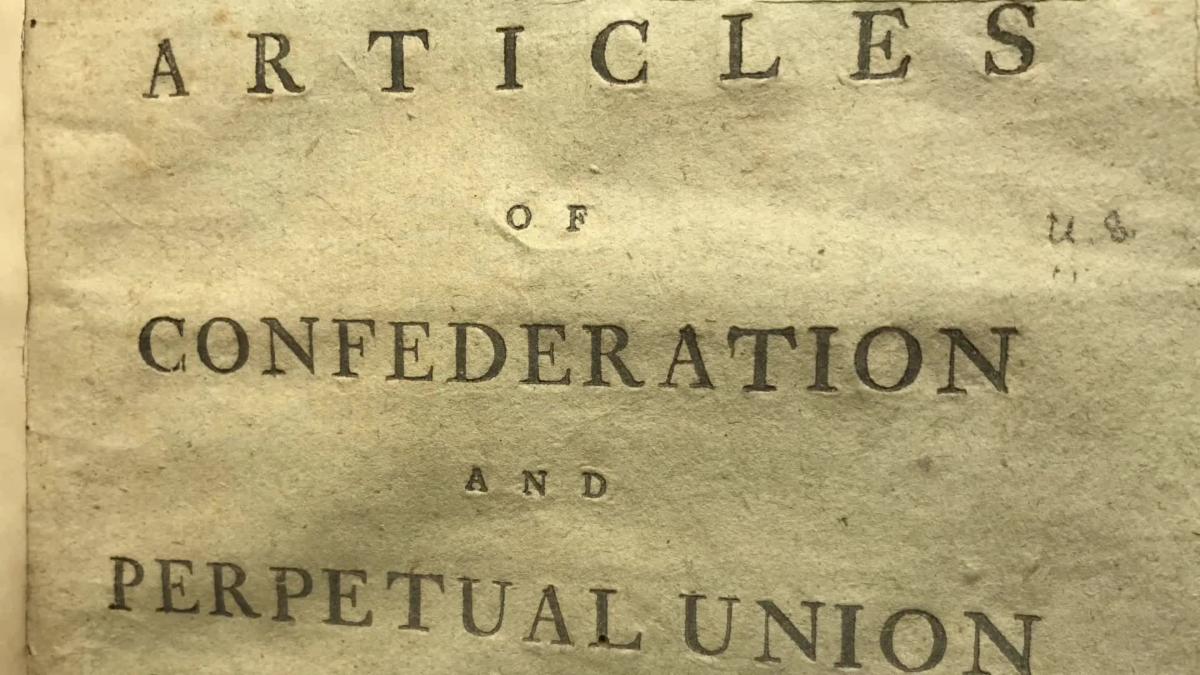
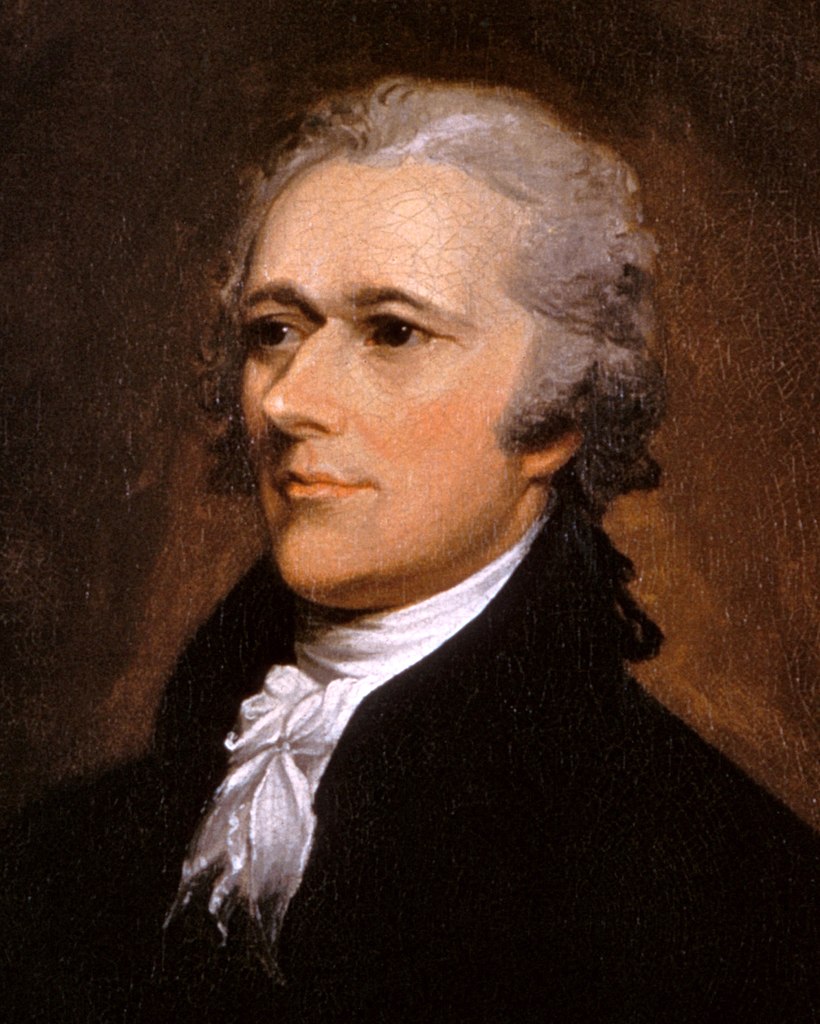
When the colonies obtained their independence from Britain in 1783, they had been working for some time on a plan of union for purposes of mutual defense and for maintaining free trade among the states. Two things the Americans did not want were a unitary national state with sovereignty held in a single government, like France and Britain, and tariff exploitation of one state by another or trade sanctions among states since these had a way in Europe of causing wars. The Americans had “ties of consanguinity” with the Mother Country, but politically and economically, they did not want to be like them. Of course, this is to speak in general terms since some people in the newly established states, like Alexander Hamilton and Gouverneur Morris, did want exactly the British model of government but under American control. Still, that kind of government was not established either in the Articles of Confederation and Perpetual Union or in the Constitution for the United States. What was established was a federation of sovereign states or “an assemblage of nations,” as it was sometimes called. The Articles of Confederation, in Article III, call the new union “a firm league of friendship” among sovereign states in which each state retains its sovereignty and independence. American political thought as it developed held that the people of Virginia were one sovereign people as the people of New York were one sovereign people and the sovereign people of each state were distinct each from the other, though bound together in a voluntary union of sovereign peoples. Of course, Americans today do not think this way about our political order. Rather, the thinking is that we are one American nation, that is one people, Americans all, from coast-to-coast, with political sovereignty held by the government in Washington, D.C. Indeed, the once-sovereign states are typically regarded today rather as administrative districts of the central government. What we find in our history, then, are actually two traditions of governance, yet both American. Since we have this important difference in our history, it is important to reach some understanding of how it came about. How did this significant change of thought happen?
|
|
Thomas Jefferson - Wikipedia |
|
Alexander Hamilton, Wikipedia |
|
In the remainder of this discussion, we will look at the rise in history of the nation-state and the rationale supporting it, and contrast this with the political order established in our Constitution. In the next issue of “Front and Center,” we will examine the important Webster-Hayne Debate that took place in January 1830 between Sen. Daniel Webster of Massachusetts and Sen. Robert Hayne of South Carolina. The occasion of the several exchanges between the senators were differences between northern and southern states over protectionist tariffs. Northern concerns demanded the tariffs as necessary to their economic security. Southern concerns opposed the tariffs because southern planters were the ones paying them in the form of lost revenues from their European trading partners on whom the tariffs were levied. What emerges in the debates between Webster and Hayne are competing understandings of American political order. Are we a federation of sovereign states, the southern view, or, are we a unitary national state, the developing northern view? In the southern view, Congress had no ground for enacting any legislation for which there is no authority expressly delegated in the Constitution. Any such enactment is an illegal usurpation of power and thus not binding on the states. Protectionist tariffs were regarded as just such a usurpation. In the northern view, that was newly emerging among American nationalists, Congress is the sovereign legislature of the United States and all states are obligated to obey congressional enactments. Thus for a state to nullify a federal law is an act of rebellion against lawfully constituted authority.
The Industrial Revolution may be said to have started in 1775 with the construction of the first commercially successful steam engine in Scotland. By the 1820s in England, machines powered by steam engines were doing the work of some 5.4 million men. This indeed created a social revolution. The businessmen of the North were eager to industrialize while the farmers of the South, at first, saw no reason for it since the southern soil and climate are well suited to agriculture, and the South, unlike the North, is blessed with an extensive array of navigable rivers that make it easy for farmers to transport their products to ports for shipment to foreign markets. As the north industrialized, manufacturers there struggled to compete with more established manufacturers in Europe. This is why they wanted the protective tariffs. But the burden of the tariffs fell on the South. This accounts for the toast offered by Vice President John C. Calhoun of South Carolina at a dinner for elected officials: “To the Union. Next to our liberty, most dear. May her benefits and burdens always be shared equally.”
With the advancing industrialization of the North came a considerable alteration in their economic interests and so the natural differences between Americans of the North and Americans of the South, that David Hackett Fisher explains so well, only magnified. Read more...
|
|
by CWO5 Lisa Potts, USMC (Ret)
Curator
|
|
_____After forming at New River (Camp Lejeune), North Carolina from October 1942 to February 1943 the Twenty Fourth Marine Regiment was activated at Camp Pendleton.
On their first Christmas under the Regimental banner, Colonel Franklin A. Hart proudly commanded - “Members of the Twenty Fourth we have trained hard since that day last March when our Regiment came into being. We have trained for a purpose. That purpose is about to be fulfilled. I know that the officers and men of the Regiment will carry the Marine Corps Banner to new heights. You will carve a niche in the hall of fame for the Twenty Fourth Marines and for yourselves; in doing so you will hasten the defeat of our enemy in the Pacific.”[i]
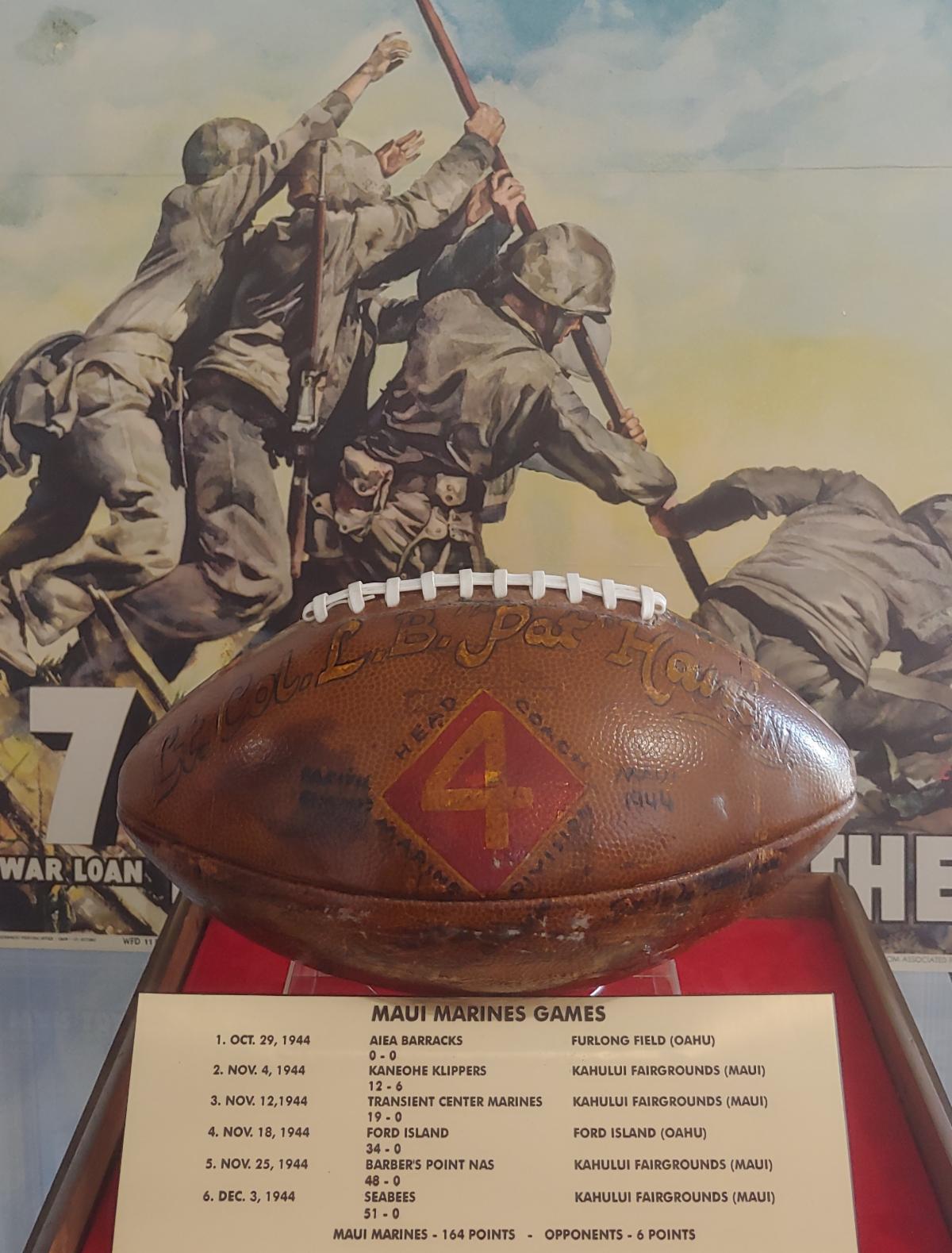
_____Over the next 14 months, the honors of the regiment were carved into Marine Corps history at Kwajalein (Namur), Saipan, Tinian, and to the heights of Iwo Jima. 70 years later, they returned to Camp Lejeune to retire the 4th Marine Division colors and another treasured honor – their football.
_____Following Roi-Namur, the Division took a respite on the island of Maui, at the foot of Haleakala. The terrain was ideally suited for training; particularly for Iwo Jima because there were all kinds of mountains and bluffs and caves. They had jungle training and a 200-target range. The machine gun range was perfect.[ii] There was a USO, a canteen, a movie theater, and intramural sports.
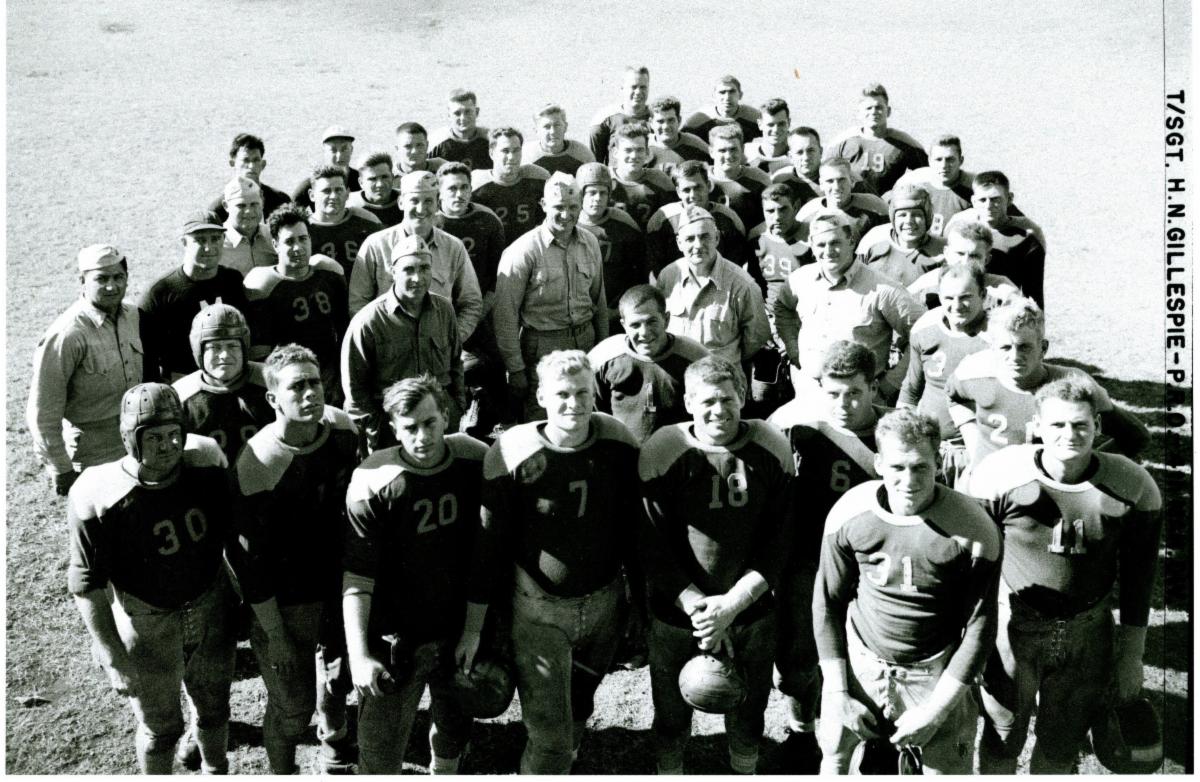
_____The 1600- acre encampment was divided by a gulch with the infantry area to the east and the Headquarters area to the west. The inter-regimental football league was established. The East Side Gulchers in red jerseys coached by Major Frank Garretson (University of Washington) and LT (MC) Carmen I. Razzano (Michigan) played against the West Side Gulchers in the blue jerseys coached by Lt. Sam Mandich (West Virginia University) and LT(MC) Irah D. Hardy (All American, Harvard 1931). LtCol “Pat” Hanley[ii] was in charge of morale and welfare. He saw great promise in the teams.
Major General Clifton B. “I Will Hold” Cates[iii] assumed command of the 4th Marine Division in June 1944. When the Division returned from Tinian, Hanley asked Cates to enter a team in the Pacific Championship football league. Cates replied “’Pat, we can’t hold a candle to the Air Corps and the Navy and the Army. They’ve got All-Americans on their team. We have a bunch of college boys, but very few of those.” But Hanley was confident. He went over to the league meeting, “and they practically laughed at him. They said, ‘You can’t stand up against these other teams.’” They finally agreed to let the Division play in the league, but the games were not to count in the championship.[iii]
|
|
Remembering BGen Richard F. Vercauteren, USMC (Ret) |
|
|
|
On 16 June, 2022, our Board Chair, Brigadier General Richard F. Vercauteren, USMC (Ret), passed away. His legacy of service and sacrifice is an example for all. To memorialize his life, a separate commercial organization reprinted the Museum’s published tribute in their customer newsletter, without consulting the Museum or the Vercauteren family. We believe their motivations were pure and not for commercial gain, but the family did not approve and was not included in the decision process to publish.
|
|
|
|
Visit Marines.mil for up-do-date information about United States Marines who are making news.
|
|
Please join us in supporting the mission of
Carolina Museum of the Marine
and Al Gray Civic Institute.
When you give to our annual campaign,
you help to ensure that operations continue during construction
and when the doors open!
|
|
as we stand up the
Museum and Institute!
|
|
Copyright June 2023.
Carolina Museum of the Marine | Al Gray Civic Institute
|
|
2022-2023 Board of Directors
Executive Committee
LtGen Mark Faulkner, USMC (Ret) - Chair
Col Bob Love, USMC (Ret) - Vice Chair
CAPT Pat Alford, USN (Ret) - Treasurer
Col Joe Atkins, USAF (Ret) - Secretary
Mr. Mark Cramer, JD - Executive Board Member
General Al Gray, USMC (Ret), 29th Commandant - Executive Board Member
MajGen Jim Kessler, USMC (Ret) - Executive Board Member
Col Grant Sparks, USMC (Ret) - Executive Board Member
BGen Kevin Stewart, USMC (Ret), CEO
Members
Col George "Bill" Ayers, USMC (Ret), Emeritus
Mr. Keith Byrd, US Marine Corps Veteran
MGySgt Osceola"Oats" Elliss, USMC (Ret)
Mr. Frank Guidara, US Army Veteran
Col Chuck Geiger, USMC (Ret)
Col Bruce Gombar, USMC (Ret)
LtCol Lynn "Kim" Kimball, USMC (Ret)
CWO4 Richard McIntosh, USMC (Ret)
LtGen Gary S. McKissock, USMC (Ret)
Col John B. Sollis, USMC (Ret)
GySgt Forest Spencer, USMC (Ret)
Staff
Carolina Museum of the Marine | Al Gray Civic Institute is a nonprofit organization that is rigorously nonpartisan, independent and objective.
|
|
Carolina Museum of the Marine | Al Gray Civic Institute
907 Lejeune Blvd
Jacksonville, NC 28540
|
|
|
|
|
|
|