WSNLogo11-2024.jpg

Celebrating a Milestone in California’s Stewardship: Statewide LiDAR Coverage and the Power of Partnership


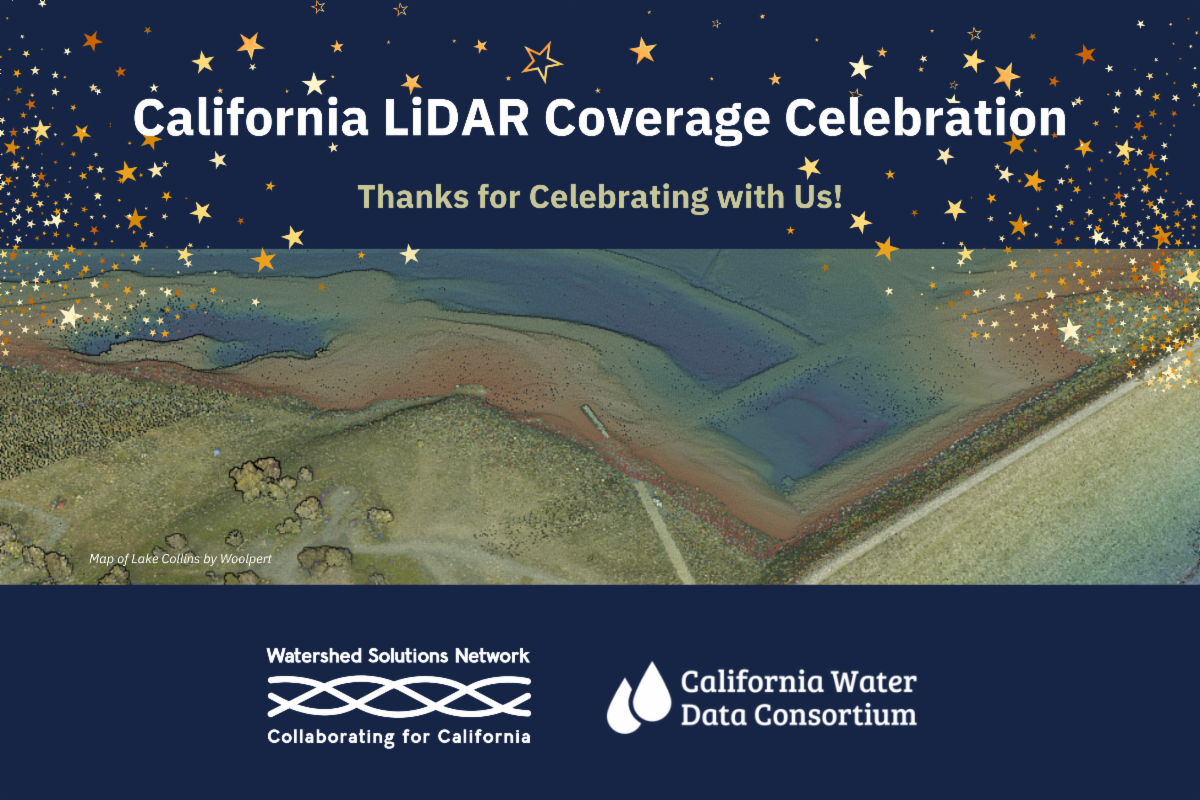
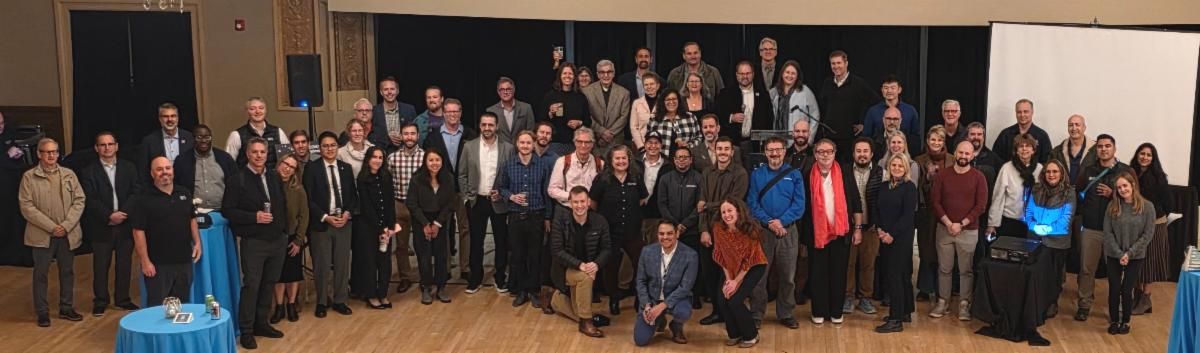
Last week, a remarkable community came together, hosted by the Watershed Solutions Network (WSN) and the California Water Data Consortium. Standing in a room—filled with agency leaders, technical experts, Tribal partners, local governments, scientists, vendors, and passionate public servants—you could feel the significance of what we were celebrating: the functional completion of statewide LiDAR data acquisition for California.


This milestone represents so much more than data on a server. It means we now hold high-resolution, three-dimensional information for the entire state—a dataset capable of revealing everything from the heights of individual trees to the traces of active earthquake faults. Achieving this level of precision and coverage is extraordinary. But even more extraordinary is how we got here.


It happened because Californians collaborate. Here’s to the achievement at hand and the ongoing efforts to maintain and update this vital data resource. 

Partnerships Made This Possible—Full Stop


If this accomplishment demonstrates anything, it’s that partnerships are our most powerful tool.


Over the past eight years, California’s LiDAR effort has drawn support from every corner of the state and nation: financial contributors large and small, visionary thinkers, educators, champions who tirelessly advocated for the work, and end-users who showed—again and again—how essential this data is for making informed decisions about safety, climate resilience, water management, land use, vegetation mapping, emergency response, and community well-being.


In his presentation, Nate Roth shared a map showing where LiDAR has been acquired to illustrate that nearly every major portion of California’s coverage came from projects involving multiple partners. Collaboration isn’t just helpful; it's the engine that powers possibility.


All of the presenters lauded the long list of contributors. The list below is an incomplete effort to record them all. With so many contributors, we surely missed some.


Federal: USGS, FEMA, NRCS, BLM, USFS, NPS, USBR


State: CNRA, DWR, CAL FIRE, DOC, Sierra Nevada Conservancy


Counties, Resource Conservation Districts, & Local Agencies: LA County & LARIAC, Sonoma, Humboldt, Lake, San Mateo, Solano, Alameda, Marin, Santa Clara, Santa Cruz, San Benito, Monterey, San Luis Obispo County, City and County of San Francisco, and more


Cities: Elk Grove, along with many LARIAC municipal partners


Tribe: Yurok Tribe


Academic & NGO: AlertCA–UCSD, University of Washington, California Native Plant Society


Vendors: NV5, Sanborn, Dewberry, Towill, Woolpert


Champions & Contributors: Loretta Moreno, Van Kane, Liz Van Wagtendonk, Bob McGaughey, Kass Green, Mark Tukman, Tim Bailey, Russ Faux, Carol Ostergren


Everyone mattered and made an impact. Any omissions are unintentional.

What Comes Next: From Data to Insight to Action


The work is far from over—in fact, the next chapter has already begun.


Across the state, agencies and partners are now turning raw LiDAR data into actionable information products at statewide and local scales. A few examples:


  • WERK Initiative: Advancing watershed-scale remote sensing products calibrated for forest and landscape stewardship.


  • Department of Water Resources: Leading California’s contribution to the national elevation-derived hydrography dataset—essential for modeling water flow, flood behavior, and watershed resilience.


  • California Department of Fish and Wildlife: Using LiDAR to create and update fine-scale vegetation maps, enabling better habitat and biodiversity planning.


  • California Geological Survey: Beginning nearly every project, from hazard assessment to critical minerals mapping, with LiDAR as the foundational basemap.


  • CAL FIRE and its partners: Building forest growth and fire-behavior models grounded in these new data layers.


These efforts are building the next generation of environmental intelligence for California, a shared foundation that will support everything from wildfire preparedness to climate adaptation to community resilience.

A Final Thought: Why Data Matters


We close by quoting Nate Roth’s reflection.


“Data is one of our most valuable public assets. When we fail to collect it, the opportunity is gone forever.

When we do collect it, its value never diminishes.

Data, including LiDAR, in particular, is an asset that:


  • Can be reused infinitely


  • Gains value with each new application


  • Becomes exponentially more powerful when a subsequent dataset allows us to measure change over time.”


This is the legacy we have created together: a foundation of knowledge that will serve Californians for generations—guiding decisions, informing investments, and strengthening our ability to steward the lands and waters we depend on.


So thank you—to every partner, champion, advocate, technician, analyst, and leader who brought us to this moment. This is what collaboration can achieve. And it is only the beginning.

Watershed Solutions Network

Subscribe | E-mail | Website | Donate | (916) 352-3321

Facebook  Instagram  LinkedIn