|
Center for Economic Development News
Spring 2019
|
|
 |

|
|
 |
| Jason Schwenkler Executive Director |
|
With less than a month remaining in the semester here at CSU, Chico, energy and enthusiasm run high as students, professors and administrators alike celebrate another year of academic achievement and community engagement. Adding to the excitement is the recent announcement by Chico State President Gayle Hutchinson and the University Foundation Board regarding the launch of the first-ever CSU, Chico capital campaign, "Transform Tomorrow". Here at the North State Planning and Development Collective--the umbrella organization for both the Center for Economic Development and Geographical Information Center at CSU, Chico--our energy and enthusiasm for transformation runs equally high. We're dedicated to engaging across our 12-county service region to help communities transform in their own right through our economic development, market research and geographical information services.
On May 9th, we'll hold our first ever Regional Economic Summit at the CARD Community Center in Chico. Led by economist Dr. Robert Eyler, the half-day event will focus on the economics of recovery after the Camp and Carr fires, a topic selected as a direct result of feedback we received from attendees of our January Forecast Conference. Along with Eyler's analysis, we'll also hear from local leaders and FEMA, with time for Q&A from the audience. Seating is limited, however we've still got a few spaces left. Cost to attend is $30, and can be made online at
www.regonline.com/impactnorthstate
. We hope to see you there.
In this issue, you'll learn more about our work across the North State, including updates from the Northeastern and Upstate California Connect Broadband Consortia, our collaboration with the California Public Utilities Commission on a statewide Home Internet Study, and our
work on an industry-driven career pathways system in partnership with NoRTEC, our local Workforce Development Board.
If you'd like to learn more about the projects we're engaged in, or the services we offer, I'd love to hear from you. Feel free to email me at
jschwenkler@csuchico.edu.
Sincerely,
Jason Schwenkler
Executive Director
North State Planning and Development Collective
P.S. Be sure to save the date for our 2020 Economic Forecast Conference, planned for January 9, 2020 at the Sheraton Redding Hotel. More information coming your way soon!
|
|
Career Pathways Development for Agriculture and Manufacturing
|
The Center for Economic Development (a division of the North State Planning & Development Collective), in partnership with NoRTEC, our local Workforce Development Board, is furthering work on an industry-driven career pathways system. The goal of these efforts is to increase the capacity of the existing preparation pipelines in providing highly skilled workers targeted to the needs of the area's high-growth, high-need positions through the collaboration of the existing Industry Sector Partnership companies and education/training providers.
As part of this work, staff are reaching out to county partners within the NoRTEC footprint to introduce the initiative and garner support. The next phase of data collection includes connecting with hiring representatives of both agricultural and manufacturing businesses to better understand employment needs and priorities. These critical insights will help in developing an industry-driven career pathways system that addresses identified gaps and areas for coordination and collaboration.
Additionally, CED will be compiling an inventory of career preparation/pathway programs from training programs, certifications, and credentials from community colleges, job centers, technical colleges, and universities in the NoRTEC region. For additional information about the Career Pathways Development project, email Courtney Farrell, Project Manager at North State Planning and Development Collective
cafarrell@csuchico.edu
|
The Northeast and Upstate California Connect Consortia continues working throughout its 10-county region with the goal of improving high speed internet connectivity throughout rural Northern California. Led by Consortia Manager David Espinoza, the team has been actively engaging its communities to gather necessary data and information to meet the needs of its businesses and residents. Below are the most recent highlights of Consortia activities over the last quarter:
- Based on priority areas feedback from local governments, Consortia remains committed to supporting Internet Service Providers (ISPs) across the Northern California region to apply for funding to expand or upgrade broadband infrastructure and service in the region. This includes the most recent (May 1, 2019) applications for CPUC CASF Infrastructure grant funding, and USDA Reconnect Program grants (May 31, 2019). Consortia supported Plumas Sierra Telecommunications and Frontier Communications in their CASF applications to expand broadband services in Modoc, Lassen and Plumas Counties.
- Communicating with ISPs to receive feedback and identify perceived challenges and barriers for infrastructure deployments in rural areas. This information will help to provide recommendations to local governments in order to streamline permit processes.
- Developing broadband asset inventories by soliciting information on publicly owned assets from communities throughout the region; This includes conduit, poles, public-right-of-way, towers, buildings, etc. These asset inventories will help local governments to establish partnerships or develop master lease agreements for broadband deployments.
- Consortia are developing master broadband plans which include broadband infrastructure expansion, policy and adoption recommendations and strategies for regional local governments. Master Broadband Plans have been completed for the counties of Glenn and Tehama; Lake, Modoc and Siskiyou County plans are in progress.
- Ongoing work with local governments to develop model policies and ordinances for counties and cities, which are aimed to reduce technical and economic barriers and achieve cost-effective broadband infrastructure deployments.
- Coordination with California Telehealth Network (CTN) for alignment of goals and referral plans. Staff reached out to rural clinics in the consortia region to share information on Federal and State funding opportunities and facilitated coordination with CTN to apply for this funding.
- Quarterly online webinars for local government elected officials and staff, regional partners, local broadband stakeholders, ISPs, community anchor institutions and others. The Spring, 2019 webinar presented a tutorial on the CPUC California Interactive Broadband Map.
- Worked with experts to generate a survey about availability and adoption of telehealth services in rural healthcare institutions in our consortium region. Rolled out phone and email surveys to rural clinics across our region.
- Through diligent outreach and communication campaigns, the consortia are rallying residence and business broadband customers to download and run the CPUC's CalSPEED app and complete our online business broadband survey.
How YOU can help:
Gathering accurate information regarding internet speeds from businesses is critical to proving the case that improved broadband service is needed in rural California. You can help by download the CalSPEED application to your desktop computers and run the CalSPEED speed tests daily. CalSPEED desktop data validates internet speed and capacity, information that is critically needed to move potential projects forward.
|
Volunteers Being Sought for CPUC Home Internet Study
|
 The California Public Utilities Commission (CPUC), Geographical Information Center (GIC) at California State University, Chico and CSU, Monterey Bay are seeking 500 volunteers to take part in the CPUC Home Internet Study. The study aims to explore and analyze the Californian's internet connections including:
* Performance of connections in rural areas, compared with connections in urban areas.
* Performance of DSL connections, compared with Cable connections.
* WiFi Router technologies in use in the California WiFi landscape.
* Performance of Ethernet (wired) connections vs WiFi connections.
For additional information about the project, or to sign up, visit www.calspeed.net
|
Targeted Marketing Assistance Opportunity for Food and Beverage Manufactures, Producers and Processors
|
|

The Center for Economic Development (CED) at CSU Chico is partnering with USDA Rural Development and California Manufacturing Technology Consulting (CMTC) to provide targeting
targeted marketing research and technical assistance to assist
for businesses looking to expand operations and
to identify find new markets for their products.
These no cost services are tailored to meet your business' needs to enhance your
enhancing their knowledge of consumer demand for your products.
Eligible business will receive;
the following services:
- Tailored and targeted market research specific to business' needs
- Enhanced knowledge of distribution options for products to new regions
- Analyzed demographic, economic, and consumer behavior data on potential new market areas
- Visualized market mapping (a display of potential new retailers, distributions routes, new store locations, etc.)
- Identified potential retail partners and shipping companies
For more information please contact Caitlin Kammerer, Project Analyst at Center for Economic Development at
ctkammerer@csuchico.edu or 530-898-3851
|
Map It!:
Regional Housing Shortage Compounds Statewide Housing Crisis
|
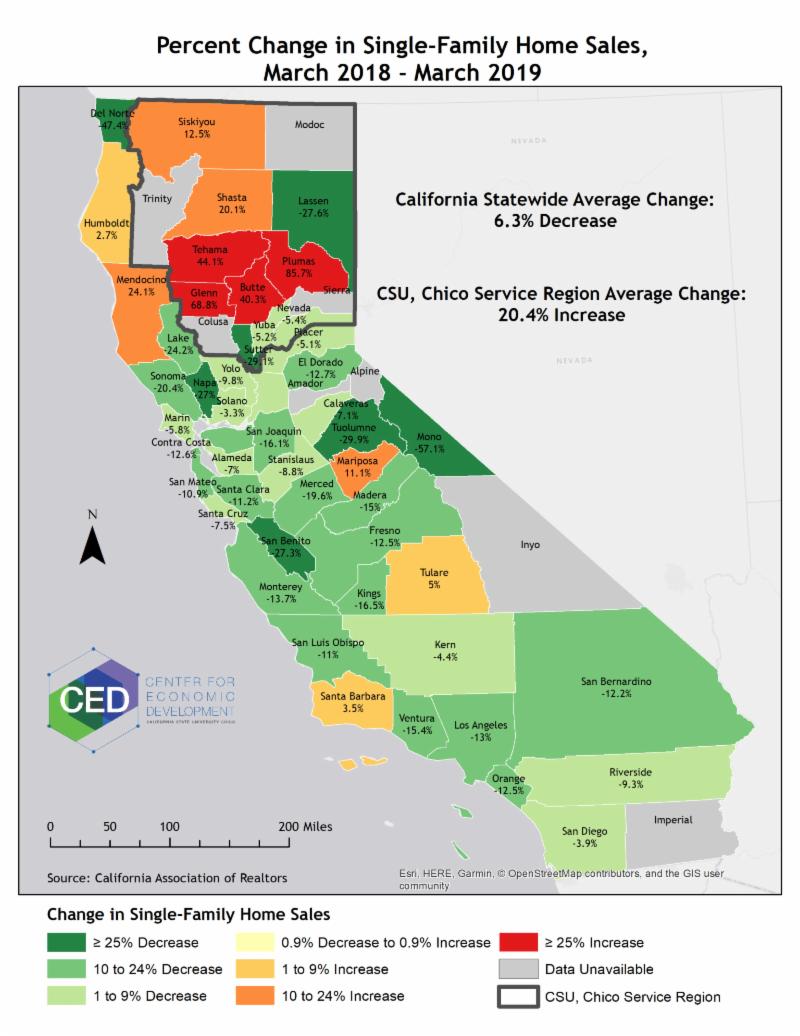
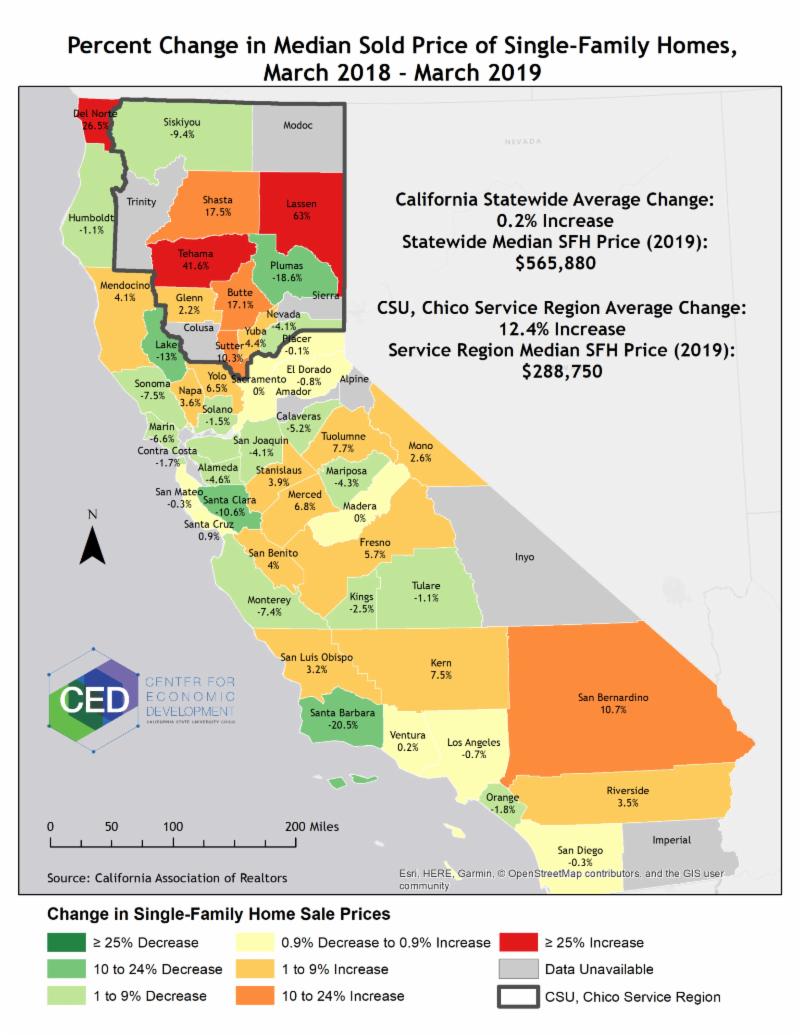
For this newsletter map series (see maps, below), we look at newly released housing market data from the California Association of Realtors. As the North State continues to recover from devastating wildfires, including the Camp, Carr, and Mendocino Complex fires, one of the most pressing issues confronting these efforts is a lack of available and affordable housing in the region. This regional housing shortage of course compounds an already severe statewide affordable housing crisis, and these combined effects are likely to spur out-migration to both other parts of California and to other states unless remedied. In the two maps below, we look at changes between March 2018 and March 2019 in both the volume of single-family home sales, and in the median sold price for single-family homes.
During this period, sales of single-family homes across California decreased by 6.3 percent. Outside of the CSU, Chico Service Region, counties that experienced recent and direct wildfire impacts often experienced the highest increases in sales, such as Mendocino (24.1 percent increase), Mariposa (11.1 percent increase), and Santa Barbara (3.5 percent increase). The notable exception to this link between direct wildfire effects and increasing home sales is Lake County, where sales decreased by 24.2 percent. In most other California counties, single family home sales decreased in frequency. Within the CSU, Chico Service Region, and in sharp contrast to the rest of the state, sales increased by 20.4 percent during this same period. The largest statewide county-level increases were located within the region, with sales increasing by 85.7 percent in Plumas County, 68.8 percent in Glenn County, 44.1 percent in Tehama County, 40.3 percent in Butte County, and 20.1 percent in Shasta County. In counties closer to Sacramento (Nevada, Sutter, and Yuba) and in Lassen County, sales volumes decreased.
To continue reading,
click here
.
|
|
|
|
|
|
|
Stay Connected


|
|
|
|