|
To keep you connected to current issues and topics discussed in the Flagship Program, LT shares reflections and resources from our Challenge Days. New this year, write-ups will feature reflections from LT'22 class members. (Class member reflections are in the gray boxes below.)
This Challenge Day was focused on the issue of homelessness and was centered around this question: Historic structural racism has long been a factor in the ability for communities to thrive and its community members to have their basic needs met. How do we transcend the existing paradigm and progress to a place where community members have control of their future and the ability to build neighborhoods and communities where all needs are met?
This write-up is a brief snapshot of highlights from the day. To get a feel for the full day, read the agenda HERE. For a list of resources related to this Challenge Day, read the prework HERE.
Many thanks to WSP for their sponsorship of this day and leadership in our community.
|  | |
Thomasina's Reflections
Thomasina Schmitt, Seattle Neighborhood Group
Our first LT Challenge Day focused on one of the most pressing issues of our region: homelessness. My family and I were homeless during my junior year in high school so this issue is close to my heart. I also worked at a local nonprofit for several years which focused on family homelessness so I was eager to participate in this first Challenge Day.
We had an incredible opportunity to hear from the new CEO of the King County Regional Homelessness Authority, Marc Dones. Following Marc's presentation, we heard from a panel of diverse and interesting speakers who had different ideas on how to solve our region's homelessness crisis. We also had engaging conversations with smaller groups and time to write our reflections.
There are three take-aways that have stayed with me. First, as leaders it's imperative that we know the history of an issue and incorporate that knowledge into our decision making. Second, it's crucial to have all voices at the table before drafting and implementing policies and decisions. One quote from the panel discussion that kept getting repeated is, "Those closest to the problem are closest to the solution, but furthest from the power to make changes and decisions." Finally, as leaders we need to be willing to make decisions and take responsibility no matter what the outcome is. I'm grateful for the opportunity to be part of this LT cohort, and I look forward to the next Challenge Day.
| | |
Homelessness in our Region | |
|
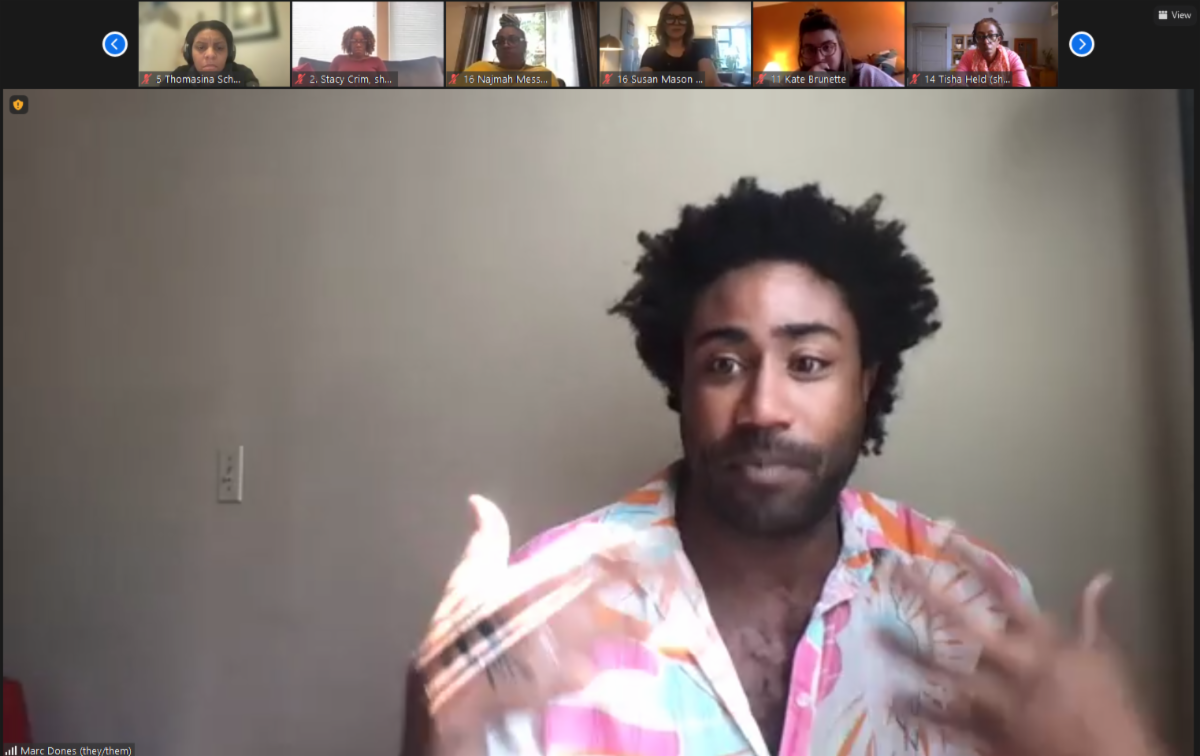
Marc Dones, CEO, King County Regional Homelessness Authority
Marc Dones framed the day by discussing the drivers of homelessness and possible solutions. Marc put it simply: Homelessness is an economic problem; it’s about a person's ability to pay for stuff. Marc debunked common narratives about the causes of homelessness (drug use, mental health, etc.), commenting that rich people have drug abuse and mental health problems too; they just do it from their living rooms. The vast majority of people who are experiencing homelessness are not unsheltered. They are in shelters, couch surfing, living in cars, etc. We as a region have spent a lot of money on the unhoused because it is such a visible issue, but it isn't the right conversation. As leaders, we must ground our conversations in history and economics. Leadership is about knowing which conversation to be in.
| |
Kate's Reflections
Kate Elliott, Maul Foster & Alongi, Inc.
Coming in to our first Challenge Day, I was eager to learn more about a topic that hits close in many ways—as it does for many in our region—homelessness. My first job out of school was at Greenbridge, a King County Housing Authority mixed-income housing project in White Center, followed by my next job as a Housing Assistant at the then called Capitol Hill Housing. Both of which showed me daily the challenges, benefits, and shortcomings of public housing and housing policy in this growing region.
LT staff and speakers did an amazing job pulling in different perspectives and providing a broader look at homelessness. I have many more questions now than when we started, and I’m thrilled to dig into these questions with my LT'22 cohort. It has been several days past our Challenge Day now and the things that are still coming up for me include:
- Leadership means giving a voice to those who aren't at the table and/or making sure those that have lived experience are at the table.
-
This quote from Marc Dones resonated with me: "Leadership is being able to identify the right conversation to have and sticking with it."
Both of these statements are very relevant to my work in public engagement and all other facets of my life, especially as I think about and employ antiracist leadership. I’m so appreciative of this opportunity, the great LT staff and volunteers, my cohort for digging into these topics and speaking their minds, and the opportunity to challenge my unconscious beliefs so I can be a better leader, friend, and ancestor.
| | |
Compassion Seattle Case Study | |
|
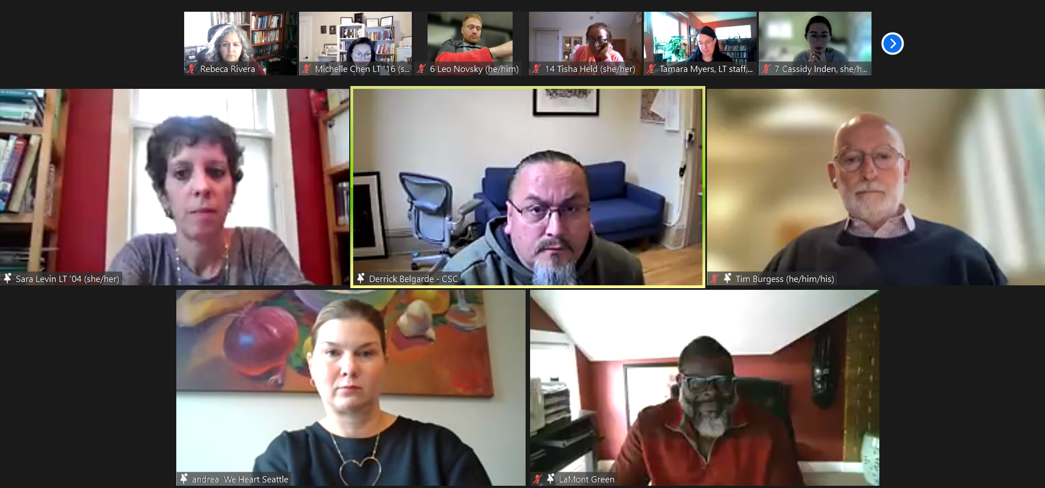
Derrick Belgarde, Executive Director, Chief Seattle Club; Tim Burgess, Former Seattle City Council President and Interim Mayor; Lisa Daugaard (not pictured), Director, Public Defender Association; Dr. LaMont Green, Director of Diversity, Equity, and Inclusion, Technical Assistance Collaborative, Inc. and Co-Founder, Lived Experience Coalition; Sara Levin, LT’02, Curriculum Committee and Board of Directors; Andrea Suarez, Executive Director and Founder, We Heart Seattle
The region has declared a state of emergency around homelessness for nearly six years. Homelessness is as big a crisis as ever, with thousands of people living on the streets and thousands more unstably housed. Panelists were asked to share why they took leadership around Compassion Seattle, either in support of the proposed charter amendment or against it and in support of other solutions.
| |
Saunjah's Reflections
Saunjah Brantley, Microsoft
Although I did not agree with the perspectives of some of the panelists or the language they used, I am more informed about the barriers to eradicating homelessness in a way that I never would have been otherwise.
During our Challenge Day, I remembered Brian, an unhoused gentleman I met during a community event in New Jersey years ago. He shared his story with me and inspired a vision of a transition facility that treated our neighbors with respect and dignity. An establishment that was clean, filled with light and love, which provided access to grossly needed social resources and the opportunity to contribute to the sanctity of the shared space with a spirit of accountability and respect rather than being punitive.
I remembered the moment in college when I volunteered with a student organization to cook a meal for residents of a shelter. After the service opportunity, I went to my closest friend in tears later that day wondering why I was pursuing an engineering degree and not doing more to help those who are unhoused. She shared with me that I would do more for the community by completing my engineering degree and creating a life where I can donate my time and money toward similar causes.
During the Challenge Day, I was confronted with the fact that my community outreach endeavors since graduating years ago have been impactful...but not focused on eradicating homelessness. My only answer to why is because of the complexity of the issue and not knowing where to begin outside of cooking meals and facilitating access to social resources through community programs. Then, I was introduced to the "Housing First" approach by a member of my cohort, did online research during our lunch break, and learned how Utah reduced chronic homelessness by more than 80% using this approach and how other countries like Denmark, Singapore and Japan have the lowest rates of homelessness in the world.
In the midst of the messy imperfection of divergent perspectives on this panel discussion, I was reminded of two experiences that rocked my world years ago, was introduced to a pathway for action called "Housing First," and leaned into an accountability opportunity to sign up as a convener to discuss this innovative approach with a smaller group at our November Challenge Day.
| | |
Michael's Reflections
Michael Furze, Washington State Department of Commerce
The tone and tenor shifted during the panel session. They put forward multiple competing perspectives informed by their experiences. At times, the differences seemed incompatible, shifting between othering and inclusion depending on the speaker. Dialogue between participants seemed fleeting and positions seemed fixed. All of this felt familiar, reminding me of legislative policy debates in Olympia or over Zoom.
I'm curious how we, as community leaders, can engage effectively in such spaces. How can we understand the substance of a policy debate from a quantitative and qualitative perspective? How can we center race in discussions with white leaders who have experience and practice shutting down? How can we intervene effectively, acknowledging that the outcome and the process used to get there are equally important?
| | |
Special Thanks to our
Challenge Day Sponsor!
| | | | |