|
Penny Dash, the chair of the irrelevant NHSE Board…
Has given herself a problem, and now…
… we have a problem with her.
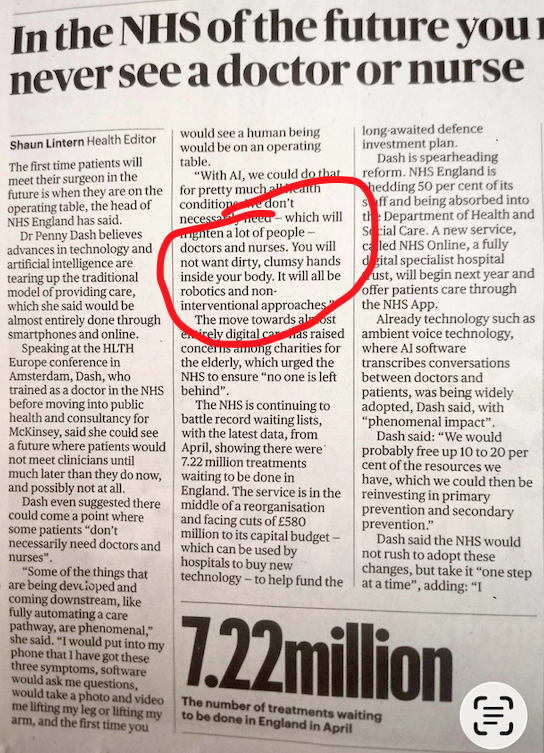
Speaking at a conference in Amsterdam, the Chair of NHSE painted a picture of the future where patients may rarely, if ever, see a doctor or nurse. [Article below]
Most care would be delivered through smartphones, software, robotics and AI…
… not especially shocking. We can all see the direction of travel.
AI-assisted diagnosis. Remote monitoring. Digital consultations. Ambient voice technology. Robotics. Smarter pathways. Less friction. Faster decisions.
The NHS can’t meet twenty-first century demand using twentieth century methods. We understand that.
What caught everyone’s attention wasn’t the technology.
It was the phrase.
“You will not want dirty, clumsy hands inside your body.”
The remark was intended to illustrate the precision of robotics and the potential of non-invasive treatments.
Unfortunately, it sounded like an insult.
Doctors, nurses, surgeons, theatre staff and countless others have spent years developing the skills that keep patients alive.
The NHS runs on expertise, commitment and judgement.
Describing the work of highly trained professionals as ‘dirty, clumsy hands’ is not a technological observation.
It is a leadership mistake. A howler.
Perhaps she was carried away by being a prophet in a foreign land.
It doesn't matter. What matters is...
...leadership isn’t about what you meant. It’s about what people hear, and… right now, NHS staff are hearing all sorts of things.
They are hearing about; redundancies, reorganisations, artificial intelligence, productivity targets, cost reduction.
Many are worried about their jobs, their futures and whether anyone at the top really understands what life feels like on the front-line.
Against that backdrop, telling them their contribution amounts to a pair of dirty hands is unlikely to land well.
The timing could hardly be worse.
The NHS is in the middle of one of the largest organisational upheavals in its history. NHSE is being dismantled.
- Thousands of management and support posts are disappearing.
- Trusts are struggling financially.
- Staff morale is fragile.
- Strikes have not, yet, gone away.
- Replacing doctors with associate grades is happening across the NHS.
- The draft workforce plan is a comedy turn.
The service is trying simultaneously, to save money, reduce waiting lists, absorb new technology and maintain public confidence.
This is not a moment for carelessly chosen words.
It is a moment for leadership.
The interesting thing is that the future Dash describes may well arrive.
AI will change healthcare. Robotics will improve outcomes. Diagnostics will become increasingly automated. Routine consultations will become increasingly digital.
Much of healthcare’s future will catchup with the reality of the future in the rest of our lives, but …
…there is a profound difference between saying technology will help clinicians and saying technology will replace them.
One story creates excitement. The other… fear.
One encourages people to participate in change. The other encourages resistance.
The narrative matters.
Every successful change programme begins with people understanding why change is necessary and believing they still have a place in the future being created.
The NHS has never struggled to find technology. Its challenge has always been bringing people with it.
That’s the real lesson here;
Technology changes organisations.
Language changes cultures.
The first is expensive... the second can be catastrophic.
Right now, while the NHS may be planning for a future of algorithms and robotics, it still depends entirely on the goodwill, commitment and judgement of the people whose hands are very much not dirty and very much not clumsy.
When Gerald Ratner described his own products as ‘total crap’, the issue wasn’t whether some of the jewellery was good or bad.
The issue was that the chief executive had publicly undermined confidence in his own business.
The words changed the relationship between the company and its customers.
Dash has given us a Ratner moment.
If the Chair of NHS England appears to describe colleague's and people's skills as ‘dirty, clumsy hands’, staff are entitled to ask:
‘If that’s what you think of us, why should we trust you to lead us?’
A leader celebrating the future by belittling the present…a classic, obvious and page one management trap.
Like so many leaders, Dash has become beguiled by technology, mesmerised by the future, and stopped valuing the people who have to deliver her dreams.
That’s poison during a period of change. Dash’s days are numbered...
...there’s no place for NHSE in the future and we can certainly do without our own Gerald Ratner.
|