School Health Clinics and Community Schools -- Vaping Prevention and Progress: Please Participate in the Chautauqua County Survey -- Health and Science Journalism Workshop at JCC -- Childhood Obesity and Weight Loss Medications -- Community Events/Programs -- Data Corner


Pictures not loading? Click here to view as webpage.

School Health Clinics and Community Schools


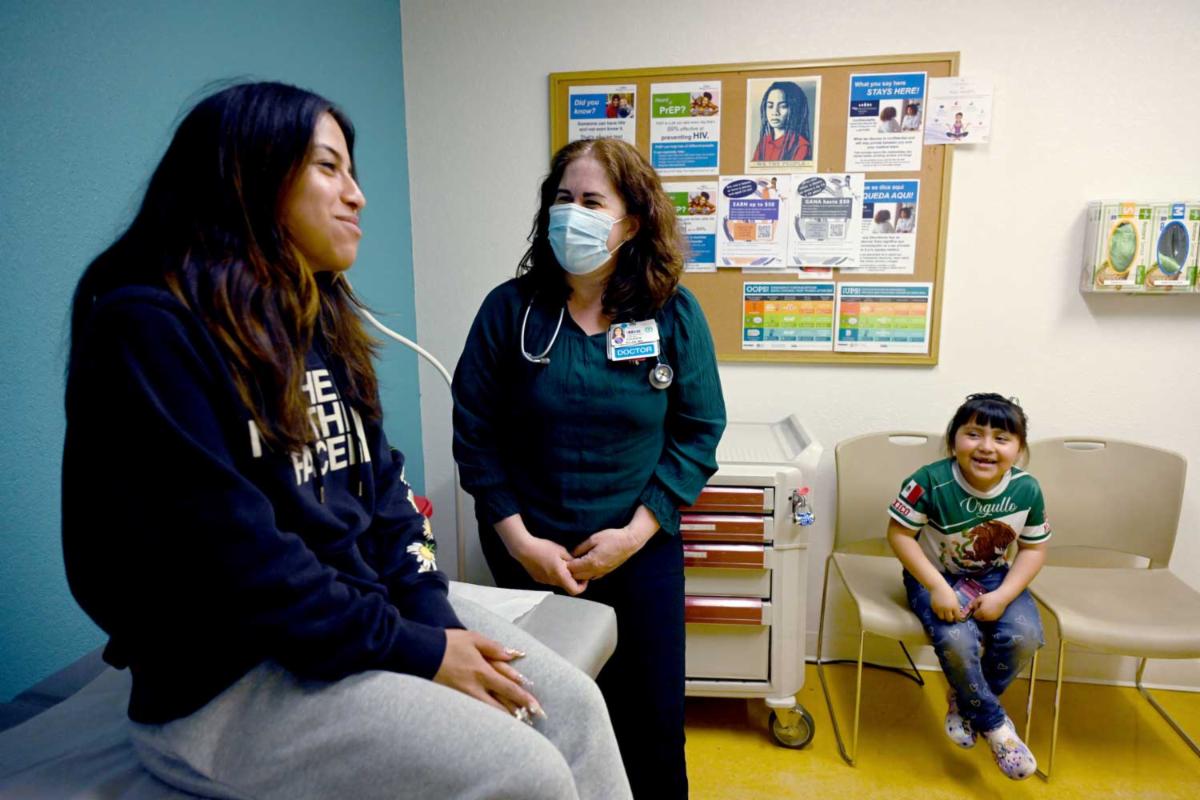
School-based health clinics bring all necessary healthcare needs to our schools, which are the hubs of our communities. Having access to healthcare at school removes barriers to preventive and immediate care. There can be many challenges for parents and students to attend appointments off campus. These include adequate transportation, cost, work and school schedules, or a variety of socio-economic and other related challenges.


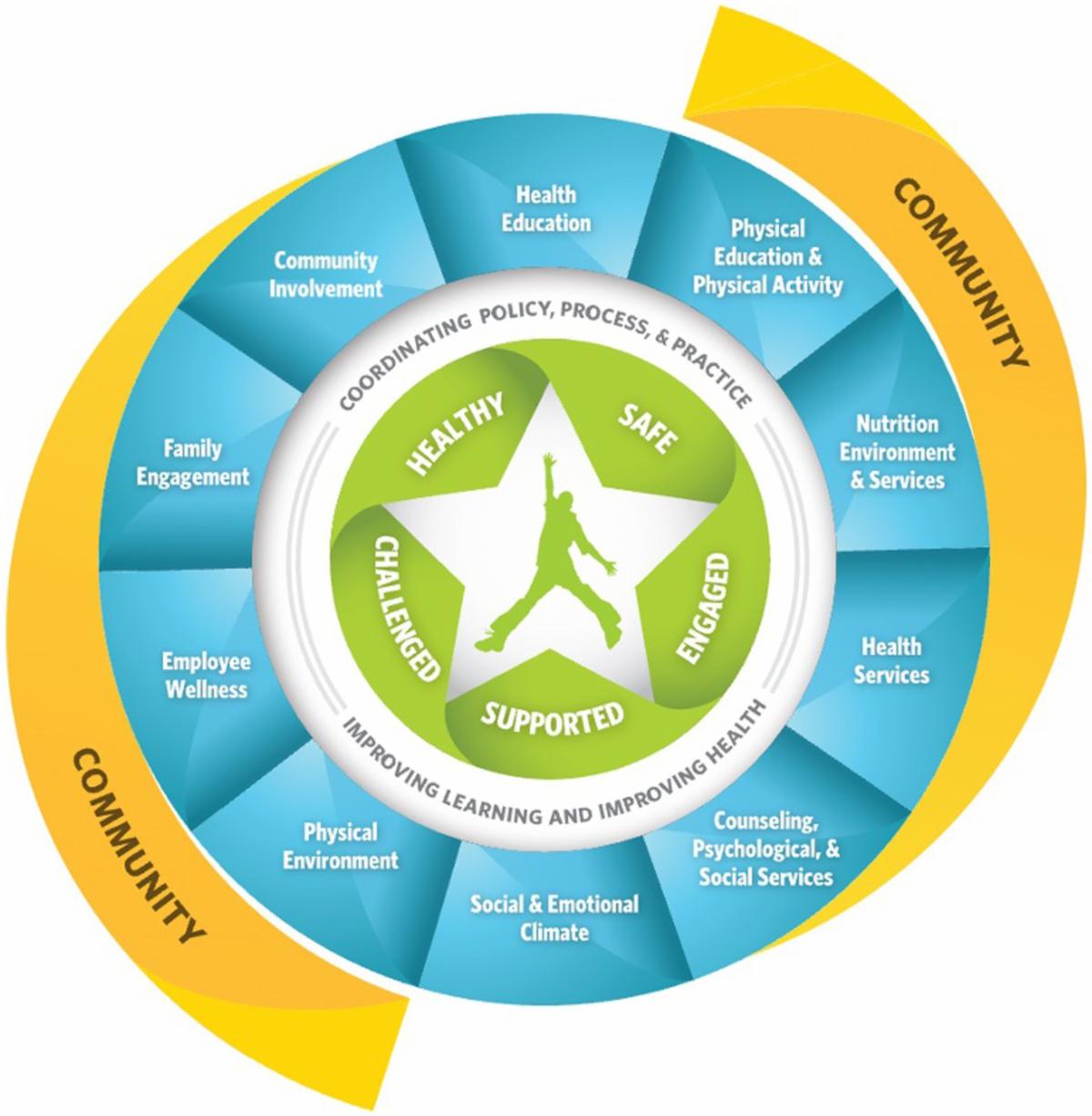
The CDC Whole School, Whole Community, Whole Child Model (WSCC) is a best practice for bringing all community and health services to the school to support student health and growth which benefits the entire community.


"WSCC is CDC’s framework for addressing health in schools. The student-centered WSCC framework emphasizes the role of the community in supporting the school." The WSCC framework also emphasizes the connections between health and academic achievement and the importance of evidence-based school policies and practices.


School based-health clinics provide:


  1. Preventive care, including annual physicals and immunizations.
  2. Acute illness management.
  3. Mental health and behavioral health service's and supports.
  4. Oral health and vision services.
  5. Chronic disease management.


Across the United States, there has been growth in the number of SBHCs over the past 30 years. In New York State alone, there were 252 approved SBHCs operating as of April 10, 2023 (https://bit.ly/4bvcUi8), including one locally in Jamestown (JHS School Based Health Center). 


A study by Cornell indicated that students who had access to a school-based health center had less ER visits and less absenteeism than those without access to a SBHC. Starting rural school-based health centers can be challenging due to limited resources, funding, and infrastructure. 


These centers provide critical health services to children and adolescents in rural areas, where they spend most of their waking hours at school. The presence of health services within schools enhances equitable access, reduces stigma, and allows for early intervention. How can Chautauqua County implement these health centers and/or increase services to better serve our rural school students and communities?


School-based health clinics benefit rural NYS communities | Cornell Chronicle


Whole School, Whole Community, Whole Child (WSCC) | Whole School, Whole Community, Whole Child (WSCC) | CDC


How School Health Clinics Help Students and Families Access Care | UC San Francisco


What Are School-Based Health Clinics? | Adolescent Medicine | JAMA Pediatrics | JAMA Network


School Health Services | Managing Health Conditions in School | CDC


School-Based Health Centers


School-Based Health Centers - RHIhub SDOH Toolkit


Principles & Guidelines for School Based Health Centers in New York State


School-Based Health Centers Are a Critical Component of Health Care for Children: A Public Health of Consequence, August 2024 | AJPH | Vol. 114 Issue 8

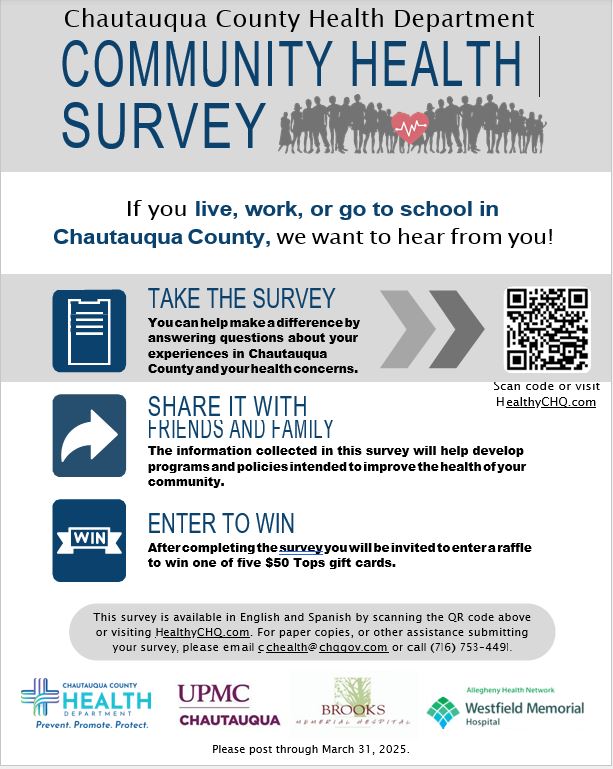
Vaping Prevention and Progress: Please Participate in the Chautauqua County Survey

Vaping has been problem among youth for over 10 years in our country. The harmful effects of vaping became evident in the United States in December of 2018, when the Surgeon General declared youth e-cigarette use an "epidemic". 


A 2019 survey revealed that vaping among preteens and teens has reached a crisis point, threatening to undo years of public health efforts that had led to a decline in nicotine use. Since that report, there has been a decrease in use and showed there was a significant drop in the number of U.S. middle and high school students who reported current (past 30 days) e-cigarette use – a decrease from 2.13 million (7.7%) youth in 2023 to 1.63 million (5.9%) youth in 2024. These are promising results but more work to be done to eliminate vaping.


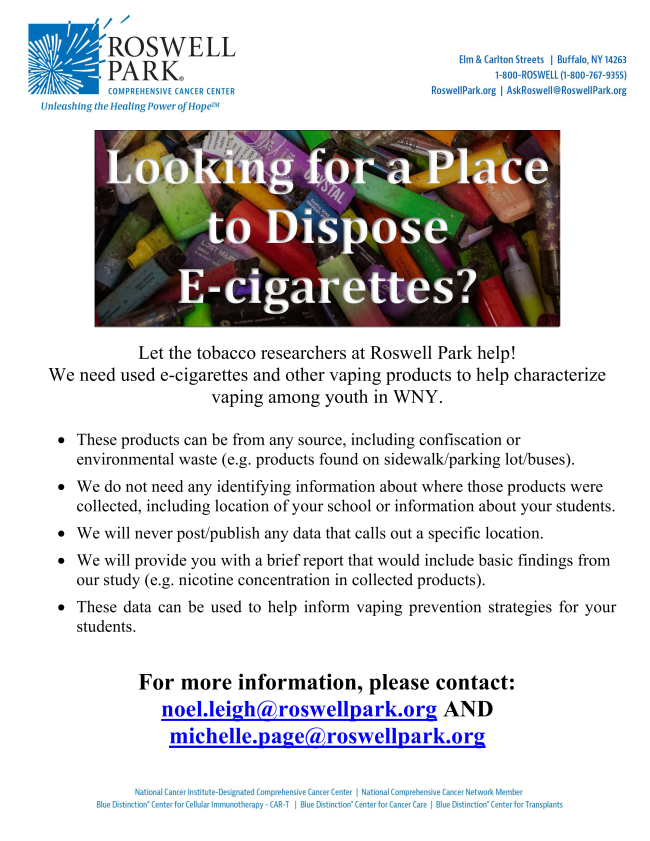
Roswell has been working vigorously to collect and analyze vaping devices confiscated at schools to better understand what our youth are using and how to help young people make better choices for their health. Schools in our area can contribute to the study by contacting Roswell at: noel.leigh@roswellpark.org or michelle.page@roswellpark.org 


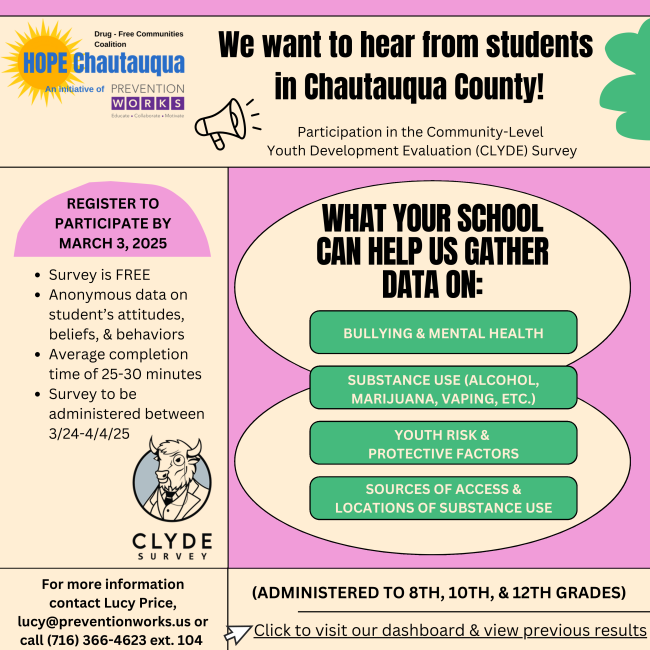
Prevention Works has programming within in each district and is diligently working toward improvement in the overall physical and mental health of our youth. To continue their great work in promoting healthy behaviors among our youth, they are asking that all schools to help by participating in the short Community-Level Youth Development Evaluation (CLYDE) survey in the infographic above. Each district has also received an information packet with full details. If you have any questions about the survey or need additional services and support from Prevention Works, please contact Lucy Price at lucy@preventionworks.us or 716-366-4623.


For previous CLYDE study results please see: https://clyde.catalyst-insight.com/public/dashboard/chautauqua_ny


Additional resources related to vaping below:


Sports Team Participation and Vaping Among High School Students: 2015–2019 | Pediatrics | American Academy of Pediatrics


Roswell Park, Western N.Y. schools team up to analyze vaping


Reducing Vaping Among Youth and Young Adults | SAMHSA


E-cigarette, vaping, tobacco use down for high school students: CDC


Over two-thirds of US teens don't drink, smoke or use marijuana: survey


More than 2.5 Million Youth Reported E-Cigarette Use in 2022 | CDC Online Newsroom | CDC

Health and Science Journalism Event

Health and Science Journalism Workshop

Jamestown Community College

Carnahan Theater, Canahan Center

525 Falconer St, Jamestown, NY 14701


Virtual kick-off February 27, 2025 | 9 a.m. – 10:30 a.m.

In-person event March 27, 2025 | 9 a.m. – 1:30 p.m.


The Chautauqua Health Network and Jamestown Community College are excited to offer a free, two-part Health and Science Journalism Workshop. Through interactive sessions, expert insights, and a practical exercise, participants will learn the art of translating complex scientific concepts into compelling stories, master ethical considerations in reporting, and utilize diverse media platforms to disseminate accurate information to the public. 


On February 27 from 9 – 10:30 a.m., there will be a virtual kick-off, featuring speakers from the field of journalism who will give students background information on the program and an activity to work on in preparation for the March event.


On March 27 from 9 a.m. – 1:30 p.m., students will come to the JCC Jamestown Campus. The day will incorporate experiences designed to equip aspiring journalists with the necessary skills and knowledge to excel in reporting on health and science topics. Part of the time will be spent working in the JCC media arts production studio.


After participating in this event, students should:


  • Understand the principles and practices involved in health and science journalism, evidence-based reporting, and the critical evaluation of scientific research.
  • Understand career pathways in health/science journalism and institutional writing.  
  • Learn how to communicate complex health and science concepts in a clear, accessible, and engaging manner. Students should be able to tailor their stories to reach diverse audiences across various media platforms including television, newspaper, and social media.  
  • Enhance their research, analysis, and fact-checking skills.  


Workshop content will be presented by national and local experts in the field.

Panelists include:


Brianne Celeski - Multimedia Producer, Life Science Connect.


Christine Schuyler - Program Director for Healthcare Initiatives, SUNY JCC Workforce Development.


Cynthia McKane - Assistant Professor/Reference Librarian, SUNY JCC Hultquist Library.


Greg Bacon - Dunkirk Observer and Jamestown Post-Journal.


Justin Gould - Media Information Officer, Chautauqua County Government.


Lisa Roberts - Youth and School Program Coordinator/MOVE.CHQ Initiatives, Chautauqua Health Network.


Sara Holthouse - Jamestown Post-Journal.


Scott MacDowell - News Director, Lilly Broadcasting Corporation.


Sherri Rater - Administrative and Communications Coordinator, Chautauqua County Health Department.


Simone Sellstrom - Assistant Professor of Communications, SUNY JCC.


Students will have the opportunity to publish an article and may be selected for a journalism award and scholarship from Chautauqua Health Network.


Attendance at both dates is required to participate. Breakfast and lunch will be provided on March 27.


Please register below!


High Schools can register for this event by February 7th here: https://forms.office.com/r/tnzu8udcVM


JCC Students who wish to participate can register for this event by February 7th here: https://forms.office.com/r/8Pb2PLVWUW


For questions, please contact Lisa Roberts at lisa.roberts@chq.health or 814-823-1148.

Childhood Obesity and Weight Loss Medications


Over 15 million Americans utilize weight loss medications such as Ozempic, Wegovy and Zepbound. One in eight adults have used a GLP-1 drug like Ozempic and Mounjaro at some point in their life. The popularity of these drugs is well known and is also being prescribed for youth to combat the many health related issues that accompany obesity.


"Weight loss medications have been popular for a century, but it wasn't until 1959 when the FDA approved phentermine that weight loss treatments began to turn a corner". In recent years, new weight-loss drugs have become wildly popular, with the number of prescriptions quadrupling from 2020 to 2022. These drugs, known as glucagon-like peptide-1 (GLP-1) receptor agonists, have taken off in popularity in America and around the world. The historical progression of weight loss drugs dates back through the ages.


The general pediatrician recommendation for weight loss medications for youth is listed below. If youth can benefit from temporary pharmaceutical assistance to decrease the onset of additional health issues and improve the state of their health along with interventions, support, and education some pediatricians feel the medications are justified.


As with adults, we cannot rely on drugs alone to maintain a healthy weight and lifestyle. This is a complicated issue as children are not autonomous and this is a multi-faceted issue. Many challenges such as culture, socio-economic status, support, access to care, stigma, mental health and more, can make this health concern difficult to address or improve. This issue demands involvement and lifestyle changes for the entire family. Education, support, and sustainable treatment is imperative.


Best practices for parents and educators, staff, and health professionals is to encourage, model, and share these tips and behaviors:


  1. Teach about hunger and fullness cues.
  2. Use child-sized plates.
  3. Be a good role model.
  4. Provide healthy snacks and drinks.
  5. Encourage daily physical activity.
  6. Cut screen time.
  7. Provide plenty of vegetables, fruits, and whole-grain products.
  8. Choose lean meats, poultry, fish, lentils, and beans for protein.
  9. Include low-fat or non-fat milk or dairy products.
  10. Encourage drinking water instead of sugary drinks.
  11. Cut back on processed and fast foods.
  12. Fill plates with fruits and vegetables.
  13. Trade white bread, rice, and pasta for whole-grain versions.
  14. Consult a pediatrician for medical advice and weight management.


Our CHQ county schools are doing an amazing job with healthy food tastings - menu item swaps for healthier choices and utilizing air fryers and healthier cooking methods. Plenty of physical activity opportunities exist in our county, but access and safety are areas we are all working on to improve. Our CHQ schools are also increasing the use of local produce from farmers


Weight loss medications for youth (10-18) should be considered based on the following criteria:


To better address health issues such as obesity and all aspects of health for our county please participate in the Chautauqua County Health Department Community Health Survey above or at this link: https://form.jotform.com/243515847472160


Additional Resources:


Weight loss drugs for children and teens: What you should know


Evaluation and Treatment for Child Obesity | Obesity | CDC


How Often Do Doctors Use New Weight-Loss Drugs in Kids? | MedPage Today


American Academy of Pediatrics Issues Its First Comprehensive Guideline on Evaluating, Treating Children and Adolescents With Obesity


Weight-loss Drug Prescriptions for Kids and Teens Soar Despite No Safety Data • Children's Health Defense


Why the USPSTF Doesn't Yet Recommend Weight Loss Medications for Kids


More teens are using weight loss drugs like Wegovy and Ozempic

Community Events and Programs

Service Hour Opportunities for Students: Our community has a wide variety of ways for students to earn community service hours. CHN and our community partners have opportunities available! Please reach out to us for ideas and contacts!


Chautauqua Striders: Service hour opportunities for students - any students who need service hours can volunteer at any of the Striders Winter 5K Races/events. The races take place at the Chautauqua Harbor Hotel in January and February. Any student interested in volunteering can contact:

Lexi Lindamer, Director of Athletics

301 E. 2nd St., Suite 102 

Jamestown, NY 14701 

Phone: 716-489-3481 


Chautauqua Watershed Conservancy: volunteers are needed in many capacities: A great way to get out an enjoy nature and help our environment! Visit www.chautauquawatershed.org or call 716-664-2166 EXT. 1010.


St Susan Center: Volunteers are needed. View St. Susan Center’s website and find out more about the organization and their donation needs here: https://stsusancenter.org/


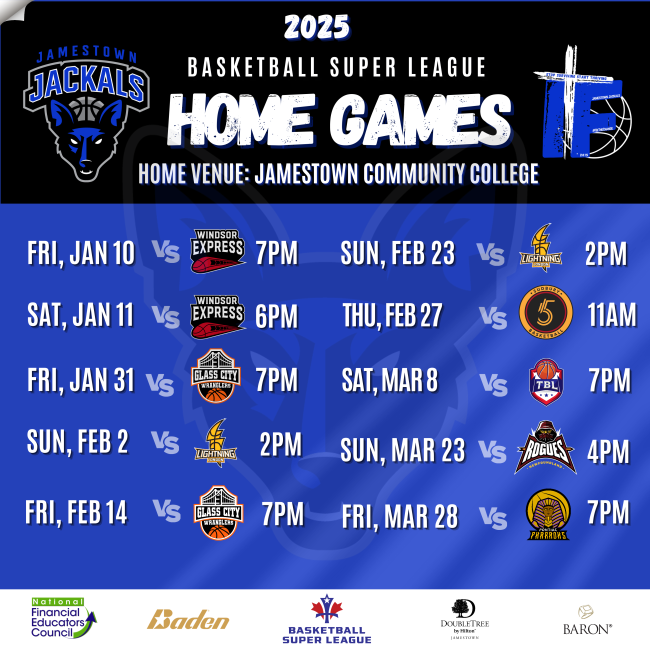
Jamestown Jackals Programming and Events: FULL schedule above! Please contact Kayla Crosby for more information on events and school appearances/programs: kayla@jamestownjackals.com


School Affinity Group Convenings: Would you like to collaborate and share resources and ideas with your education and wellness colleagues? We can help! We would love to bring you together and provide breakfast or lunch a facilitate. Please let us know!


CHN MOVE.CHQ Internships are available again this year for interested classes this coming spring, as well as our summer high school internships. Please inquire!


Please see more information on events from our community partners below:

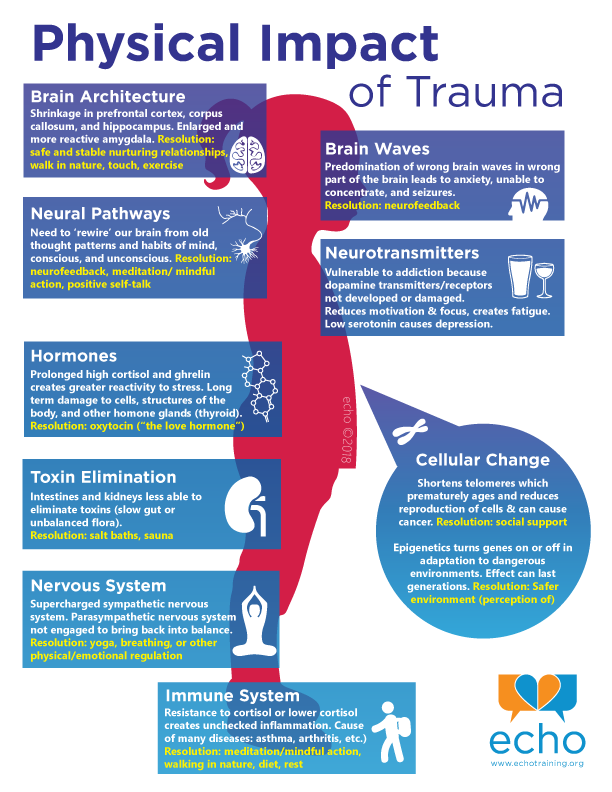
Data Corner: Trauma Informed Physical Education


Additional resources on Trauma Informed Physical Education:


Trauma-Sensitive Learning Environments: Physical Education and Health


Trauma-Informed PE: A Beginner's Guide for Teachers


Trauma-Informed Practice in Physical Activity Programs for Young People: A Systematic Review - Emily Berger, Katelyn O’Donohue, Ruth Jeanes, Laura Alfrey, 2024


“The Biological Effects of Childhood Trauma” - PMC


Trauma-Informed Practice in Physical Activity Programs for Young People: A Systematic Review - PMC


Trauma-Informed PE Series 3/3: Examples of how you can implement Trauma-Informed PE in your setting - PE Scholar

Did someone forward this to you?

We want to keep in contact. Please consider signing up on our mailing list. Keep up to date with School Health and Wellness information when you add your name to our growing.

Sign up here

This e-newsletter for school administrators, coaches and nurses as well as other groups interested in improving health and wellness in school settings and overall quality of life in Chautauqua County; please forward this email freely!


Your feedback is important. Drop us a line and let us know what you want to hear more about.

Email us!