|
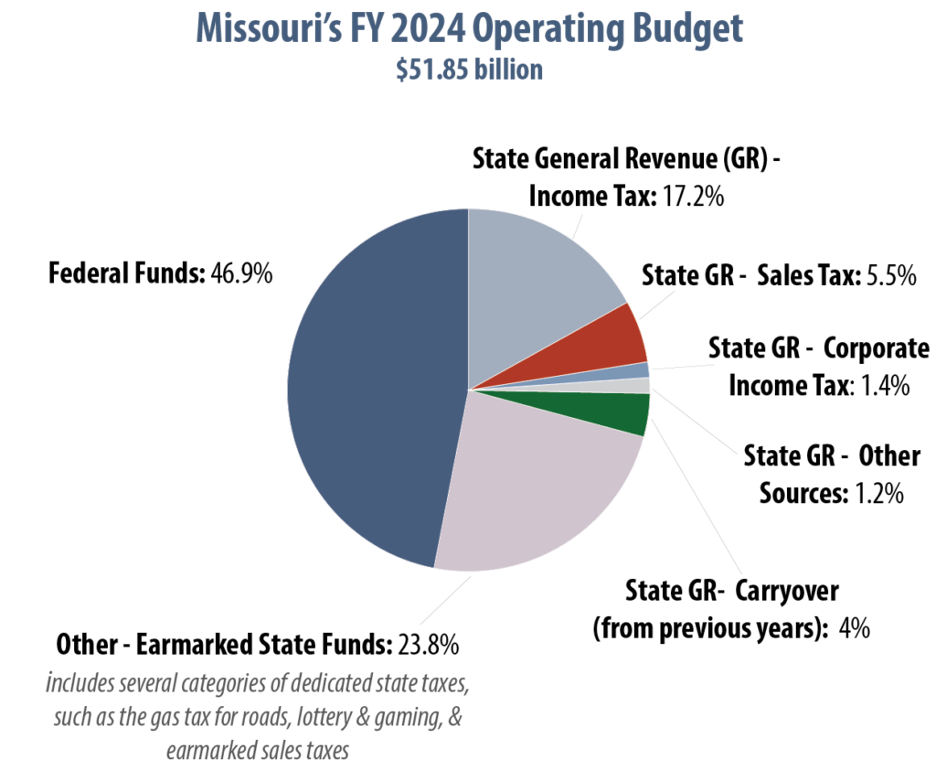
Source: Missouri Budget Office
When the federal government shuts down, the consequences reach far beyond Washington, D.C. For Missouri’s families, businesses and public institutions, a government shutdown is not an abstract political standoff; it is an immediate economic shock that seeps into every corner of the Missouri economy. From the families of federal workers in Kansas City and St. Louis to farmers in rural counties who depend on federal agricultural programs, Missouri stands to lose when Congress and the White House fail to agree on a budget.
The National Picture: Political Brinkmanship, Real Economic Costs
At the national level, a shutdown halts federal spending on “non-essential” services, furloughs hundreds of thousands of workers and delays vital public functions. According to the Congressional Budget Office, the 2018–2019 shutdown reduced U.S. economic output by about $11 billion, with nearly $3 billion permanently lost. Each week that the government remains closed trims billions from the economy, weakens consumer confidence and disrupts private sector planning.
But beyond the national numbers, the real story unfolds in states like Missouri, where ordinary citizens feel the pinch in paychecks, benefits and business operations.
Missouri’s Exposure: Federal Dependence and Local Vulnerabilities
Missouri has a sizable federal footprint. Nearly 37,000 federal employees live and work in the state, many concentrated in the Kansas City area (home to major USDA and GSA offices) and in St. Louis, which houses federal courts, postal facilities and defense-related operations. When these workers are furloughed or forced to work without pay, household spending drops sharply. The results are immediate: less traffic at grocery stores, restaurants and local retailers. These are the small businesses that form the backbone of Missouri’s economy.
Agriculture, one of Missouri’s economic pillars, is particularly vulnerable. Many farmers rely on the U.S. Department of Agriculture for commodity price support, crop insurance payments and conservation grants. During a shutdown, USDA field offices close, delaying loans and payments that are time-sensitive for planting and harvest cycles. For family farms already facing tight margins, even a short disruption can create lasting financial strain.
We also have low-income households that depend on federal benefits like the Supplemental Nutrition Assistance Program (SNAP), and these families and their dependents will face food insecurity if funding lapses. Missouri has roughly 650,000 residents receiving SNAP benefits, and a prolonged shutdown could force state agencies and local food banks to shoulder the burden.
Community-Level Impacts: The Human Side of the Shutdown
A federal shutdown trickles down into daily life across Missouri’s communities. Delays in housing and small business loans can stall development in growing towns like Columbia and Springfield. National parks and historic sites such as the Ozark National Scenic Riverways and Gateway Arch National Park will see closures that reduce tourism revenue. Students awaiting federal financial aid may face uncertainty at the start of a semester, while local governments relying on federal grants would have to postpone projects.
Missouri’s economy thrives on reliability and planning. A shutdown introduces unpredictability that shakes confidence among workers, investors and families alike.
What Missouri Needs from Washington
Both Congress and the White House can take concrete steps to prevent future shutdowns and shield states like Missouri from economic collateral damage:
-
Adopt an Automatic Funding Continuation (“Bridge Budget”): When lawmakers miss budget deadlines, a temporary funding measure should automatically activate to keep essential services running. This would protect Missouri workers and businesses from unnecessary disruption while maintaining accountability for fiscal discipline.
-
Safeguard Essential Programs: Congress should ensure that core safety net benefits such as SNAP, veterans’ healthcare and Social Security are insulated from funding lapses. These programs are lifelines for many Missouri families and must not become bargaining chips in political negotiations.
-
Protect Small Businesses and Contractors: Many Missouri contractors and suppliers depend on federal contracts for infrastructure, defense and research projects. Lawmakers should guarantee prompt back pay for workers and timely compensation for small firms facing delayed federal payments.
-
Strengthen State-Federal Coordination: Missouri’s leadership should work closely with federal agencies to identify critical services and local projects that need protection during budget gaps. Better communication between Jefferson City and Washington would help buffer communities from federal gridlock.
-
Promote Long-Term Budget Reform: Moving toward multi-year federal budgeting and greater transparency in spending negotiations would reduce the annual cycle of brinkmanship that threatens states’ stability.
Conclusion: A Call for Leadership and Stability
A government shutdown is not just a political maneuver; it has tangible consequences for Missouri’s people. The state’s families, farmers, veterans and small business owners deserve predictability rather than recurring crises that jeopardize their livelihoods.
Bridging the budget gap requires courage and cooperation from both ends of Pennsylvania Avenue. The White House and Congress must place stability above partisanship, designing a budget process that protects citizens and keeps America’s and Missouri’s economy moving forward.
In the end, protecting Missouri from the next shutdown is not only a matter of economics, but also a matter of leadership and trust in government itself.
|