|
Source: (Vos, 2022).
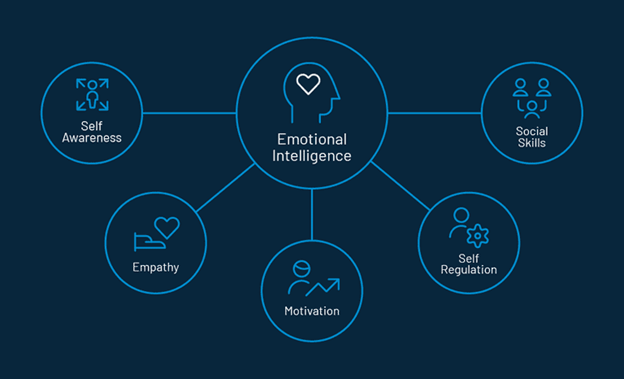
Because there has been an increased awareness of workplace stressors and mental health, businesses and their leaders are embracing soft skills like emotional intelligence to understand and better manage emotions in the workplace. Psychologist Daniel Goleman popularized the term emotional intelligence or EQ in 1998 in a Harvard Business Review publication and since then, it has gained wide acceptance in both popular and scholarly literature. Goleman lists five critical components of emotional intelligence, these are:
- Empathy: the ability to understand and share the feelings of another.
- Motivation: the reason or reasons for behaving or acting in a particular way
- Self-awareness: the ability to recognize your thoughts, feelings, and actions. It also involves being honest about your strengths and weaknesses and understanding how your actions and behavior affect others.
-
Self-regulation: the ability to control behavior and achieve goals regardless of the external environment.
-
Social skills: Social skills such as active listening skills, verbal and nonverbal communication skills, and persuasiveness allow us to build meaningful relationships with others and develop a stronger understanding of them and ourselves.
The benefits of emotional intelligence to organizational culture
Successful leaders and organizations nurture improved relationships by making genuine effort in understanding individual motivations. Cultivating emotional intelligence is no longer just a good human resource practice but an essential component of an organizational strategic mission. According to Lowe – MacAuley (2023), an emotionally intelligent workplace can lead to better collaboration, improved trust, healthier relationships with colleagues, and improved overall performance.
How to cultivate emotional intelligence in your organization
According to the Boyatzis-Goleman model, emotional intelligence (EI) is made up of four core competencies:
- Self-awareness: The ability to recognize your own emotions and how they affect your responses to different situations
- Self-management: The ability to manage yourself.
- Social awareness: The ability to understand and share the emotions of others.
- Relationship management: The ability to use your understanding of emotions to improve your relationships.
Against this backdrop, the following are ways to cultivate emotional intelligence in the workplace.
- Leaders must recognize their own emotions and intentionally foster a positive, uplifting environment. This will set a good, positive tone and motivate people across the organization.
- Leaders should foster a culture of cooperation across the organization and recognize both individual and group efforts.
- Leaders should also learn to recognize tension in the workplace and respond to it with urgency before it becomes a full-blown crisis.
- Organizations should encourage and invest in team bonding. Organizational bonding sessions can help improve the mood of the workplace, enhance communication, and increase collaboration.
The benefits of emotional intelligence in the workplace
Cultivating and reinforcing emotional intelligence in your business can lead to numerous improvements, from increased performance to a better culture. Some of the other benefits are:
-
Team alignment: When teams are aligned, collaboration, communication, productivity, and efficiency can thrive.
- Better communication: Effective communication is a key part of emotional intelligence. The more effective an organization gets at communicating with empathy, the more heard and valued people across the organization will feel.
-
Increased productivity: When people feel happy, they are more motivated, focused, and engaged, which leads to increased productivity.
-
Less turnover: A low turnover rate indicates that employees are satisfied, engaged, and motivated to stay with the organization for a long time.
-
Cohesive and stable organization: Cohesive teams have a strong interpersonal connection that motivates members to work together toward shared goals.
|