|
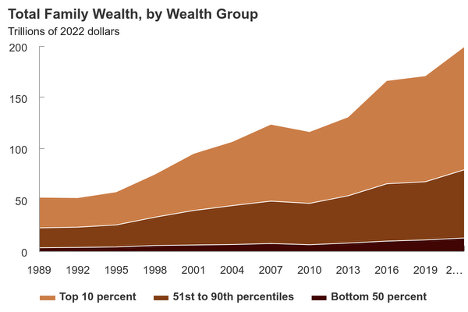
Source: The Congressional Budget Office
Inequality is often discussed in terms of income, wages, and headline economic indicators. Yet for many households, inequality is experienced most directly through everyday market realities: what it costs to live, how far a paycheck stretches, and which needs must be prioritized when budgets tighten. One practical way to understand this lived experience is to examine consumption capacity. How households allocate their spending across essential and discretionary categories, and what those allocations reveal about consumer welfare.
A consumption capacity perspective shifts attention from what people earn to what they can actually afford to do in the marketplace. When housing costs, transportation expenses, healthcare payments, and food prices rise, households do not adjust all spending categories equally. Instead, they make tradeoffs: some categories “win” share because they are unavoidable, while other categories lose share because they are easier to delay, downgrade, or cut. These reallocations shape quality of life, participation in social life, and long run opportunity, often in ways that conventional inequality measures fail to capture.
A useful framework for analyzing these dynamics is the income quintile view: comparing the lowest 20 percent of households to the next quintile, up through the highest 20 percent. Quintiles help reveal not only differences in total spending levels, but also differences in how spending is distributed across categories. For instance, essentials such as shelter related expenses, utilities, transportation, and healthcare tend to operate like quasi fixed commitments. Households can trim at the margins, but they cannot easily opt out. By contrast, discretionary categories, apparel, entertainment, recreation, and many service experiences, often function as the “adjustment valve” when essential burdens rise. The resulting pattern is not merely a budget artifact; it reflects a welfare mechanism. When essential shares rise for some groups, those households typically lose flexibility, absorb more risk, and face a narrower range of feasible market choices.
This approach also helps clarify why markets are not experienced equally. The marketplace is shaped by local cost structures, price dispersion, fees, and the availability of affordable substitutes. In high cost environments, households may be pushed toward trade down behavior, private label adoption, reduced service consumption, and longer replacement cycles for durables. Rising costs tied to mobility, particularly vehicle insurance and other vehicle related expenses, can create access constraints, affecting employment options, healthcare access, and shopping patterns. When healthcare obligations rise, they can crowd out other forms of consumption that support wellbeing, especially for households with limited buffers. Even the everyday choice between food at home and food away from home can signal deeper constraints related to time scarcity, work schedules, family structure, and the cost of convenience.
For practitioners and policymakers, a consumption capacity lens provides actionable insight. Category level budget shares can function as early warning indicators of consumer stress, pointing to where pressures are building and how households are adapting. For firms, the implication is that pricing and product design must reflect heterogeneous constraints: affordability is not only about low prices, but also about predictability, transparency, durability, and reduced hidden costs. For regulators and community leaders, the implication is that consumer welfare protection can be strengthened by monitoring how essential burdens evolve and by targeting interventions where tradeoffs are most damaging to long term stability.
Understanding inequality through consumption capacity ultimately reframes the conversation: the key issue is not only differences in earnings, but differences in lived market access, flexibility, and the ability to participate in the consumption domains that shape dignity and opportunity.
These themes will be explored further in my forthcoming book, The American Consumption Divide: Quintiles, Consumer Welfare, and the Market Experience of Inequality.
|