Perspectives

from the Lincoln University School of Business

Issue 3: March 12, 2024

Welcome to the LU School of Business’s Perspectives newsletter, bringing you contemporary and evidence-based business perspectives from our faculty.

Safer Missouri, Stronger Missouri: A Review of the Missouri Chamber Foundation’s 2030 Strategic Plan


Crime rate is one of the highest factors that individuals, families, and organizations consider before deciding to live in a place permanently or temporarily for work. As individuals, families, and organizations are faced with these decisions, it becomes a business and economic competitiveness issue. Anytime that an individual, family, or organization decides to pass over Missouri in favor of another state with a low crime rate, that is an opportunity lost for us here in Missouri.


A 2021 poll of Missouri Chief Executives commissioned by the Missouri Chamber of Commerce reveals that a significant number of business leaders believe crime is hurting Missouri's economy, and they want to see change quickly. This concern is highest amongst chief executives in St Louis.

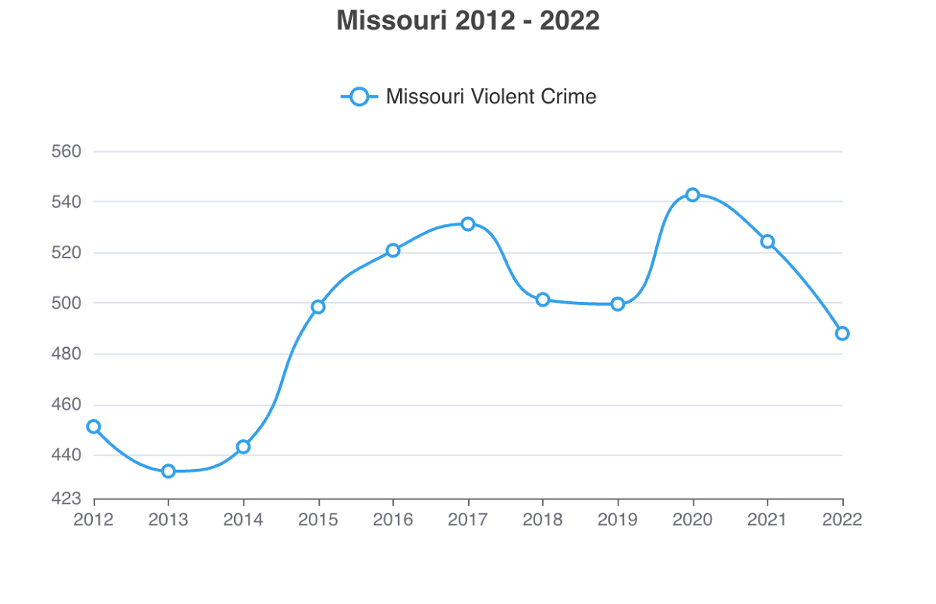
Source: FBI


According to the Federal Bureau of Investigation, violent crime rose from about 450 per 100,000 people in 2012 to 490 per 100,000 people in 2022. We can argue that 2020 is an outlier due to COVID-19 and its associated public health issues, one of which is mental health exacerbated by the long Covid lockdown. Yet, as the graph above demonstrates, the numbers are still high at 490 per 100,000 people in the most recent year that data was collected.


The Missouri Chamber Foundation’s 2030 Strategic Plan highlighted the need to better use limited state and local resources by focusing on high-risk individuals and high-crime geographic areas. This is evident in the Safer Missouri, Stronger Missouri report released by Economic Leadership LLC on behalf of the Missouri Chamber.


While acknowledging competing interests struggling for lawmakers’ attention, keeping Missouri's crime rate in check should be a top priority for local and state policymakers, and there must be a concerted effort on the part of the leaders to ensure many of these commonsense recommendations are enacted into law and implemented as soon as it is practicable to do so. Some of the recommendations highlighted by the Missouri Chamber report are:


  • Deploy evidence-based and hot-spot approaches to crime reduction.
  • Increase and protect tools to support policing.
  • Increase public safety staffing.
  • Address substance misuse and mental health.
  • Reduce recidivism among those on probation or parole.
  • Improve training and employment opportunities for incarcerated individuals.
  • Improve public perception of law enforcement.
  • Increase prosecutorial consistency and transparency.

Abdulmumini Yinka Ajia is an Associate Professor in the School of Business at Lincoln University. Dr. Ajia is also the Coordinator of the LU MBA Program, and editor of the LU Perspectives. The author can be reached at ajiaa@lincolnu.edu.

_____

Disclaimer

The views expressed in this newsletter are solely those of the author and do not represent nor reflect the views of the School of Business or that of the University.

Facebook  Twitter  Instagram  Linkedin  Youtube  Email  Web

Lincoln University of Missouri, a historically Black, 1890 land-grant, public, comprehensive institution, provides a diverse population access to excellent educational opportunities through teaching, research, and extension services within a nurturing, student-centered environment.