Perspectives

from the Lincoln University School of Business

Issue 2: March 5, 2024

Welcome to the LU School of Business’s Perspectives newsletter, bringing you contemporary and evidence-based business perspectives from our faculty.

As Missouri Prepares for an Aging Population: Perspectives on the Causal Impact of Aging on GDP Growth


As the population in the state of Missouri trends older, there will be an attendant increase in dependency ratio and changes to the local economy. In recognition of this fact, Missouri Governor, Mike Parsons, commissioned a master plan on aging to address seven critical factors. These are: daily life and employment, issues around care giving, housing, and aging in place, long term services, safety and security, transportation and mobility, and whole person health. The Governor’s approach is a proactive measure aimed at solving the attendant questions raised about the economic and social outcomes associated with the size of the working population.

_____

In this edition of the Perspectives, we discuss the relationship between population age – structure and economic growth. We know from the literature that adverse effects on economic growth as the population is aging are mitigated by the level of education, willingness to adopt technology, health and disability status, and the future of work. All these factors must be considered carefully as the population is aging and as the state continue to work on the master plan on aging.

_____

It is not contestable that an aging population slows the growth of the labor force and may lead to a lower GDP growth. An aging population also puts a strain on the prime age working population whose taxes will be required to pay for the benefits and programs offered to the elderly population. It also puts a strain on government expenditure in the areas of medical care and publicly funded retirement programs. According to the department of health and senior services, there are more than 1.1 million Missouri citizens over the age of 60 and estimates suggest that older adults will outnumber minors for the first time by 2030 and will significantly outnumber minors by 2060 if the current birth rate is maintained (DHSS, 2024). At the state level three things are important, growth, revenue, and services that would allow the elderly to age gracefully.

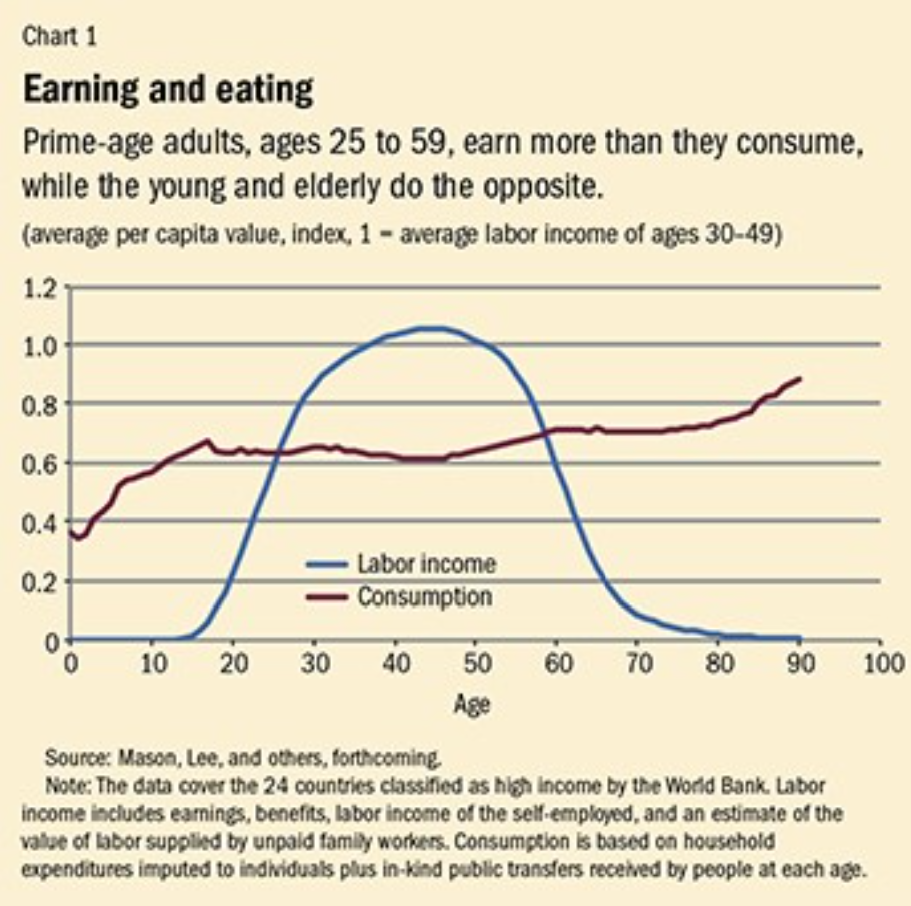
Source: Mason, Lee, et al. (2017)


As the chart above shows, labor income falls off after age 60 while consumption increases. To maintain the pace of growth and revenue flows to fiscal authorities, the state must be willing to implement the following policies:

  1. Introduce policies to encourage family formation through the enactment of newborn child credit.
  2. Introduce a refundable child credit tax of at least $1000 per qualifying child in furtherance of number one objective above.
  3. Examine the tax policies of the state of Pennsylvania and how it was able to raise the state’s match of the federal Child and Dependent Care Credit from 30% to 100%, resulting in a maximum refund of $1,050 for one child and $2,100 for two or more children. This is another way to incentivize the formation of family and be less reliant on immigration because while immigration can offset some of the challenges posed by an aging population, it is not sufficient to reverse the effect of an aging population. 
  4. Work with childcare providers to make childcare more affordable and accessible. The comprehensive tax credit package to promote the development of additional childcare resources is a step in the right direction but the state needs to go further in its efforts to end childcare deserts. Public records have shown that over 1 billion dollars is lost annually by the state in terms of productivity and over 200 million dollars lost in taxes annually because families cannot afford and sometimes cannot find placement in childcare facilities nearest to them. The champion for children tax credit is also a step in the right direction but does not go far enough in solving the problem. The state needs to convene a stakeholder meeting with providers and parents in all 115 counties to come up with a permanent solution.
  5. Institute a grant system for interested young adults without the requisite financial capital to go into childcare services to further strengthen objective four above.
  6. Incentivize childcare management as a career of choice and a means towards self-employment. This can be tied to objective five above and the grant proposed in five above can further be tied to a minimum level of education in childcare management and services.
  7. Work with the federal government to benefit from place-based immigration to attract skilled immigration to Missouri.
  8. The state can also incentivize delayed retirement, this should be optional for those who want to remain in the labor force longer than 67.
  9. The state should also incentivize the creation of a leisure economy that can serve as a means of post-retirement employment for interested seniors while driving their consumption towards more outdoor activities with its potential health benefits.

_____

To achieve a whole person health for the elderly, Missouri needs to align family formation, family health and wellbeing with the masterplan on aging. In short, as the state of Missouri prepares for an aging population, we need a whole of society approach to not only make life more meaningful for our elderly seniors but also encourage family formation, incentivize delayed retirement (optional), encourage post-retirement employment amongst interested seniors, tap into place – based immigration to benefit from skilled immigration, and find innovative solution to the issues of childcare affordability and accessibility.

Abdulmumini Yinka Ajia is an Associate Professor in the School of Business at Lincoln University. Dr. Ajia is also the Coordinator of the LU MBA Program, and editor of the LU Perspectives. The author can be reached at ajiaa@lincolnu.edu.

_____

Disclaimer

The views expressed in this newsletter are solely those of the author and do not represent nor reflect the views of the School of Business or that of the University.

Facebook  Twitter  Instagram  Linkedin  Youtube  Email  Web

Lincoln University of Missouri, a historically Black, 1890 land-grant, public, comprehensive institution, provides a diverse population access to excellent educational opportunities through teaching, research, and extension services within a nurturing, student-centered environment.