|
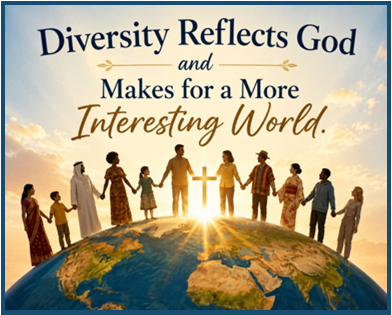
Because we are created in the image and likeness of God, something of that diversity and communion is reflected in humanity. We are not all the same, nor were we ever intended to be. Our differences are not obstacles to overcome but gifts to be received.
Yet human beings often fear difference. We are naturally drawn to people who think like us, look like us, worship like us, vote like us, and share our experiences. The familiar feels safe; the unfamiliar can feel threatening. When fear takes root, it can become prejudice. Prejudice can become exclusion. Exclusion can become discrimination, racism, and division. These wounds have marked human history for centuries, but they do not come from God.
As a nation, we have often struggled with diversity. From the treatment of Native Americans, to slavery, segregation, discrimination against immigrants, religious prejudice, and continuing debates over race, culture, and identity, our history reveals both our failures and our aspirations. Too often diversity has been viewed not as a gift to be embraced but as a threat to be resisted.
At the same time, we must be careful not to misunderstand diversity. Diversity is not an end in itself. It is not about dividing people into competing groups or reducing individuals to labels and categories. The goal is not diversity for diversity's sake, but communion. The danger lies not in recognizing differences but in allowing those differences to become barriers rather than bridges.
The United States itself is a nation built upon diversity—diversity of peoples, cultures, ideas, experiences, and dreams. This diversity has often been messy, sometimes painful, and frequently challenging. Yet it has also been one of our greatest strengths. The richness of our nation comes not despite our differences, but often because of them.
For Christians, embracing diversity is not optional. It flows directly from our belief in the Trinity and from the Gospel itself. The Church was born diverse. On Pentecost, people from many nations heard the Good News proclaimed in their own languages. The Book of Revelation envisions a multitude before God's throne "from every nation, race, people, and tongue."
The Christian response is not simply to coexist but to build community. To listen before judging. To understand before condemning. To recognize that our differences need not divide us but can deepen our understanding of one another and of God.
Honoring those differences is essential to empathy. True empathy is not assuming that others are just like us. It requires recognizing that other people may have experiences very different from our own. We often speak about "walking in another person's shoes," but the truth is that there are some shoes we will never walk in. We cannot fully know another person's story, struggles, fears, or hopes. Yet we can listen. We can learn. We can respect. We can love.
When we look for God's fingerprints in creation, every difference becomes another clue pointing toward the infinite mystery of the Creator. Each culture, each personality, each perspective, and each human story reflects another facet of God's beauty. This brings to mind the words of the Jesuit poet Gerard Manley Hopkins in his poem Pied Beauty:
"All things counter, original, spare, strange;
Whatever is fickle, freckled (who knows how?)
With swift, slow; sweet, sour; adazzle, dim;
He fathers-forth whose beauty is past change."
~ Fr. Paulson
|