Message from the Sustainability Manager
Dear Sustainability Champions,
I hope you enjoyed a wonderful holiday season and are having a great start to 2026! As we celebrate the new year, I also want to take a moment to thank you for your participation in events that capped a successful year for the Office of Sustainability in 2025.
| | |
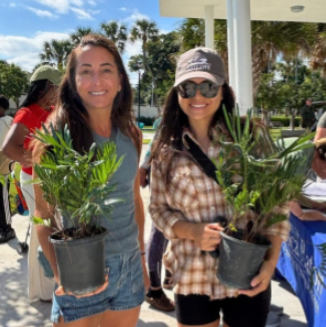
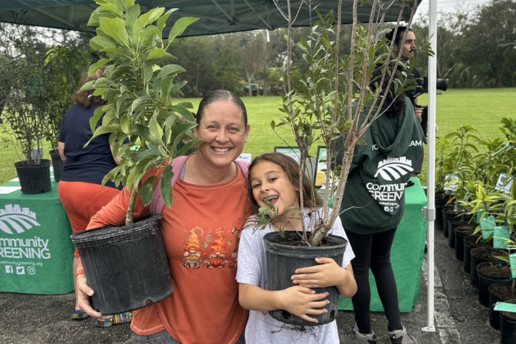
On November 14 and December 12, 2025, the Office of Sustainability held Native Plant Giveaways as part of Recreation Services' Wildflower in Bloom initiative, at Wildflower Park. Over 60 residents participated in each event, either taking home a native plant (of various species such as coontie, dune sunflower, tickseed, muhly grass, and sage) or a seed packet of native wildflowers with a small flowerpot starter kit. Be sure to check out future Wildflower in Bloom events and stop by the park any day to enjoy the new Centennial Legacy Mosaics on the central pavilion, the Mi Casa, Your Casa 2.0 swings, the “Sense of Place” Palmetto Park underpass murals, and unmatched views of the Intracoastal Waterway! Stay tuned for details on future plant giveaways scheduled for February 13, and April 10.
| |
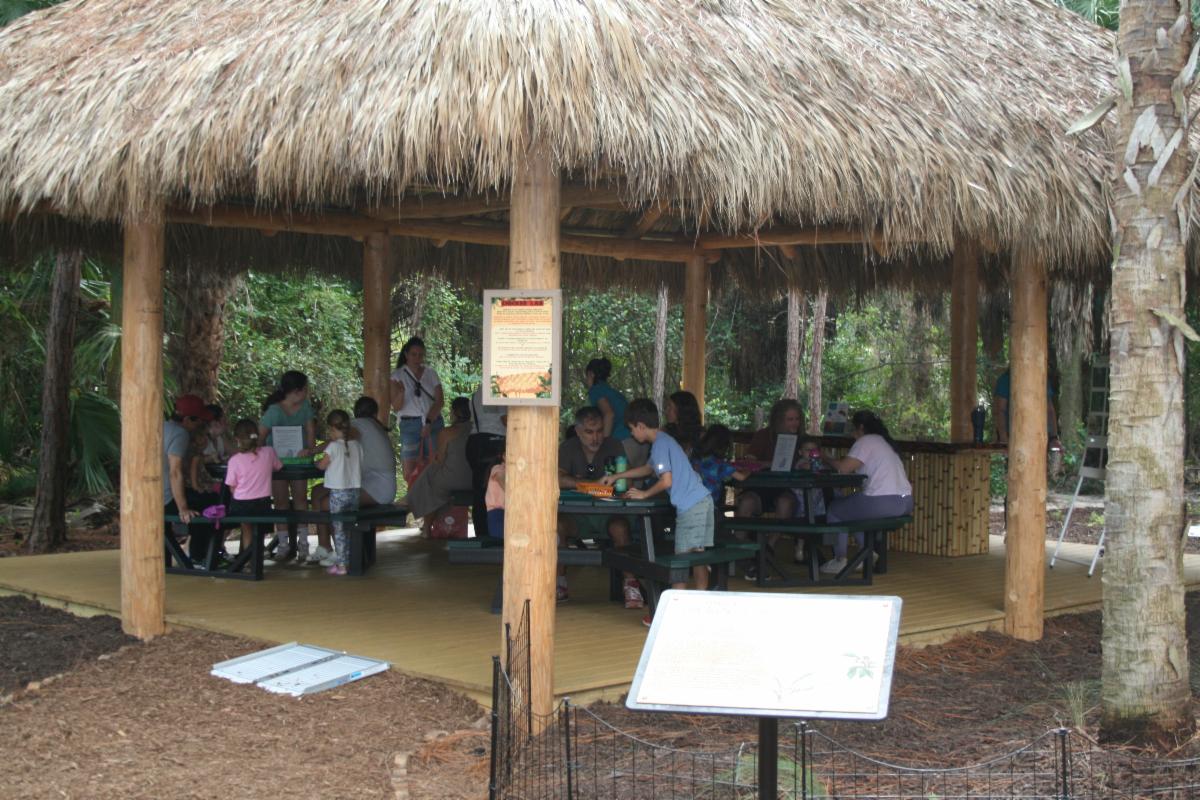
On December 7, 2025, the Office of Sustainability was on hand to celebrate the grand opening of the Children’s Science Explorium’s Chickee Lab! The teaching bench and round tables beneath the hut will enhance programing for the Explorium and provide visitors and program participants the opportunity to enjoy and connect with their natural surroundings. You can find information about programs for children and families on the Explorium’s Programs page. When you visit the Explorium and Chickee Lab, make sure to stop and appreciate the native Florida landscape installed around the hut. The plants were selected (by Explorium and Office of Sustainability staff) based on their native status and role in enhancing biodiversity. The plants are labeled so you can learn more about the biology of each species and perhaps consider incorporating them in your own yards.
| | |
And to round up 2025 by the numbers, here are some Sustainability achievements we can all take pride in as a community:
-
Number of trees given away to residents or installed by the Office of Sustainability: 625 trees (plus over 400 installed by Recreation Services)
-
Number of native plants installed: 1,400 plants
-
Number of volunteer hours dedicated to restoration or planting projects: > 400 hours
-
Number of native plants provided to residents at events and lectures: 260 plants
-
Pounds of E-waste recycled from collection events: 7,369 lbs. (that’s 3.7 tons!)
-
New certifications achieved: 2 (Blue Flag Beach and LEED for Cities Gold)
-
Outreach events and learning opportunities: over 40!
-
Amount of thanks your Sustainability Manager has for your unending support: Infinite!
We can now start off 2026 with some great news. For the 46th year, Boca Raton has received designation as a Tree City USA by Arbor Day Foundation. The City also received the Tree City USA Growth Award for a 7th year. The City’s commitment to enhancing tree canopy will continue with a tree giveaway during the MLK JR. Day Unity Celebration on January 19 (see details in the Take Action section).
Please read on for additional information on:
- Upcoming events
- Water quality at our Blue Flag Beach
- Eco-friendly seawalls
- A very relevant creature feature! 😉
- Some promising news on the transition towards renewable energy
| |
Looking forward to seeing you at sustainability events this year! Until then, stay well and stay sustainable.
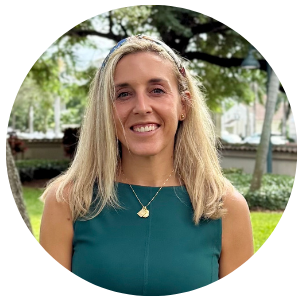
Tina Batoh-Jennings
Sustainability Manager, City of Boca Raton
| | |
Take Action!
Participate in these upcoming events.
Tree Giveaway with Community Greening
Monday, Jan. 19 | 11:30am | Mizner Park Amphitheater
590 Plaza Real, Boca Raton, 33432
- City of Boca Raton residents can receive a FREE Florida native shade tree or fruit tree.
- Tree distribution takes place at the Mizner Park Amphitheater during the MLK Jr. Day Unity Celebration
-
Proof of residency is required, and residency can be checked here: Boca Raton Residency Map. Residents must live within the City limits (blue area on residency map).
- Species Options:
-
Native Trees: blackbead & Simpson’s stopper
-
Fruit Trees: avocado & mango
- One tree per household.
-
Learn more!
| | |
Ecological Restoration Volunteer Day- Beach Dunes
Saturday, Jan. 24 | 9-11am | Red Reef Park | 1400 N Ocean Blvd, Boca Raton, 33432
Join the Institute for Regional Conservation (IRC) and the City of Boca Raton to restore the beach dunes at Red Reef Park! Come volunteer for this fun event where participants will remove invasive species that are causing harm to the dunes and install native plants. This allows us to enhance and restore the native biodiversity of the important beach dune ecosystem.
-
There is no experience required! So, grab a friend and come out to help restore the essential biodiversity of Red Reef Park.
-
Please be sure to RSVP if you want to participate in this event.
- We recommend that you wear comfortable outdoor clothing. You will be in full sun.
- Wear a hat and sunscreen! Bring a reusable water bottle and anything else that makes you comfortable in the outdoors!
- The Institute for Regional Conservation will provide the rest.
-
The IRC will send a reminder email before the event so please be sure you sign-up to receive the details.
| | |
Virtual Lunch & Learn: Climate Smart Floridians
Thursdays, Jan. 27 - Mar 3 | 12-1:00pm | Zoom
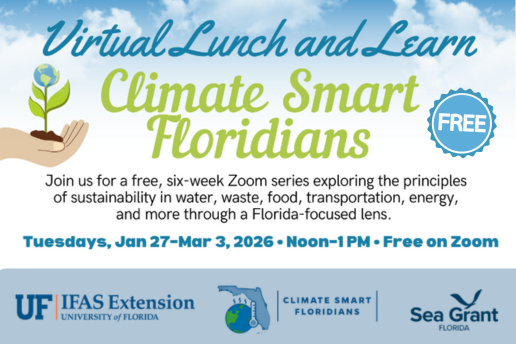
Join for a FREE, 6-week Zoom series exploring the principles of sustainability in water, food, transportation, energy, and more through a Florida-focused lens run by UF/IFAS and FL Sea Grant.
Sign Up
| | |
Intracoastal Cleanup
Thursday, Feb. 5 | 3:45-5:30pm | James A. Rutherford Park
600 NE 24th St, Boca Raton, 33431
-
RSVP online here.
- Check-in begins at 3:45pm the day of the event, on-site.
- Minors must be accompanied by an adult.
- Participants aged 13+ may use Gumbo Limbo kayaks or canoes (first comes, first served; limited supply) or bring your own.
- Land-based cleanup is available to all participants and required for those under 13 years old (unless on personal equipment).
- All cleanup materials will be provided.
- GIVEAWAYS from 4Ocean.
| | |
Be On the Lookout: Sustainable Yard Series
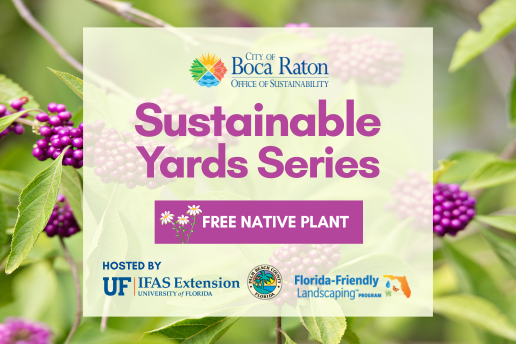
Our favorite lecture series is back with UF/IFAS extension agent, Kara Kruger, joining us to speak on topics such as managing yard pests, the basics of Florida Friendly Landscaping, landscaping for and within an HOA, and composting.
Finalized lecture schedule, details of each talk, and registration information will be provided in early February so please be sure to check the Take Action page, and any emails sent from the Office of Sustainability, regularly.
Lecture dates will be as follows:
- Tues., February 24
- Tues., March 31
- Tues., April 28
- Tues., May 26
Time and Location:
Lectures take place from 6:00–7:30pm at the Spanish River Library, 1501 Spanish River Blvd.
| |
Recycle Your Christmas Tree
The City's Christmas tree recycling program will run from NOW through Jan. 19, 2026.
Residents can drop off their “clean” Christmas trees (remove all lights & decorations) at Countess de Hoernle Park (1000 Spanish River Blvd, southern end of the parking lot next to the maintenance area). Recreation Services will pick up the trees and chip them into mulch to be used at the Gumbo Limbo Nature Center.
Drop-off Times:
- Monday - Saturday: 8:00am - 8:00pm
- Sunday: 8:00am - 5:00pm
| | |
A Word About Water Quality
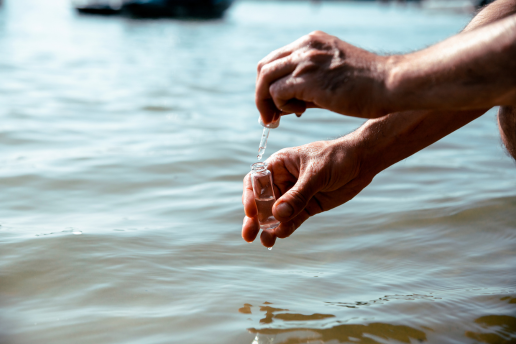
Recently, Spanish River Park beach, the City’s Blue Flag Beach, experienced a swim advisory from December 29-30, 2025 due to high levels of bacteria. The bacteria in question, Enterococcus, is sampled weekly by the Florida Department of Health (FLDOH). When concentrations of the bacteria (tested in the laboratory with a handy Enterolert kit) are greater than 71 colony forming units (cfu) per 100mL of seawater, FLDOH issues the “no swim” warning until the beach tests below 71 cfu again.
While these warnings might seem worrisome, please rest assured that our ocean-facing beaches experience these advisories only very rarely. In fact, between April 1, 2024, and Jan 5, 2026, a span of 645 days, only five advisories were issued for Spanish River Park, beach. That’s only about once every four months. The high water quality is one of the reasons the beach was awarded the Blue Flag and the City works diligently to maintain the cleanliness of the beach for annual award renewal.
You may now be asking, though…
“Where does Enterococcus come from and why do we measure it’s concentration?”
Enterococci are bacteria found in the intestinal tracts of animals that indicate fecal contamination of water. They are used to test water quality because their presence is a reliable indicator of potential disease-causing pathogens. Detecting enterococci helps identify whether water is safe for swimming.
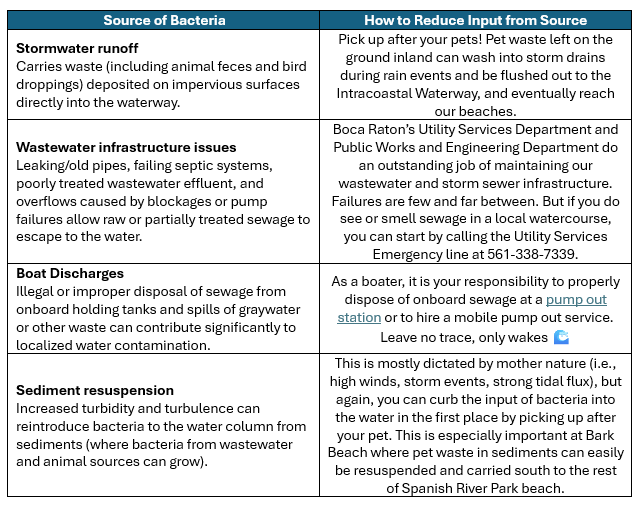
“Well how does it end up in the waters of our beaches and how can we keep the concentrations below thresholds?”
| | |
“How can I protect myself?”
High concentrations of Enterococcus can cause gastrointestinal illness, skin rashes, and eye, ear, nose and throat infections. But remember, the presence of this fecal indicator means there could potentially be other pathogenic bacteria or viruses present. To protect yourself:
- Do not enter the water if a no-swim advisory is issued. Also, be aware of your surroundings. If you smell sewage or see brownish, frothy slicks on the water, stay out.
- Cover open cuts. Water shoes and rash guards/wetsuits can offer an extra layer of protection.
- Be sure to shower as soon as possible after exiting the water. Make sure to rinse off any of your gear as well (snorkeling and diving gear, boards, wetsuits, etc.)
- Advocate for community measures that reduce stormwater runoff into our waterways.
Now go ahead and get out there to enjoy and protect our beautiful waters!
| | |
Creature Feature
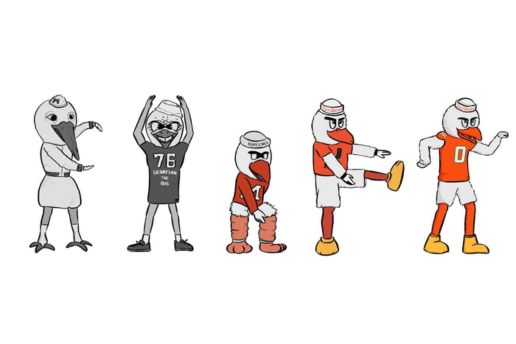
Small but Mighty - The American White Ibis (aka "Sebastian" to My Fellow Miami Hurricanes)
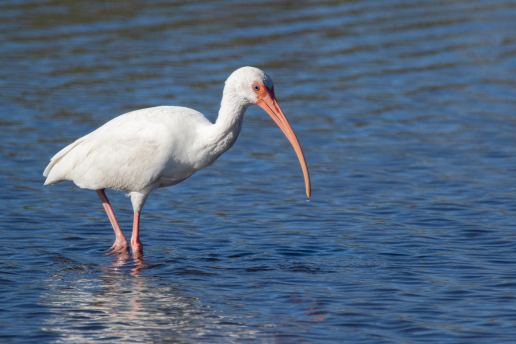
If you’ve spent time near South Florida’s wetlands, parks, or shorelines, or even just walked out your front door, I’m sure you’ve seen the American white ibis (Eudocimus albus)—a striking wading bird with bright white feathers, black-tipped wings, and a long, curved reddish-orange/pink bill.
Adult ibises typically measure 22–27 inches long, and weigh just 2–3 pounds. Though modest in size, they boast an impressive wingspan of 36–41 inches. Perfectly designed for probing mud and shallow water for crabs, insects, and other small prey, the ibis is a powerful example of how being small doesn’t mean being fragile—in fact, these birds are anything but.
Beyond their beauty, American white ibises are known for their remarkable resilience. They are highly adaptable, capable of navigating storms and rapidly changing conditions, and thriving across marshes, estuaries, mangroves, and even urban green spaces. Their ability to persist in both natural and built environments makes them an excellent reminder of how closely our ecosystems and communities are connected—and how important it is to protect the water quality and habitats they depend on. Moreover, local folklore maintains that the ibis is the last bird to flee before a hurricane and the first to return.
| |
This resilience is one reason the American white ibis was chosen as the inspiration for the University of Miami’s mascot, Sebastian the Ibis. The ibis represents strength, adaptability, and perseverance—qualities that align closely with the University and its athletics program.
The resilient spirit of the ibis has been on full display by the Miami Hurricanes throughout the college football playoffs and was especially poignant in the recent Fiesta Bowl win over Ole Miss. Just like their iconic mascot, the Hurricanes demonstrated grit, determination, and heart. We proudly congratulate them on punching their ticket home to the Hard Rock and we wish them the very best of luck in the National Championship—Go ’Canes! And thanks, Sebastian, for your endless enthusiasm in rallying the players and fans alike, and teaching all of us an important lesson in resilience.
| | |
Sustainability Heroes
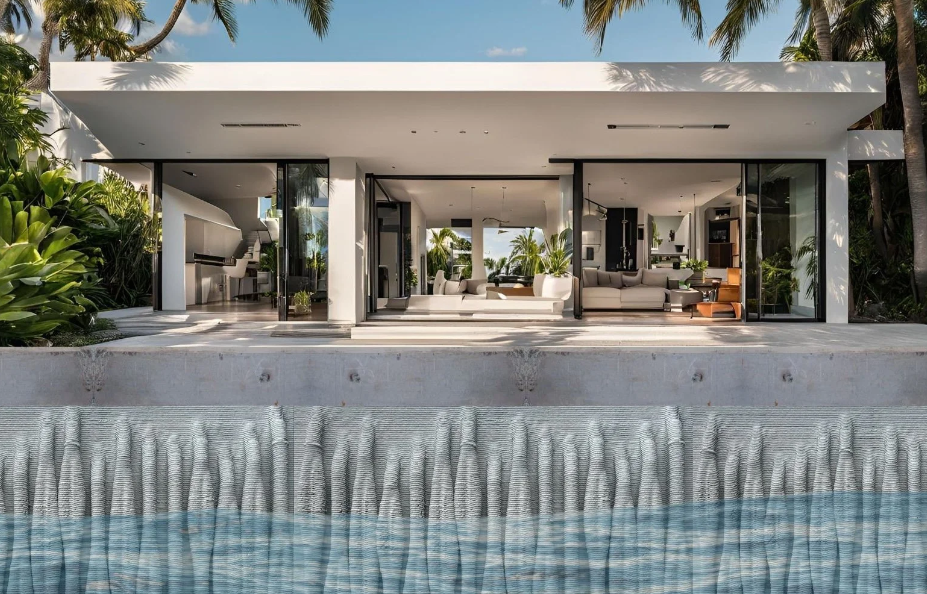
This issue’s hero is a bit different in that they are an innovative company specializing in sustainable coastal infrastructure. The company is KindDesigns based out of Miami. As sea level rises and coastal erosion accelerates, resilient solutions are more important than ever. KindDesigns is redefining what seawalls can do by combining structural protection with ecological regeneration. Their patented 3D-printed Living Seawalls™ are crafted using eco-friendly materials and biological designs that mimic natural habitats like mangrove roots and coral reefs — encouraging oysters, sponges, algae, and fish to colonize the structure while filtering water and improving overall shoreline health.
Unlike traditional flat concrete seawalls, KindDesigns’ systems use textured, pH-neutral surfaces to foster biodiversity while enhancing resilience to storms and flooding. Pilot installations have documented rapid marine growth and measurable ecological benefits within months of deployment. Moreover, the 3D walls are better able to dissipate wave energy and reduce scour (erosion) at the toe of the seawall relative to standard, flat seawalls.
In addition to Living Seawalls, KindDesigns offers Kind Tiles™ that can be retrofit to existing seawalls, piling wraps that transform dock infrastructure into living habitat, and planters designed to support mangroves and native shoreline vegetation — making it easier to add ecological value without full reconstruction.
By choosing KindDesigns’ solutions, waterfront property owners can protect critical infrastructure while actively restoring coastal ecosystems, aligning shoreline resilience with long-term sustainability goals. See how the Village of Miami Shores and Church by the Sea in Fort Lauderdale are using their KindDesigns seawalls to protect upland assets while healing our marine habitats. If you’re in the market for a new seawall, consider KindDesigns.
| | Read, Watch, and Listen with the Office of Sustainability | |
Listen
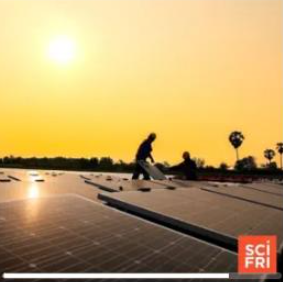
Here’s some fantastic news. The Science Friday Podcast, "Can The Rise In Solar Power Balance Out Clean Energy Cuts?", reports on encouraging data in the transition from fossil fuels to renewable sources of energy. Thanks to the leadership of Texas and California, as of March 2025, fossil fuels generated less than half the electricity in the US for the first time ever. Listen to the podcast to find out how we are building on this success, but also learning from other countries how we can continue to improve.
| | | | Are you, or someone you know, going above and beyond for sustainability in the City of Boca Raton? Submit them for the next edition! Email us at sustainability@myboca.us | | | | |