Civil Rights Spotlight: The Mississippi Delta
Historian James Cobb has described the Mississippi Delta as "The Most Southern Place on Earth," and that designation certainly applies to the region's civil rights history. Black residents of Mississippi faced brutal oppression, intimidation, and violence. Yet the communities in the Delta also share the long southern legacy of building a movement in response to this racism. The Civil Rights Movement of the Mississippi Delta changed America forever.
The Story of Emmett Till
In the summer of 1955, 14-year-old Chicagoan Emmett Till was visiting family in Money, Mississippi. On 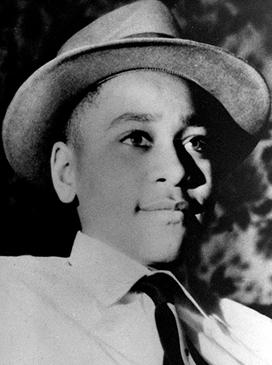 August 24, Till allegedly whistled at Carolyn Bryant, a white woman, in the local grocery store. During the night of August 28, Roy Bryant, Carolyn's husband, and his half-brother, J.W. Milam, took Till from his great-uncle's house. Till was severely beaten, shot, and eventually thrown into the Tallahatchie River with a cotton gin fan tied around his neck with barbed wire. Several days later, Till's disfigured body was found in the river. August 24, Till allegedly whistled at Carolyn Bryant, a white woman, in the local grocery store. During the night of August 28, Roy Bryant, Carolyn's husband, and his half-brother, J.W. Milam, took Till from his great-uncle's house. Till was severely beaten, shot, and eventually thrown into the Tallahatchie River with a cotton gin fan tied around his neck with barbed wire. Several days later, Till's disfigured body was found in the river.
Mamie Till-Mobley, Emmett Till's mother, insisted on having an open-casket funeral for her son in Chicago, because, as she said, "I wanted the world to see what they did to my baby." Thousands of people attended Till's funeral, and pictures of his body were published in The Chicago Defender and Jet magazine. Yet despite the national moral outrage caused by Till's murder, Bryant and Milam were acquitted at trial. Only a few months later, in an interview in Look magazine, the two confessed to murdering Till. Emmett Till's murder widened support for the burgeoning Civil Rights Movement.
Building a Local Movement in Clarksdale
 | | Clarksdale Organizers: Left to right: J. D. Rayford Jr., unidentified woman, C. T. Vivian, Noelle Henry, Pigee, and Rev. Frazer Thomason. |
One of the most active branches of the NAACP in the early Civil Rights Movement was located in the Delta town of Clarksdale. The chapter, formed in 1952, was led by Aaron Henry, a local pharmacist, and had a strong Youth Council program, organized by Vera Mae Pigee. In the fall of 1961, the Youth Council was inspired by the Freedom Riders and began to test the segregation practices of the Clarksdale bus station. In the process, several young people as well as Pigee were denied service, harassed, and arrested. However, by December 1961, the police had voluntarily removed all the segregation signs from the Clarksdale bus terminal.
Apparently in response to the activism of the NAACP, the bands from two black high schools were banned from performing in the annual Clarksdale Christmas parade, despite the fact that they had been doing so since the late 1940s. Henry, Medgar Evers, and many others responded by organizing a Christmas boycott of the downtown Clarksdale stores under the slogan, "If we can't parade downtown, we won't trade downtown." The boycott was extremely effective at crippling downtown businesses, and Henry was arrested and convicted on charges of "conspiring to withold trade." The protest continued for two years.
"One Man, One Vote"
In the early 1960s, local organizers all over Mississippi were attempting to register black people to  vote. These organizers and the individuals who attempted to vote faced incredible violence, firings, evictions, and murders. In order to respond more effectively to this oppression, several organizations decided to form a coalition to focus on civil rights and voting rights issues in Mississippi. In 1962, the Student Nonviolent Coordinating Committee (SNCC), the Congress of Racial Equality (CORE), the Southern Christian Leadership Conference (SCLC), and the National Association for the Advancement of Colored People (NAACP) joined together to form the Council of Federated Organizations (COFO).
Under the auspices of COFO, the number of voter registration campaigns in the state began to grow, but their success was still limited. The White Citizens' Councils, which had formed in 1954 to oppose racial integration in Mississippi, continued to use violence and political power to prevent black people from registering. When black people did risk attempting to register, they had to pass complicated and subjectively graded literacy tests. In 1962 - 1963, fewer than 4,000 black Mississippians were added to the voter rolls. In the lead-up to the 1963 general election, COFO decided to hold a "Freedom Vote" to display how many black Mississippians were interested in voting and to challenge the concept of voter "qualification." Interracial slates of Democratic and Republican candidates were assembled, and anyone who was interested was allowed to vote. In the end more than 80,000 people participated in the "Freedom Vote." The overwhelming success of the "Freedom Vote" paved the way for even larger voting rights campaigns.
Read more about the Mississippi Delta's rich history in Freedom Lifted's next newsletter!
|