|
Welcome to this month’s
Energy Update!
| Stay informed on the latest in clean energy, sustainability, and community initiatives across Suffolk County. From renewable energy programs to practical tips for saving power at home, we’re here to keep you energized and inspired! | | |
Clean Energy Options for Homeowners and Job Seekers
Energy Saving Tips for Winter
In New York State, heating is by far the biggest energy expense. It costs the average family between $800 and $2,000 per year, depending on heating type and other factors. There are actions you can take to cut these costs. This page lists some tips to reduce your energy use and lower your bills. Remember, you can always contact one of our Energy Advisors with questions or to get help.
Explore your options here.
| | |
Learn How to Get a Free Home Energy Assessment
Thanks to New York’s Residential Energy Assessment Program, home energy assessments, which are valued at over $250.00, are available to most Long Island residents - renters and home owners - at no cost. The assessments are performed by professional, certified contractors and help you identify which improvements make sense for your home. Having an energy assessment qualifies you for incentives, rebates, and low-interest loans that can be applied to your energy-efficiency improvements.
Click here to schedule a FREE meeting with an Energy Advisor
| | |
Federal Energy Savings You Can Claim Before
2025 Ends
Homeowners can claim up to $3,200 in federal tax credits for energy-efficient upgrades through December 31, 2025, under the Inflation Reduction Act.
-
The Energy Efficient Home Improvement Credit covers 30% of eligible costs, up to $1,200 for insulation and electrical upgrades. Plus, $2,000 for heat pumps and heat pump water heaters.
-
The Residential Clean Energy Credit offers 30% back on systems like geothermal heat pumps and battery storage. All items must be placed in service by the deadline. You must have a tax bill to benefit, which may not be the case for certain low-income households.
Learn more about claiming Federal Tax Credits for Energy Efficiency on the EnergyStar.gov website here!
| | A Comfortable, Energy-Efficient Home Starts Here | | |
If you’ve been thinking about improving your home’s comfort and energy efficiency, now is a great time to do it. Federal tax credits, which expire December 31, 2025, can be combined with New York State incentives for maximum savings.
Check out the tables below to see which technologies and products qualify, and start your clean energy future today:
Energy Efficiency Upgrades
Upgrades such as insulation and windows, and more are eligible for combined federal and State incentives.
| |
| Eligible
Clean
Energy
Technology | Expiring
Federal
Tax
Credit | New York State
Incentives | | Electric Panel or Circuit Upgrades for New Electric Equipment | 30% of cost, up to $600* | Incentives may be available if completed with an appliance upgrade or home energy upgrades. | | Insulation Materials† | 30% of cost* | Incentives: $1,000 - $4,000 | | Windows, Including Skylights† | 30% of cost, up to $600* | Incentives may be available with insulation materials packages. |
Your copy should address 3 key questions: Who am I writing for (audience)? Why should they care (benefit)? What do I want them to do (call-to-action)?
Create a great offer by adding words like "free," "personalized," "complimentary," or "customized." A sense of urgency often helps readers take action, so consider inserting phrases like "for a limited time only" or "only 7 remaining!"
| | |
Table Credit: United States Department of Energy
* Subject to cap of $1,200/year
† Eligible for New York State low-interest financing
| | |
Heating, Cooling, and Water Heating
If you’re thinking about switching to clean energy for heating, cooling, and water, these incentives for heat pumps and other technologies can help.
| |
| Eligible Clean
Energy Technology | Expiring Federal Tax Credit | New York State Incentives | | Cold-climate Air Source Heat Pumps† | 30% of cost, up to $2,000 per year | Incentives:
Partial home solutions $100-$400 on average
Whole home solutions $2,000 - $3,000 on average | | Heat Pump Water Heaters | 30% of cost, up to $2,000 per year | Incentives: $700 - $1, 000 on average | | Biomass Stoves | 30% of cost, up to $2,000 per year |
| | Ground Source (Geothermal) Heat Pumps† | 30% of cost | Incentives: $7,000 - $9,000 on average
Tax Credit: 25% up to $5,000 | | Solar (Water Heating) | 30% of cost |
| | Efficient Air Conditioners | 30% of cost, up to $600* |
| | Efficient Heating Equipment | 30% of cost, up to $600* |
| | Efficient Water Heating Equipment | 30% of cost, up to $600 |
|
Your copy should address 3 key questions: Who am I writing for (audience)? Why should they care (benefit)? What do I want them to do (call-to-action)?
Create a great offer by adding words like "free," "personalized," "complimentary," or "customized." A sense of urgency often helps readers take action, so consider inserting phrases like "for a limited time only" or "only 7 remaining!"
| | |
Table Credit: United States Department of Energy
* Subject to cap of $1,200/year
† Eligible for New York State low-interest financing
| | |
Clean Electricity Products
If you’re ready to invest in larger clean energy technologies like solar, fuel cells, and battery storage, consider these high-impact options.
| |
|
Eligible Clean
Energy Technology |
Expiring Federal Tax Credit
|
New York State Incentives
| | Solar (Electricity)† | 30% of cost | Incentives: $1,200-$2,400 average
Tax Credit: 25%, up to $5,000 | |
Fuel Cells |
30% of cost |
| | Wind Turbine |
30% of cost
|
| | Battery Storage |
30% of cost |
|
Your copy should address 3 key questions: Who am I writing for (audience)? Why should they care (benefit)? What do I want them to do (call-to-action)?
Create a great offer by adding words like "free," "personalized," "complimentary," or "customized." A sense of urgency often helps readers take action, so consider inserting phrases like "for a limited time only" or "only 7 remaining!"
| | |
Visit NYSERDA’s Inflation Reduction Act for Homeowners site to learn more about the products, services, and technologies that can improve your comfort, safety, and quality of life.
The Fine Print
Eligibility for Federal and New York State incentives may vary by income, tax liability, and product specifications. Consult the Internal Revenue Service (IRS) guidance for taxpayers on credits and deductions and your tax advisor for details. Additional rebates may be available for income-eligible New Yorkers.
| | |
Get EV Savings on Long Island with new
EV Deals Hub!
| | |
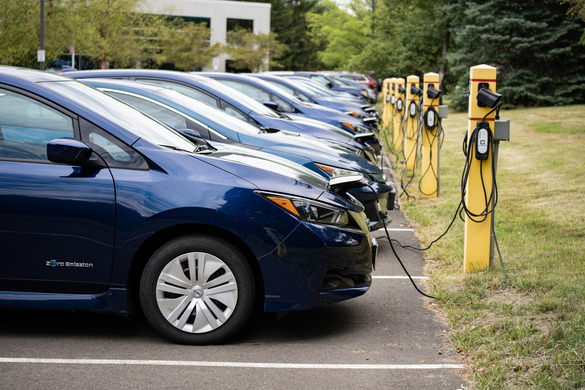
Long Island Clean Energy Hub partner Drive Electric Long Island has launched a new EV Deals webpage where Long Island drivers like you can find incentives, special offers, and partner promotions on electric vehicles (EVs)!
Whether you’re ready to buy your first EV or simply exploring your options, you will find all the most compelling local deals in one place, making it easy to choose smarter, cleaner transportation.
Find Drive Electric Long Island’s EV Deals Hub at www.driveelectriclongisland.org/deals
| | |
Clean Energy Solutions for Large and Small Businesses
| | |
Waste to Low-Carbon Fuels Pilot and Demonstration
The New York State Energy Research and Development Authority (NYSERDA) announced the availability of up to $7.8 million to support pilot and demo-scale projects that convert in-state waste streams into low-carbon fuels. This solicitation aims to identify the most viable waste-to-fuel pathways to decarbonize hard-to-electrify sectors such as aviation, maritime, heavy-duty transportation, industry, and low-capacity factor firm resources.
This solicitation will support end-to-end pilot or demo projects—from securing a site agreement and feedstock supply agreement through engineering, construction, commissioning, and operation. Eligible feedstocks include landfill gas, municipal solid waste organics, wastewater sludge, agricultural residues, and point-source or waste CO₂, while eligible fuels include sustainable aviation fuel (SAF), renewable diesel (RD), renewable natural gas (RNG), clean methanol, and sustainable marine fuels.
The proposing entity does not need to be based in or operating in New York, but the project site must be located in New York State and also use in-state feedstock. The proposing entity must be able to operate in New York State.
Project team and partners must include, at a minimum:
- a low-carbon fuel conversion technology provider with IP access,
- an engineering, procurement, and construction (EPC) partner,
- a New York State feedstock supplier partner,
- a host-site partner based in New York State, and
- an offtake or end-use partner to support testing and market validation.
Funding can be applied to activities ranging from the initial feedstock point to the transfer point of the finished fuel. It can also cover third-party analysis or certification testing to verify that the finished fuel meets specifications or regulatory limits. Projects must have a minimum of at least a 50% cost-share from non-NYSERDA funding sources.
The program has three phases:
-
Phase One: site selection, partnering with host site or feedstock partners, and a feedstock supply agreement.
-
Phase Two: engineering design for the site selected, including safety and permitting review.
-
Phase Three: building, commissioning, and operating the site including equipment, utility installation and performance.
Proposals must include complete scopes of work for all three phases including costs, based on size, technology and complexity of the project. NYSERDA reserves the right not to move forward based on its evaluation of each phase.
Proposals are due by January 22, 2026 by 3:00 p.m. E.T. A complete list of all eligibility rules and evaluation criteria can be found in the solicitation summary on NYSERDA’s website .
NYSERDA hosted an informational webinar on October 6, 2025 where they provided more explanation on the solicitation, project requirements, and application process. Find the slides for PON 6031 Pre-Bid Webinar: Waste to Low-Carbon Fuels Pilot and Demonstration here!
| | Are You An Energy Efficiency Contractor, Electrician, HVAC Company or Renewable Energy Company Looking to Expand Your Workforce? | | |
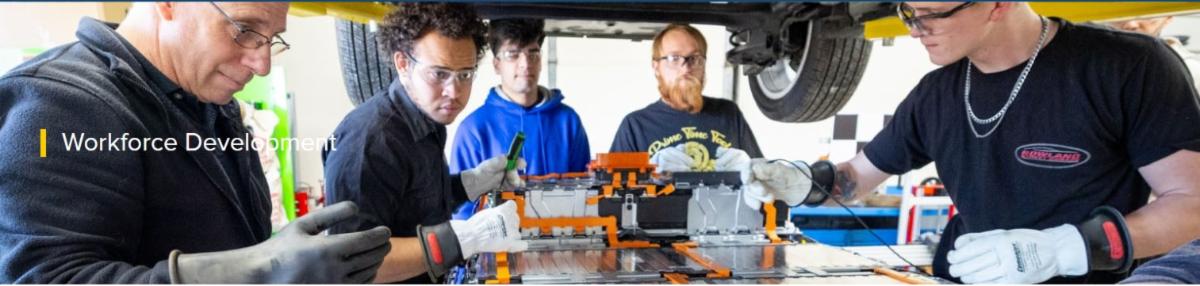
The Long Island Clean Energy Hub can provide access to NYSERDA-funded workforce development programs designed to support local businesses with hiring and training needs. These programs can assist with job placement and, for any new hires, may offer substantially subsidized wages through New York State. Businesses can register for on-the-job training, internship, and apprenticeship funds—making it easier to bring on and train new employees.
Beyond hiring support, the Long Island Clean Energy Hub’s Workforce Manager also maintains a directory of training centers across Long Island and NYC. Whether you need to upskill your team, obtain certifications, or get new hires up to speed, we can recommend training options that fit your needs.
If you have job openings, please share them with us by emailing and sending details to workforce@lismartenergychoices.org. Our Clean Energy Workforce Development Manager, Chad Marvin, will follow up with you.
| | New On-Demand Heat Pump Courses for NYS Building Professionals | | |
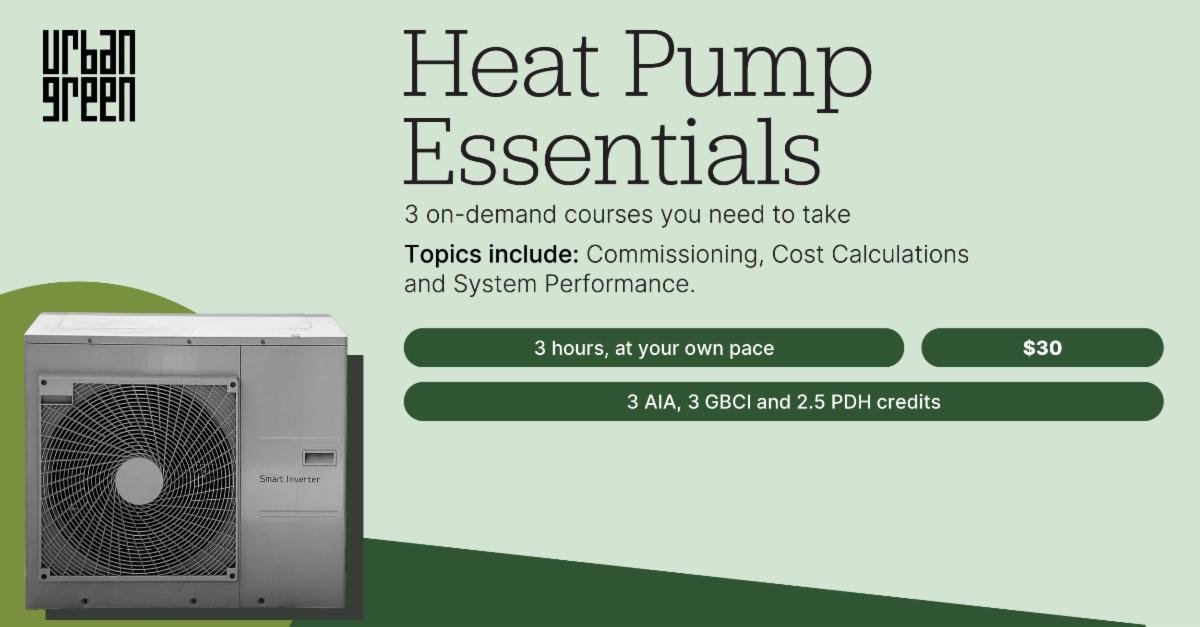
The Urban Green Council has launched three on-demand heat pump courses for New Yorkers on their courses portal! Designed to be quick, interactive, and immediately actionable, these self-paced courses help building professionals gain confidence in heat pump technology with topics that cover commissioning, cost calculations, and system performance.
Their aim is to support the growth of heat pump literacy and expertise across the industry. These courses empower professionals to make smarter, more sustainable decisions.
Course details:
Learn how to gather the right information, run quick calculations, and estimate
the potential energy use and cost of a heat pump system. Along the way, you’ll
gain a better understanding of how heat flows, how fossil fuel and electric
systems compare, and how to avoid common pitfalls in early-stage cost
estimates. 60 minutes at your own pace.
Learn the 3 key temperature readings essential for fast, accurate heat pump
diagnostics. By the end of this course, you will be able to diagnose common
performance issues, take appropriate corrective actions, and track key
maintenance data. 30 minutes at your own pace.
Learn what commissioning is, how it works, and how each team member—from
owners to contractors—can drive project success. Whether you're involved in
design, construction, or operations, this course will give you the tools to support a smooth commissioning process and deliver reliable, efficient results. 90
minutes at your own pace.
Course access:
Thanks to NYSERDA, these courses are free for members of Disadvantaged Communities and Priority Populations (eligibility information here) and only $10 for all other New York residents. If your entity primarily serves these audiences, Urban Green Council will create a free code to share within your network.
Urban Green has a 22-year track record of decarbonizing buildings for healthy and resilient communities. You can email Urban Green’s Education Team with any questions or concerns: education@urbangreencouncil.org.
| |
Empowering
Your Communities
| | Clean Energy Opportunities At Large | | |
Solar+Storage Microgrids for
Community Resilience
| | |
This quick new video introduces the concept of a microgrid and how it can serve a community during power outages! Solar panels paired with energy storage provides a clean and reliable source of backup power in the event of outage emergencies.
Produced by Clean Energy Group, the video outlines the economic, environmental, and resilience benefits of a solar and energy storage-powered microgrid at community facilities, such as health clinics, affordable and senior housing, food banks, and fire stations.
Clean Energy Group’s Technical Assistance Fund offers project development support to community-serving microgrids. Over the last 10 years, Clean Energy Group has provided early-stage technical assistance to over 360 facilities, over 100 of which have installed solar and/or energy storage so far. Learn more at https://www.cleanegroup.org/TAF
| | |
Lawyers For Good Government Launch “Elective Pay Sprint Hub” to Help Communities Navigate Clean Energy Requirements
Lawyers for Good Government (L4GG) announced the launch of its Elective Pay Sprint Hub, a rapid-response initiative designed to help schools, Tribes, nonprofits, faith organizations, and local governments navigate the complex landscape of clean energy tax credits in the wake of the “One Big Beautiful Bill Act” (OBBBA, or H.R. 1).
The Elective Pay Sprint Hub will serve as a concierge service for tax exempt entities to work with L4GG and its partners to design, fund, and implement their clean energy projects in a way that maximizes tax credits, providing:
- Legal and technical support to interpret shifting Treasury and IRS guidance on “placed-in-service” and “beginning-of-construction” requirements.
- Policy expertise to maximize available clean energy tax credits before they phase out.
- Specialized assistance for projects in disadvantaged communities, or those at risk of being stalled or cancelled due to unlawful rescissions.
- Green Financing opportunities connecting L4GG's clients with investors and providing the legal support necessary to build investor confidence in these projects.
L4GG is partnering with an extensive network of partners to carry out this mission, including the Milken Institute and its $1B Capital Mobilization Campaign, World Resources Institute, Urban Sustainability Directors Network, NYU Tax Law Center, Natural Resources Defense Council, the US Climate Alliance, Justice Climate Fund, Community Progressive Caucus Center, S2 Strategies, and the GB 50, among many other partners who are ready to work with L4GG to push clean energy projects forward.
L4GG is inviting nonprofits, Tribes, faith-based groups, schools, and local governments with pending or at-risk projects to complete a simple intake form and join the Sprint Hub. The initiative will connect projects with pro-bono legal support, policy expertise, and technical partners to unlock credits while they remain available.
To sign up for assistance, please fill out the form HERE.
| | |
Climate Resilient Farming Grant Program and
Ecosystem Based Management Program
NYSERDA has announced two grant opportunities totaling $26 million for projects that will help address the impacts of climate change and protect water quality across New York State: $2 million is available to assist New York’s Soil and Water Conservation Districts (SWCDs) protect water quality and the long-term health of New York's waterways through the State’s Ecosystem Based Management Program; $24 million will be available through the Climate Resilient Farming Grant Program to support soil health and on-farm projects that reduce greenhouse gas emissions, and improve water quality.
The State's County SWCDs can also apply for the Ecosystem Based Management - Stream Corridor Management Program. The application and additional information are available on the Department of Agriculture and Market's website. Submit project proposals by 4:00 p.m. on December 8.
The State's County Soil and Water Conservation Districts (SWCDs) can apply now on behalf of farmers for the Climate Resilient Farming Grant Program. The application and additional information are available on the Department of Agriculture and Market's website. Submit project proposals by 5:00 p.m. on November 17.
Local conservation districts can make applications on behalf of eligible projects. Information about the Suffolk County Soil and Water Conservation District, its office and appropriate contact information, can be found here.
| | NYPA Opens Applications for Clean Energy Workforce Training | | |
The New York Power Authority (NYPA) has launched a Request for Applications (RFA) to expand clean energy workforce training in New York State, inviting schools, universities, trade associations, manufacturers, and other providers to deliver technical instruction, hands-on experience, and job placement support. Programs should address skills in areas such as EV charging, renewable energy, energy storage, HVAC, building electrification, and supportive fields like IT, safety, and construction trades.
Applicants must submit a scope of work, budget, and supplier diversity utilization plan, with funding available across three rounds: September 15; November 28; and January 30, 2026. Eligible expenses include staff salaries, training materials, curriculum development, and participant stipends, while all applicants and beneficiaries must be based in New York.
| | NYSERDA Announces Additional $200 Million Funding Now Available for Zero-Emission School Buses – First Come, First Served | | |
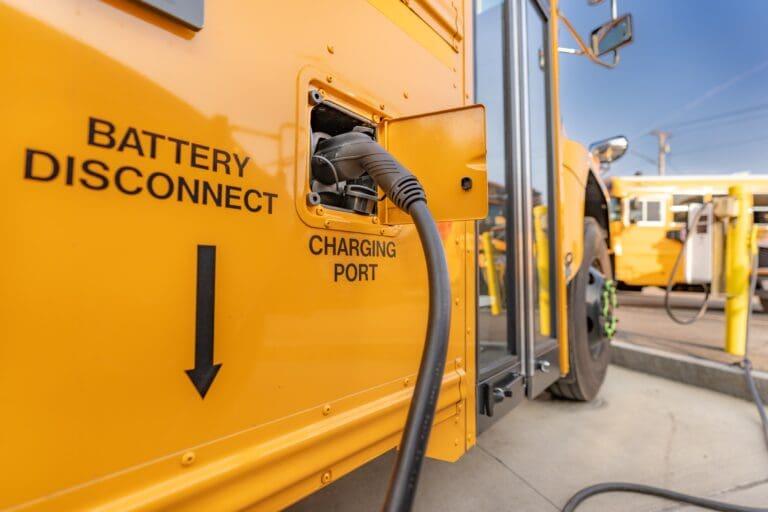
The New York State Energy Research and Development Authority (NYSERDA) has announced that an additional $200 million is now available for zero-emission school buses through the third installment of funding from the $4.2 billion Clean Water, Clean Air, and Green Jobs Environmental Bond Act of 2022. The funding, distributed through the New York School Bus Incentive Program (NYSBIP), supports the purchase of electric buses, charging infrastructure, and fleet electrification planning as public schools transition to zero-emission technologies that improve air quality and reduce pollution in communities.
This investment helps ensure that schoolchildren, drivers, and the communities where they live across New York benefit from clean, quiet, and healthy buses. NYSBIP provides incentives to eligible school bus fleet operators, including school districts and school bus operators, that purchase zero-emission buses. It also offers charging infrastructure vouchers to help support the installation of Level 2 or DC fast chargers and provides funding to develop fleet electrification plans. This support helps ensure safer, more reliable transportation for students while giving schools the tools they need to make smart, cost-effective upgrades.
The funding is available on a first-come, first-served basis with incentive amounts covering up to 100 percent of the incremental cost of a new or repowered electric school bus. This helps offset some or all of the difference in purchase price between zero-emission buses and comparable diesel or gasoline buses. All school bus fleet operators in New York State can also qualify for funding for fleet electrification plans, which provide a customized roadmap for electric bus adoption.
Program eligibility and rules for charging infrastructure funding are available online through the NYSBIP Implementation Manual. School bus fleet operators do not apply directly for school bus funding. Vehicle dealers apply the funding to the price of buses on their behalf after fleet operators have issued purchase orders. Fleet operators apply directly to NYSERDA for charging vouchers, which support adding charging infrastructure to their depots.
Larger funding amounts are available for high-need school districts and school districts with significant portions of their population living in disadvantaged communities, as determined by the New York State Climate Justice Working Group criteria. While these districts are defined as priority districts through this program, all school districts can earn increased incentives by removing a gas or diesel bus from operation, purchasing wheelchair accessible buses, or purchasing buses with vehicle to grid capability! All school districts that complete fleet electrification plans also become eligible for higher funding amounts.
Climate Justice Working Group criteria. While these districts are defined as priority districts through this program, all school districts can earn increased incentives by removing a gas or diesel bus from operation, purchasing wheelchair accessible buses, or purchasing buses with vehicle to grid capability! All school districts that complete fleet electrification plans also become eligible for higher funding amounts.
Since NYSBIP’s launch, 88 school districts have applied for funds to purchase 529 buses, which includes 50 priority school districts accounting for 406 buses, and 400 districts are now working with NYSERDA to create Fleet Electrification Plans.
| Zero-Emission Vehicle and Infrastructure Grants Now Available | |
On October 15, DEC announced that the next round of the Municipal Zero-Emission Vehicle (ZEV) Infrastructure Grant program and the Municipal ZEV Rebate program are now open for applications! The funding advances New York’s climate efforts to reduce emissions through supporting electric vehicle adoption and expansion in municipalities across the State.
- A total of $5 million for municipalities is available on a first-come, first-served basis through the Municipal ZEV Infrastructure Grant program to support the installation of Level 2 and Level 3 electric vehicle chargers, in addition to hydrogen filling station components. DEC is accepting applications through 4 p.m. on February 27, 2026.
- The Municipal ZEV Rebate program provides rebates to municipalities that purchase electric vehicles for fleet use. A total of $585,000 is available this round on a first-come, first-served basis and available to municipalities that purchase – or lease for a minimum of 36 months – an eligible electric vehicle placed into service between September 28, 2024, and February 27, 2026. All-electric, plug-in hybrid and hydrogen fuel cell vehicles are eligible for rebates.
For more information regarding both grant programs and to apply, visit DEC’s website.
| Help NYSERDA Advance the Transition to a Just, Clean Energy Future in New York State! | |
NYSERDA is working to facilitate an affordable and equitable energy transition to help overburdened and underserved communities benefit from the transition to a clean energy economy. We can’t do it without the lived experiences and knowledge of the communities that are most affected.
By working with a network of statewide disadvantaged community (DAC) Consultants that reflect the diversity of New York State communities, NYSERDA can better understand and address the challenges faced by historically marginalized communities and create equitable solutions for an inclusive clean energy economy. We encourage you to review the Request for Qualifications (RFQL 4922), apply and/or share it with other organizations in your network.
Become part of the pool of consultants that provide community input to NYSERDA program and initiative development to help NYSERDA make informed program decisions.
Through RFQL 4922, NYSERDA intends to expand the existing pool of community-based organizations (CBO) and other entities, including Indigenous Nations, that represent and serve New York State’s DACs. The DAC Consultant Pool is a way for entities that represent historically marginalized communities to be compensated for their time and experience when engaging with NYSERDA around energy issues that matter to frontline communities.
DAC Consultants accepted into this pool may be invited to advise NYSERDA staff across multiple programmatic areas. Depending on program needs, they may have the opportunity to:
- serve on advisory groups;
- provide input on topics such as identifying barriers to clean energy program participation, energy plans, data tools, collaborative design of new programs;
- provide facilitation and translation services, and more.
Applications will be accepted on an ongoing basis until December 31, 2030 and reviewed on a quarterly basis.
| | |
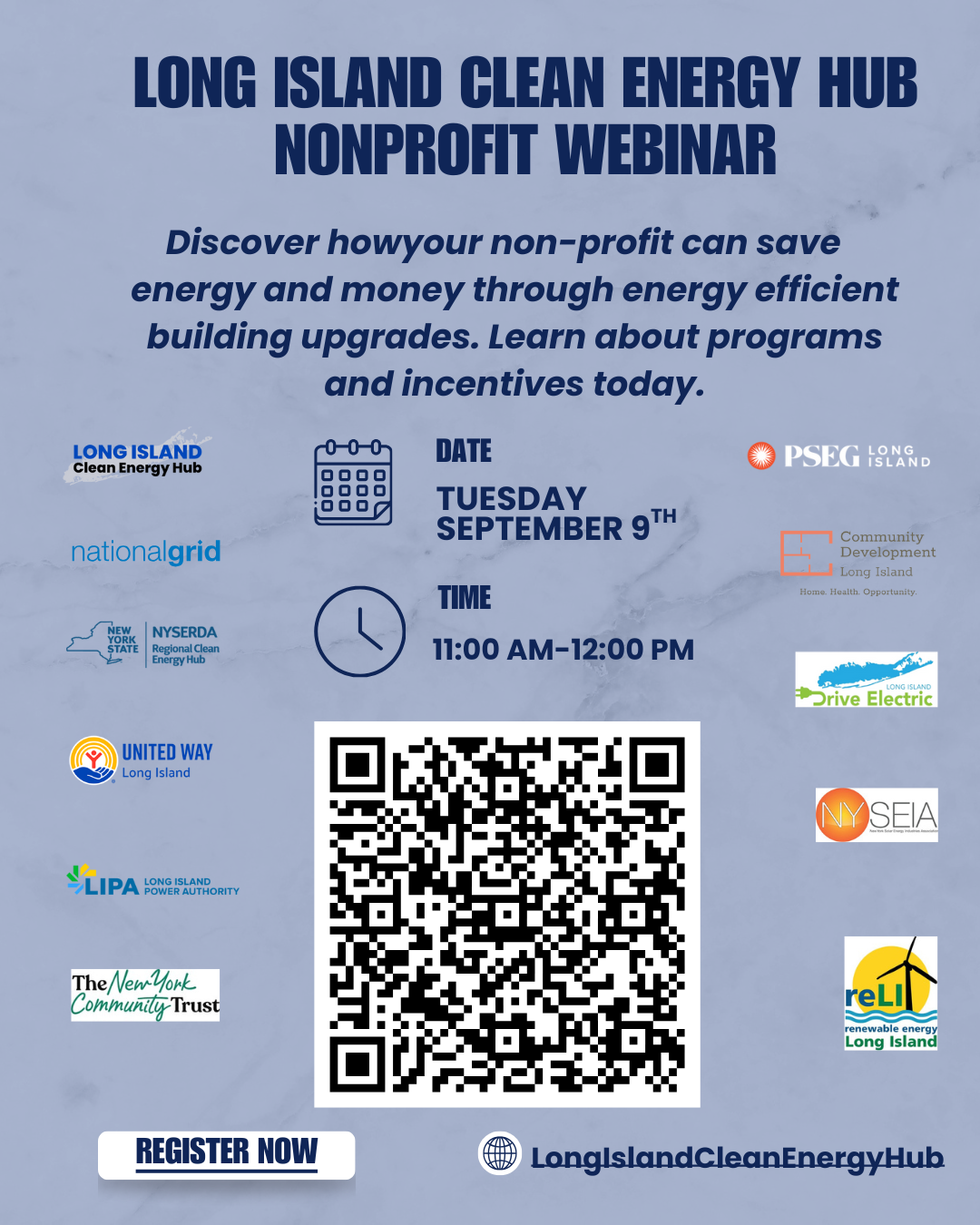
During the second week of September, the Long Island Clean Energy Hub's Energy Advisor August Ruckdeschel hosted an educational webinar for Long Island-based nonprofits. The session brought together local community members and leaders to learn about federal, state, and local utility incentives, rebates, and resources available to help nonprofits invest in cost-saving energy efficiency and renewable energy infrastructure.
Topics included solar energy, electric vehicle rebates, building weatherization, and heating and cooling electrification. These clean energy solutions can help nonprofit organizations and institutions save money while supporting a cleaner, more sustainable future.
This webinar was a wonderful opportunity for the community to engage, share knowledge, and explore ways to transition to a cleaner and renewable Long Island. If you missed the webinar, you can view a recording here! If your not-for-profit has any specific questions about energy saving and renewable energy opportunities, please contact August directly at ar2464@cornell.edu.
| | |
Clean Energy at CCE Suffolk
Suffolk County is leading New York State’s clean energy transformation—ranked #1 in clean energy jobs statewide. Guided by New York’s ambitious climate goals for 70% renewable energy by 2030 and carbon neutrality by mid-century, Cornell Cooperative Extension of Suffolk County (CCE Suffolk) supports residents, businesses, and organizations in this transition.
Our Clean Energy team connects the community to workforce training, career opportunities, and programs that reduce energy costs and emissions. Together, we’re building a cleaner, more sustainable, and equitable future for all Long Islanders.
| | Follow us on our social media platforms: | | | | |