Proposed Mid-Year Change
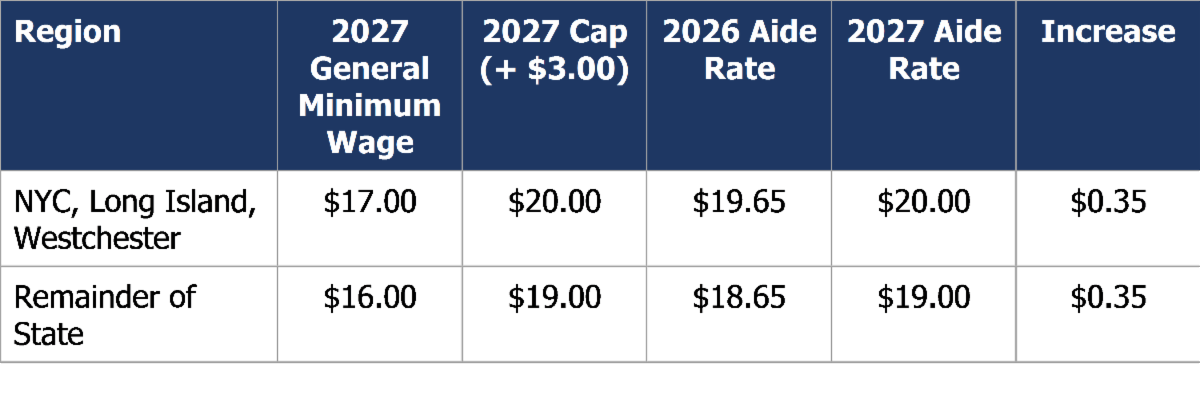
The Governor has also proposed legislation that would raise the general minimum wage on March 1, 2027, to $17.60 downstate and $16.55 upstate, to rise with inflation. If enacted, the §3614-f cap could rise to $20.60 and $19.55. However, unless the legislation provides otherwise, aide wages would not raise mid-year, because §3614-f adjusts the home care aide minimum wage on January 1st of each year.
What Agencies Should Do by January 1, 2027
- Update payroll. Apply the rate for the region where the work is performed and recalculate overtime and live-in or 24-hour shift pay at the new rate.
- Issue LS-62 pay rate notices. Provide employees written notice of the rate change as required by Labor Law §195, and update Wage Parity supplemental benefit notices.
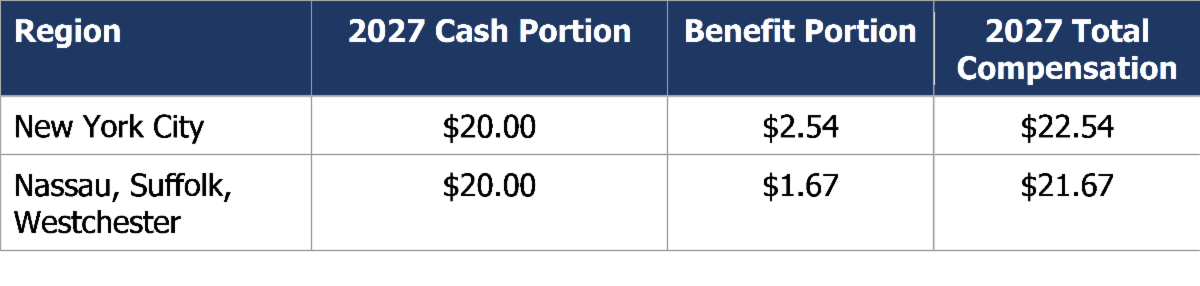
- Confirm Wage Parity compliance. For Medicaid cases, confirm that total compensation meets the 2027 minimums of $22.54 in New York City and $21.67 in Nassau, Suffolk, and Westchester.
Contact us for questions regarding minimum wage and wage parity obligations.
New York Employers Face New Personnel Record Obligations
Beginning November 8, 2026, pursuant to the newly enacted Section 210-b of the New York Labor Law, New York employers must provide current and former employees with copies of their personnel records within five (5) business days of a written request, at no cost to the employees.
“Personnel record” is broadly defined in the statute to include records used or potentially used to affect an employee’s qualifications for employment, promotion, transfer, additional compensation, or discipline. This includes records maintained by a third-party vendor, such as an outside payroll or human resource provider, under contract with the employer. Examples include without limitation: the employee’s name, address, date of birth, job applications, resumes, job descriptions, compensation information, performance evaluations, disciplinary records, and termination notices. The definition excludes personal information about individuals other than the employee, but only to the extent disclosure would be a clearly unwarranted invasion of that person’s privacy. For example, a coworker’s statement in an investigation file would not automatically be excluded. Employers need not permit review of a personnel record more than twice per calendar year, except that a review prompted by a negative-information notice does not count toward that limit.
The law also requires employers to notify employees within ten (10) calendar days after adding negative information to their personnel records. Although the statute does not formally define “negative information,” it indicates that it includes “any information to the extent that the information is, has been used or may be used, to negatively affect the employee's qualification for employment, promotion, transfer, additional compensation or the possibility that the employee will be subject to disciplinary action.”
Employees who disagree with the negative information in their personnel records may seek to have it corrected or removed upon mutual agreement with the employer. If the parties cannot agree, the employee may submit a written statement explaining the employee’s position, which must be included in the personnel record. That statement must accompany the disputed information whenever it is shared with a third party. Separately, if the employer knew or should have known that the negative information was false, the employee may pursue expungement through a collective bargaining agreement, the employer’s personnel procedures, or a court proceeding.
Employers must also retain each employee’s complete personnel record from the date of hire through three (3) years following separation, including records subject to correction and expungement procedures.
Violations of this statute may result in civil penalties of $500 to $2,500 and will be enforced by the attorney general. Employers also may not discriminate or retaliate against employees for exercising their rights under the law, including by threatening to report or reporting an employee’s immigration status or that of a family member or household member.
When signing this bill into law, Governor Hochul had also issued an approval memorandum identifying ambiguities in the statutory language that will be addressed in a future legislative session after the new year. Therefore, the statute is expected to be amended to narrow the definition of “personnel record” and clarify that employers are not required to create or compile records they do not maintain in the ordinary course of business. Nevertheless, the statute, as currently written, will take effect on November 8, 2026.
Employers should begin preparing by designating a process and responsible person for responding to personnel requests within five business days and train supervisors and staff on the requirements.
Key Administrative Law Judge (ALJ) Decisions
Highlight the Cost of Incomplete Records
With OMIG audit activity continuing across homecare, two recent ALJ decisions bring into focus the level of scrutiny now applied to the New York State Health Care and Mental Hygiene Worker Bonus Program (HBW) program claims and assisted living program documentation. Both cases below underscore the same important lesson for providers: understanding and following regulatory requirements, as well as keeping thorough and complete records can make the difference between facing and avoiding potentially crippling penalties.
In the Matter of Garden of Eden Home ALP, LLC (February 4, 2026) OMIG audited a Brooklyn adult care facility’s claims under the HWB and identified errors in all 46 claims reviewed, resulting in overpayments of $55,439.75. The errors involved (1) bonuses paid to ineligible employees; (2) incorrect bonus amounts paid to employees; and (3) failure to complete required medical assessments. The facility appealed the findings, arguing that home health aides should qualify for bonuses and disputing the amounts paid to certain employees, but failed to provide sufficient evidence to substantiate its claims. Administrative Law Judge Natalie J. Bordeaux agreed with OMIG concluding that home health aides are ineligible for HWB because their title was not among those codified as eligible under the statute. The ALJ further concluded that the facility did not meet its burden of proving the accuracy of the bonus payments and affirmed OMIG’s determination to recover the full $55,439.75.
In the Matter of Bronxwood Home for the Aged, Inc. (January 27, 2026), OMIG audited a Bronx adult care facility approved to operate an assisted living program. OMIG’s final audit report sought approximately $3.84 million in restitution, alleging missing or invalid physician signatures on medical evaluations and interim assessments, which were prepared by an outside medical practice. ALJ John Harris Terepka found that OMIG failed to establish that the provider knew of, participated in, or should have known about the alleged signature irregularities, and reversed those disallowances. However, the ALJ upheld certain other disallowances involving missing plans of care, incomplete medical evaluations, insufficient service documentation, services not rendered, and invalid or false records. The ALJ also rejected OMIG’s statistical extrapolation because OMIG failed to adequately explain its sampling and stratification methodology, finding that the provider had overcome the presumption that the extrapolated results were accurate. Ultimately, the ALJ limited restitution to $1,650.89 for 19 substantiated sample disallowances, substantially reducing the provider’s repayment obligation and affirming OMIG’s determination only to that limited extent.
U.S. Department of Labor Issues Opinion Letter
Clarifying Compensability of Meal Breaks
Involving Employer Mandated Travel Time
On September 7, 2026, the Wage and Hour Division of the U.S. Department of Labor (DOL) issued Opinion Letter FLSA2026-11 (the “Opinion Letter”), addressing whether employer-mandated travel to and from a break area during an unpaid meal or rest break, affects whether employees receive a bona fide, unpaid meal period under the Fair Labor Standards Act (FLSA).
The request arose from a security therapy aide at a detention center who, under a collective bargaining agreement, received an unpaid 60-minute meal period, was barred from eating in the work area and had to walk approximately three to seven minutes each way to the designated break area. While the opinion addresses a specific workforce, its reasoning offers guidance for a broader application.
Under the FLSA, a bona-fide meal period is non-compensable only if the employee is relieved of duty for the purpose of eating. If an employee is not relieved of duty, the period is compensable working time. Most courts, however, do not interpret this to mean that there must be absolute freedom from every job-related condition; instead they apply a “predominant benefit” test asking whether the break predominately benefits the employer or employee. Courts do tend to analyze this on a case-by-case basis, and have held that incidental work activities, such as securing a work site while eating a meal, is still considered a relief from duties and thus not compensable.
The Opinion Letter treats required travel time to and from a break area as one factor in the analysis that could trigger compensability but certainly not the only consideration. The dispositive question is whether the employee retains enough time to eat a regular meal after accounting for travel time. While fact specific, it is generally accepted that a thirty minute or more of a break generally survives the scrutiny where travel time still leaves ample time to eat.
The same analysis applies to licensed home care agencies. When an aide cannot take a meal break because they must continue to respond to patient care needs, safety concerns or similar interruptions during the scheduled break, the aide has not been relieved of duty, and the time should be treated as compensable working time rather than an unpaid meal period. Your Agency should have a clear policy and procedure through which an aide can report any instance in which they have not been afforded a proper, uninterrupted meal break.
Electronic Plans of Correction System Will End November 9, 2026
The New York State Department of Health (DOH) announced that vendor support for the Licensed Home Care Services Agency (LHCSA) electronic Plan of Correction system will end after November 9, 2026, which will potentially limit access to previously submitted Plans of Correction.
DOH is exploring options to preserve historical records and enable electronic submissions, with secure file transfer. The Department is still evaluating the option for submission through the Health Commerce System. Further guidance will be provided through a Dear Administrator Letter (DAL) and FAQs. In the meantime, providers should access the current system before November 9, 2026, to download and print all surveys and previously submitted Plans of Correction to ensure continued access to these records.
|