- Four Years of Bull
- Digital Estate Planning
- College FAFSA Prep List
- Medicare Open Enrollment
- What to Make of a Life
| | |
Financial Markets Update: Four Years of Bull
The current bull market in stocks will turn four years old in mid-October.
But the most recent stretch turned from a bull charge in the second quarter of 2026 to a trot in Q3. And September was a plod.
Bull Market Roundup
- Stock market returns (as measured by the S&P 500 Index of large company U.S. stocks) in the three years following the 2022 bear market were extraordinary: 2023: 26%, 2024: 25%, and 2025: 18%
- Each of these years was well above the long run annual average return for U.S. stocks of 10%
- After a pause during the first quarter of 2026, the bull continued to run: the S&P 500 charged ahead by nearly 15% in the April – June period
- The pace of U.S. large cap stock returns slowed to a modest 2% gain in Q3
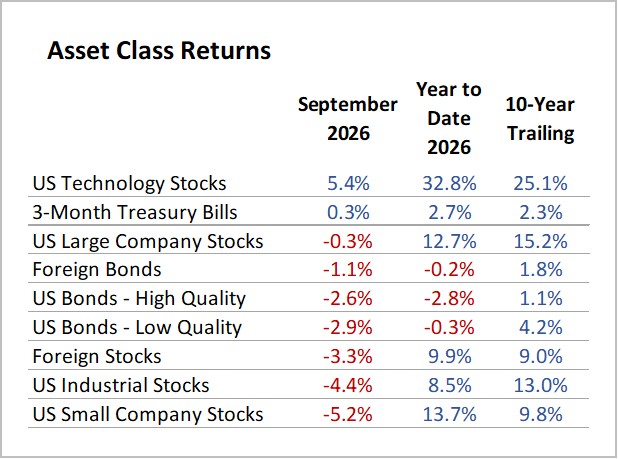
- In September, positive momentum stalled: while tech stocks pushed higher by 5.4%, most other areas of the market declined - see the details in the chart below
Here are results for September and 2026 Year-to-Date, compared to longer-term annualized returns (10-Year Trailing):
| | |
A few of the bigger questions on investors’ minds as we enter the final quarter of 2026 seem to be: What’s worrying the bull? Can the bull keep running in Q4 and beyond? What should investors do now?
The Bull’s Worries
Three issues worrying the bull and raising concerns for investors are:
-
Oil Prices & Interest Rates: While these are separate items, they are linked. Oil prices have climbed about 50% since the start of the Iran war. Higher oil prices translated directly and immediately to higher prices at the pump for consumers. And when oil stays elevated, the inflation effect broadens out. For example, think about the inflationary impact that higher fertilizer costs have on producing food; or that higher transportation costs (due to elevated diesel prices) have on getting goods to market. Elevated prices triggered the Federal Reserve to act in mid-September. The Fed raised short-term interest rates, and long-term interest rates climbed, too. Higher interest rates mean an increased cost of financing, putting pressure on businesses and consumers alike. Lower profit margins are a headwind for stock prices, and household budget pressures mean potentially less is available for retirement savings and investment. Reduced tension in the Middle East likely would begin to reverse the negative dynamic of elevated energy prices and higher interest rates. Absent progress toward peace, pressure on stocks can persist.
-
Midterm Elections: In just under a month, the U.S. will hold midterm elections. The midterm year is usually the weakest for the stock market of the four-year presidential cycle. And the stock market swings are typically bigger in midterm years. On average, stocks sink 19% from peak to trough during a midterm year, compared to about 15% on average in non-midterm years. Interestingly, October and November of midterm years have averaged gains of about 3% and 2.7% since 1950. A plausible explanation is that uncertainty drops once the results are known.
-
Bad Market Breadth: September’s stock price moves show that market returns have narrowed to a relatively small subset of stocks. Last month, almost 80% of stocks in the S&P 500 were down; the average stock was off 5%; and only 2 out of 11 sectors were up, led by technology. Some market commentators call this narrowing of market performance “bad breadth”. Technical analysis Jonathan Krinsky of BTIG, a brokerage firm, was quoted in a recent MarketWatch article, and pointed to bad breadth to support his claim that “the clock is ticking, and we see a sell-off coming sooner than later.”
These issues highlighted above can, and often do, act as a drag on stock prices in the near-term.
But investors should keep these negative influences in perspective.
The direction and rate of change of the U.S. economy tends to have a greater impact on financial markets over the longer term.
The Bull’s Legs
Whether you love it, hate it, or fall somewhere in between, Artificial Intelligence (AI) is giving the stock bull market its legs.
Many of today’s stock market stars are AI-focused companies, because AI usage is increasing rapidly and investors are quite enthusiastic about their future prospects.
But the build-out of AI infrastructure is boosting demand for products and services of all sorts of companies – such as construction firms, industrial manufacturers, power producers, and electric utilities – and is therefore having a much broader impact on the corporate sector and the U.S. economy.
In a recent research note, Capital Group, a California-based fund manager, points out that “the sheer scale of AI-related spending is nothing like we’ve seen before.”
Much of the capital expenditures – an estimated $800 billion in 2026 – are going toward the construction of massive AI data centers and related projects across the U.S. And the spending is expected to accelerate in 2027.
The companies leading the spending charge are well-known technology firms often referred to as “Hyperscalers”: Alphabet, Amazon, Meta Platforms, Microsoft, and Oracle.
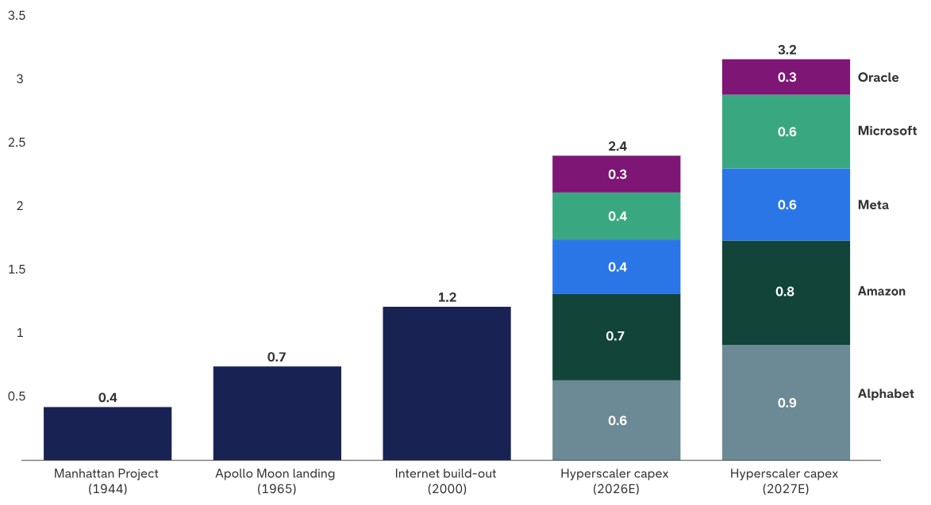
The chart below, courtesy of Capital Group, indicates that AI capital expenditure in 2026 will equal 2.4% of U.S. Gross Domestic Product (GDP) in 2026, and rise to 3.2% in 2027.
| | |
This type of spending dwarfs other large, concentrated capital expenditure episodes in history, such as the build out of the internet in 2000 (1.2% of GDP); the Apollo Moon landing in 1965 (0.7% of GDP); and the Manhattan Project in 1944 (0.4% of GDP).
While beyond the scope of this chart, capital expenditure during the railroad buildout in the 1800s was of a similar magnitude as today’s AI activity.
AI spending feeds directly into economic growth. Real U.S. economy is expected to expand by 2.5. – 3.0% (after inflation is considered) in both 2026 and 2027.
Mark Zandi, the chief economist at Moody’s Analytics, estimates that about 30% of the economy’s inflation-adjusted growth this year will come from the AI boom, directly or indirectly (cited in a recent New York Times article).
While stock market selloffs can happen at any time, it would be highly unusual to see an extended stock market downturn or bear market during a time of such strong economic growth.
No Bull: What Investors Should Do
Risk, volatility, and uncertainty often create unease. Discomfort is the price we pay as investors to earn returns that support our financial plans.
The psychological tendency that drives us to do something – even when avoiding action is likely to result in a better outcome – is known as action bias.
Typically, the best course of action is to stay the course, even when the bull market takes a break.
Continuing to make regular contributions to savings and retirement accounts (especially when markets decline), and rebalancing when portfolios get out of line with long-term asset allocation targets, are two of the best moves investors can make.
Beyond this, it can be helpful to meditate on the behavioral mantra that Jack Bogle, the founder of Vanguard, used to implore, especially when investors feel a strong urge to take action in a portfolio because of a perceived negative development (such as, when stocks sell off): “Don’t just do something, sit there!”
| | |
Digital Estate Planning: The Gap in an Otherwise Excellent Plan
Founder Susan Moore explains why Digital Estate Planning is a good idea, and provides pointers on how to put a plan for digital assets in place.
Most of the estate plans we review are in good shape. The will is current, the trust is funded, the beneficiary designations match the documents, the health care proxy names someone who will actually answer the phone.
Then we ask a simple question — if something happened to you tomorrow, could the person you named get into your email? — and the room goes quiet.
That silence is what digital estate planning is about. It is the least glamorous part of your plan and, increasingly, the part most likely to cause your family real trouble.
What We Mean By “Digital Assets”
The term is broad enough to be unhelpful, so it's worth breaking into four categories that behave very differently.
Assets with independent monetary value. Cryptocurrency and self-custodied digital holdings, domain names, monetized channels or online storefronts, gaming accounts with resale value, and intellectual property in digital form — manuscripts, photograph libraries, software. All of these have independent monetary value.
Assets with sentimental value only. Twenty years of photographs in iCloud or Google Photos. Text message threads with a parent who has died. Video. Recorded voicemails. These have no dollar value and are frequently the thing families grieve losing most.
Accounts that are keys to everything else. Your primary email address is the single most important digital asset you own, because it is the password-reset destination for your bank, your custodian, your insurer, and your tax preparer. Your password manager and your phone number sit in the same category. None of these have value in themselves; all of them can be used to access valuable assets.
Obligations, not assets. Auto-renewing subscriptions. A business domain that lapses. Cloud storage that stops being paid for and gets purged. Two-factor authentication tied to a phone line a family member “helpfully” cancels three days after the funeral. These are obligations that in many cases should be serviced for a period after a loved one passes.
Digital estate planning means deciding, in advance and in writing, who gets access to each of these, how they will get in, and what you want done with them.
Why This Is Genuinely Hard
It would be reasonable to assume that if your executor has a death certificate and letters of appointment, the rest is paperwork. It isn't, for three independent reasons.
Federal privacy law was written to keep people out. The Stored Communications Act prohibits providers from disclosing the contents of electronic communications to third parties. It was drafted in 1986 to protect users from snooping, and it makes no exception for a grieving spouse. Separately, the Computer Fraud and Abuse Act makes unauthorized access to a computer system a federal offense. This is why "my wife knows my passwords" is not a plan — it is, at best, an arrangement that works only as long as nobody scrutinizes it.
Terms of service usually say the account is not transferable. You do not own your Apple ID or your Gmail account in the way you own your car. You hold a license, personal to you, that a company's contract terms may say terminates at death. Custodians have historically leaned on those terms to refuse access even when the estate's authority was clear.
Most states have the statute that solves this. The Revised Uniform Fiduciary Access to Digital Assets Act (RUFADAA) — a model law giving executors, trustees, conservators, and agents under a power of attorney a defined legal path to digital assets — has been adopted by forty-eight states and the District of Columbia. Massachusetts and Louisiana have not adopted this statute.
The practical consequence is important, so I want to state it plainly: in these states, the authorization language in your own documents is doing more work than it would in almost any other state. Elsewhere, a statute supplies a default when the documents are silent. Here, silence is closer to a dead end.
It's also worth understanding the hierarchy RUFADAA establishes, because the platforms follow it regardless of what your state has enacted:
- The first priority goes to an online tool — a legacy contact setting inside the platform itself.
- The second priority goes to your will, trust, or power of attorney. Only if both are silent do the company's terms of service control.
- That ordering surprises people: a legacy contact you designated on your phone in 2023 outranks the will you signed in 2024.
- Consistency between the two matters.
Four Ways This Goes Wrong
-
Eleven years of litigation over one email account. John Ajemian, a Massachusetts man, died in a bicycle accident in August 2006 at age 43 without a will. His siblings who were appointed personal representatives of his estate, asked Yahoo for access to the email account he had used as his primary address. Yahoo refused without a court order. The dispute went to the Massachusetts Supreme Judicial Court, which held in October 2017 that the Stored Communications Act does not bar a provider from disclosing contents to personal representatives, who can give lawful consent on the decedent's behalf. That ruling was a meaningful win — but it did not hand the family the account. Yahoo's separate argument that its terms of service permitted refusal went back down for further proceedings. Eleven years, an SJC opinion, and the underlying question of can the family read their brother's email was still not cleanly resolved.
-
Ninety-seven percent of an estate behind a password nobody had. Matthew Mellon, a banking heir, died suddenly in April 2018 at 54. Roughly $193 million of his estate — about 97% of it — was held in the cryptocurrency XRP. Mellon had been deliberately careful about security: he split holdings across multiple cold wallets, stored credentials in different physical locations, and held some accounts under other people's names. He had never shared the map with anyone, and his will did not mention digital assets at all. His estate spent years unable to reach the asset that was supposed to pay its taxes and creditors. The security architecture that protected him from hackers protected the assets from his own children.
-
A court order for a card game. In August 2015, David Bush died of lung cancer in British Columbia. His widow Peggy, then 72, had the passcode to their shared iPad but not his Apple ID password. When she tried to reinstall a card game, she couldn't. Over two months, her daughter supplied Apple with the device serial numbers, a copy of the will leaving everything to Peggy, and a notarized death certificate — the same documents that had already been sufficient to transfer the house and the car. Apple's answer was that recovering the password would require a court order. The family only got a different answer after a CBC consumer-affairs program intervened. Note the scale here: this was not a fortune. It was a game on a tablet, and it still required a news organization to resolve.
-
The ordinary version, which we see most often. A client is hospitalized. The agent under her durable power of attorney has full legal authority over her finances and no ability to use it, because every login attempt triggers a verification code sent to a phone that is in a drawer at the hospital, locked, with a passcode nobody knows. Nothing here involves crypto or litigation. It is just a competent fiduciary, an unambiguous document, and a six-digit code — and the code wins.
Steps You Can Take Now
None of this requires a lawyer, and most of it can be done in a single afternoon.
Build an inventory. List your accounts by category: email, financial, cloud storage, social, subscriptions, business, and anything holding cryptocurrency. You want the account name, the provider, the login identity, and a note on what you want done with it — preserve, transfer, or close. You do not need to write down passwords, and mostly you shouldn't.
Use a password manager and turn on its emergency access feature. This is the single highest-value step on this list. A reputable password manager becomes one door instead of two hundred, and most offer an emergency or legacy access function that grants a person you designate entry after a waiting period you set. One master credential, stored securely, replaces the inventory of passwords you were about to write on paper.
Solve the two-factor problem explicitly. This is the failure point people miss. Make sure your inventory records where second factors live — which phone number, which authenticator app, where the printed backup codes are. Tell your family, in writing, not to cancel your phone line until your fiduciary says so.
Set your platform legacy tools. These take minutes and, according to the hierarchy above, they carry first priority.
-
Apple: Settings → your name → Sign-In & Security → Legacy Contact. Apple generates an access key; give a copy to your contact and store one with your estate documents. Your contact will also need a death certificate. Note the limits — legacy access is read-only, excludes purchases and stored passwords, and expires roughly three years after Apple approves the request.
-
Google: Inactive Account Manager, at myaccount.google.com/inactive. Choose an inactivity window of 3, 6, 12, or 18 months, name up to ten people, and select exactly which data each receives. It is not available on Google Workspace accounts, so use your personal account.
-
Facebook and Instagram: Settings → Memorialization Settings. Name a legacy contact, or elect deletion. Understand that a legacy contact manages a memorialized profile — they never receive your login or your private messages.
Write a letter of instruction. Separate from your legal documents, unsigned and informal, this is where you say what you want: which photographs matter, whether the Facebook account should be memorialized or deleted, who should be told, what should simply be closed. It carries no legal force, and it is often the most useful page in the file.
Do not put passwords in your will. A will admitted to probate becomes a public record. Credentials belong in a password manager or a sealed document your fiduciary can find — and your will should point to their location, not contain them.
What To Ask Your Estate Planning Attorney to Do
When you next meet with counsel, these are the specific requests worth making. Attorneys who do this work regularly will have language ready; those who don't will appreciate a client who knows to ask.
Add express digital asset authority to every document, not just the will. Incapacity is the more common scenario, so your durable power of attorney needs this authority as much as your will does. Ask that your will, revocable trust, and durable power of attorney each grant your fiduciary explicit authority to access, control, manage, distribute, copy, and dispose of your digital assets.
Include specific consent to disclosure of electronic communications content. This is the clause that matters most, and it is separate from general digital asset authority. Ask for language expressly consenting, for purposes of the Stored Communications Act, to disclose the content of your electronic communications to your fiduciary. Without it, a provider's most reliable objection stays intact.
Ask whether a named digital fiduciary makes sense. The person best suited to administer a trust is not always the person you'd want reading twenty years of your email or handling a hardware wallet. Some plans benefit from naming a separate digital executor, or from granting narrower digital authority to a co-fiduciary.
Have the plan drafted to work without RUFADAA — and to keep working if it passes. If you are in Massachusetts or Louisiana, ask counsel to draft on the assumption that no statute will supply the defaults, while tracking RUFADAA's structure closely enough that the documents fit cleanly if your state adopts it.
Reconcile your documents with your online tool designations. Ask your attorney to note in the file who you have named as legacy contact at Apple, Google, and Meta, and to confirm those designations don't contradict the documents. Remember that the platform designation wins.
Address business digital assets separately. If you own a business, domain registration, payment processor, hosting, social accounts, and administrative logins are business continuity items, not personal estate items. They belong in the succession plan and in your operating agreement, not only in your will.
Next Steps
The reason to do this is not that your digital life is your most valuable asset. It's that a plan can be beautifully drafted, fully funded, and perfectly current, and still fail at the moment someone needs to log in. That's a fixable problem, and it's much easier to fix now than later.
| |
Your College FAFSA Prep List: What to Have Ready Now That It's Open
Financial Planning lead and College Planner Donna Cournoyer provides an update on the FAFSA, and gives valuable tips on how to complete it accurately and efficiently
If you've been waiting for the FAFSA to open, stop waiting — it's live. This year the form actually opened about a week early, ahead of the October 1 deadline set by the FAFSA Deadline Act. For families who've been burned by a rocky FAFSA season in years past, that's genuinely good news: an earlier, smoother launch means more time before the priority deadlines that matter most on state and school financial aid pages.
What’s Actually Better This Year
A few changes are worth knowing about before you start, because they'll save you time and, in some cases, worry:
-
Pre-populated fields for returning filers. If you filed last year, a good chunk of your information carries forward, which cuts the time the form takes substantially.
-
Reusable parent information. If you have more than one child applying to college this year or next, a parent's financial information can now be reused across multiple students' applications instead of re-entered from scratch each time.
-
Plainer language throughout. The Department of Education stripped out a lot of the financial-aid jargon that used to make certain questions genuinely confusing to answer correctly.
-
Small family businesses and farms are excluded from asset calculations. If your household owns a family business with fewer than 100 employees, a family farm, or a commercial fishing operation, that value is no longer counted against you in the need calculation.
One more detail worth knowing: this cycle's FAFSA runs on 2025 tax data under the “prior-prior year” rule, so you're not scrambling to finish this year's return before you can file.
Before You Sit Down: The Prep List
Saying the FAFSA “is open” and “we're ready to sit down and file it” are two different things. Think about this: the families who get through the FAFSA in one sitting aren't the ones who are especially tech-savvy — they're the ones who gather everything first. Here's what I want every family on my list to have in hand before they open that first screen.
Set aside twenty minutes before you ever open the form itself and gather these. It's the single biggest thing you can do to keep the process from dragging into three separate sessions.
-
A StudentAid.gov account for the student — and for each parent who'll be a contributor. Every contributor needs their own FSA ID, and verification can take a day or two, so this is the very first thing to do, not an afterthought.
-
Social Security numbers for the student and for any parent who has one (there's a path for parents without an SSN, so that alone shouldn't hold a family back from filing). A common mistake is transposing one digit or using the wrong child’s number. Be careful!
-
Consent to the IRS data transfer. Every contributor must consent to having federal tax information pulled directly from the IRS — without it, the form can't be processed, no matter how accurately the rest is filled in.
-
Current account balances, not estimates — cash, checking, savings, and investment account statements, valued as of the day you actually sign the form.
-
Records of child support received in the prior calendar year, if that applies to your household.
-
Your school list. You can list up to twenty schools on the FAFSA, and you need at least one to submit — so have the full list ready, not just the favorite.
Don’t Stop at the FAFSA: The CSS Profile Is a Different Animal
If any school on your list is a private college, there's a good chance the FAFSA isn't the whole assignment. About 200 mostly private colleges also require the CSS Profile, a separate form run by the College Board that determines eligibility for the school's own institutional aid — not federal aid. Confuse the two, or assume filing one covers the other, and a family can miss out on exactly the kind of grant money a private school's price tag depends on.
A few things make it genuinely different, not just a second copy of the same homework:
-
It costs money. $25 for the first school, $16 for each additional one — though it's free for U.S. undergrads with family adjusted gross income up to $100,000, anyone who already qualified for an SAT fee waiver, or a student who is an orphan or ward of the court under 24.
-
It digs deeper into assets. Home equity, small business and family farm value, and even a non-custodial parent's finances after divorce can all come into play — details the FAFSA either doesn't ask about or, this year, specifically excludes.
-
It opens on the same date, but each school sets its own deadline. The 2027-28 CSS Profile opened October 1, 2026, same as the FAFSA — but don't assume the filing windows line up after that; check every school's own priority date.
The practical takeaway: pull the list of schools first, check each one's financial aid page for “CSS Profile required,” and budget both the time and the (sometimes waivable) fee before assuming the FAFSA alone tells the story.
A Common Mistake: Waiting
Families wait. They wait for a final decision on where their child is applying, they wait for a “better time,” they wait until a deadline is staring them down. Don't.
Filing the FAFSA has nothing to do with being accepted anywhere — it's simply how a family becomes eligible to be considered for aid at all the schools on that list. The earlier it's in, the earlier your family shows up in line for aid that, at many schools, is awarded on a rolling or limited basis.
And if something on the form turns out to be wrong after you've submitted it? It can be corrected. That's not a reason to rush through it carelessly, but it is a reason not to let a single unanswered question hold up the whole submission for weeks.
The Bottom Line
The FAFSA being open earlier and running smoother this year is a real gift of time — don't spend it waiting. Get every contributor's account set up this week, gather your actual account balances, and get the form filed well before any priority deadlines start appearing on your target schools' financial aid pages.
If you want my best advice on filling out these forms; be honest, don’t overestimate, don’t overshare.
Good luck!
| | |
Medicare Open Enrollment 2026: What to Review for 2027
Medicare's annual Open Enrollment Period runs from October 15 through December 7, 2026, and any changes you make take effect January 1, 2027. It is the one time each year when most people on Medicare can freely change how they receive their coverage.
We've written about Open Enrollment each fall, and the core advice hasn't changed: plans change their costs, networks, and drug lists every year, so last year's good choice may not be this year's.
What is different for 2027 is the size of the changes. Drug plan costs are shifting, many Medicare Advantage plans are being cut or reshaped, and a federal subsidy that held down drug plan premiums is ending. That makes this a good year to take a careful look, even if you've been happy with your coverage.
What You Can Change During Open Enrollment
Between October 15 and December 7, you can:
- Switch Part D drug plans or join one if you don't have drug coverage.
- Move from Original Medicare to a Medicare Advantage plan (Part C).
- Switch from one Medicare Advantage plan to another, with or without drug coverage.
- Return from Medicare Advantage to Original Medicare and add a stand-alone Part D plan.
If you're in a Medicare Advantage plan, you get a second chance from January 1 through March 31, 2027 to switch to a different Advantage plan or return to Original Medicare.
A note for Massachusetts residents: Medicare Supplement (Medigap) rules here are more flexible than in most states. You can generally change Medigap plans at any time of year without medical underwriting, so you aren't locked into the October–December window for that decision.
Clients living in other states should check with us first, because a Medigap application outside a protected window can be denied based on health.
What's New for 2027
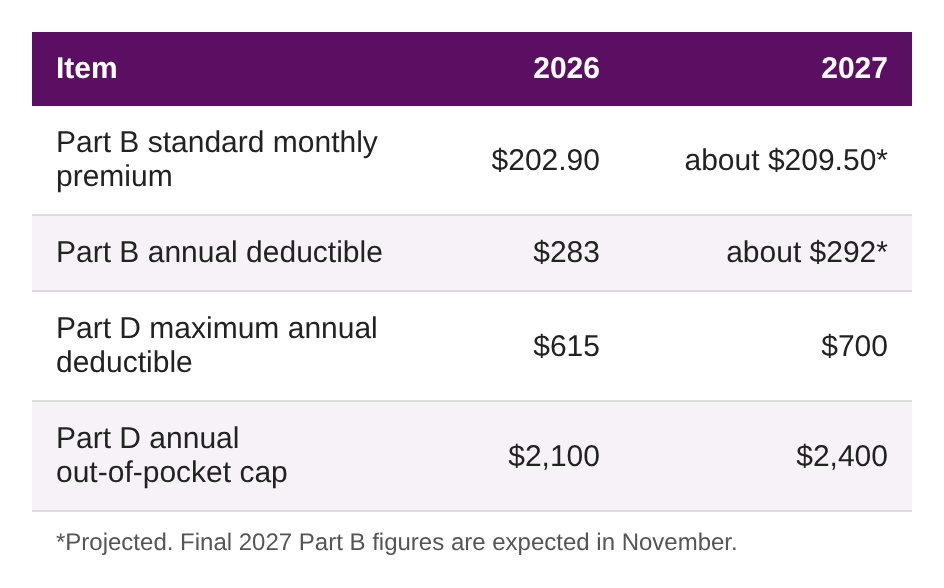
The headline for 2027 is that drug coverage costs more up front, while Medicare Advantage plans are getting leaner. Here are the key figures:
| Source: Moore Financial Advisors | |
Drug Plan Premiums May Rise as a Federal Subsidy Ends
For the past two years, a temporary federal program has helped hold down premiums on stand-alone Part D drug plans.
That program ends on December 31, 2026, a year earlier than planned. Some drug plans may raise premiums noticeably for 2027, so check your plan's new premium rather than assuming it will stay the same.
The $2,400 out-of-pocket cap is still a strong protection. Once you reach it, you pay nothing more for covered drugs for the rest of the year. If you take expensive medications, you can also spread those costs into monthly payments through the Medicare Prescription Payment Plan instead of paying large amounts early in the year.
Lower Negotiated Prices on 15 More Drugs
Starting January 1, 2027, Medicare's negotiated prices take effect for a second group of 15 drugs, including Ozempic and Wegovy and treatments for diabetes, asthma, COPD, and certain cancers.
How much you save depends on your plan. If your plan charges a percentage of the drug's cost, you're more likely to see a lower bill. If it charges a flat copay, your cost may not change much.
Medicare Advantage: Lower Average Premiums, Leaner Plans
CMS projects that the average Medicare Advantage premium will fall to about $12 a month in 2027.
But a low premium doesn't tell the whole story. Insurers are cutting thousands of plans and leaving hundreds of counties nationwide. Plans that remain are, on average, raising their out-of-pocket maximums about 10% and trimming extras such as dental coverage.
If your Medicare Advantage plan is ending, you should have received a notice.
You'll have until the end of February 2027 to choose a new plan, and you'll have a guaranteed right to buy a Medigap policy if you return to Original Medicare.
If you do nothing, you'll generally be moved to Original Medicare without drug coverage, so please don't let that happen by default.
Closer to Home: Massachusetts Networks
Provider networks continue to shift here in Massachusetts. For example, Mass General Brigham primary care is no longer in network with UnitedHealthcare or Blue Cross Blue Shield of Massachusetts Medicare Advantage plans in eastern Massachusetts.
If you're in a Medicare Advantage plan, confirm that your doctors and hospitals will be in network for 2027 before you renew.
Your Review Checklist
Start with the Annual Notice of Change your plan mailed by September 30. It lists every change to your premium, costs, network, and drug list for 2027.
If you have Original Medicare (Parts A and B):
- Part D drug plan: Are all your medications still covered? Have their tiers, copays, or pharmacy rules changed? Has the premium gone up?
- Medigap policy: Has your premium increased? Would a different plan serve you better at a lower cost?
- Total cost: Use the Plan Finder at Medicare.gov to compare your full expected cost for 2027 (premiums plus drug costs), not just the monthly premium.
If you have a Medicare Advantage plan:
- Is your plan continuing? If not, choose a new plan before December 7.
- Network: Are your doctors, specialists, and hospitals still in network for 2027?
- Drugs: Are your medications still on the drug list? Do any now need prior approval?
- Costs: Have the premium, deductible, copays, or out-of-pocket maximum changed?
- Extras: If you rely on dental, vision, or hearing benefits, are they still offered at the same level?
Before you compare plans, it helps to write down your "must-haves": your doctors, your medications, your preferred pharmacy, and any travel plans that require coverage out of state.
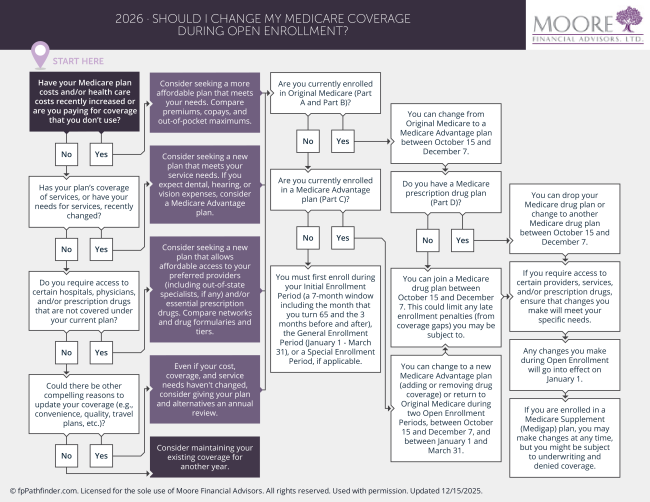
For further reference, here's a flowchart that helps you decide if you should change your Medicare coverage during open enrollment. Click on the image to receive a pdf that you can download and print.
| |
A Reminder About IRMAA
Higher-income Medicare enrollees pay a surcharge on Part B and Part D premiums, known as IRMAA. Your 2027 surcharge will be based on the income on your 2025 tax return.
In 2026, IRMAA applied above $109,000 of modified adjusted gross income for single filers and $218,000 for joint filers.The 2027 thresholds will be announced in November.
Two points worth keeping in mind:
- If your income has dropped because of a life-changing event, such as retirement, the loss of a pension, or the death of a spouse, you can ask Social Security to use more recent income by filing Form SSA-44.
- Because of the two-year lookback, decisions you make this year, such as Roth conversions or realizing capital gains, can affect your Medicare premiums in 2028. We factor this into our year-end tax planning with you.
Next Steps
- Read your Annual Notice of Change as soon as possible, and note anything that has changed.
- Use the enclosed checklist, "Should I Change My Medicare Coverage During Open Enrollment?", to work through whether a change makes sense for you.
- Compare plans on Medicare.gov if your costs, network, or drugs have changed. Starting early in the window gives you time to ask questions.
- Get free, unbiased help if you'd like it. In Massachusetts, SHINE (Serving the Health Insurance Needs of Everyone) offers free one-on-one counseling. You can also call 1-800-MEDICARE.
- Make any changes by December 7. New coverage begins January 1, 2027.
As a fee-only firm, we don't sell insurance and receive no commissions, so our role is to help you think through your options objectively. We're happy to review your Annual Notice of Change with you, talk through how Medicare costs fit into your retirement budget, and coordinate on IRMAA planning. Please reach out with any questions.
| | |
What to Make of a Life
Jim Collins is a well-known business researcher and writer. He taught at Stanford's Graduate School of Business before founding his own research lab in Boulder, Colorado. His signature approach is to study matched pairs of companies to work out why some became great and others didn't.
His newest book, What to Make of a Life: Cliffs, Fog, Fire, and the Self-Knowledge Imperative, applies his matched-pair method to people instead of companies. It is the product of about a decade of research and two years of writing.
The book studies 34 notable people from music, athletics, politics, science and literature, paired up to show how key choices lead lives in different directions.
Collins builds a framework around a few central ideas. "Encodings" are the built-in capacities each of us has to discover. "Cliffs" are the life-changing events that almost no one gets through a long life without. "Fog" is the confusing stretch after a cliff. "Fire" is the energy that can bring a person's most productive years surprisingly late.
The book's strongest message is that meaning and peak contribution are not reserved for youth. Collins also moves away from his earlier thinking about who is "worthier" than whom, landing on the view that lives are "not about better… about different." That message may resonate with readers in or near retirement.
The book has weaknesses. Some readers may find the terminology heavy for ideas that come down to familiar wisdom: know your strengths, follow what energizes you, stay curious. More serious critics may point to survivorship bias and to a sample of famous, well-resourced people whose options most readers don't have. The research also relies on existing biographies rather than original interviews.
Even so, What to Make of a Life is thoughtful, generous and often moving. It works best as a guide for thinking through life transitions rather than as proof of a formula. It's worth reading for anyone facing a "cliff," especially the move out of a long career.
| | |
Best regards,
Rob, Susan, Donna & Alex
| | If you like this letter, and want to share it, please feel free to forward it to a friend! | | |
Moore Financial Advisors
83 Leonard St, Suite 9
Belmont, MA 02478
617-393-9999
|
| | | | |