- Trés Amusant
- Earnings Bonanza
- Move-In Day Money Moments
- Kings
| | |
Financial Markets Update: Trés Amusant
In July, I visited Old Orchard Beach, Maine. The cottage where I stayed with extended family is a short walk from Palace Playland, an amusement park, which first opened in 1902.
My style of ride is the Merry-Go-Round: old-fashioned, somewhat whimsical – and most importantly, one directional. My 12-year-old niece has a different vibe.
Attempting to curry favor, I accompanied her on HyperJump, which Palace Playland’s website describes as: “feel your heart race as you spin around and defy gravity with bursts of speed that send you soaring up and down.”
The HyperJump description is accurate; I may have scored a point with my niece; and two minutes of terror reaffirmed my amusement park ride preferences.
July’s market activity encompassed elements of both Carousel and HyperJump.
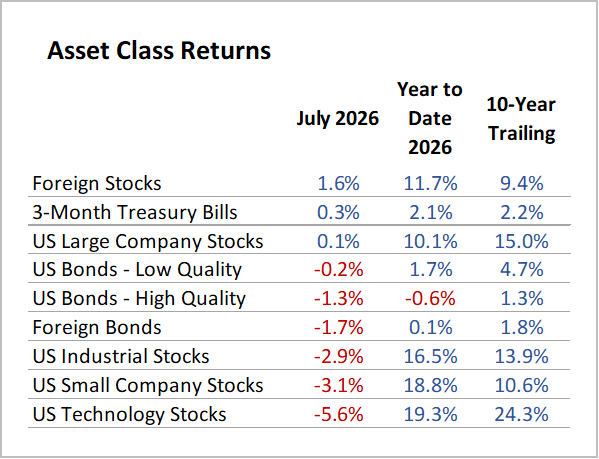
Performance for a good portion of the stock and bond markets was Carousel-like. Foreign stocks (+1.6%), US Treasury Bills (+0.3%) and US Large Company Stocks (+0.1%) all recorded modest positive performance in July.
Other segments of the financial markets, including US Bonds (-1.3%) and Foreign Bonds (-1.7%), registered modest negative performance. Small company stocks declined a bit more (-3.1%), but results were far from stomach-turning.
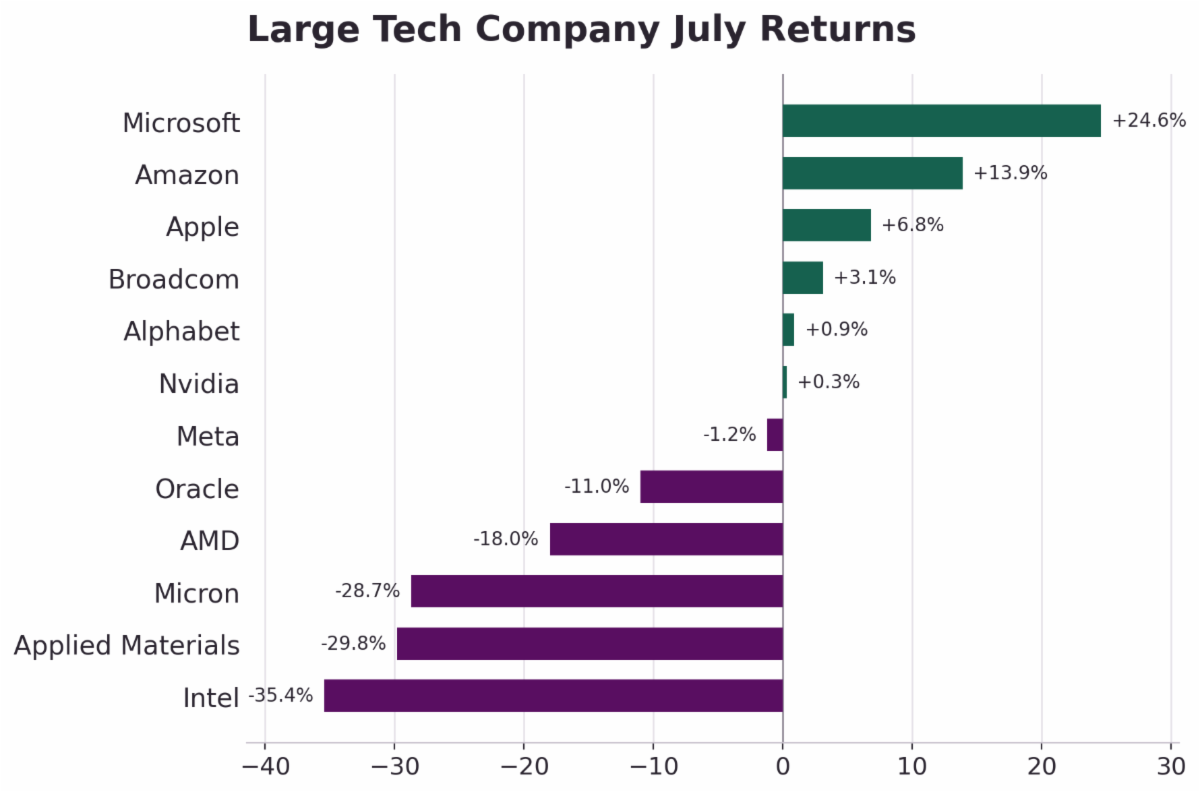
HyperJump activity was concentrated mainly in the technology sector (-5.6%), and the gyrations were more obvious by looking at individual stock performance for the month.
As the chart below indicates, stock prices of major tech companies ranged from +25% to -35%. Several companies involved in cloud computing and data management soared, while semiconductor manufacturers, which had done very well in the first half of 2027, fell particularly hard.
| | |
Away from technology sector, oil prices increased by more than 20% in July, pushed higher by increased hostilities in the Middle East, which helped boost Energy sector stocks by 12%.
In sum, I concur with sentiment shared recently in a note by Jeremy Siegel, Emeritus Professor of Finance at Wharton and Senior Economist at WisdomTree: “The recent rotation away from the market’s most speculative leadership, while uncomfortable for some investors, strengthens rather than weakens the foundation of this bull market.”
Another way of framing this: prices for some technology stocks had come too far, too fast. The downward adjustment in their share prices in July, without a broad-based stock sell-off, is a healthy sign for the market as a whole.
Here are results for July and 2026 Year-to-Date, compared to longer-term annualized returns (10-Year Trailing):
| Note: YTD 2026 as of July 31; Source: Morningstar | | |
Earnings Bonanza - And Why It Matters for Stocks
A note on corporate profits, the outlook for stocks – and the risk posed by higher interest rates
Markets have had a lot to digest this year — a shaky spring, a war in the Middle East, and now a swirl of headlines about tariffs, AI spending, and inflation.
With all of that noise, I wanted to step back to discuss the data that typically matters most for the direction of stock prices: company profits.
What Moves Stock Prices?
Over short stretches — a week, a month, even a year — stock prices can be driven by reactions to all kinds of things: headlines, interest rate movements, electoral outcomes, geopolitics, changes in tax law.
But zoom out to longer stretches of time, and one relationship stands out above all the rest: stock prices move with company earnings.
Looking back over the last 25-plus years, S&P 500 company profits and the index's share price have moved in the same direction over nearly every long stretch, and no other single factor comes as close to explaining where stocks end up over time.
Other things cause bumps along the way, but earnings are a road unto themselves.
Why is that?
A share of stock is simply a small ownership stake in a company's future profits — the same way owning a piece of a local business entitles you to a slice of what it earns. When you buy that business, you're generally willing to pay some multiple of its current profits, based on how much you expect those profits to grow.
If the business's profits then grow by 20%, and buyers are still willing to pay roughly that same multiple, the business itself is now worth about 20% more.
Publicly traded companies work the same way, just with a price you can check every day: as long as investors keep valuing companies at roughly similar multiples of their profits, growing profits should translate into a rising share price.
That's why, when we think about the market's prospects, we start with a simple question: are company profits healthy, and are they likely to stay that way?
Right now, my answer is yes — with one thing to watch, which I'll get to below.
Earnings Have Been Remarkably Strong
This year's earnings season has been one of the best in recent memory. As David Kelly, Chief Global Strategist at J.P. Morgan Asset Management, put it in a July 2026 research note, this earnings season “has started with a blast”:
-
Second-quarter 2026 results have come in well ahead of expectations, with roughly 86% of companies beating Wall Street analysts’ estimates — a noticeably higher hit rate than the historical average.
-
For the full year 2026, analysts now expect company profits to grow by roughly a quarter over 2025 levels — building on solid gains of about 10% in 2024 and 13% in 2025. This isn't a one-quarter blip; it's the continuation of a multi-year upswing.
-
Profit margins — essentially, how many cents of profit a company keeps out of every dollar of sales — are near their highest levels in decades. Companies aren't just selling more; they're keeping more of what they sell.
-
Looking further out, analysts expect profit growth to continue into 2027, albeit at a somewhat more moderate pace than this year's exceptional gains. In other words, this isn't expected to be a one-year sugar high.
Much of this year's growth has been concentrated in a handful of large technology companies riding the AI investment wave.
But the broader trend — profits growing faster than the economy as a whole — has been in place for decades and reflects durable structural forces, not just one hot sector.
The Bigger Picture: a Decades-Long Climb
Zooming out even further helps put this year in context.
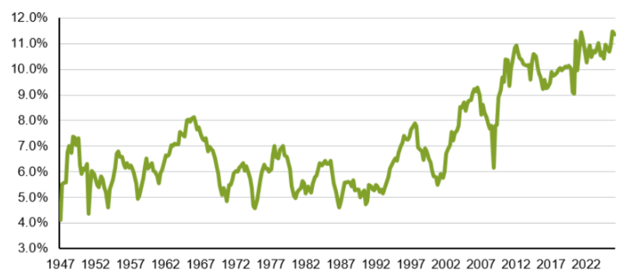
The chart below shows corporate America's after-tax profits as a percentage of the entire U.S. economy, going back to 1947.
| | Source: JP Morgan Asset Management | |
For nearly 50 years, that share hovered in a narrow band around 6%. Since the mid-1990s, it has climbed steadily, reaching roughly 11.4% in early 2026 — essentially double its historical norm.
As Kelly at JP Morgan notes, this reflects a combination of businesses controlling labor costs more effectively and a more favorable corporate tax environment over the past three decades — durable, structural forces rather than a one-year phenomenon.
Watch Out for Interest Rates
Earnings are the foundation for the stock market, but interest rates can be a wildcard.
Here's the simple version of why interest rates matter: when the Federal Reserve raises interest rates quickly, it makes borrowing more expensive and makes other investments (like bonds) relatively more attractive compared to stocks — which can pull stock prices down even when company profits are perfectly healthy.
We saw this play out a few years ago. In 2022, company earnings and the job market were both in good shape, yet stocks still fell nearly 20%, because the Fed was raising rates aggressively and rapidly (seven times in less than a year) to fight inflation.
It was a reminder that strong profits alone aren't a guarantee of a rising market if the Fed is working against you at the same time.
So could that happen again? For now, a repeat of 2022 seems unlikely for two reasons:
-
We're not starting from an artificially low base. Going into 2022, interest rates had been held near zero for years, which meant the Fed had a long way to climb, in a hurry, to catch up with inflation. Today, the 10-year Treasury yield sits around 4.7% — already close to its long-run historical average of roughly 5.7% going back to the late 1950s. There simply isn't the same “room” for a shock of similar size.
-
This year's inflation uptick has a different cause. Much of the recent rise in inflation traces back to a spike in oil and energy prices tied to the conflict with Iran, rather than a broad-based, self-reinforcing wage-and-price spiral working through the whole economy. Core inflation (which strips out food and energy) was actually cooling coming into this year, before the conflict began. An energy-price shock is a different animal than embedded inflation, and it tends to fade as the underlying disruption resolves rather than requiring an extended period of aggressive rate hikes to stamp out.
To be candid: the Fed has held rates steady at its last several meetings, but it's possible that we see an interest rate increase or two before year-end if energy-driven inflation stays elevated — a few Fed officials have recently pushed for exactly that.
My expectation is that this would look nothing like 2022's rapid-fire string of hikes — at most a few adjustments over the course of the next year, rather than a sustained tightening campaign.
But higher interest rates, even if the increases are moderate and reinforce the Fed’s inflation-fighting credibility, may unsettle the stock market.
The Bottom Line
The fundamentals supporting this market are genuinely strong: company profits are growing and margins are near record levels. That growth is expected to continue into next year — and historically earnings growth has been a reliable predictor of a healthy stock market over time.
Interest rates remain the variable most capable of disrupting that picture in the near term, but the setup today looks different from 2022: rates have already adjusted up from post-pandemic lows, and the current inflation pressure looks more like an energy shock than a deep-seated structural problem.
We're watching both sides closely and will keep you posted if anything changes our thinking.
| |
Move-In Day Money Moments: What's Actually Worth the Spend
This month’s college article discusses money matters related to move-in day.
It's that time of year again. The “Move-In Day” for college that I speak of often in my writing, is fast approaching.
I have had the pleasure of observing many full days of move-ins on college campuses as an administrator, not a parent. This is emotional for parents, but I was able to view it more objectively and always found this time interesting and fun!
Right now, the dorm shopping lists are circulating, shopping runs are turning into full-blown expeditions, and somewhere between the extra-long twin sheets and the third trip to Target (or wherever we're all shopping these days), a question keeps popping up with parents:
"Are we spending too much on this move-in stuff?"
Short answer: probably, in some places. Not enough, in others. Let's talk about it.
The Emotional Math of Move-In Day
Here's something I've noticed after years of sitting across the table from families during this exact season — move-in shopping isn't really about the stuff. It's about control. One last item before the big hand off at campus.
You can't control whether your kid makes friends, likes their roommate, or figures out how to do laundry without turning everything pink. But you can control whether they have a good desk lamp. Also, you can’t help but want to give them everything they want for this exciting new chapter!
So, we overspend. A little guilt, a little love, a little "let me do this one thing right" and suddenly the dorm fridge costs more than your first apartment's rent did.
Consider this: every dollar spent on move-in day is a dollar not compounding toward tuition, a spring break flight home, or that emergency fund your student will absolutely need by October. Doesn't mean don't spend it. Just means spend it on purpose.
What's Actually Worth Buying New
-
A real mattress topper. Dorm mattresses are notoriously bad, and sleep quality affects everything from grades to mood. This is not the place to cut corners. A good night's sleep cannot be overrated.
-
A surge protector with USB ports. Cheap, useful for four years, and prevents the inevitable "everyone's phone charger fighting for the one outlet" situation.
-
A shower caddy and shower shoes. Non-negotiable. Trust me on this one.
-
Renter's insurance or a rider on your homeowner's policy. This one's actually a financial planning point disguised as a packing tip — a $1,500 laptop walking off in a dorm hallway happens more than you'd think, and coverage is often shockingly cheap to add.
What to Skip (or Buy Used, or Split)
-
The mini-fridge. Many schools rent these directly, and it's almost always cheaper than buying them - plus you're not hauling it home in May or storing it all summer.
-
New furniture for a room they'll live in for nine months. A $40 papasan chair from a garage sale does the same job as the $200 one.
-
Duplicate small appliances. If your student has a roommate, one coffee maker, one mini-vacuum, one set of tools is plenty. This is a text-your-kid's-roommate's-parents conversation, and it's worth having before move-in day, not in the parking lot.
-
Textbooks bought new, full price, before classes start. I know - separate topic-but it belongs on this list too. Buying used or renting can save a lot.
A Budget Framework That Actually Works
Instead of shopping item by item and watching the cart total climb (dangerous), try setting a total move-in budget first — say, $300–$500 depending on what your student already owns — and then let the list compete for that money.
Think about this: if the lamp and the storage bins and the extra bedding are all fighting for the same $400, you start making sharper choices. Suddenly that $60 desk organizer must prove itself against a $60 addition to the emergency fund.
The Conversation Worth Having in the Car
Somewhere on that drive to campus — maybe not the whole way, nobody wants a financial lecture for six hours — it's worth having a short, low-pressure money talk:
-
What's the spending limit on the credit or debit card, and what's it for (emergencies, not late-night Amazon)?
- Who's covering incidentals — pizza with new friends, laundry money, the club fair T-shirt they didn't know they needed?
- Are they planning on working on campus? How will this money be used?
- What does "call us" mean financially — is there a number where you say "let's talk before you spend this"?
You don't need a spreadsheet for this. You need five honest minutes before the goodbye hug. Or if you really don’t want to have this conversation on the drive to college, have the conversation while shopping.
Move-in day is going to be emotional no matter what you spend. The stuff isn't the point — it's the last errand you get to run together before this next chapter starts.
Spend where it matters, skip where it doesn't, and save the real investment for what's coming next: tuition, textbooks, and the four years ahead.
| | |
Kings
We’re now at peak summer season, and I hope you’re finding time to rest, relax, and enjoy some reading that takes you farther afield. Here are two non-finance books that I’ve enjoyed this summer.
King of Kings: The Iranian Revolution: A Story of Hubris, Delusion and Catastrophic Miscalculation by Scott Anderson
I trace my first recollection of political awareness back to 1979. In 5th grade, one student stood out as more worldly than the rest of us. She talked about the Middle East, oil, political strife, the State Department, and “the Shah” – things I knew nothing about at the time.
I’d filled in some of the gaps since then, but Anderson’s book tells a full story of what happened in Iran in the late 1970s.
Once toasted by President Carter as an unshakable ally presiding over "an island of stability," commanding the world's fifth largest army and vast oil wealth— Shah Mohammad Reza Pahlavi fled into exile just fourteen months later, forced out by a religious revolution led by Ayatollah Khomeini.
Anderson frames the collapse as a story of American diplomatic blunders and miscalculations that helped trigger hostilities that have destabilized the region for decades, arguing that the revolution was as world-shattering as the French and Russian revolutions.
What makes it especially resonant now is the broader pattern Anderson identifies: the resentment of economically marginalized, religiously fervent populations toward a wealthy secular elite has fueled unrest across the Middle East, India, Southeast Asia, and Europe – with Iran serving as the template.
The book is a useful lens for understanding how great-power miscalculation and populist backlash can compound into events with generational consequences.
Monsters in the Archives: My Year of Fear with Stephen King by Caroline Bicks
My summer wouldn’t be complete without reading something by, or about, Stephen King.
A few months ago, I was listening to a BBC reporter interview Caroline Bicks, the inaugural Stephen E. King Chair of Literature at the University of Maine.
Bicks told the story that she was instructed by the University of Maine administration to set aside the idea of ever getting in touch with Stephen King, despite her holding the chair endowed by him.
However, King eventually reached out to Bicks, they struck up a professional relationship and friendship, and this book is the product of her having access to his archives.
Monsters in the Archives is part literary master class, part biography, part memoir, and an investigation into our deepest anxieties, drawing on unprecedented access to King's private papers.
Bicks focuses on five of King's most iconic early works—The Shining, Carrie, Pet Sematary, 'Salem's Lot, and Night Shift—tracing his margin notes and editorial changes to reveal how he built his language, storylines, and characters, and she uncovered unpublished scenes and alternate endings that King allowed her to publish for the first time.
The book offers longtime readers a rare backstage look at how some of the most influential horror fiction of the last half-century was actually constructed, alongside Bicks's own story of rereading these books as an adult confronting the childhood fears they first stirred in her.
Happy Reading!
| | |
Best regards,
Rob, Susan, Donna & Alex
| | If you like this letter, and want to share it, please feel free to forward it to a friend! | | |
Moore Financial Advisors
83 Leonard St, Suite 9
Belmont, MA 02478
617-393-9999
|
| | | | |