|
Others worried that a new commission would be duplicating the work of the Water Resources Planning Committee, which met most recently this past April.
Ryan Gordon, Hydrogeologist at the Maine Geological Survey, said that while he was "in general very supportive" of the recommendations, several colleagues who'd read the draft were "dubious" of the need for a new commission and worried that it would be "redundant to the work that's already being done" by the Water Resources Planning Committee and others.
A recommendation to further study the legal status of groundwater rights and ownership in Maine also met with some pushback from both Berger and Mark Dubois, Natural Resource Manager with Nestle Waters.
In Maine, groundwater is the property of the landowner, who is "not liable for damages if their use of that groundwater affects a neighbor’s or adjacent user’s ability to access the groundwater below their property," according to the draft report, what is known as "absolute dominion."
That worries some activists, including Sekera, who would like to see groundwater held in the public trust, which they say would protect Maine's resources from privatization and allow for better long-range planning. "It's important to disrupt Wall Street's grab on our water," she said in an interview before the meeting. "You kind of have to imagine the future, when water isn't running freely."
But Berger said that changing the law would impact public water suppliers, who "need to know that the supply is ours and it's available to use." He also noted that there are many exceptions to the absolute dominion rule, which has been modified over the years.
"Maine does not allow unfettered water extraction based solely on land ownership," said Berger. "It’s regulated by several different agencies. Even though the land is mine and I have rights to the groundwater, I have no rights to arbitrarily extract the amount of water under my property."
A recommendation that the Legislature consider requiring commercial bottlers to test for and report on PFAS levels was less controversial, with all commission members who were present voting in favor.
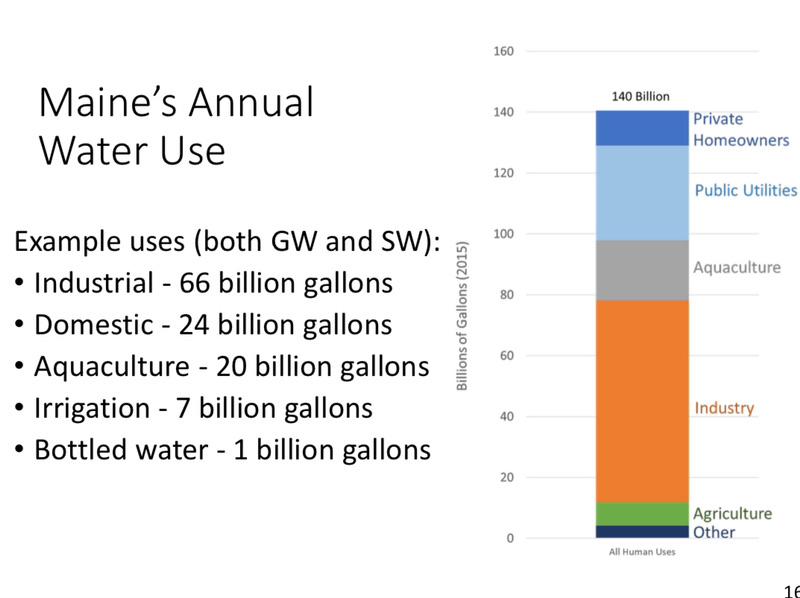
The commission also recommended taking steps to centralize data on water use within a single state agency, collect more data, require annual reporting to the Legislature on water use and asked that state agencies identify measures to enhance drought preparedness and drought resilience by agricultural producers. It also suggested making data on water use more available to the public.
The final report is due out Dec. 7th; it will be sent to the Legislature and will eventually be taken up by the Taxation Committee, which will determine whether they want to take any action on the report's recommendations. In the meantime, you can watch all of the commission's meetings and its materials here.
|