A regional resource for Cape & Islands climate activists
January 28, 2021
|
|
Who’s Delaying Climate Action in Massachusetts? Twelve Findings
Policy Briefing, The Climate and Development Lab Institute at Brown for Environment and Society, January 2021, Introduction by Christian Morris
Using analysis from the statehouse’s data on lobbying and testimonies, the report details how four major groups – fossil fuels, real estate firms, utilities, and power generators – wield significant influence on the state’s climate and energy policy. Among the findings, climate action opponents rarely submit public testimony, preferring to operate behind closed doors. Researchers also found that the Associated Industries of Massachusetts (AIM), a major industry group, “lobbies and testifies nearly completely in line with the utilities,” giving the public utilities a veiled voice in climate policy discussions on Beacon Hill.
In general, “90% of all testimony we collected on environmentalist priority bills was delivered in support.” Among the authors' conclusions, “when the Massachusetts legislature has advanced climate and energy policy, it has been in spite of, not because of, these factors.” Read the report here.
|
|
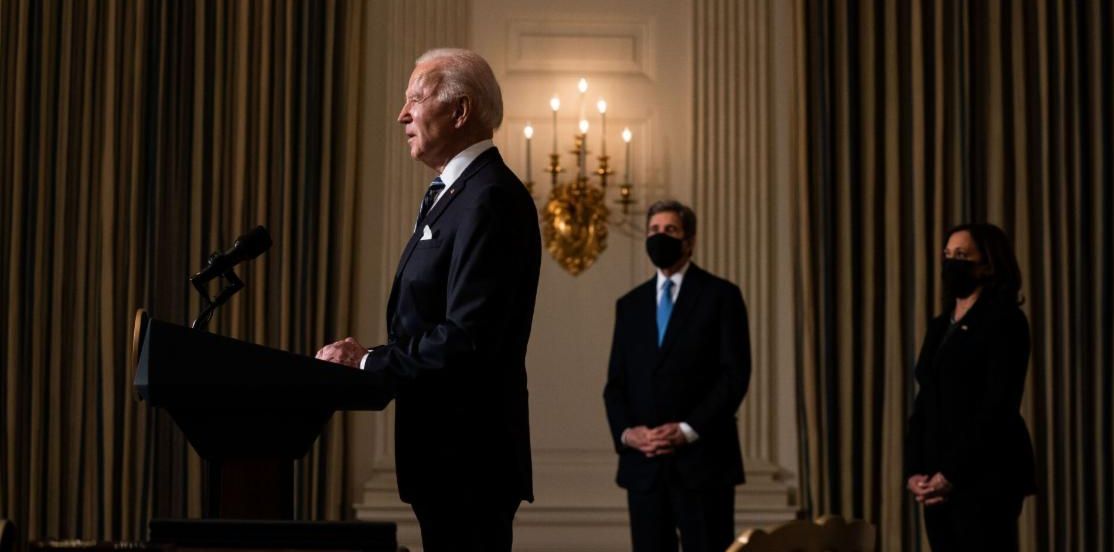
Biden, Emphasizing Job Creation, Signs Sweeping Climate Actions
The array of directives — touching on international relations, drilling policy, employment and national security, among other things — elevate climate change across every level of the federal government.
Mr. Biden said his directives would reserve 30 percent of federal land and water for conservation purposes, make climate policy central to national security decisions and build out a network of electric-car charging stations nationwide. Read more here.
|
|
— SYNOPSIS —
-
President Biden signed a package of executive orders on climate change, including electrifying the government’s vast fleet of vehicles.
- Biden said the measures would create millions of jobs. Many of those would be in the auto industry, he said, while others would come from the construction of energy-efficient homes.
- “We’ve already waited too long to deal with this climate crisis,” Biden said. “We see it with our own eyes. We feel it. We know it in our bones. And it’s time to act.”
- Much of the planet will endure climate-related extreme weather by 2040.
-
Every Country Has Its Own Climate Risks. What’s Yours?-This interactive shows the biggest threats that each country will face.
|
|
Proposed National Guard Machine Gun Range at Joint Base Cape Cod
Need more ammunition? Read on and take these opportunities to learn and speak out!
A growing coalition of environmental, faith-based, climate, social justice, and youth groups are opposed to the planned, 8-lane machine gun range for Camp Edwards, the Massachusetts Army National Guard training area of Joint Base Cape Cod.
According to the plan, which became public knowledge only last August, the 8-lane gun range would be sited on conservation area in the northern 15,000-acre area of the Training Base. That area sits atop an aquifer that is a source of drinking water for Upper Cape Cod. It’s also the largest piece of undeveloped land on Cape Cod and home to 37 rare and endangered listed species.
After decades of pollution at the Base and mitigation costing taxpayers more than one billion dollars, the 15,000 acre site was designated by the state as the “Upper Cape Water Supply Reserve,” to serve 3 primary purposes:
- water supply and wildlife habitat protection;
- the development and construction of public water supply systems; and
-
the use and training of the military forces of the commonwealth - provided that such military use and training is compatible with the natural resource purposes of water supply and wildlife habitat protection.
The Joint Base recently released its own Environmental Assessment for public comment. The study, curiously, determined a “Finding of No Significant Impacts (FNSI)” and that it would stir “No Significant Controversy.” But Joint Base has received 900 comments from the public, so Cape Cod citizens clearly question the appropriateness of this project for Cape Cod.
Coalition representatives include: Dr. Sandy Faiman-Silva, Coalition for Social Justice; Dr. Madhavi Venkatesan, Sierra Club of Cape Cod and Sustainable Practices; Jim Wolf, Cape Cod Climate Change Collaborative; Dr. Jane Ward, Faith Communities Environmental Network (also a physician and retired marine colonel), and Ella Sampou, member of the CC Youth Climate Action Network of the Climate Collaborative.
|
|
 |
Conversations with Barbara: Proposed National Guard Machine Gun Range at Joint Base Cape Cod
Barbara Kanellopoulos, producer of Falmouth Community Television's (FCTV) "Conversations with Barbara," interviewed members of a coalition of organizations opposed to the proposed National Guard Machine Gun Range project at Joint Base Cape Cod.
Representatives discussed bases for widespread opposition to this project including degradation of the Upper Cape Water Supply, incompatibility with habitat protection, declining real estate values, and injurious social, cultural and health impacts on local and regional communities.
- Rosemary Dreger Carey, 350CC
- Sandy Faiman-Silva, Ph.D., Coalition for Social Justice
-
Dr. Jane B. Ward, Faith Communities Environmental Network (FCEN)*
- Ella Sampou, CC Youth Climate Action Network (CCYCAN)*
- Madhavi Venkatesan, Ph.D., Sierra Club Cape Cod, Sustainable Practices
- Jim Wolf, Cape Cod Climate Change Collaborative
*Networks of the Cape Cod Climate Change Collaborative
|
|
|
|
Two Virtual Town Hall Meetings with Congressman Bill Keating (CD-9)
Congressman Bill Keating has scheduled two virtual town hall meetings with constituents to discuss pressing issues facing our community and our country. These meetings will also provide opportunities for constituents to express their opinion on the proposed Machine Gun Range project at Camp Edwards, Joint Base Cape Cod.
The Climate Collaborative and its partners have opposed the proposed project on the basis of inadequate environmental review and for numerous environmental, economic, health, and social justice reasons.
February 3
5:00-6:00 PM
Moderated by Massachusetts Senate Ways and Means Chairman, Michael Rodrigues. All are welcome.
Plymouth & Barnstable Senate District Town Hall
March 15
5:00-6:00 PM
Moderated by State Senator Su Moran of the Plymouth-Barnstable State Senate District including Falmouth, Bourne, Sandwich, Plymouth, Kingston, Pembroke. All are welcome.
|
|
|
|
Climate X Change presents
The Road to 100% Renewable Energy
February 16
3:00 - 4:00 pm
The concept of 100% renewable energy is rising as a policy choice for reducing carbon pollution. In recent years, several cities and states have committed to 100% renewable energy or net-zero goals, and President Joe Biden has committed to carbon neutrality nationwide before 2050 in his most recent climate plan.
February’s Deep Dive webinar looks at these policies under a microscope. What is the difference between 100% renewable, net-zero, and carbon neutrality? How can we ensure the protection of jobs in a massive energy transition? How can we ensure that vulnerable populations are protected? What technology is needed to achieve 100% renewable energy? How can we pass these policies in legislatures across the country? Join the call!
|
|
International momentum has developed around bold actions to conserve our planet’s land and water. Many prominent scientists, including ecologist Edward O. Wilson, have called for the conservation of half of the world’s land and oceans for the long-term health of the planet. This has sparked a movement to conserve 30% of the world’s land and oceans by 2030. Read more here.
|
|
Listen: Climate Action Podcast series
The Cape Cod Commission has launched a podcast series that highlights the work of the agency and its community partners working together as one Cape to build resilience to climate change in our region.
|
|
Vineyard Wind completes technical review, requests BOEM permitting go-ahead
Vineyard Wind has rescinded its December 2020 request to withdraw the Construction and Operations Plan (COP) for Vineyard Wind 1, allowing the federal permitting process to resume. With final review complete and no changes to the COP necessary, VW is anticipating BOEM review finalization and permitting phase completion, enabling the company to finalize engineering, contract and financing of the first utility-scale offshore windfarm in the U.S. Read more here.
|
|
Electric Cars Are Better for the Planet – and Often Your Budget, Too
Electric vehicles are better for the climate than gas-powered cars, but many Americans are still reluctant to buy them. One reason: The larger upfront cost. New data published Thursday shows that despite the higher sticker price, electric cars may actually save drivers money in the long-run. Read more here.
|
|
Missed the Net Zero 2020 Conference?
Check out recordings of all sessions below.
Watch 30+ videos and learn from experts around the region, state and country.
Join the conversation and get involved!
|
|
MASSACHUSETTS LEGISLATIVE RESOURCES
|
|
|
|
The Cape Cod Climate Change Collaborative is an all-volunteer 501(c)(3) organization whose mission is to reach carbon neutrality—or net zero—on Cape Cod and the Islands of Massachusetts by enhancing communication, collaboration, and activism among organizations, programs, and individuals committed to mitigating the climate crisis. We depend upon the generosity of our stakeholders to conduct our work.
All donations are tax deductible as allowed by law.
|
|
CAPE COD CLIMATE CHANGE COLLABORATIVE
|
|
The Climate Action Alerts newsletter is written and produced by Fran Schofield with contributions by Rosemary Dreger Carey and Lauren McKean. If you've got a climate story, please be in touch! And don't forget to share this action alert with your friends and suggest they subscribe here.
|
|
|
|
|
|
|